A machinist walks to the tool crib, waits behind two other people, signs out a carbide insert, walks back to the machine — and that round trip, repeated a dozen times a shift across a dozen operators, adds up to hours of lost machine time that never shows up on any single work order. Tool crib inefficiency hides in plain sight because no one measures the walk, only the part count. Whether the fix is a smarter centralized crib or point-of-use vending pushed out to the floor depends on the plant, but the decision should be made with data, not habit. iFactory's tool tracking and utilization platform gives plant teams that data before they redesign anything.
Factory Space Utilization
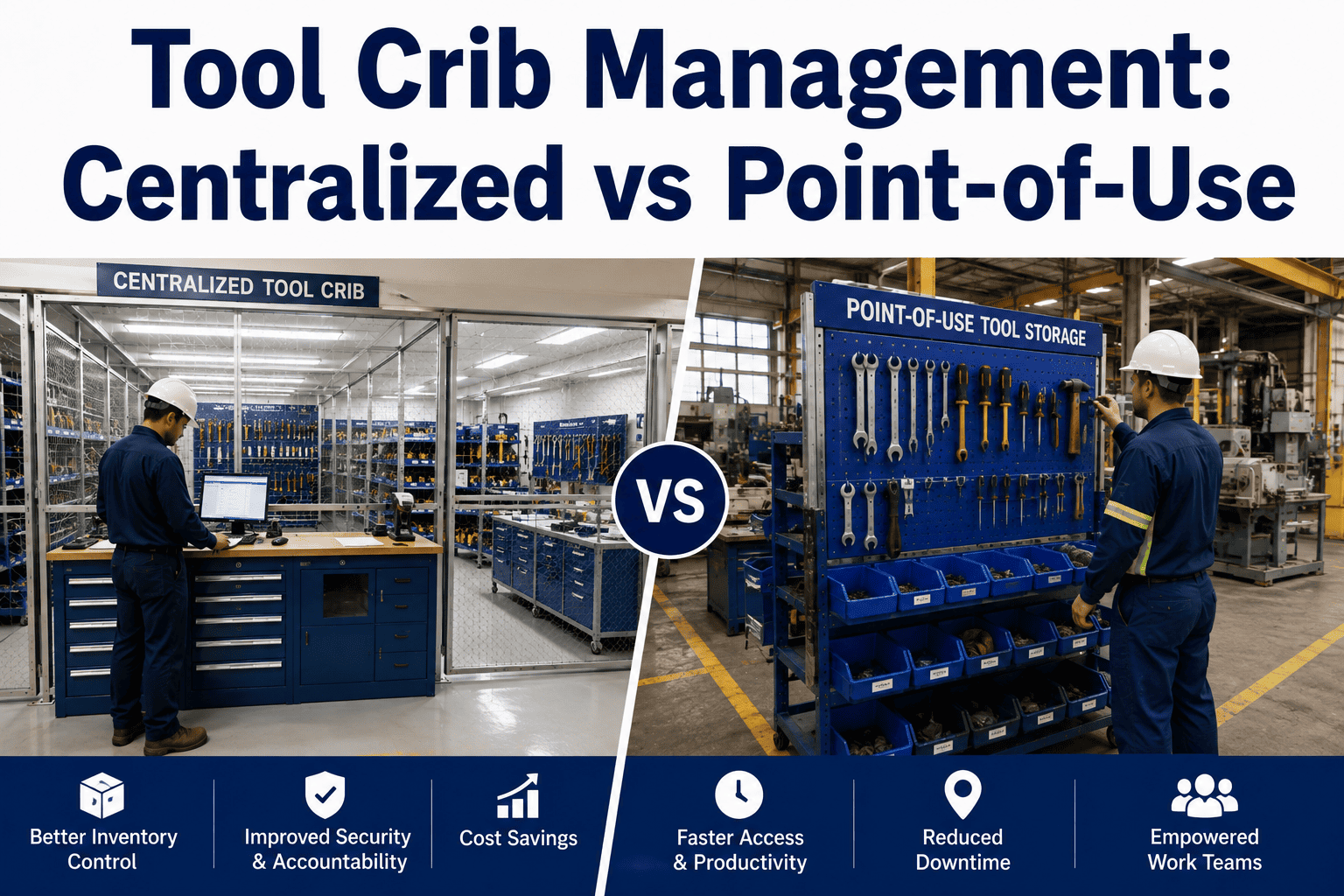
Tool Crib Management: Centralized vs. Point-of-Use
Vending machines, RFID tracking, and availability strategies that keep tools where the work is — without losing control of inventory.
The Hidden Cost of a Single Tool Crib
A single centralized crib is easy to control and easy to audit, which is exactly why so many plants default to it — and exactly why so many plants underestimate what it costs in walk time, queue time, and production delays every single shift.
Walk Time
Every trip to a distant crib is machine time the operator isn't running the machine.
Queue Time
Shift-start and shift-change rushes create lines at the crib window that stack delays across the floor.
Hoarding
Operators stash extra tooling at their stations to avoid the trip, breaking inventory accuracy entirely.
Downtime Risk
A machine stopped waiting on a tool is a machine not producing, regardless of how good the crib's inventory looks on paper.
Two Models, Side by Side
Centralized and point-of-use are not mutually exclusive — most well-run plants use both, matching the model to the tool's cost, criticality, and how often it's needed. The comparison below shows where each earns its place.
Centralized Crib
Tight control over high-cost and precision tooling
Single point for calibration, repair, and inspection
Longer retrieval time, especially on large floors
Best for low-frequency, high-value items
Point-of-Use Vending
Consumables available at the machine, no walk required
Automatic usage tracking tied to operator and job
Reduces hoarding since access is fast and logged
Best for high-frequency, lower-cost consumables
Not sure which tools belong in which model? Talk to our team about mapping your tool catalog by cost and usage frequency.
Where RFID Closes the Visibility Gap
Neither model works well without accurate tracking. RFID tagging turns a manual sign-out sheet into a real-time record of what tool is where, who has it, and how long it's been out — without adding a step for the operator.
| Tracking Method | Accuracy | Operator Effort |
|---|
| Manual sign-out sheet | Low, prone to gaps | High, easily skipped |
| Barcode scan at issue | Moderate | Moderate |
| RFID at crib and vending | High, real-time | Minimal, automatic |
From Checkout to Reorder — the Automated Loop
The real payoff of RFID and vending isn't just faster checkout — it's a closed loop that keeps inventory accurate and reorders happening before a critical tool runs out.
1
Issue
Operator badges in at a vending unit or crib window; the tool logs out automatically
2
Track
RFID confirms location and usage in real time, tied to the job it was issued for
3
Return
Reusable tooling scans back in, closing the loop and updating available inventory
4
Reorder
Consumption data triggers reorder points before stock actually runs out
What Better Tool Access Delivers
Plants that redesign tool crib access around actual usage patterns — not habit — see the gains where it matters most: less idle machine time and fewer production delays traced back to a missing tool.
Higher
Inventory accuracy
Fewer
Tool-related stoppages
Want to see where your current crib model is costing machine time? Book a 30-minute walkthrough with our team.
Choosing the Right Vending Technology for Your Floor
Not all vending hardware fits every tool category. Matching the mechanism to what's actually being dispensed avoids paying for capability the tool crib doesn't need — or under-securing tooling that does.
Coil & Locker Units
Best for small, high-volume consumables like inserts and drill bits
Fast dispensing with minimal per-transaction friction
Lower per-item security than a locker compartment
Locker & Cabinet Units
Best for higher-value or precision tooling needing individual tracking
Each compartment logs exact item and operator on open
Slower per-transaction, but tighter accountability
Managing the Transition Without Disrupting Production
Shifting from a purely centralized model to a hybrid one is a change management problem as much as a hardware one — operators who've worked around a slow crib for years need a reason to trust the new system before old habits like hoarding actually stop.
1
Pilot Zone
Deploy vending for one high-frequency consumable category on one line first
2
Prove Availability
Keep the pilot units reliably stocked so operators build trust in the new access point
3
Reclaim Stashes
Once trust builds, informally hoarded tooling tends to return to the tracked system on its own
4
Expand by Category
Roll the model out to additional tool categories using the pilot's usage data as the template
Frequently Asked Questions
Should we replace our central crib entirely with vending machines?
Rarely all at once, and rarely completely. Most plants get the best results from a hybrid model — vending for high-frequency consumables at the point of use, and a smaller centralized crib retained for expensive, low-frequency, or precision tooling that genuinely benefits from tighter control.
Our team can help segment your tool catalog to see which items belong in which model before any capital is spent.
How much machine time does crib walking actually cost?
It varies by plant layout and shift structure, but the trips add up faster than most teams expect once every operator's round trip is multiplied across a shift and a crew. The number is rarely visible without dedicated tracking, since it gets absorbed into general "non-productive time" rather than logged against the crib specifically. A short observation study or RFID pilot is usually the fastest way to get a real number for your floor.
Does RFID tracking slow operators down at checkout?
No — it's designed to remove the step, not add one. A badge tap or automatic tag read at a vending unit or crib window logs the transaction instantly, replacing a manual sign-out sheet that took longer and was more often skipped than filled in correctly. The net effect is faster checkout with better data, not the other way around.
How does point-of-use vending reduce tool hoarding?
Hoarding happens because operators don't trust the tool to be available when they need it, so they stash extras at their station as insurance. When a vending unit sits within reach and reliably has stock, that insurance behavior loses its purpose, and inventory accuracy improves because tools stay in the system instead of disappearing into a drawer. The fix is availability, not enforcement.
What's the first step to redesigning our tool crib strategy?
Start with data, not a layout change — a usage and frequency analysis of your current tool catalog shows which items are high-volume consumables versus low-frequency precision tooling, and that split drives the centralized-versus-point-of-use decision far more reliably than intuition.
Book a demo to see how tool tracking data turns into a concrete crib redesign plan.
Stop Losing Machine Time to a Walk Across the Floor.
See Your Tool Access Costs, Then Fix Them
Bring your current crib layout and tool catalog. We'll show where walk and queue time is costing production hours, and what a hybrid centralized and point-of-use model looks like for your floor.