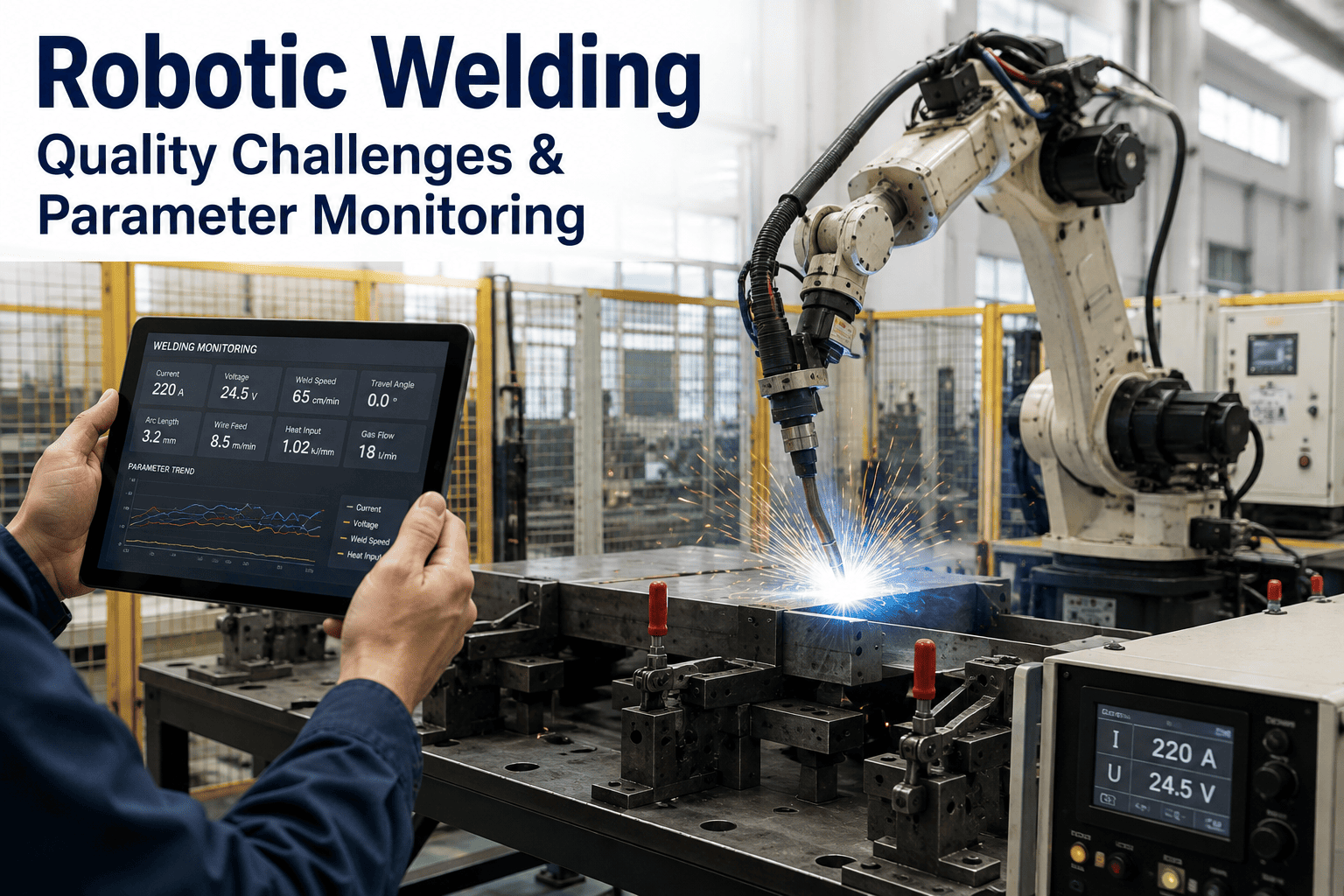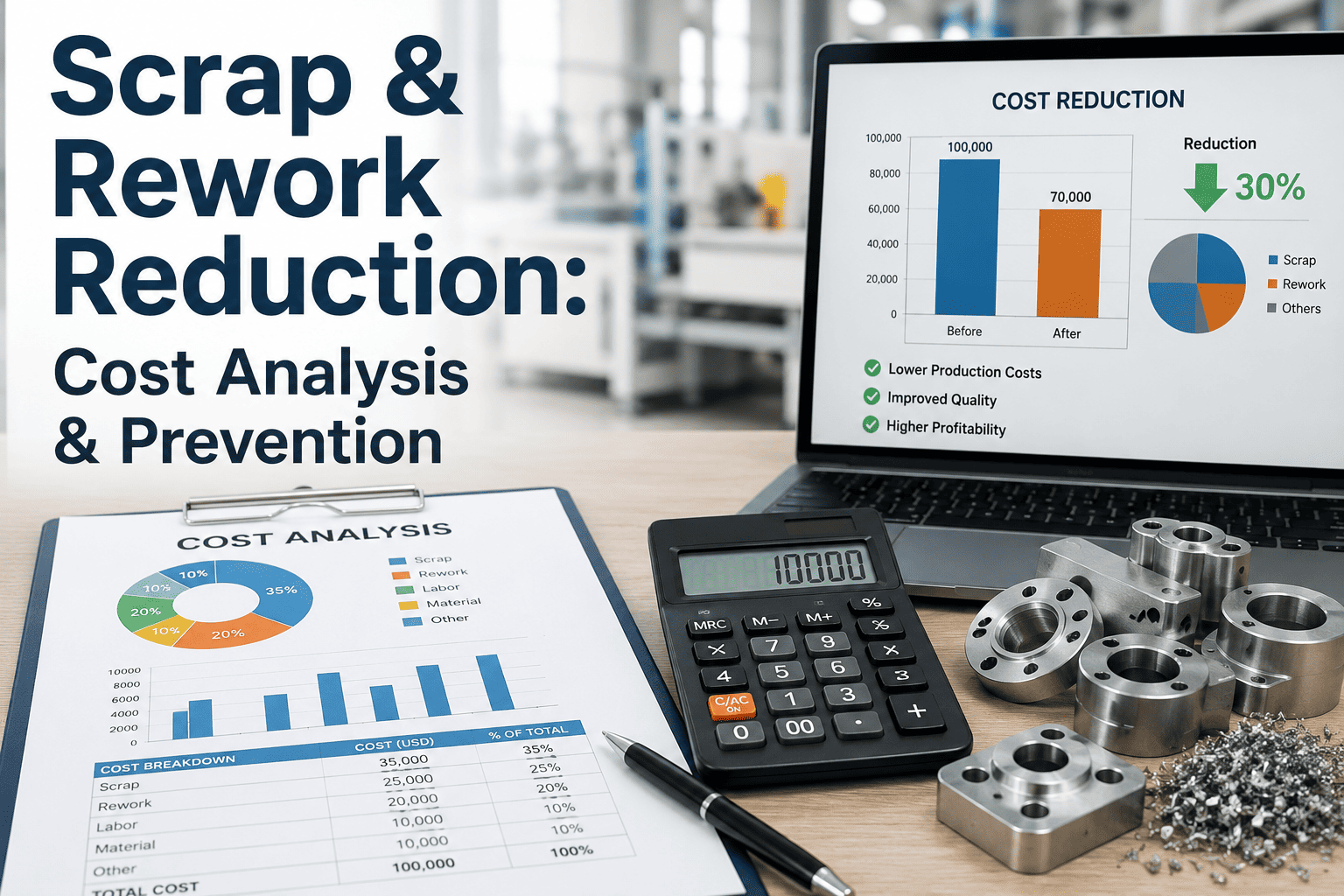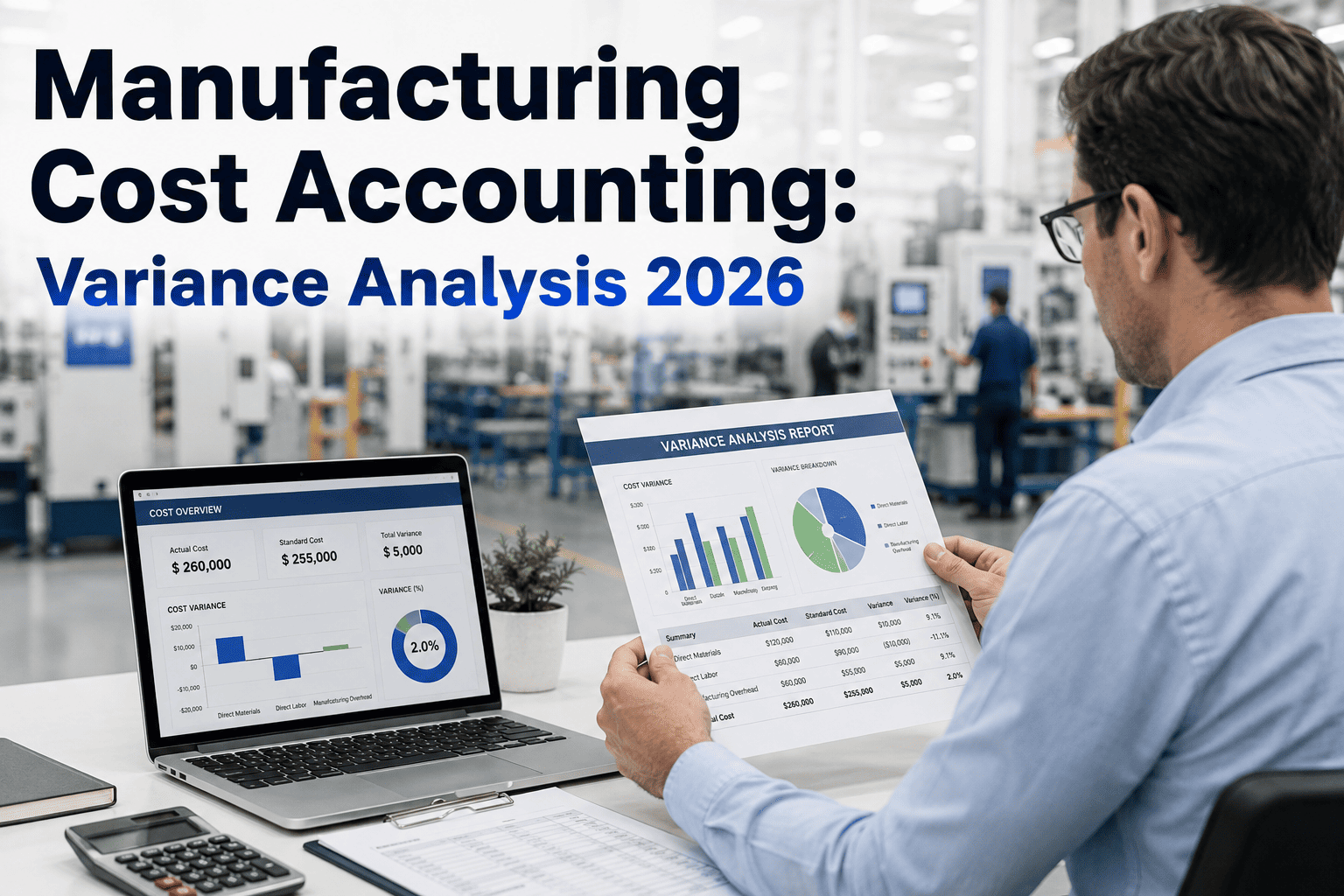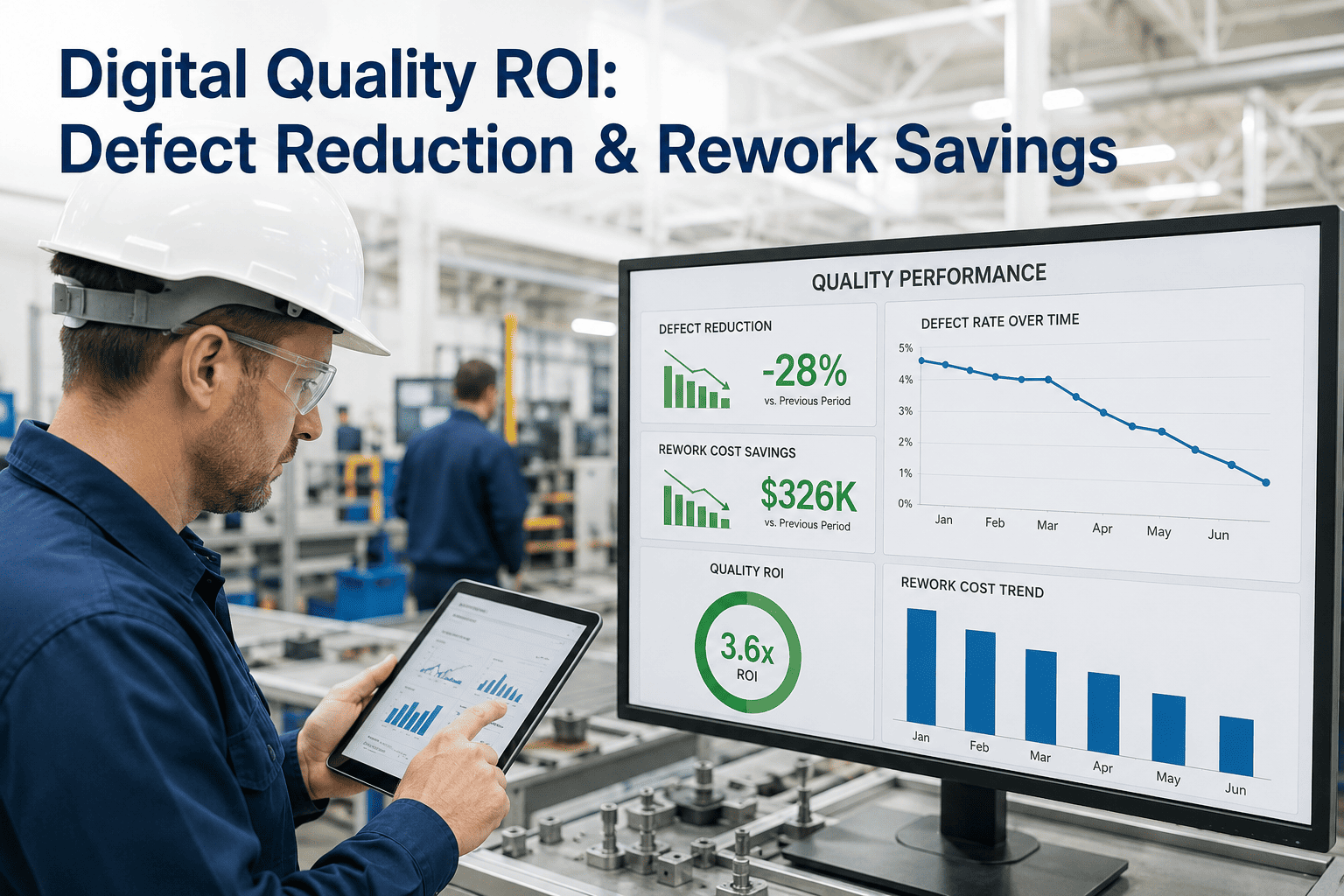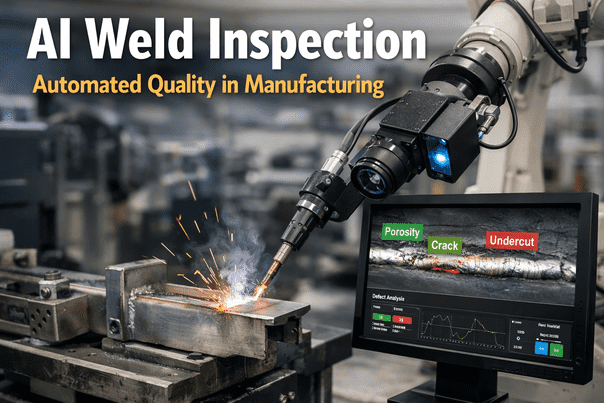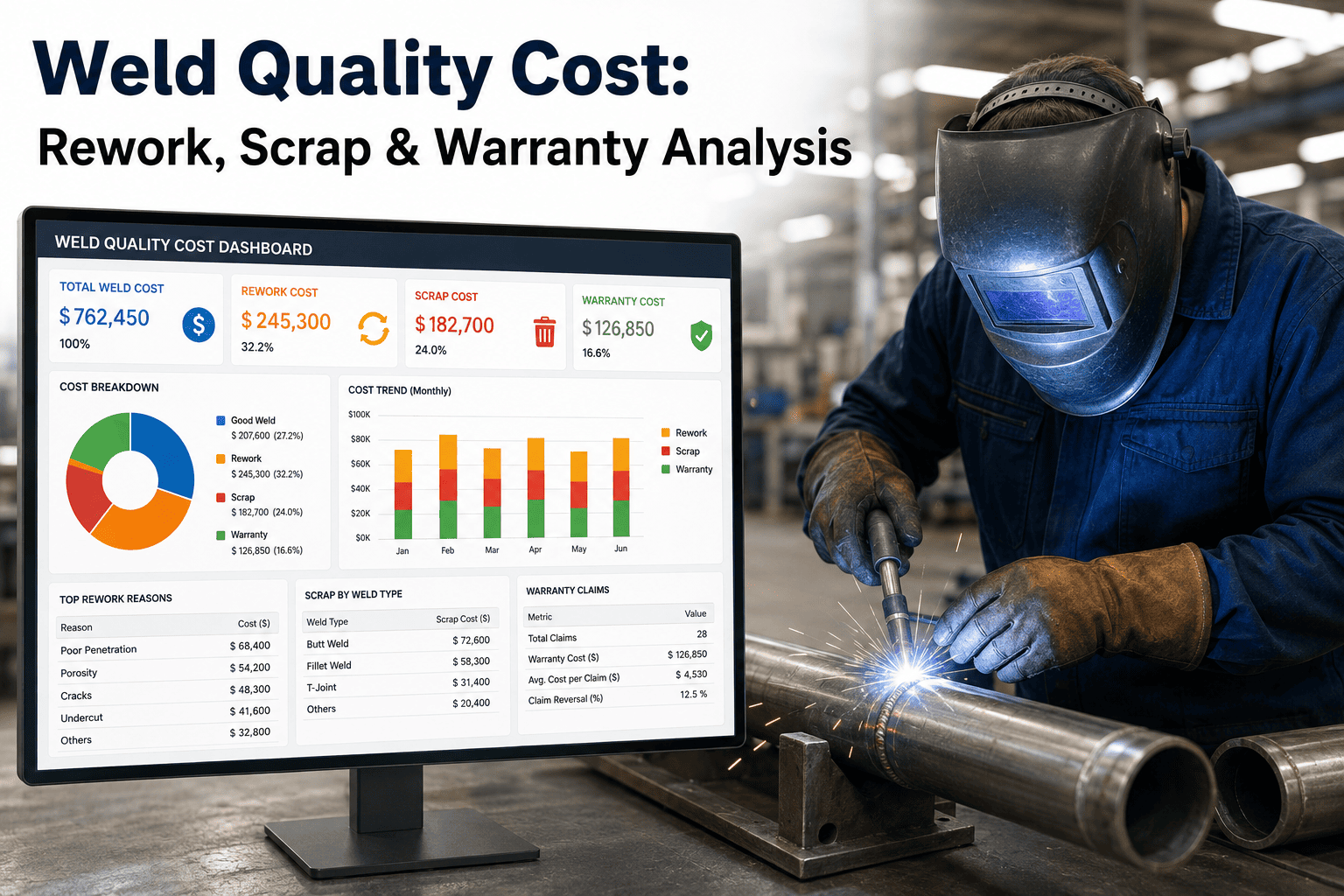
A weld that fails inspection almost never costs what the scrap tag on the part suggests. By the time a bad joint is caught, the metal has already been cut, fit, tacked, and welded once — meaning the labour, machine time, gas, and energy behind it are already spent before anyone decides whether to repair it or throw it away. Multiply that by every rejected joint across a shift, a week, and a fiscal year, and most manufacturers discover their real weld quality cost is a number finance has never actually seen in one place. Book a demo to see how AI weld inspection puts that number in front of you before it grows any larger.
Cost Of Poor Weld Quality
The Weld Defect Nobody Costed Out Is Usually The Most Expensive One In The Plant
Rework, scrap, warranty claims, and production delays from welding defects rarely show up as one line item — they hide across a dozen accounts until someone adds them up. Here is how to add them up correctly, and what changes once you do.
Why The Number Feels Smaller Than It Is
The Visible Cost Is a Fraction of the Real One
What Finance Usually Sees
Scrap material cost logged against the work order · Obvious rework hours entered on a timesheet
What Gets Missed First
Machine time and energy already spent before the defect was found · Downstream station idle time while the part is pulled and requeued · Inspection and NDT hours triggered by the reject
What Almost Never Gets Tracked
Expedited freight to replace a shipment that missed a ship date · Warranty labour and parts if the defect escaped to the field · Engineering hours spent on root cause reports and corrective action · Customer trust and the reorder that quietly never comes
Most cost-of-poor-quality studies across manufacturing put the fully loaded figure at somewhere between five and thirty percent of annual revenue, with weld-intensive operations frequently sitting toward the higher end of that range because a welded joint carries so much accumulated labour and process time by the point it can be inspected. The gap between the number a plant reports and the number a plant actually loses is almost always explained by this iceberg — the visible tip is scrap and obvious rework, and everything below the waterline is where the real damage happens.
Why Welding Specifically
What Makes Weld Defects More Expensive Than Most Other Manufacturing Errors
A stamping error or a machining tolerance miss is usually caught quickly and corrected with a straightforward re-cut or a new blank. A weld defect behaves differently, and that difference is the reason weld quality cost tends to run higher than the plant-wide average for cost of poor quality. First, a weld is often one of the last operations performed on a part, which means the component arrives at the weld station already carrying the cost of every upstream process — cutting, forming, machining, and fit-up. A rejected weld does not just waste weld time, it waives all of that accumulated investment as well. Second, many weld defects are not visible to the naked eye. Porosity, lack of fusion, and subsurface cracking can sit inside a joint that looks perfectly acceptable on the surface, which is exactly why radiographic and ultrasonic testing exist as separate, costly appraisal steps rather than a simple visual check. Third, repairing a weld is not always a neutral operation — grinding out a defective pass and re-welding introduces a second heat cycle, and on certain alloys and thicknesses, repeated heat cycles change the metallurgy of the joint in ways that can themselves become a new defect. That combination — high accumulated part value, difficult-to-see failure modes, and a repair process that is not risk-free — is what pushes weld quality cost above the average for a typical manufacturing defect, and it is also exactly why catching problems while the arc is still running has a disproportionately large payoff compared to catching them later.
The Four Places The Money Goes
Breaking Weld Defect Cost Into Its Real Components
01
Rework Cost
Grinding out a bad joint, re-fitting, and re-welding rarely costs less than the original weld and frequently costs several times more, because the part has to be pulled from the line, positioned again, and often preheated or stress-relieved a second time before the repair weld can even start.
02
Scrap Cost
When a defect makes repair uneconomical or the part geometry cannot tolerate another heat cycle, the component is scrapped outright — and the true loss includes every machining, forming, and assembly step already invested in that part, not just the raw material weight.
03
Warranty And Field Failure Cost
A weld defect that escapes final inspection and reaches a customer is the most expensive version of the same problem, since it now carries replacement parts, field labour, return logistics, and in regulated sectors, the reporting and re-certification work that follows a failure in service.
04
Production Delay Cost
Every rejected weld that stops a line, quarantines a fixture, or forces an unplanned inspection round eats into the shift's planned output, and that lost throughput rarely gets attributed back to the defect that actually caused it.
See Your Own Numbers
iFactory Turns Weld Defect Data Into a Live Cost Figure, Not a Quarterly Estimate
AI weld inspection tags every reject with a reason code, a station, a shift, and a cost the moment it happens, so rework and scrap stop being a number someone reconstructs from memory at month end.
The Multiplier Effect
Why a Defect Costs More The Later It Is Caught
3–10×
Rework caught in-process
A defect flagged during or immediately after welding typically costs several times the original joint value to fix, mainly in labour and requeue time.
15–25×
Defect caught at final inspection
Once a part has moved through downstream operations before the defect is found, indirect costs — delays, penalties, additional scrap — stack on top of the direct repair.
50–100×
Defect that escapes to the field
A weld failure discovered after shipment can trigger warranty replacement, return logistics, and in pressure equipment or structural applications, formal re-testing and regulatory notification.
Timing Is Everything
The Cost of the Same Defect at Four Different Stages
| Detection Stage | What Is Already Spent | Typical Cost Driver | Relative Cost |
|---|---|---|---|
| During Welding | Filler wire, gas, arc time for that pass | Parameter correction, single re-pass | Baseline |
| Post-Weld Inspection | Full weld, fixture time, initial NDT pass | Grinding, re-weld, second inspection | 3–10× baseline |
| Final Assembly / Test | All downstream operations already applied | Disassembly, repair, re-test, schedule slip | 15–25× baseline |
| In The Field | Shipping, installation, service life to date | Warranty, logistics, liability, trust | 50–100× baseline |
This is the entire argument for catching weld defects earlier rather than inspecting harder later — every stage a defect survives adds a layer of sunk cost that repair alone cannot recover, which is why the detection point matters as much as the detection method. It also explains why simply adding more inspectors or more NDT hours at the end of the line rarely fixes the underlying cost problem. More appraisal effort at final inspection catches more defects before they escape, which is valuable, but it does nothing to prevent the sunk cost that has already accumulated by that point in the process. The only lever that actually reduces the multiplier is moving detection earlier, closer to the arc itself, where a correction costs a parameter adjustment rather than a disassembly and a schedule slip.
It Varies By What You Weld
Weld Quality Cost Across Four Industrial Sectors
Automotive Body-In-White
High-volume resistance spot and MIG welding means individual defect cost is modest, but volume multiplies it fast — a drifting parameter across thousands of welds per shift can generate a recurring rework bill before anyone notices the trend.
Pressure Vessels And Piping
A single undetected weld defect can trigger a full hydrostatic re-test and partial disassembly, pushing the cost of one missed joint to a level that dwarfs the entire welding budget for that unit.
Structural Steel
Field-welded structural joints are expensive to access once erection is complete, so a defect caught after the structure is standing carries scaffolding, access, and schedule costs on top of the repair itself.
Oil And Gas Fabrication
Code-governed welds often require radiographic or ultrasonic re-testing after any repair, so appraisal cost climbs alongside rework cost every time a joint fails and has to be reworked and re-qualified.
A Quality Manager's View
The number that finally gets a capital request approved is almost never the scrap report — it is the fully loaded figure that includes the rework hours nobody logged separately, the NDT re-tests triggered by a bad batch, and the one warranty claim that made the customer ask hard questions. Plants that pull twelve months of scrap postings, rework hours, and warranty reserves into one sheet are usually shocked at how much bigger the real number is than what they had been reporting internally, and that gap is exactly what justifies moving from post-weld inspection to catching defects while the arc is still running.
Dinesh Vora
Quality Systems Manager · 14 years across pressure equipment and structural steel fabrication · Has led cost-of-poor-quality baselining for multiple welding-intensive plants
Build Your Own Number
Five Steps To Calculate Your Real Weld Quality Cost
1
Pull twelve months of scrap postings from your ERP
Filter by nonconformance reason code where possible so weld-related scrap is separated from other causes.
2
Add rework labour hours at fully loaded rate
Include overhead, not just base wage, and count fixture and machine time consumed during the repair, not only welder time.
3
Add NDT and re-inspection labour
Visual re-checks, radiographic re-tests, and ultrasonic re-scans triggered specifically by a repair should be counted separately from routine inspection.
4
Add warranty claims attributable to weld quality
Work with the service or after-sales team to isolate claims where the root cause traces back to a welded joint specifically.
5
Value the downtime, not just the direct cost
A quarantined fixture or stopped line has a cost per minute even when nothing is being scrapped — apply your contribution margin per minute to the actual stoppage time.
Once these five totals are sitting in one sheet instead of scattered across ERP, maintenance logs, and after-sales records, most plants find their real weld quality cost is meaningfully higher than what was previously reported to leadership, and that gap is not a sign of poor bookkeeping — it reflects how naturally these costs scatter across departments that rarely compare notes. A quality manager sees the rework hours. Finance sees the scrap postings. Service sees the warranty claims. Production sees the downtime. None of them individually sees the full weld quality cost, which is exactly why building this baseline once, and then keeping it current automatically, tends to be the single most persuasive document in any conversation about funding better weld inspection.
Weld Quality Cost Questions
Frequently Asked Questions
Why does the cost of poor weld quality vary so widely between plants, from single digits to over thirty percent of revenue?
The range mostly reflects how much of the cost a plant actually tracks rather than how different the underlying defect rates really are. A plant that only logs obvious scrap will report a low number even while carrying significant hidden rework, downtime, and warranty exposure, while a plant that has baselined its full cost of poor quality tends to report a higher but far more accurate figure. Book a demo to see how continuous defect tracking closes that reporting gap.
Is rework always cheaper than scrap, or can reworking a defective weld actually cost more in the long run?
Rework is usually cheaper than scrap in raw material terms, but it is not automatically cheaper overall once fixture time, requeue delay, and the risk of a second failed repair are counted. Parts that require repeated heat cycles or that have already absorbed several downstream operations can reach a point where scrapping and remaking is the more economical decision, which is exactly the kind of comparison a proper cost baseline makes visible.
How much of weld defect cost is actually preventable versus an unavoidable cost of doing business?
A meaningful share of weld defect cost traces back to parameter drift, inconsistent fit-up, or operator variation that inline monitoring can catch and correct before a defect fully forms, rather than defects that are genuinely random. Plants that move from post-weld inspection to real-time parameter monitoring commonly report a sizeable reduction in both scrap and rework within the first year, which suggests a large share of the cost was preventable rather than inherent. Contact support to discuss what a realistic reduction looks like for your specific process.
Does warranty cost from weld defects really connect back to something that happened on the shop floor months or years earlier?
Yes, and that time gap is exactly what makes warranty cost so hard to control without good traceability. Without a record connecting a specific weld to its parameters, operator, and station, a field failure investigation has to work backward from incomplete information, while a plant with weld-level data can trace a claim to a specific process condition and correct it at the source instead of guessing.
What is the fastest way to get leadership to take weld quality cost seriously enough to fund a monitoring system?
Presenting the number at station level rather than plant-wide tends to land better, since a specific figure like a defined defect rate and a defined annual rework and scrap cost for one station is more concrete and harder to dismiss than a facility-wide average buried in a broader quality report. Pairing that station-level number with the multiplier effect of late-stage detection makes the case for earlier catching, not just more inspection. Book a demo to see how iFactory presents this data in a format built for that conversation.
Stop Reconstructing This Number From Memory
See Your Real Weld Quality Cost, Updated Every Shift
iFactory's AI weld inspection tags every defect with its station, cause, and cost the moment it happens, turning rework, scrap, and warranty exposure into a number you can actually manage instead of one you estimate once a quarter.