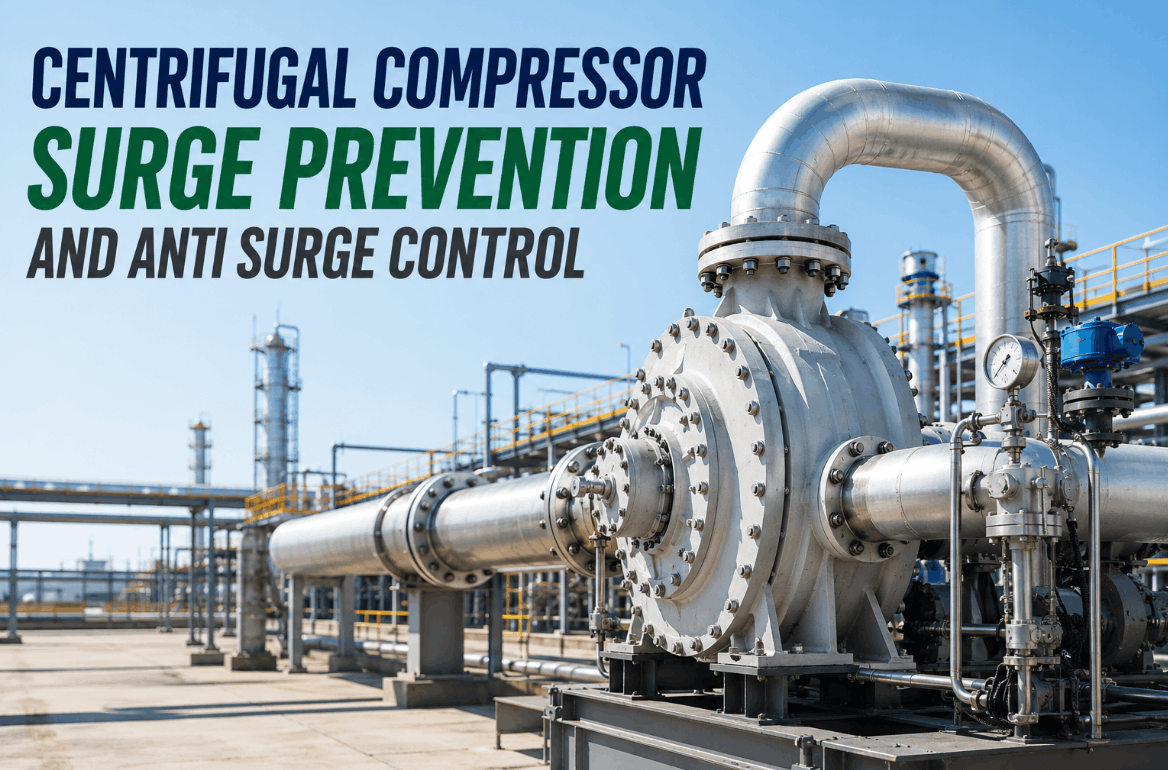
Every anti-surge control system on a centrifugal compressor is protecting against a boundary that was fixed once, at commissioning, and treated as permanent ever since. In reality the surge line shifts continuously with inlet temperature, gas composition, fouling, and machine wear, but the control line the recycle valve responds to almost never moves with it. The result is a margin sized for worst-case conditions applied to every hour of operation, including the hours when actual conditions would safely allow the compressor to run closer to its true limit. That gap is where AI anti-surge optimization makes its case. Book a demo to see how much margin your own compressor is leaving on the table.
FLOW ASSURANCE INTELLIGENCE · ANTI-SURGE OPTIMIZATION
Your Surge Line Moves. Your Control Line Doesn't. That Gap Costs Real Throughput.
iFactory layers AI on top of your existing anti-surge controller, tracking the real surge boundary as it shifts with fouling, gas composition, and ambient conditions — recovering margin without touching your protection layer.
COMPRESSOR MAP — FIXED CONTROL LINE VS AI-TRACKED BOUNDARY
True surge line
AI-tracked line, updated continuously
Fixed control line, set at commissioning
Recovered operating margin
Protected zone, never entered
WHY THE MARGIN IS WIDER THAN IT NEEDS TO BE
Conservative Isn't Free — Every Recycled Unit of Gas Is Work Thrown Away
When the anti-surge valve opens, compressed gas recycles back to suction, and the compressor re-compresses that returned gas without delivering any net throughput for it. A margin sized to cover worst-case transients, sensor delay, and valve response time is a defensible engineering choice, but it is applied uniformly across every operating hour rather than only the hours that actually need it. Industry guidance suggests a poorly designed system may need a margin of 16 percent or more, while a well-tuned one can run meaningfully tighter — and that difference compounds into real dollars over a full year of operating hours. The energy penalty is not a one-time cost that shows up once and is done; it accrues continuously, hour after hour, shift after shift, invisible on any single day's production report but unmistakable once totaled across a full year of operation.
10-16%
Typical fixed surge margin held between the control line and the true surge limit, sized for worst-case conditions
100%
Share of recycled compression energy that is fully wasted — work already performed and then thrown away
Several %
Typical throughput reduction from an oversized safety cushion that adds no revenue and no protection benefit
WHAT MOVES THE SURGE BOUNDARY
The Line That Was Fixed at Commissioning Was Never Meant to Stay Fixed
The surge boundary is a property of the compressor's actual aerodynamic state at any given moment, not a permanent feature of the machine. Every one of the factors below shifts it, sometimes significantly, and a control line calculated once at commissioning has no way to know any of this happened — it simply keeps enforcing the same assumption it started with, indefinitely, regardless of how far the real machine has drifted from that original snapshot.
Inlet Temperature Swings
Seasonal and even daily ambient temperature changes shift gas density and move the effective surge point measurably.
Gas Composition Changes
Molecular weight variation from upstream process changes or feedstock shifts alters compressor behavior at the same flow rate.
Fouling and Wear
Impeller and diffuser fouling gradually degrades performance, moving the real surge line without any change to the control system's assumptions.
Speed and Load Changes
Variable-speed operation and load-following duty cycle mean the compressor spends time at points a single fixed line cannot accurately represent.
Sensor Calibration Drift
Transmitter calibration spans used in proximity-to-surge calculations drift over time, quietly changing how close to the real boundary the system believes it is operating.
Multi-Unit Load Imbalance
In parallel compressor trains, running units at equal flow rather than equal distance from each machine's own surge line can push one unit into unnecessary recycle.
Find Out How Much Margin Your Compressor Is Currently Giving Away
Send us your historical operating data and current anti-surge control line settings. We'll show you where the real surge boundary sits against your fixed line today.
HOW AI OPTIMIZATION WORKS ALONGSIDE YOUR EXISTING CONTROLLER
A Supervisory Layer, Not a Replacement for Protection
The dedicated anti-surge controller is designed for one job — fast, deterministic compressor protection — and that job does not change. AI optimization sits above it as a supervisory layer, continuously recalculating where the true boundary actually is and adjusting the operating target the protection layer works from, while the protection layer itself keeps executing exactly as it always has. This separation of responsibilities matters enormously to anyone responsible for compressor reliability: the fast-acting safety logic that has to respond within a second of a rapid upset is never the thing being modified or made smarter, only the slower-moving target it aims for.
01
Ingest Real-Time Operating Data
Flow, pressure, temperature, vibration, and speed signals stream continuously from existing plant instrumentation, no new sensors required in most deployments.
02
Model the Current Aerodynamic State
The model tracks how inlet conditions, gas composition, and machine condition are shifting the compressor's actual performance curve in real time.
03
Recalculate the True Surge Boundary
Rather than trusting a line fixed at commissioning, the system continuously re-derives where the actual surge limit sits under current conditions.
04
Recommend a Tighter, Confidence-Scored Margin
Every recommended adjustment carries a confidence interval, so operators can see exactly how much certainty backs each proposed change before accepting it.
05
Pass the Target to the Existing Controller
The dedicated anti-surge controller keeps full authority over protection, executing against the updated target the same way it always has against a fixed one.
FIXED LINE VS AI-TRACKED BOUNDARY
The Same Compressor, Two Very Different Operating Realities
A fixed surge control line and a continuously updated AI boundary produce meaningfully different outcomes across the exact same hardware, purely because one adapts to reality and the other assumes reality never changed since commissioning day. The comparison below reflects the structural difference between the two approaches, not a specific vendor claim, and holds regardless of which compressor OEM or control system is already installed on your train.
| Factor |
Fixed Control Line |
AI-Tracked Boundary |
| Basis for the Margin |
Worst-case assumptions set once at commissioning |
Continuously recalculated from live operating data |
| Response to Fouling |
None — margin stays fixed as real boundary drifts |
Tracked and compensated for automatically |
| Response to Gas Composition Change |
Requires manual re-tuning by an engineer |
Incorporated into the model in real time |
| Recycle Frequency |
Opens earlier and more often than current conditions require |
Opens only when the actual boundary is genuinely being approached |
| Protection Layer |
Dedicated controller, unchanged |
Same dedicated controller, unchanged — AI supervises, does not replace |
WHERE THE RECOVERED VALUE SHOWS UP
Recovered Margin Turns Into Throughput, Not Just a Cleaner Chart
Optimizing the surge margin is not an academic exercise in control theory — every percentage point of unnecessary recycle recovered translates directly into measurable operating outcomes across the compression train, outcomes that show up on the same operational dashboards plant managers already review every shift.
Higher Net Throughput
Less flow diverted to recycle means more compressed gas actually moves downstream toward product rather than looping back to suction.
Lower Driver Power Consumption
Every unit of gas that is not needlessly recompressed is driver power that was never wasted re-doing work already completed.
Reduced Anti-Surge Valve Wear
Fewer unnecessary valve open-close cycles reduce mechanical wear on a component that is expensive and disruptive to replace.
Extended Turndown Range
A more accurate boundary lets the compressor safely turn down further before recycle protection engages, improving flexibility at low-demand periods.
See the Supervisory Layer Running Against Your Own Compressor Data
iFactory connects to your existing historian and control system, models your compressor's real surge behavior, and shows exactly where margin can be safely recovered — with your dedicated anti-surge controller keeping full protection authority throughout.
TURNKEY DEPLOYMENT
Live in 8 to 14 Weeks, Layered Over Your Existing Control System
Deploying AI anti-surge optimization does not mean replacing or re-engineering your existing protection system. iFactory connects a supervisory model to your historian and DCS, validates it against historical operating data before any live recommendation is ever issued, and hands control targets to your existing anti-surge controller once confidence is established — a deployment approach designed specifically to avoid the disruption and re-commissioning risk that any change to a safety-critical system naturally raises for a reliability team.
Weeks 1–5
Data Connection and Historical Validation
Connect to historian and DCS data. Model trained and validated against months of historical operating data before any live recommendation is issued.
Weeks 6–10
Shadow Mode Operation
System runs in advisory mode alongside the existing fixed control line, with recommended margin adjustments logged and reviewed by engineering before any target is passed to the controller.
Weeks 11–14
Supervisory Go-Live
Confidence-scored targets begin passing to the existing anti-surge controller, with twenty-four seven remote monitoring and rollback to the original fixed line always available.
WHERE THIS APPLIES
Any Centrifugal Compression Service Running a Fixed Margin
Anti-surge optimization applies wherever centrifugal compressors run behind a conservative fixed control line, which describes the vast majority of gas compression services across these sectors.
Natural Gas Transmission and Pipeline
Multi-unit compressor stations where load balancing across parallel trains compounds unnecessary recycle losses.
Gas Processing and Refining
Process gas compressors subject to frequent composition shifts from upstream unit operations.
Petrochemical Compression Trains
High-value compression services where every percentage point of throughput recovery carries significant revenue impact.
Power Generation Gas Turbines
Compressor sections where surge margin directly trades off against combined-cycle efficiency and output.
FREQUENTLY ASKED QUESTIONS
Questions Reliability and Process Engineers Ask First
Does this replace our existing anti-surge controller or safety instrumented system?
No, the dedicated anti-surge controller and any safety instrumented system remain fully in place and retain complete authority over compressor protection. AI optimization operates as a supervisory layer above the controller, continuously recalculating where the true surge boundary sits and passing an updated operating target to the existing controller, which then executes exactly as it always has. The fast, deterministic protection logic that keeps the compressor safe during a rapid upset is never touched or bypassed by the optimization layer — it remains the sole authority for real-time protection decisions, with the same response speed and the same fail-safe behavior it had before optimization was ever introduced.
Book a demo to see how the supervisory architecture is validated before any live deployment.
How do you validate that a tighter margin is actually safe before it goes live?
Every deployment begins with the model trained and validated against months of historical operating data before it ever issues a live recommendation, followed by a shadow mode period where recommended adjustments are logged and reviewed by engineering rather than acted on automatically. Each recommendation carries a confidence interval so engineers can see exactly how much certainty backs a proposed tightening before it is ever passed to the controller, and rollback to the original fixed line is always available at any point. Nothing changes about the compressor's actual protection until this validation process has run its course.
Contact our support team to discuss the validation process for your specific compressor train.
What data do you need from our plant to get started?
The core requirement is historical operating data from your historian, typically flow, suction and discharge pressure, temperature, vibration, and speed signals, along with the current anti-surge control line settings and any available gas composition data. Most deployments work with instrumentation already installed for existing anti-surge control, since the model is built to work from the same signal set the dedicated controller already relies on rather than requiring a new sensor installation project. Where genuine gaps exist, targeted additions can be scoped separately.
Book a demo to review what your current historian and instrumentation already support.
How much throughput or energy improvement is realistic for our specific compressor?
The realistic improvement depends heavily on how conservative your current fixed margin is relative to the true, moving surge boundary — a compressor already tuned tightly through careful manual engineering has less room to recover than one running an older, more conservative setting inherited from commissioning. An initial assessment against your own historical data typically shows where the gap actually sits before any commitment is made, since a generic industry percentage is a poor substitute for a number grounded in your specific machine's operating history, its instrumentation quality, and how frequently its true boundary actually shifts throughout a typical year.
Contact our support team to discuss a realistic estimate for your compressor train.
Does this work across multi-unit parallel compressor stations?
Yes, and multi-unit stations are often where the largest recoverable margin exists, since fixed control strategies that balance parallel units by equal flow rather than equal distance from each machine's own surge line can push one unit into unnecessary recycle while others still have genuine margin available. A supervisory layer that understands each unit's individual, continuously updated boundary can coordinate load allocation across the train more effectively than a strategy built around a single shared assumption.
Book a demo to discuss a multi-unit deployment for your compressor station.
Recover the Margin Your Fixed Control Line Has Been Giving Away
iFactory layers AI optimization over your existing anti-surge controller, tracks the real surge boundary continuously, and recovers throughput without touching your protection layer. Book a demo and see the gap on your own compressor data.