A crude unit runs for weeks with desalter salt content sitting comfortably under target, and then a single crude slate change quietly pushes it past the line. Nobody notices until preheat exchangers start fouling faster than the cleaning schedule accounts for, or a corrosion coupon in the overhead comes back showing chloride attack nobody budgeted for. The desalter did not fail; the mix valve pressure, chemical dose, and interface level that used to be right for one crude blend were simply never re-tuned for the next one, and by the time a lab result flags it, the damage is already downstream. You can see how continuous AI tuning closes that gap by choosing to book a demo with our team.
Your Desalter Is Tuned for the Crude You Ran Last Month, Not the Crude You're Running Today
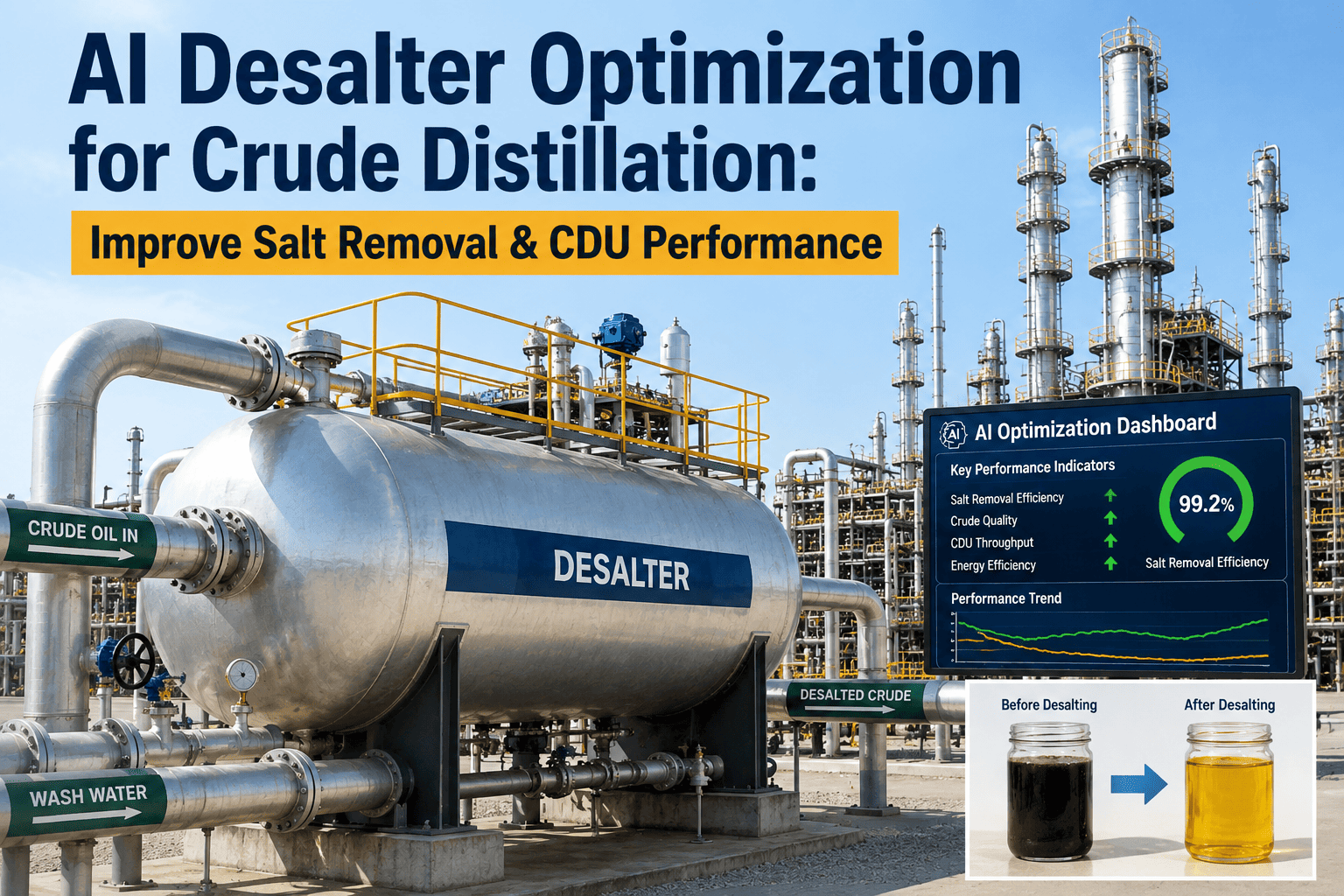
Mix valve pressure, chemical injection rate, temperature, and mud wash all interact, and the right setpoints for one crude blend can be exactly wrong for the next. iFactory continuously re-tunes desalter operating parameters against live feed characteristics so salt carry-over stays inside target instead of drifting until a corrosion or fouling event forces a correction.
The Desalter Sits Between Four Variables That All Move at Once
A desalter does one job: strip enough water-soluble salt and suspended solids out of crude before it reaches the atmospheric tower, so downstream chloride hydrolysis does not generate hydrochloric acid in the overhead. The mechanism for doing that job well depends on wash water mixing thoroughly with the crude, which depends on mix valve pressure drop, which depends on crude viscosity, which changes with every blend and every ambient temperature swing.
Operators typically set mix valve pressure once, based on the crude the unit was designed to run, and leave it there through blend changes that were never modeled into that original setpoint. Too little shear and the wash water never contacts enough of the salt; too much shear and the emulsion becomes so stable it will not separate in the settling section, which shows up as a rising rag layer and eventually as oil-in-water carry-under or water-in-oil carry-over, either direction of failure.
Chemical demulsifier dose compounds the same problem. A dose rate tuned for a heavier, more asphaltenic crude will often overtreat a lighter blend, which can itself destabilize the interface rather than help it, while a dose tuned for a light sweet crude will consistently undertreat a heavier opportunity crude brought in to capture a margin advantage. Because demulsifier chemistry is crude-specific and blend ratios shift week to week on many units, a fixed dose curve is almost never the right dose curve for more than a portion of the operating window.
Temperature, Mix Valve Pressure, Chemical Dose, and Mud Wash Have to Move Together
Treating these four variables as independent settings is the most common reason a desalter optimization effort stalls. They interact, and the correct value for any one of them depends on where the other three currently sit relative to the crude blend actually flowing through the vessel right now.
See What Your Current Desalter Setpoints Are Actually Costing You
iFactory maps live mix valve pressure, chemical dose, and salt content trends against your blend schedule so drift gets corrected before it reaches the tower.
What Changes When the Desalter Adjusts to the Blend Instead of the Other Way Around
Most units already have the instrumentation needed to run this way, salt-in-crude analyzers, mix valve ΔP transmitters, interface level detection, and dosing pumps, but the control logic connecting them was set once and rarely revisited. The gap is not equipment, it is the absence of a system that recalculates the right combination of setpoints every time the feed changes.
| Operating Approach | Fixed Setpoint Operation | AI-Tuned Operation |
|---|---|---|
| Response to Blend Change | Same mix valve ΔP and dose regardless of crude switch | Setpoints recalculated against live viscosity and water cut |
| Chemical Cost | Dose set for worst-case crude, overtreating lighter blends | Dose matched to current asphaltene and resin demand |
| Mud Wash Timing | Calendar-based interval regardless of solids accumulation | Triggered by accumulation trend, not a fixed schedule |
| Detection of Salt Excursion | Discovered on next scheduled lab sample | Flagged from live analyzer trend before target is exceeded |
Getting From Fixed Setpoints to Continuous Retuning
Where Desalter Optimization Efforts Usually Go Wrong
Demulsifier Selection Is a Second Layer of the Same Problem
Dose rate is only half of the chemical picture. The demulsifier chemistry itself, its solvent package, its HLB balance, and its treating speed, is formulated around a specific range of asphaltene, resin, and wax content, and a product selected for a heavier opportunity crude can underperform badly on a lighter blend even at a correctly scaled dose. Refineries that run a wide blend rotation often standardize on a single demulsifier for operational simplicity, which trades chemical performance across part of the rotation for procurement convenience.
AI-assisted blend tracking makes it possible to flag when the current feed has drifted far enough from the chemistry's design window that a product switch, rather than a dose adjustment, is the more effective correction. This does not mean carrying a large chemical inventory; it means having visibility into when the existing product is being asked to do a job it was not formulated for, so the decision to switch or blend chemistries is made deliberately rather than discovered through a rag layer problem weeks later.
Desalter Optimization Crosses Three Roles That Rarely Share a Dashboard
Setpoint drift is as much an organizational gap as a technical one. Crude purchasing decisions, board operator setpoint adjustments, and process engineering review of salt content trends are typically owned by three different people who see three different slices of the same problem, and none of them individually has the full picture needed to catch a drift before it becomes an excursion.
Questions Process Engineers Ask About Desalter AI Optimization
Stop Re-Tuning the Desalter After the Blend Has Already Changed
iFactory keeps mix valve pressure, chemical dose, temperature, and mud wash timing matched to the crude actually running through the vessel, not the crude the unit was last tuned for.