Pipeline gas specifications exist for a reason — too much H2S, CO2, or moisture and the gas becomes unsalable or corrosive to the very infrastructure carrying it, yet many treating units are still operated against fixed setpoints tuned for average inlet conditions rather than what is actually arriving at the plant right now. AI-based gas quality monitoring changes that by reading real-time composition data continuously and adjusting amine treating, glycol dehydration, and NGL recovery operations to match the gas actually flowing through the plant, not the gas the unit was designed around years ago. Below is how continuous quality monitoring connects to treating operations, and how to book a session with our midstream team to review your plant.
Flow Assurance Intelligence · Gas Quality
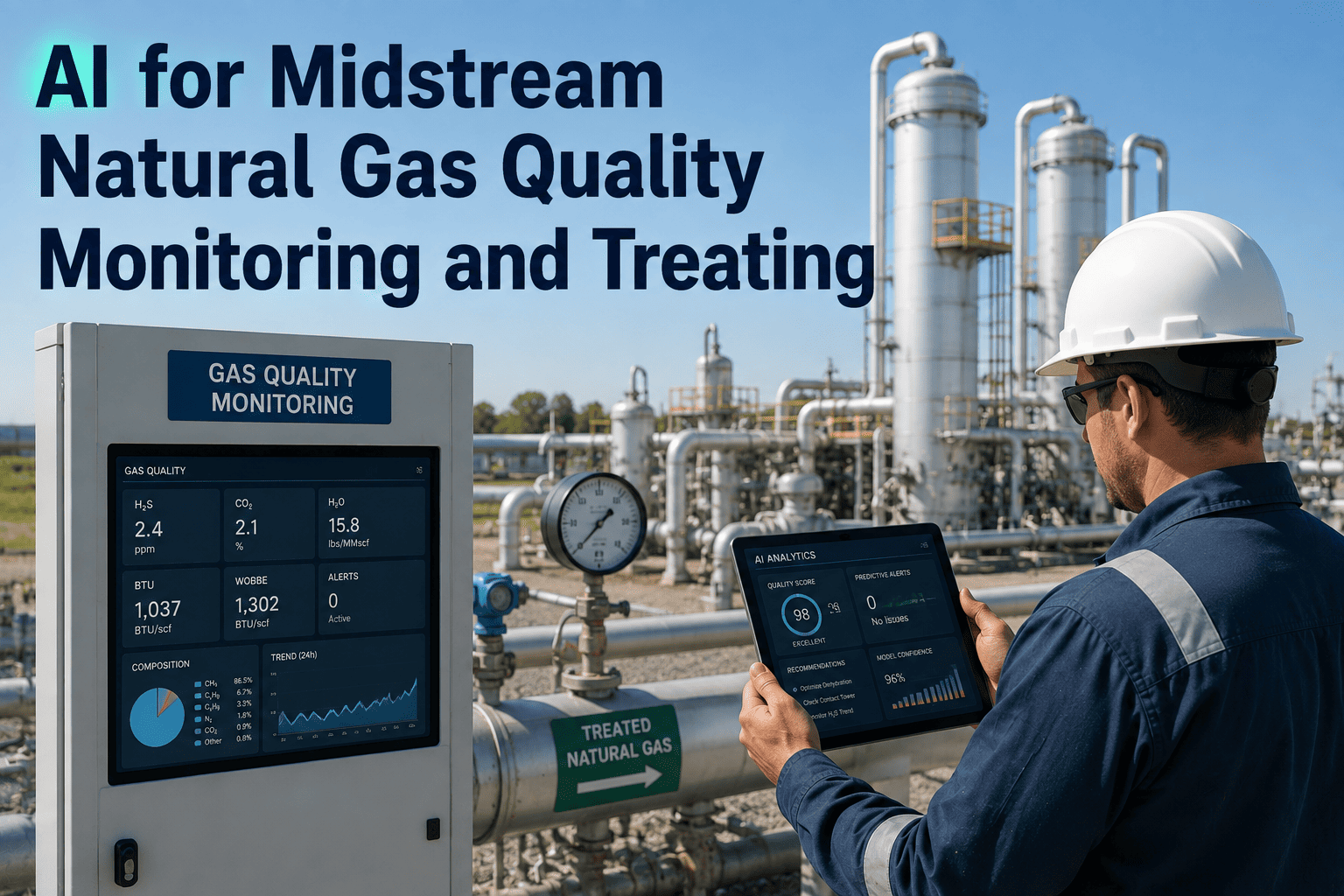
AI for Midstream Natural Gas Quality Monitoring and Treating
Continuous H2S, CO2, moisture, and hydrocarbon dewpoint monitoring feeding real-time amine treating, glycol dehydration, and NGL recovery optimization — keeping treated gas on spec as inlet composition changes.
The Underlying Issue
Why Fixed Setpoints Struggle Against Variable Inlet Gas
Inlet gas composition is rarely constant — it shifts as different wells or gathering areas contribute to the stream, as reservoir conditions change over field life, and as ambient temperature affects moisture and hydrocarbon dewpoint behavior throughout the day. A treating unit tuned to a fixed setpoint handles the average case reasonably well but leaves margin unused on easy days and risks off-spec gas on harder days, since the operator has no continuous visibility into exactly how today's inlet composition compares to what the unit was set up for. Continuous monitoring turns that blind spot into a live input the treating process actually responds to.
Treating Process Optimization
Three Treating Processes AI Connects to Real-Time Gas Quality
Amine Treating
H2S and CO2 readings feed circulation rate and lean amine concentration adjustments, keeping acid gas removal matched to actual inlet loading instead of running the unit at a fixed rate that either over-treats or risks a specification excursion.
Glycol Dehydration
Moisture content readings drive glycol circulation rate and reboiler temperature recommendations, targeting the water dewpoint specification without unnecessarily over-circulating glycol on drier inlet days.
NGL Recovery
Hydrocarbon dewpoint and composition data inform recovery unit operating conditions, balancing NGL yield against the risk of retrograde condensation forming downstream in the pipeline.
Specification Reference
Typical Pipeline Gas Quality Parameters AI Monitors Against
| Parameter | Typical Pipeline Spec | Consequence If Off-Spec | Treating Process Involved |
| H2S |
Commonly ≤ 0.25 - 4 grains/100 scf |
Toxicity risk, pipeline corrosion, rejection at delivery point |
Amine treating |
| CO2 |
Commonly ≤ 2-3 mol % |
Heating value dilution, corrosion in wet conditions |
Amine treating |
| Water Content |
Commonly ≤ 7 lb/MMscf |
Hydrate formation, internal pipeline corrosion |
Glycol dehydration |
| Hydrocarbon Dewpoint |
Set by pipeline tariff, often seasonal |
Retrograde condensation, liquid dropout downstream |
NGL recovery |
Instrumentation Requirements
What a Plant Needs Connected Before Monitoring Adds Value
Most gas processing plants built or upgraded in the last decade already have the online analyzers a quality monitoring model needs — H2S and moisture analyzers on the inlet and outlet of treating units, gas chromatographs feeding custody transfer measurement, and dewpoint analyzers at NGL recovery. The integration work is rarely about installing new instrumentation from scratch; it is about connecting the data these analyzers already produce into a system that can correlate it continuously against treating operations rather than leaving each reading siloed in its own historian trend with no connection to the others.
Continuous H2S and CO2 analyzers on treated gas outlet, ideally also on inlet for load calculation
Moisture analyzer downstream of the glycol contactor, reading against the pipeline water dewpoint specification
Gas chromatograph data for composition and heating value, typically already present for custody transfer
Hydrocarbon dewpoint analyzer at the NGL recovery outlet or pipeline delivery point
See How Often Your Inlet Gas Actually Shifts
Most plants underestimate how much their inlet composition moves day to day until they see it plotted against current treating setpoints. A gas quality review shows exactly where the margin is being left on the table.
Financial Impact
Where the Cost of Running Conservative Actually Shows Up
Running a treating unit conservatively to avoid an off-spec rejection has a real cost that is easy to overlook because it never shows up as a single dramatic event — it shows up gradually, as amine circulated beyond what the inlet gas actually required, glycol reboiler duty spent drying gas that was already close to spec, and NGL recovery operated more conservatively than the actual dewpoint risk justified. None of these individually looks like a large number on a monthly operating statement, but across a full year of continuous operation, the aggregate cost of unnecessary conservatism at a mid-size processing plant can represent a meaningful share of avoidable treating cost — margin that continuous, composition-matched operation recovers without increasing off-spec risk.
Applied Example
A Seasonal Composition Shift Working Through the Model
Consider a gathering system where a new set of wells begins contributing to the inlet stream during a seasonal production ramp-up, gradually shifting inlet CO2 concentration higher than the historical average the amine unit was tuned around. Under fixed setpoint operation, this shift would either go unaddressed until an outlet spec excursion prompted a manual investigation, or the unit would already be running conservatively enough to absorb it at the cost of ongoing overtreatment. With continuous monitoring, the gradual inlet composition shift is visible in the trend data well before it becomes a spec concern, and a circulation rate adjustment recommendation is generated proactively — matching treating intensity to the new inlet reality instead of waiting for either a problem or a permanent conservative baseline to develop.
Getting Started
What a Plant Should Confirm Before an Implementation Kickoff
Plants that move from initial conversation to a working system fastest are usually the ones that walk into the first implementation meeting already knowing which analyzers are online, where the data currently lands, and who owns operating envelope approval for any recommended setpoint change. That short list of preparation questions saves the early weeks of an implementation that would otherwise go toward discovery rather than actual configuration, and it gives the operator a clearer sense of how much of the groundwork is already in place before committing to a project timeline.
| Question | Why It Matters |
| Which analyzers report to a historian today? |
Determines what can be connected immediately versus what needs a new data path |
| What is the current setpoint approval process? |
Defines who reviews and approves a model-generated adjustment recommendation |
| Are pipeline tariff specs seasonal or fixed? |
Shapes how monitoring thresholds are configured for dewpoint and other seasonal specs |
| Is there a history of off-spec events on file? |
Gives the model early context on where conservatism has historically been justified |
Plant operators tend to run treating units conservatively because the cost of an off-spec gas rejection is so much higher than the cost of a little wasted amine circulation or glycol reboiler duty — which is a reasonable instinct without better visibility, but it leaves real margin unused on most days. What continuous quality monitoring gives an operator is the confidence to run closer to actual conditions instead of the worst-case assumption, because the system is watching composition continuously rather than relying on periodic lab samples that are already hours old by the time the result comes back.
Thaddeus Okonkwo-Reyes
Midstream Process Engineer · 15 years in gas processing, amine treating, and dehydration unit operations
Gas Quality Questions
Gas Quality Monitoring and Treating AI — Frequently Asked
Does this replace periodic lab sampling and gas chromatograph analysis?
No — continuous online analyzers and gas chromatograph data feed the model, and periodic lab sampling continues to serve as a calibration check against the continuous readings rather than being replaced by them.
Book a review to see how continuous and lab data work together in this setup.
Can this work if our plant only has H2S and moisture analyzers, not full composition monitoring?
Yes — the model can start with whatever continuous analyzers are already installed and provide value on those specific parameters, then expand as additional monitoring points are added over time.
Contact support to review what your current instrumentation supports.
How does the system recommend amine circulation changes without risking an off-spec excursion?
Recommendations stay within operator-approved operating envelopes and are presented for review rather than applied automatically by default, so an operator retains final judgment on any circulation rate or reboiler temperature change before it takes effect.
Book a demo to see the recommendation workflow.
Does this help with seasonal hydrocarbon dewpoint specification changes?
Yes — seasonal tariff specification changes can be built directly into the monitoring thresholds, so NGL recovery recommendations automatically account for a tighter winter dewpoint requirement without a manual setpoint change each season.
Ask our team about configuring seasonal specifications.
How quickly can a plant start seeing value from this kind of monitoring?
Once existing analyzer data is connected, most plants see their first meaningful optimization recommendation within the first few weeks, since the model can begin working from historical composition trends already on file.
Book a call to scope a timeline for your facility.
Treat the Gas You Actually Have, Not the Gas You Designed For
iFactory connects continuous H2S, CO2, moisture, and dewpoint monitoring to amine, glycol, and NGL recovery operations — keeping treated gas on spec without leaving margin unused.