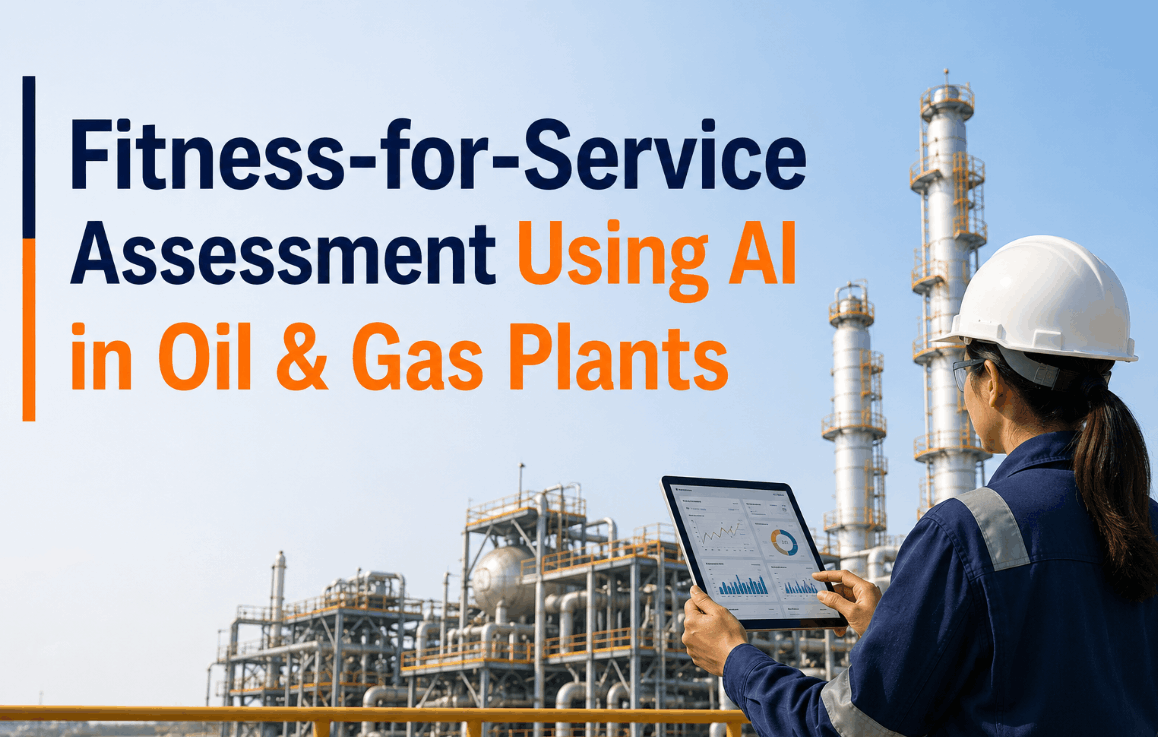
Every oil and gas plant operates equipment that ages, corrodes, and accumulates damage — pressure vessels exposed to hydrogen sulfide, pipelines experiencing wall thinning, heat exchangers degraded by fouling and erosion. The engineering question that determines whether that equipment gets replaced, repaired, or safely continued in service is answered through a Fitness-for-Service assessment. Traditional FFS programs rely on periodic manual inspections, conservative design-code assumptions, and point-in-time engineering calculations that are outdated the moment operating conditions change. AI-driven fitness for service oil gas programs replace that static model with continuous, data-validated structural integrity intelligence — generating real-time remaining useful life projections, automating API 579-1/ASME FFS-1 calculations from live inspection data, and integrating directly into CMMS work order workflows. Operators evaluating how AI transforms their FFS program can Book a Demo with iFactory to see a facility-specific capability assessment before any platform commitment.
Transform Your Fitness-for-Service Program With AI-Driven Structural Integrity Intelligence
iFactory's AI platform automates API 579-1/ASME FFS-1 assessments using real-time inspection and sensor data — continuously calculating remaining useful life, generating CMMS-integrated work orders, and maintaining audit-ready compliance documentation across every asset class in your oil and gas operation.
What Is Fitness-for-Service Assessment in Oil and Gas?
Fitness-for-Service (FFS) is a structured, quantitative engineering methodology used to evaluate whether in-service equipment containing flaws, corrosion, deformation, or other damage can continue operating safely within defined parameters. The governing standard — API 579-1/ASME FFS-1 — defines assessment procedures across damage mechanisms including general metal loss, local metal loss, pitting corrosion, crack-like flaws, creep damage, weld misalignment, and brittle fracture risk. Rather than triggering automatic replacement every time damage is detected, FFS gives engineers a defensible, code-backed answer to the fundamental question: can this asset continue operating, for how long, and under what operating conditions?
The assets typically evaluated under FFS in oil and gas include pressure vessels, heat exchangers, storage tanks, piping circuits, columns, reactors, and fired heaters — exactly the equipment classes where failure consequences combine production loss, environmental liability, and personnel safety risk. Traditional FFS programs treat assessments as discrete engineering events triggered by inspection findings. AI-driven FFS treats the assessment as a continuous, living calculation — updated in real time as new inspection data, sensor readings, and operating condition changes feed the model.
The Three Assessment Levels Defined by API 579 — and Where AI Changes Each One
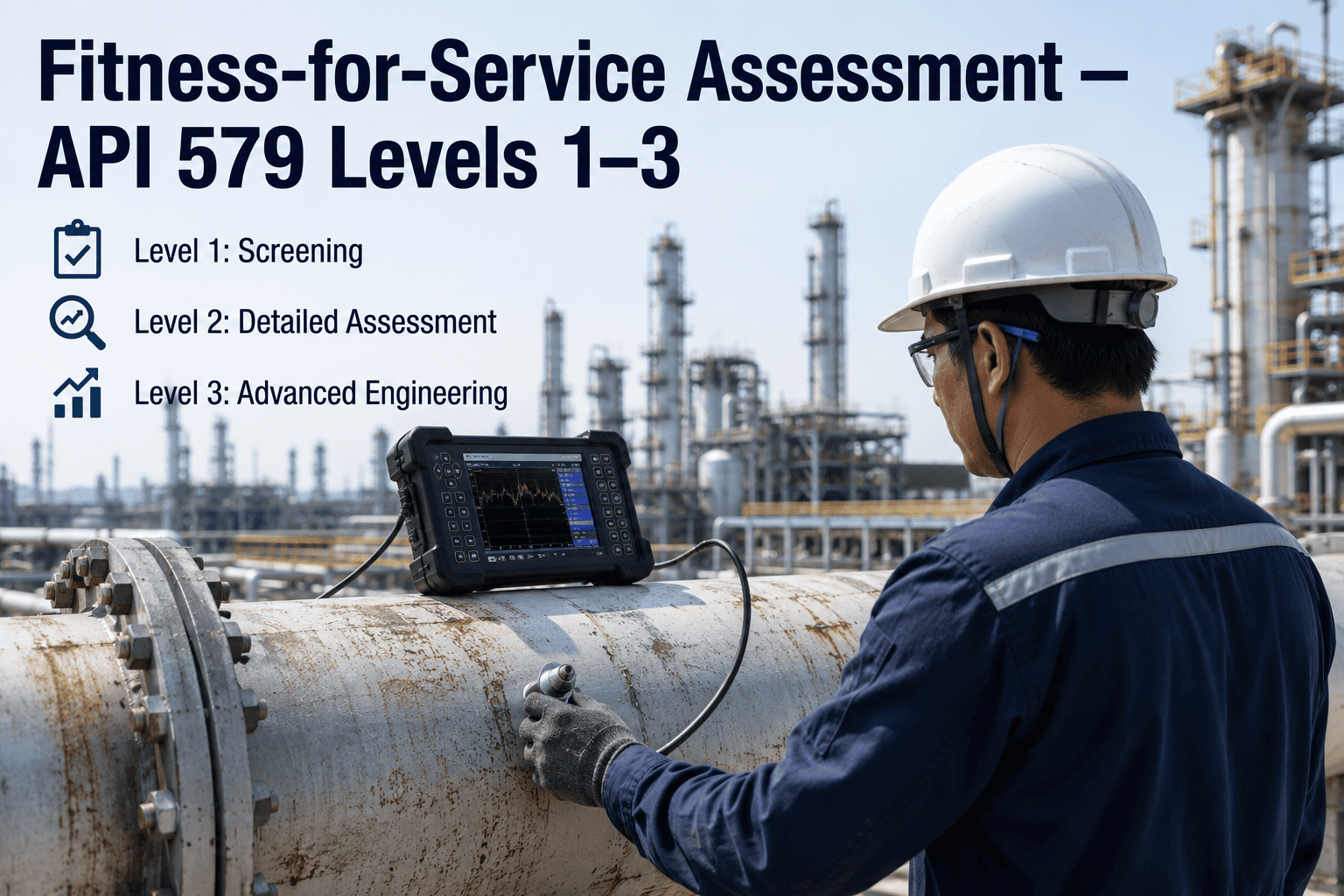
API 579-1/ASME FFS-1 defines three levels of assessment complexity. Understanding how AI augments each level clarifies why AI-native FFS programs deliver outcomes that traditional manual assessment cannot replicate. Oil and gas teams evaluating AI augmentation for their existing FFS program can Book a Demo with iFactory for a level-specific capability comparison against their current assessment workflow.
Screening Assessment — Conservative Acceptance Criteria
Level 1 applies conservative, code-tabulated acceptance criteria requiring minimal inspection data. It is designed for screening decisions — accepting equipment without detailed analysis or flagging it for higher-level assessment. AI accelerates Level 1 by automatically ingesting inspection measurements, applying API 579 screening criteria in real time, and routing to Level 2 or 3 when screening limits are exceeded — replacing manual spreadsheet workflows with sub-second automated decisions.
Detailed Assessment — Equipment-Specific Engineering Calculations
Level 2 applies more detailed engineering calculations using actual equipment geometry, material properties, and inspection data. It produces a remaining useful life projection and remaining corrosion allowance calculation specific to the assessed component. AI automates Level 2 calculation workflows — continuously updating RUL projections as new UT thickness measurements, temperature excursion records, and process chemistry data stream in, without requiring manual engineering recalculation after each inspection event.
Advanced Assessment — Finite Element Analysis and Fracture Mechanics
Level 3 applies advanced engineering analysis — finite element modeling, fracture mechanics, creep damage assessment — for equipment that exceeds Level 2 limits or carries high consequence of failure. AI supports Level 3 by generating physics-informed damage models that incorporate real-time operating parameters, enabling engineers to run scenario analyses across multiple operating condition assumptions and identify the precise conditions under which continued service remains viable.
Damage Mechanisms Addressed by AI-Native FFS in Oil and Gas Plants
Fitness for service AI oil gas programs are most valuable where damage mechanism identification and rate prediction are the key engineering challenges. Static corrosion tables and periodic inspection cycles cannot keep pace with the actual degradation trajectories of assets operating in complex, variable process environments. AI damage mechanism models trained on real plant data address this gap with asset-specific accuracy that industry-table estimates cannot match.
General and Local Metal Loss
AI models correlate actual process chemistry, temperature, and flow velocity data to generate asset-specific corrosion rate predictions — replacing conservative industry-table estimates with measured degradation trajectories that update continuously as operating conditions change.
Wet H₂S, HIC, and SCC Damage
Hydrogen-induced cracking, stress corrosion cracking, and wet H₂S damage are driven by process chemistry conditions that AI monitors continuously — flagging when process environments cross into damage-initiating regimes before inspection-detectable crack growth begins.
High-Temperature Creep Damage
Fired heater tubes, reformer piping, and high-temperature process equipment accumulate creep damage as a function of time at temperature. AI tube metal temperature modeling identifies segments approaching creep damage thresholds weeks before they reach critical limits — a failure mode periodic thermography misses between inspection intervals.
Fatigue, Dents, and Weld Defects
Cyclic loading, mechanical impact damage, and weld anomalies are assessed under API 579 Parts 12 and 9. AI integrates vibration monitoring, pressure cycling history, and ILI tool data to continuously update fatigue damage accumulation calculations without requiring manual engineering intervention after each data collection event.
Traditional FFS vs. AI-Native FFS: The Performance Gap That Determines Asset Decisions
The difference between traditional periodic FFS assessment and AI-native continuous FFS intelligence is not a marginal improvement in calculation speed. It is a fundamental change in what information is available at the moment an asset decision must be made — and whether that decision is proactive or reactive. Reliability teams evaluating whether to augment their existing FFS program with AI who Book a Demo with iFactory consistently identify high-consequence degradation pathways their current assessment program had missed entirely.
| Assessment Dimension | Traditional Periodic FFS | iFactory AI-Native FFS | Performance Gap |
|---|---|---|---|
| RUL Calculation Frequency | At turnaround events only (1–4 yr) | Continuous; updated with every data point | Always-current projection |
| Corrosion Rate Source | Industry tables / design estimates | Measured from actual process chemistry data | Asset-specific accuracy |
| Damage Mechanism Detection | Post-inspection finding review | Continuous process chemistry monitoring | Pre-initiation detection |
| API 579 Calculation Workflow | Manual engineering spreadsheets | Automated from live inspection data inputs | Instant post-inspection update |
| Inspection Interval Basis | Fixed calendar; conservative assumptions | Dynamic; actual degradation rate and risk | Risk-calibrated intervals |
| CMMS Work Order Integration | Manual entry after engineering review | Auto-generated from AI health score alerts | 100% traceability per WO |
| Regulatory Compliance Records | Manual assembly for each audit | Automated; continuously audit-ready | Zero documentation gaps |
Key Asset Classes Where AI-FFS Delivers the Highest ROI
Not every asset class carries the same consequence of failure or benefits equally from AI-native FFS intelligence. The equipment categories below represent the highest-value applications of AI-driven fitness for service in upstream, midstream, and downstream oil and gas operations.
Separators, Reactors, and Absorbers
Physics-informed AI models correlate process chemistry, operating temperature, and material properties to generate vessel-specific corrosion rate predictions. Automated FFS per API 579 calculates retirement date projections updated with every UT thickness measurement — replacing conservative design-table estimates with measured degradation trajectories.
Transmission, Distribution, and Process Piping Circuits
AI corrosion rate models process water chemistry, soil conditions, and cathodic protection data to generate segment-specific wall thinning projections. Internal corrosion monitoring integrates with ILI tool data to maintain continuously updated FFS status across pipeline network assets — enabling interval optimization that reduces ILI program cost by 30–50%.
Shell and Tube, Air Fin Coolers, and Plate Exchangers
Continuous monitoring of fouling factor trends, pressure drop, and thermal efficiency identifies tube bundle degradation months before it causes process temperature excursions or unplanned cleaning events. AI FFS models predict tube failure probability from actual service data rather than conservative design assumptions that ignore operating variability.
Crude Heaters, Reformer Furnaces, and Reboilers
AI tube metal temperature modeling identifies tube segments approaching creep damage thresholds weeks before they reach critical limits. Burner performance monitoring detects flame impingement patterns that accelerate localized tube degradation — a failure mode periodic thermography misses between inspection intervals and that FFS assessments historically underestimate without continuous operating data.
Expert Perspective: Why AI Changes the FFS Decision From Event-Driven to Continuous
The fundamental problem with traditional FFS is that it gives you the right answer at the wrong time. You do the assessment, get a remaining life projection, and then the plant runs for another 18 months under conditions that were nothing like the assumptions in that assessment — different feed chemistry, higher temperatures during peak demand, more aggressive service than the design basis anticipated. By the time the next turnaround confirms the corrosion rate accelerated, you've lost the intervention window. AI changes this by making the FFS calculation a living document — updated every time an inspection reading comes in, every time process chemistry shifts. The engineers still make the decisions. But now they're making them with current data, not 18-month-old data.
Conclusion: From Point-in-Time Assessment to Continuous Structural Integrity Intelligence
Fitness-for-Service assessment has always been the right engineering methodology for managing aging oil and gas assets. What has changed in 2025 is that AI has made it possible to perform FFS continuously — updating remaining useful life projections in real time, automating API 579 calculation workflows from live data inputs, and integrating structural integrity intelligence directly into the CMMS and inspection program without adding engineering headcount.
The facilities that invest in AI-native FFS programs today are building a structural integrity data infrastructure that generates increasingly precise failure predictions, increasingly optimized inspection intervals, and increasingly accurate capital planning support as each production cycle adds to the training dataset. For oil and gas operators managing aging assets under tightening margins and increasing regulatory scrutiny of mechanical integrity programs, the decision to move from periodic FFS events to AI-driven continuous intelligence is not a question of whether — it is a question of how fast. Teams ready to assess the fit between iFactory's AI platform and their specific FFS program are encouraged to Book a Demo with iFactory's oil and gas engineering team this week.
Frequently Asked Questions: Fitness-for-Service AI in Oil and Gas
What is Fitness-for-Service assessment in oil and gas?
FFS is a structured, code-based engineering evaluation per API 579-1/ASME FFS-1 that determines whether equipment with flaws or corrosion can continue operating safely — enabling repair, rerate, or continued service decisions instead of automatic replacement.
How does AI improve the accuracy of FFS remaining useful life calculations?
AI replaces conservative industry-table corrosion rates with asset-specific rates measured from actual process chemistry and sensor data — continuously updating RUL projections rather than recalculating only at turnaround events.
Does iFactory's AI FFS platform integrate with existing CMMS systems like SAP PM or IBM Maximo?
Yes — iFactory connects bidirectionally to SAP PM, IBM Maximo, and Infor EAM via standard APIs, automatically generating predictive work orders from AI health score alerts and returning completion data to close the model training feedback loop.
How long does it take to deploy an AI-native FFS program in an oil and gas facility?
A phased deployment covering data foundation, predictive model activation, and CMMS integration typically spans 6–12 weeks for initial go-live on priority equipment classes, with full facility coverage completed within 6–12 months.
What is the typical ROI timeline for AI fitness-for-service in oil and gas operations?
Most facilities realize initial ROI within 6–12 months through avoided unplanned downtime and inspection resource optimization, with full program ROI documented within 12–18 months as model accuracy improves and turnaround scope savings are realized at the first planned shutdown.
Ready to Move From Periodic FFS Events to Continuous Structural Integrity Intelligence?
iFactory's AI platform automates API 579-1/ASME FFS-1 workflows from real-time inspection and sensor data — so your next asset decision is backed by current structural integrity intelligence, not an 18-month-old assessment. Available on-prem or cloud, live in 6–12 weeks.
-rollout.png)