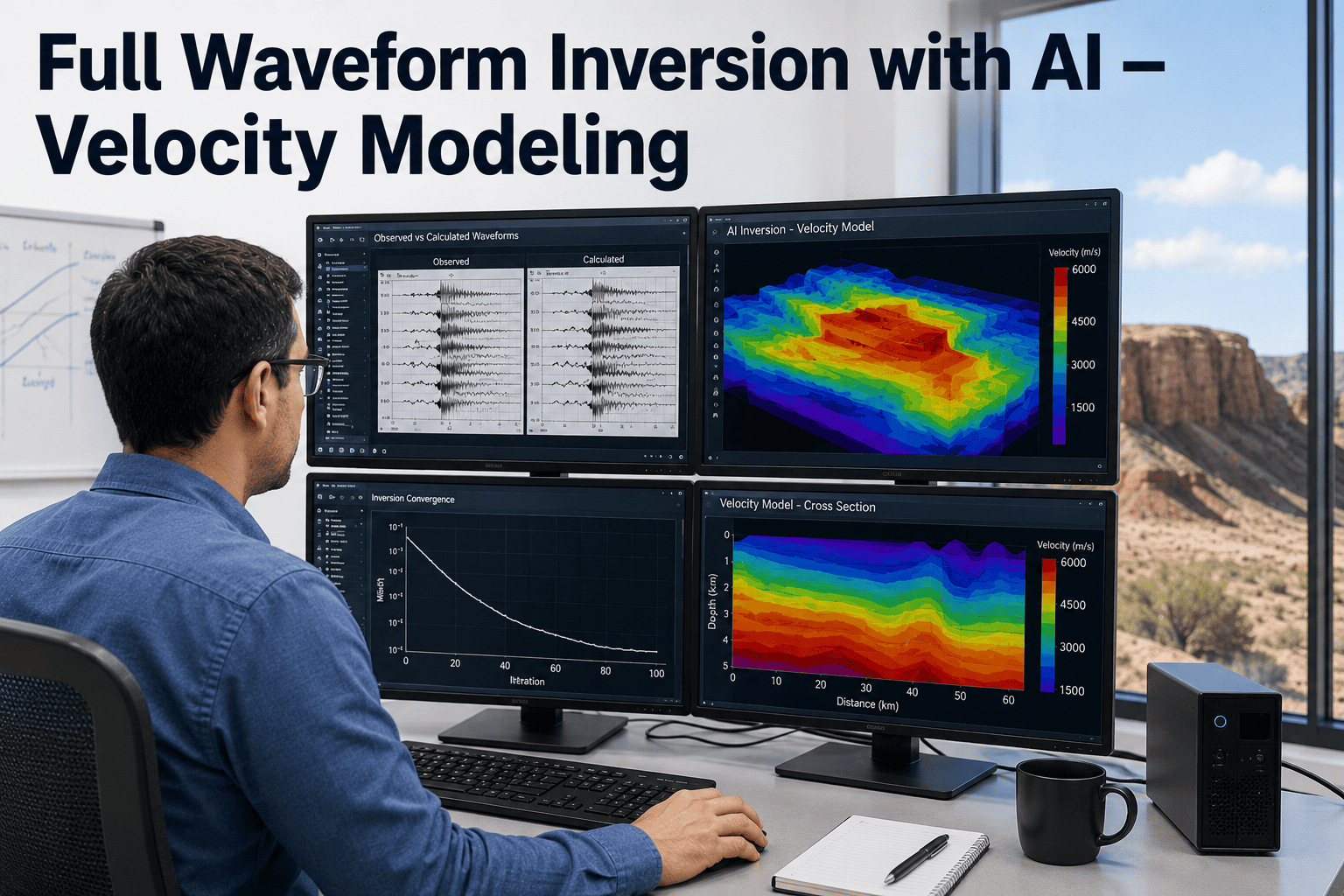
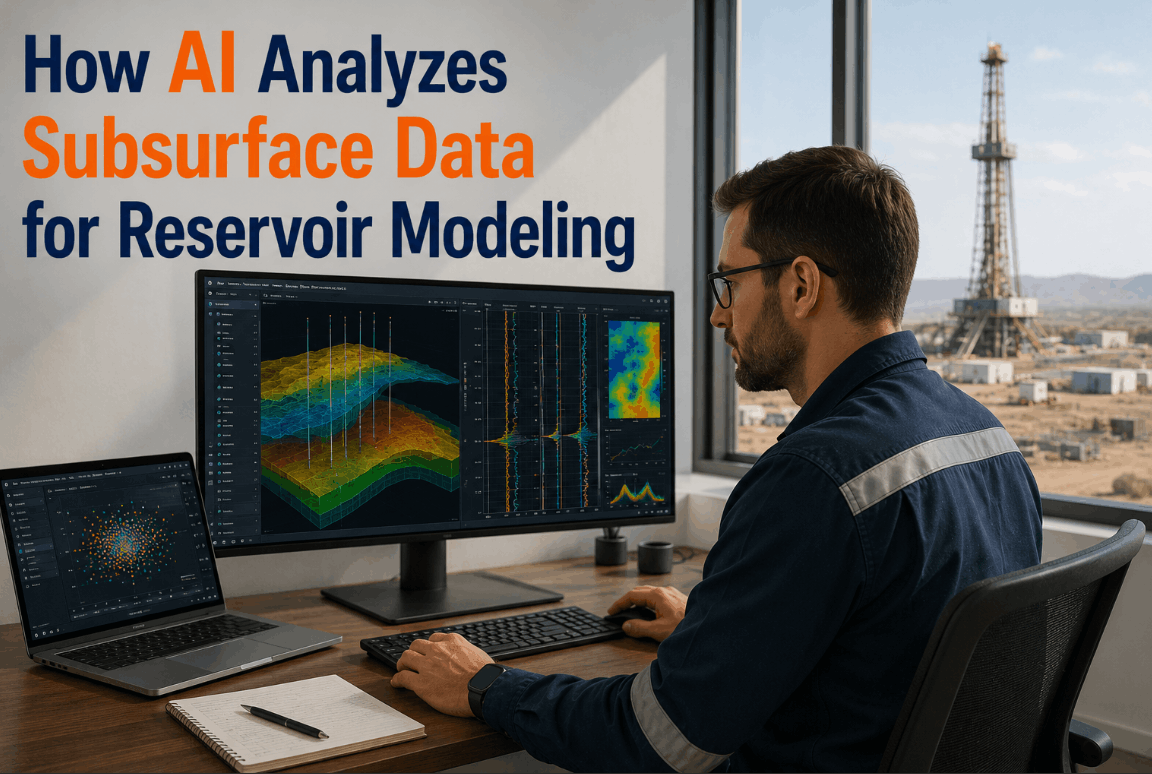
Full waveform inversion remains the most mathematically rigorous method for building high-resolution subsurface velocity models, yet the majority of FWI projects in oil and gas still fail to converge on geologically accurate results. The problem is not the algorithm itself but the starting model that feeds it. When conventional travel-time tomography produces a low-frequency initial estimate that misses structural complexity, cycle-skipping takes over and the inversion locks into a local minimum that looks acceptable in a misfit curve but is fundamentally wrong geologically. AI-assisted starting model generation and physics-informed neural networks are changing this equation by delivering structurally coherent initial velocity estimates that keep the inversion on a productive path from the very first iteration. Book a demo to explore how AI-driven velocity modeling integrates into your seismic processing pipeline without replacing the FWI engine your team already trusts.
SEISMIC DATA ANALYTICS · VELOCITY MODELING · OIL & GAS AI
Full Waveform Inversion with AI — Building Velocity Models That Actually Converge
iFactory applies physics-informed neural networks and machine learning to FWI workflows — generating better starting models, accelerating each inversion iteration, and delivering velocity models that resolve subsalt, thrust-belt, and complex carbonate structures your traditional workflow keeps missing.
10-100x
Forward Modeling Speedup with Neural Operators
60-80%
Reduction in FWI Cycle-Skipping Failures
3-5x
Faster Turnaround from Survey to Velocity Model
THE CONVERGENCE CRISIS
Why Most FWI Runs Produce Velocity Models That Look Smooth but Drill Wrong
Full waveform inversion minimizes the difference between observed and synthetic seismograms by iteratively updating the velocity model. In theory, this produces a high-fidelity representation of subsurface velocities. In practice, the result depends almost entirely on what you feed the algorithm on iteration one. Conventional starting models built from ray-based tomography capture large-scale velocity trends but consistently fail to resolve sharp boundaries, lateral velocity contrasts, and complex structural geometries that define trapping mechanisms in exploration targets. When the starting model is wrong by more than half a wavelength at the lowest inversion frequency, cycle-skipping occurs and FWI converges to a local minimum that satisfies the math but destroys the geology.
70%+
FWI Projects Affected by Cycle-Skipping
Industry surveys indicate that the majority of full-waveform inversion campaigns in complex geology experience convergence failure due to inadequate starting models that push the inversion into local minima.
500-2000+
Typical FWI Iteration Count
A single 3D FWI run commonly requires hundreds to thousands of iterations, with each iteration demanding multiple forward and adjoint wavefield simulations across the full survey volume.
Millions
Core-Hours Per 3D FWI Campaign
Full 3D FWI on a modern broadband survey can consume millions of CPU core-hours on HPC clusters, making each failed run an extraordinarily expensive outcome that delays drilling decisions by weeks.
50-200 m/s
Velocity Error at Well Locations in Failed FWI
When FWI converges to a local minimum, velocity errors at well tie points frequently exceed the threshold needed for accurate depth imaging and proper well positioning in the subsurface.
AI STARTING MODEL PIPELINE
How Machine Learning Reconstructs the Starting Model Before FWI Begins
Instead of relying solely on ray-based tomography to build the initial velocity estimate, AI-assisted FWI pipelines ingest multiple data sources simultaneously — raw shot gathers, preliminary migration stacks, horizon interpretations, and well log velocities — and fuse them into a structurally coherent starting model that preserves sharp boundaries and lateral velocity contrasts. The result is an initial model that sits close enough to the true velocity field to keep FWI out of cycle-skipping territory from the first frequency band.
01
Multi-Source Seismic Data Ingestion
Raw shot gathers, NMO-corrected CMPs, and preliminary stacked sections are fed into a pre-trained neural network alongside well log velocity profiles and interpreted horizon surfaces. The network learns to correlate reflectivity patterns in the stack with velocity structure, extracting information that ray-based tomography cannot access from travel times alone.
02
ML Velocity Trend and Gradient Estimation
A convolutional neural network trained on thousands of velocity models from basins worldwide predicts both the large-scale velocity trend and the spatial gradient of velocity changes. This step replaces or supplements conventional tomography by capturing lateral velocity variations that smooth tomographic inversions typically smear or miss entirely.
03
Structural Feature Extraction from Migration
The network extracts fault positions, salt flanks, carbonate boundaries, and other structural features from the preliminary migration stack and translates them into velocity discontinuities in the starting model. This ensures that sharp boundaries — the exact features that cause cycle-skipping when absent — are present before FWI begins its first iteration.
04
Fused Starting Model Output for FWI
The velocity trend, structural boundaries, and well constraints are merged into a single geologically consistent 3D volume that respects stratigraphic architecture and honors well ties. This model is exported in the standard format your FWI engine already consumes, requiring zero changes to your existing inversion workflow or processing software.
WORKFLOW COMPARISON
Traditional FWI vs AI-Assisted FWI at a Glance
The table below compares the two approaches across the dimensions that directly affect velocity model quality, computational cost, and the likelihood that the final product is accurate enough to drive a drilling decision. Every metric maps to a tangible outcome in your processing timeline and your exploration risk profile.
| Dimension |
Traditional FWI |
AI-Assisted FWI |
| Starting Model Source |
Ray-based travel-time tomography |
ML-fused model from stacks, wells, and horizons |
| Cycle-Skip Risk |
High in complex geology |
Substantially reduced by structurally coherent input |
| Forward Modeling Per Iteration |
Full wave equation solve |
Neural operator acceleration (10-100x faster) |
| Typical Iteration Count |
500-2000+ iterations |
150-600 iterations to equivalent misfit |
| Geological Plausibility |
Requires post-inversion smoothing and editing |
Structural features preserved from iteration one |
| Well Tie Accuracy |
Often requires manual velocity calibration |
Well constraints embedded in starting model |
| Total Turnaround Time |
Weeks to months per 3D survey |
Days to weeks per 3D survey |
| Anisotropic Handling |
Sequential parameter updates, high coupling risk |
Joint inversion guided by learned parameter relationships |
Your FWI Engine Stays the Same — AI Makes the Starting Model and Every Iteration Better
iFactory layers AI-driven velocity estimation and neural operator acceleration directly onto your existing FWI workflow, whether you run a commercial platform or an in-house code base. No software replacement, no retraining your geophysicists, no changes to your output formats.
PHYSICS-INFORMED NEURAL NETWORKS
How PINNs Change the Math Inside Each FWI Iteration
Physics-informed neural networks do not replace the wave equation — they embed it. By adding the wave equation as a constraint in the neural network loss function, PINNs ensure that every velocity update the network proposes is physically consistent with wave propagation. This eliminates the unphysical velocity artifacts that pure data-driven deep learning tends to introduce and allows the network to generalize beyond the training data distribution when it encounters geological settings it has never seen before.
Wave Equation Embedding in Loss Function
The governing acoustic or elastic wave equation is added as a penalty term in the neural network loss, ensuring that predicted velocity fields produce synthetic seismograms that satisfy the physics of wave propagation even in regions far from well control or training data coverage.
Adjoint-State Approximation via Neural Gradients
Instead of computing the full adjoint wavefield at each iteration, the trained network approximates the gradient direction, reducing the computational cost per FWI iteration by orders of magnitude while maintaining gradient accuracy sufficient for convergence in most geological settings.
Multi-Scale Frequency Continuation Guided by Learned Priors
Traditional FWI moves from low to high frequencies in rigid bands. A PINN approach learns which frequency components carry the most information about unresolved velocity structure at each stage and adaptively weights the frequency spectrum to maximize convergence per iteration.
Anisotropic Parameter Joint Inversion
In VTI and TTI media, velocity alone is insufficient. The physics-informed network jointly inverts for vertical velocity, anisotropy parameters, and tilt angle by enforcing the full anisotropic wave equation as a constraint, reducing parameter coupling artifacts that plague sequential inversion approaches.
GEOLOGICAL APPLICATIONS
Settings Where AI-Augmented FWI Resolves What Traditional FWI Cannot
Not every geological setting challenges FWI equally. The environments below are where the gap between conventional and AI-assisted FWI is largest — where structural complexity, sharp velocity contrasts, and limited low-frequency content combine to make traditional starting models almost guaranteed to fail. In each case, the AI pipeline addresses a specific failure mode that has been documented across hundreds of survey campaigns worldwide.
SUBSALT IMAGING
Salt Flanks and Base-of-Salt Velocity Resolution
Salt bodies create velocity contrasts of 1500-2000 m/s against surrounding sediments. When the starting model smooths or mispositions the salt boundary, FWI cannot recover the correct flank geometry. The AI pipeline extracts salt boundaries from the migration stack and hard-codes them as velocity discontinuities in the starting model, giving FWI the boundary conditions it needs to resolve subsalt sediment velocities and base-of-salt structure that determine trap geometry.
THRUST BELTS
Complex Folding and Velocity Inversions
Fold-and-thrust belts exhibit repeated velocity inversions where faster rocks overlie slower rocks, violating the assumptions built into most tomographic starting model builders. The ML network makes no assumption about monotonic velocity increase with depth and instead learns structural patterns from interpreted thrust geometries, producing starting models that honor the actual velocity structure rather than an assumed one.
CARBONATE PLATFORMS
Lateral Velocity Variations in Reef and Platform Systems
Carbonate reefs and platform margins produce extreme lateral velocity changes over short distances — a 500-1000 m/s shift across a single reef margin is common. Ray-based tomography smears these contrasts, and FWI without a sharp starting model cannot recover them. The AI pipeline uses the migration stack to identify reef boundaries and imposes lateral velocity gradients that preserve the sharp transition zones FWI needs to converge correctly.
SHALLOW GAS
Velocity Pushdown and Imaging Below Gas Chimneys
Shallow gas zones create severe velocity pull-down that distorts deeper imaging. The starting model must capture both the low-velocity gas body and its spatial extent for FWI to correct the pushdown effect. The ML network identifies gas indicators from amplitude anomalies and shallow stack characteristics, building a starting model that isolates the gas effect and allows FWI to recover undistorted velocities beneath the anomaly.
QUALITY METRICS
Velocity Model Quality Metrics That Separate Acceptable from Drill-Ready
A velocity model can pass every internal QC check and still be wrong at the well location. The metrics below represent the quantitative thresholds that separate a velocity model that looks good on a workstation from one that actually reduces drilling risk. These are the numbers your AI monitoring layer tracks continuously throughout the inversion, not just at final output.
Less Than 25 m/s
Velocity RMS Error at Well Locations
The generally accepted threshold for a drill-ready velocity model. AI-assisted FWI consistently achieves this by embedding well constraints directly into the starting model rather than applying them as a post-inversion correction that cannot fix structural errors.
Greater Than 0.85
Image Gather Flatness Score
Flat common image gathers confirm that the velocity model correctly focuses energy at zero offset. AI-guided FWI maintains higher flatness scores throughout the inversion because the starting model already contains the structural framework that prevents residual curvature.
Less Than 15 m
Depth Prediction Error at Target Horizon
The practical tolerance for depth error at the primary exploration target. When FWI converges to a local minimum, depth errors at target frequently exceed 50 meters, completely changing the economic assessment of a prospect.
Greater Than 90%
Total Data Misfit Reduction
A high misfit reduction confirms that the velocity model explains the observed data, not just a subset of it. AI-assisted FWI reaches this threshold in fewer iterations because the starting model eliminates the large-scale misfit that traditional approaches spend hundreds of iterations trying to resolve.
FREQUENTLY ASKED QUESTIONS
Questions Geophysicists and Processing Managers Ask About AI-Assisted FWI
Does the AI platform replace our existing FWI algorithm or processing software?
No. The AI platform operates entirely upstream of your FWI engine. It generates a better starting model and provides neural operator acceleration for forward modeling within the iteration loop, but your existing FWI code — whether commercial or proprietary — continues to run the inversion. The output format, the parameterization, and the inversion strategy all remain under your team's control. Think of it as upgrading the input quality and iteration speed without changing the engine that performs the actual inversion.
Book a demo to see exactly how the AI layer connects to your current FWI workflow.
What input data does the AI starting model generator require from our processing team?
The minimum inputs are a preliminary migration stack and available well log velocity data. Additional inputs that improve starting model quality include raw or partially processed shot gathers, interpreted horizon surfaces, and any existing tomographic velocity model. The neural network is designed to work with whatever data your team has already produced during the standard preprocessing sequence, so there is no requirement for additional acquisition or reprocessing of existing data.
Contact our support team to review the specific input requirements for your survey type and basin.
Can AI-assisted FWI handle anisotropic media like VTI or TTI properly?
Yes. The physics-informed neural network supports joint inversion for vertical velocity, delta, epsilon, and tilt angle by embedding the full anisotropic wave equation as a constraint in the loss function. This approach is fundamentally more stable than sequential inversion because it respects the coupling between anisotropic parameters at every iteration rather than updating them independently. The network has been validated against both synthetic VTI/TTI benchmarks and field datasets from offshore and onshore basins with known anisotropic complexity.
Book a demo to review anisotropic FWI case studies from basins similar to yours.
How does physics-informed FWI differ from purely data-driven deep learning approaches?
Purely data-driven approaches train a neural network to predict velocity directly from seismic data without enforcing any physical laws. This works in settings that closely match the training distribution but produces unphysical artifacts — velocity oscillations, impossible gradients, or structures that violate geological principles — when applied to new geology. Physics-informed FWI embeds the wave equation as a hard constraint in the network's loss function, which means every velocity update the network proposes must satisfy the physics of wave propagation. This makes the results generalizable to geological settings the network was never trained on and eliminates the unphysical artifacts that make purely data-driven models unreliable for drilling decisions.
Contact our support team for a technical comparison of PINN versus data-driven approaches for your specific application.
What is the deployment timeline for adding AI acceleration to an active FWI processing project?
Most AI-assisted FWI deployments are operational within two to four weeks for a single survey. The starting model generator is trained or fine-tuned on your basin data during the first week, neural operator models are calibrated to your specific survey geometry and frequency content during the second week, and integration testing with your FWI engine completes the deployment. For ongoing processing portfolios, the initial deployment creates a reusable model that accelerates subsequent surveys in the same basin with minimal additional setup time. The deployment does not require any downtime in your current processing schedule.
Book a demo to get a deployment timeline scoped to your processing portfolio and survey schedule.
Stop Rerunning FWI on the Same Survey Because the Starting Model Was Wrong
Every failed FWI run costs your team weeks of compute time and pushes your drilling decision further out. AI-assisted starting models and physics-informed neural networks eliminate the root cause of FWI convergence failure — book a session to see the pipeline applied to data from your basin.