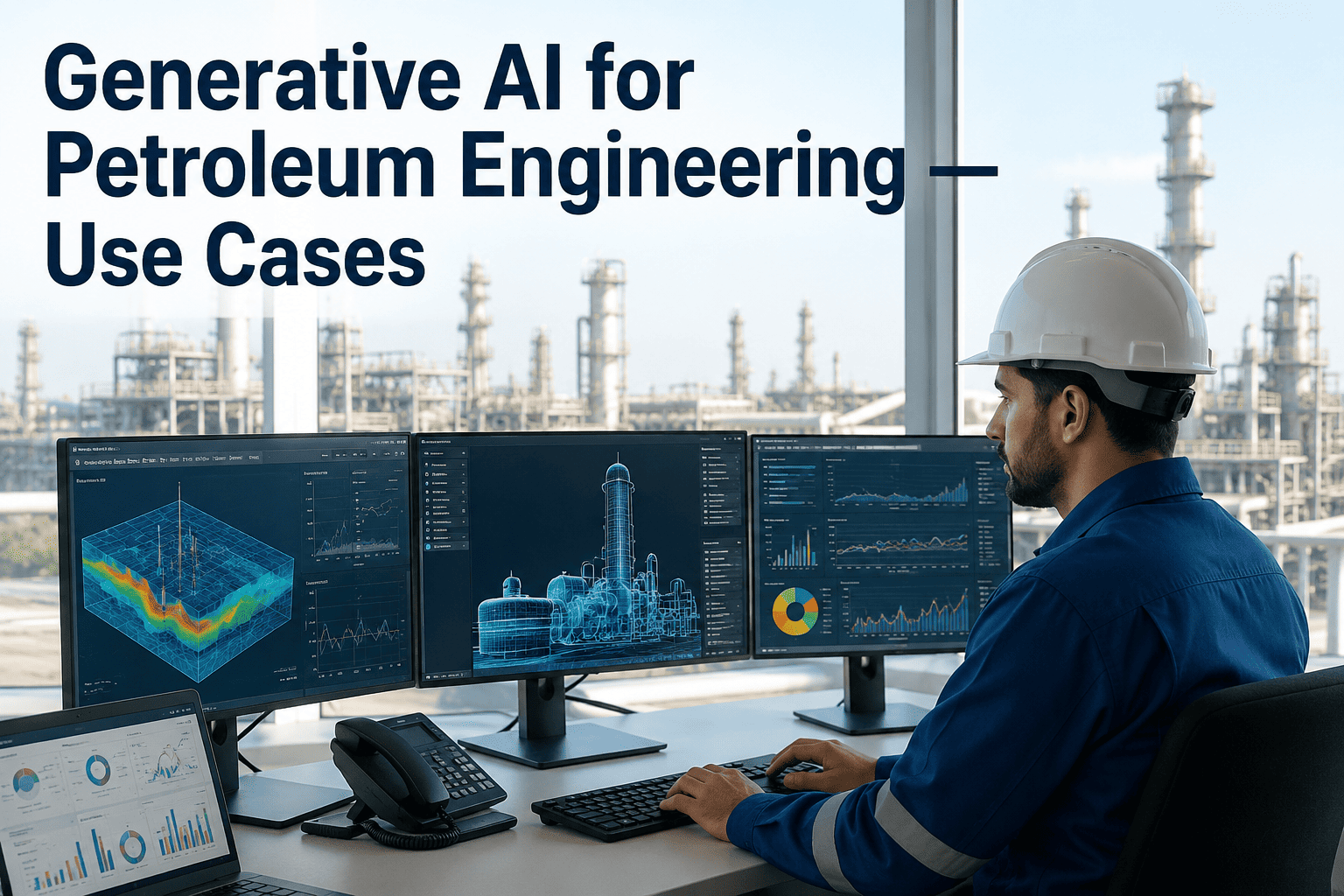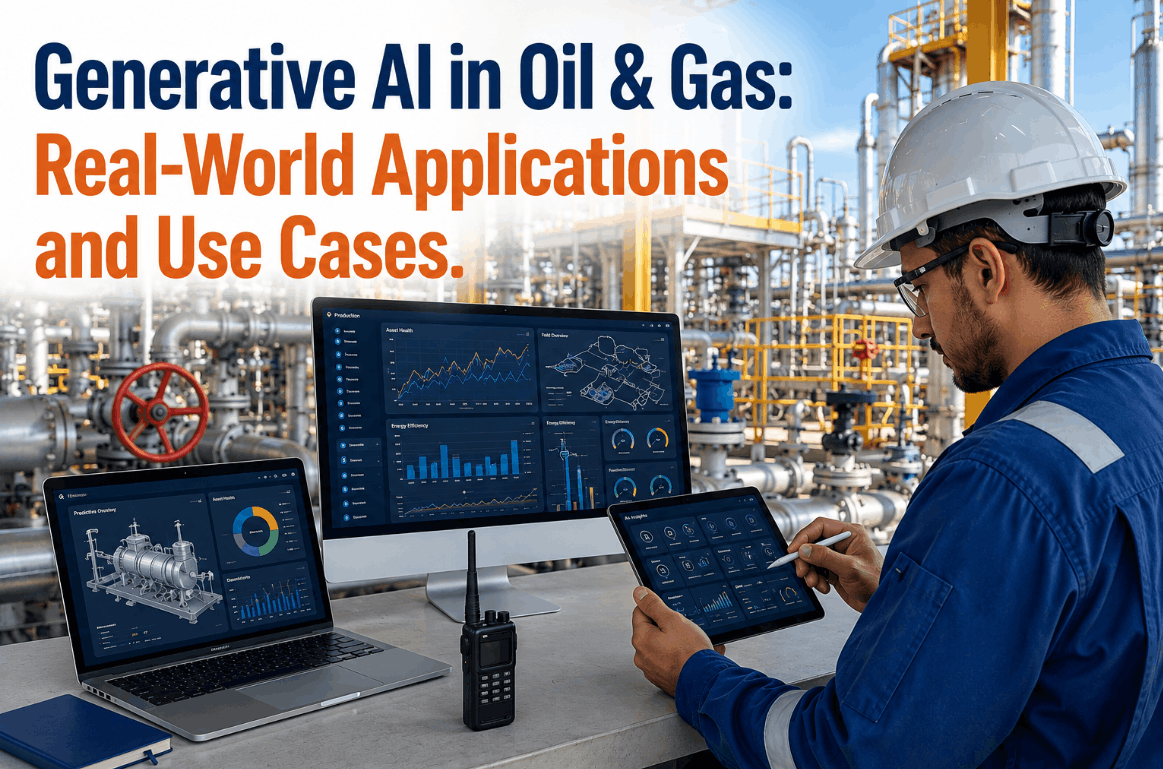
Generative AI has crossed the threshold from research curiosity to operational tool in oil and gas, and the pace of adoption in 2025 and 2026 is accelerating faster than most operations and engineering teams anticipated. Upstream geoscience teams are using large language models to synthesize thousands of well logs in minutes. Midstream operators are generating regulatory compliance packages that once required two weeks of engineering labor. Downstream refineries are deploying AI copilots that answer maintenance technicians' questions with references to the exact procedure document and equipment history. The business case is no longer theoretical — it is showing up in documented cycle time reductions, documentation cost savings, and measurable improvements in knowledge accessibility across some of the most complex industrial environments on the planet. For oil and gas operations and engineering teams evaluating where generative AI fits in their 2026 and 2027 roadmap, Book a Demo with iFactory AI to see how GenAI integrates with your existing CMMS, MES, and digital twin stack.
Deploy Generative AI Across Your Oil & Gas Operations — From Well Site to Boardroom
iFactory AI integrates generative AI with your CMMS, MES, asset data, and digital twin environment — turning your operational knowledge into a real-time AI copilot for maintenance, compliance, reporting, and field decision support.
Why Generative AI Is Gaining Serious Traction in Oil & Gas Operations
The oil and gas industry sits on one of the most data-rich — and data-inaccessible — operational environments in the world. Decades of well logs, inspection reports, maintenance histories, drilling programs, and regulatory submissions exist across fragmented systems, paper archives, and disconnected databases that even the engineers who created them struggle to search effectively. Generative AI resolves that contradiction by turning unstructured operational text into queryable, actionable knowledge — at a scale and speed no human team can replicate.
Three structural conditions are accelerating GenAI adoption specifically in oil and gas. First, the size and complexity of the document corpus in a single upstream operating company makes manual knowledge retrieval genuinely painful — and that pain has a measurable cost in engineering hours. Second, the regulatory documentation burden under OSHA PSM, EPA RMP, API standards, BSEE, and pipeline safety frameworks creates a continuous demand for high-quality technical writing that GenAI handles efficiently. Third, the accelerating retirement of experienced engineers has created a knowledge transfer problem that AI-powered knowledge management tools are specifically designed to solve. Teams ready to assess their GenAI readiness can Book a Demo with iFactory AI for a facility-specific application mapping session.
Six Generative AI Applications Delivering Value in Oil & Gas Today
Generative AI in oil and gas is not a single use case — it is a capability layer that applies across exploration, drilling, production, maintenance, safety, and regulatory functions. The six application areas below represent where documented operational value is being generated in 2025 and 2026, not where roadmap promises point.
Subsurface Intelligence & Reservoir Data Synthesis
Geoscience teams at major operators are using multimodal GenAI models to synthesize well logs, seismic interpretations, core analysis reports, and production histories into integrated reservoir summaries that previously required weeks of specialist time. Foundation models fine-tuned on subsurface data can identify stratigraphic patterns, flag anomalous pressure zones, and generate preliminary reservoir characterization reports with source citations — compressing the early-stage exploration workflow significantly.
Drilling Program Automation & Well Planning Support
LLM-based tools integrated with drilling engineering databases generate first-draft drilling programs, wellbore stability analyses, and casing design summaries by drawing from offset well histories, formation pressure databases, and geological models. Drilling engineers review, verify, and approve rather than author from scratch — shifting their time from documentation to the higher-value decisions that require judgment, not just synthesis.
Maintenance Knowledge Management & AI Copilot
GenAI copilots trained on equipment manuals, maintenance histories, P&IDs, and failure mode libraries give maintenance technicians instant access to troubleshooting guidance, spare part specifications, and repair procedure steps — without requiring them to search across disconnected document repositories. Integrated with CMMS platforms, these copilots can also auto-populate work order descriptions from technician voice input and recommend maintenance tasks based on equipment health trends. Operations teams ready to evaluate this application can Book a Demo with iFactory AI to see how the maintenance copilot integrates with your existing CMMS environment.
Safety & Incident Report Automation
Incident investigation reports, near-miss documentation, job hazard analyses, and permit-to-work packages are among the highest-volume technical writing tasks in oil and gas operations. GenAI models generate structured first drafts from operator field notes, sensor event logs, and incident classification data — reducing the time from event to documented report while improving structural consistency across sites and increasing the likelihood that root cause data is captured accurately in the CMMS for future failure analysis.
Regulatory Compliance Documentation & Audit Preparation
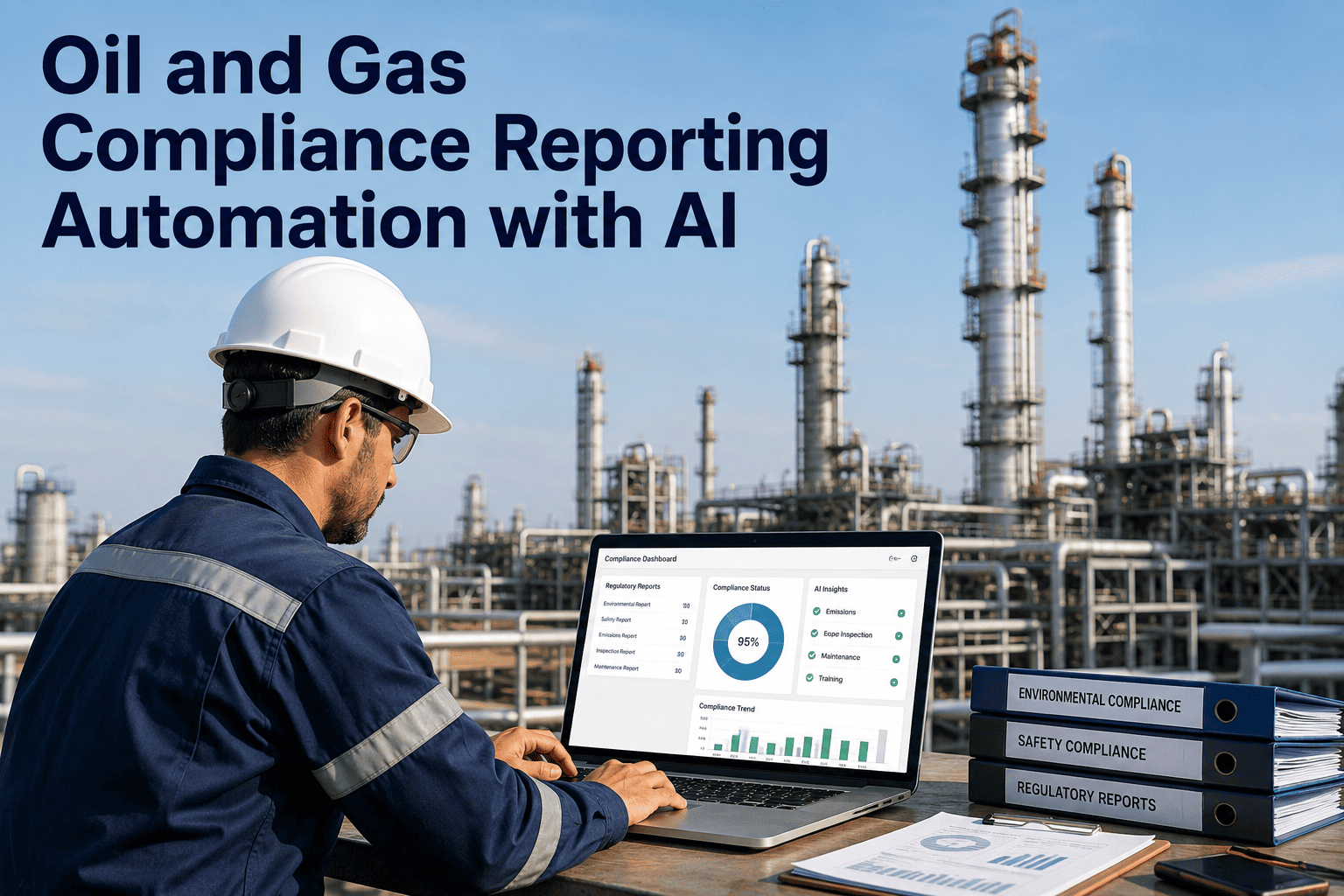
The documentation burden under OSHA PSM, EPA RMP, API 580/581, BSEE Subpart S, and pipeline integrity management regulations creates a continuous demand for technical writing that is simultaneously precise, audit-ready, and aligned with frequently updated regulatory language. GenAI tools trained on regulatory frameworks and facility-specific operating data generate compliance packages, inspection interval justifications, management of change documentation, and audit preparation summaries at a fraction of the engineering labor previously required.
Production Reporting & Operational Narrative Generation
Daily production reports, shift handover summaries, equipment performance narratives, and KPI commentary are repetitive high-volume writing tasks consuming engineering time that could be applied to analysis and decision-making. GenAI systems connected to process historian data, SCADA outputs, and CMMS work order logs auto-generate production reports with contextual commentary on variances — delivering management-ready operational narratives from raw operational data in seconds rather than hours.
Generative AI Use Cases Across the Oil & Gas Value Chain
The right GenAI application depends on where your organization carries the greatest operational friction. This matrix maps the primary use cases against value chain segment, primary users, and documented efficiency gains.
| Use Case | Value Chain Segment | Primary Users | Efficiency Gain | Integration Point |
|---|---|---|---|---|
| Reservoir Data Synthesis | Upstream / Exploration | Geoscientists, Reservoir Engineers | 30–40% cycle time reduction | Subsurface data platforms, G&G databases |
| Drilling Program Generation | Upstream / Drilling | Drilling Engineers, Well Planners | 50–60% faster first-draft creation | Offset well databases, formation data |
| Maintenance AI Copilot | All Segments | Maintenance Technicians, Reliability Engineers | 60% queries resolved without escalation | CMMS, equipment manuals, P&IDs |
| Incident Report Automation | All Segments | HSE Supervisors, Operations Teams | 70% faster report completion | CMMS, EHS systems, sensor logs |
| Compliance Documentation | Midstream / Downstream | Integrity Engineers, Regulatory Teams | 65–70% labor reduction per package | APM, CMMS, regulatory frameworks |
| Production Report Generation | Upstream / Midstream | Production Engineers, Operations Managers | Reports from hours to minutes | SCADA, process historian, MES |
Verified Generative AI Deployments in Oil & Gas Operations
The credible signal in generative AI for oil and gas is not analyst forecasts — it is documented operational outcomes from operators who have moved beyond pilots into production deployment. The examples below represent verified programs producing measurable results in 2025 and 2026.
Shell — Subsurface AI Knowledge Platform
Shell deployed a GenAI-powered subsurface knowledge platform that indexes and synthesizes well logs, drilling reports, and reservoir models across its global asset portfolio. Geoscientists query the platform in natural language to retrieve cross-asset insights that previously required multi-week data extraction projects, reducing exploration interpretation cycle times by approximately 40%.
Upstream ExplorationBP — Maintenance Knowledge Management LLM
BP implemented an LLM-based maintenance knowledge management system that gives field technicians instant retrieval of equipment manuals, historical failure data, and repair procedures across its upstream and downstream facilities. The system reduced time-to-information for maintenance queries from hours to under two minutes, improving first-time fix rates across critical rotating equipment.
Maintenance OperationsChevron — AI-Assisted Regulatory Documentation
Chevron's engineering and compliance teams piloted GenAI tools for OSHA PSM management of change documentation and API 580-aligned inspection interval justifications. The program reduced engineering authoring time per compliance package by 65%, with peer review confirming that AI-generated drafts required fewer revision cycles than manual submissions on average.
Regulatory ComplianceTotalEnergies — Production Report Automation
TotalEnergies integrated GenAI with its process historian and SCADA systems to auto-generate daily production reports and shift handover summaries across multiple upstream assets. Production engineers report that automated reports now require less than 15 minutes of review versus the 2.5 hours previously spent authoring them — effectively converting a daily documentation burden into a review-and-approve workflow.
Production OperationsFive-Phase Generative AI Deployment Roadmap for Oil & Gas Teams
Successful generative AI deployment in oil and gas follows a disciplined sequence. Teams that attempt to deploy an AI copilot without first establishing a clean, indexed knowledge foundation consistently produce low-confidence outputs that erode trust faster than they build it. The phased roadmap below reflects what actually works across upstream, midstream, and downstream environments.
Document Intelligence Foundation
Audit, index, and structure your core document corpus — equipment manuals, P&IDs, inspection records, drilling reports, maintenance histories, and regulatory submissions. GenAI quality is entirely dependent on the quality and completeness of the knowledge base it draws from. Ungoverned document repositories produce unreliable AI outputs.
Retrieval-Augmented Generation (RAG) Deployment
Deploy a retrieval-augmented generation architecture that grounds GenAI responses in your actual facility documents rather than general training data. RAG is the architectural standard for oil and gas GenAI because it enables cited, auditable answers tied to specific source documents — a non-negotiable requirement for safety-critical and regulatory applications.
Operations Copilot & Report Automation Activation
Activate the maintenance AI copilot and production report automation workflows. Integrate GenAI with CMMS for work order auto-population, with SCADA and process historian for report generation, and with EHS systems for incident documentation. Measure first-use adoption and output quality against human-authored baselines during this phase.
Compliance Documentation & Regulatory Automation
Extend GenAI into the highest-complexity documentation workflows — PSM management of change packages, API RBI justifications, pipeline integrity management program updates, and BSEE compliance submissions. Fine-tune model outputs against your specific regulatory framework and internal quality review standards before full deployment.
Continuous Learning & Enterprise-Wide Scaling
Close the feedback loop — corrected AI outputs and validated documents are returned to the training pipeline, improving model accuracy over time. Expand to additional asset classes, geographic sites, and functional departments using the governance and integration architecture established in earlier phases. GenAI ROI compounds as the knowledge base grows and user adoption drives continuous model improvement.
Map Your Oil & Gas GenAI Applications With iFactory AI
Our team will assess your document infrastructure, CMMS integration requirements, and regulatory workflow priorities to design a generative AI deployment roadmap tailored to your specific operational environment.
2026 Generative AI Performance Benchmarks for Oil & Gas Operations
Documented performance ranges from generative AI systems operating in oil and gas environments across the primary application categories active in 2025 and 2026.
How iFactory AI Brings Generative AI Into Your Oil & Gas Operations Stack
A generative AI model disconnected from your operational systems is a search engine. Connected to your CMMS, MES, asset performance data, and digital twin, it becomes an operations intelligence layer that augments every engineering and maintenance decision in your organization. iFactory AI is purpose-built for that integration — delivering generative AI capabilities inside the same platform that already orchestrates your predictive maintenance, AI vision, and digital twin workflows.
CMMS-Integrated Knowledge Copilot
GenAI trained on your equipment manuals, maintenance histories, and failure mode databases answers technician queries, auto-populates work order descriptions, and surfaces relevant repair procedures — directly inside your CMMS workflow without switching applications.
Asset Data Narrative Generation
iFactory's digital twin feeds live asset health data into the GenAI layer, enabling automated equipment performance summaries, anomaly narrative reports, and health score trend explanations — turning telemetry numbers into actionable written intelligence for engineering teams.
Regulatory Document Automation
GenAI connected to iFactory's RBI and inspection data generates API 580/581 inspection interval justifications, OSHA PSM compliance narratives, and audit preparation packages — with every claim traceable back to the source inspection record or operating parameter that supports it.
Incident & Safety Document Generation
Safety events logged in iFactory's EHS module trigger GenAI-assisted report drafting, pulling sensor event data, equipment history, and work order context into structured incident reports — reducing documentation time and improving root cause data capture consistency across facilities.
Production Report Automation
iFactory's MES data — production volumes, downtime causes, quality metrics, and shift events — feeds the GenAI reporting layer to auto-generate daily production reports, shift summaries, and KPI commentary packages that management can review and approve rather than manually author.
Visual Inspection Narrative Reports
AI vision camera findings — defect classifications, anomaly locations, quality gate results — are converted by the GenAI layer into structured inspection reports with actionable recommendations, creating a closed loop from visual detection to documented maintenance response without manual reporting overhead.
Expert Review — A Practitioner's Assessment of GenAI in Oil & Gas Operations
The generative AI conversation in oil and gas has matured significantly since 2023. Early deployments that treated LLMs as general-purpose chatbots on top of unstructured document repositories produced inconsistent outputs that eroded confidence faster than they built it. The 2025 and 2026 generation of oil and gas GenAI deployments is fundamentally different — it is built on retrieval-augmented generation architectures grounded in governed, facility-specific knowledge bases, integrated with operational data systems, and governed by human review workflows that keep engineers in the decision loop for safety-critical outputs.
The use cases with the clearest and fastest ROI are not the most technically impressive — they are the most repetitive. Production report generation, shift handover summaries, work order auto-population, and compliance document first drafts are high-volume tasks consuming significant engineering time that GenAI handles with measurable consistency. Operators who start with these foundational workflows, validate output quality against human baselines, and build user confidence before expanding to higher-stakes applications like regulatory submissions and drilling program generation are consistently seeing stronger adoption and better sustained ROI than programs that lead with the most complex use case. Operations teams at the evaluation stage should Book a Demo with iFactory AI to map their highest-ROI GenAI entry point before investing in architecture decisions.
Conclusion — Generative AI Is Now an Oil & Gas Competitive Advantage
The generative AI opportunity in oil and gas is large, documented, and accelerating. The operators deploying GenAI across maintenance knowledge management, production reporting, compliance documentation, and engineering copilot applications are not gaining marginal efficiency improvements — they are compressing multi-week workflows into minutes and fundamentally changing the leverage ratio of their engineering and operations teams. The gap between early adopters and late movers is widening with each deployment cycle, because GenAI systems improve as they accumulate more facility-specific operational data and validated outputs.
The common denominator in every successful oil and gas GenAI deployment is the integration layer — the connection between the AI model and the operational systems that hold your actual asset data, maintenance history, and regulatory records. General-purpose LLMs trained on public data cannot replace that connection. iFactory AI is purpose-built for exactly this integration challenge — delivering generative AI capabilities grounded in your CMMS, digital twin, MES, and asset performance data so every AI output is traceable, auditable, and operationally relevant. To assess your organization's GenAI readiness and map the highest-value entry points for your specific operational environment, Book a Demo with our solutions team.
Frequently Asked Questions — Generative AI in Oil & Gas
What is generative AI and how is it different from traditional AI in oil and gas?
Traditional AI in oil and gas predicts specific outcomes from structured data; generative AI understands and produces natural language, enabling it to synthesize documents, answer engineering queries, and generate reports from unstructured operational text — capabilities that predictive models cannot replicate.
Which generative AI application delivers the fastest ROI in oil and gas?
Production report automation and maintenance AI copilots consistently deliver the fastest measurable ROI because they address high-volume, repetitive tasks — allowing oil and gas operators to demonstrate value within 60 to 90 days of deployment without requiring complex integration architecture.
Is generative AI safe to use for regulatory compliance documentation in oil and gas?
Yes, when deployed in a retrieval-augmented generation architecture that grounds outputs in your specific regulatory data and facility documents — with human engineer review as a mandatory step before any compliance submission, which is the standard operating model in current oil and gas deployments.
How does generative AI integrate with existing CMMS and MES systems in oil and gas?
Platforms like iFactory AI connect GenAI directly to CMMS and MES via APIs, enabling work order auto-population, maintenance knowledge retrieval, and automated report generation that pulls live operational data rather than relying on static training data alone.
What data infrastructure is required before deploying generative AI in oil and gas operations?
A governed, indexed document corpus — equipment manuals, maintenance records, inspection histories, and regulatory submissions — is the minimum foundation; without it, GenAI outputs will be inconsistent and unreliable regardless of model quality or architecture.
Deploy Generative AI Across Your Oil & Gas Operations With iFactory AI
iFactory AI gives oil and gas operations and engineering teams the generative AI layer they need — grounded in your asset data, connected to your CMMS and MES, and built for the regulatory documentation demands of upstream, midstream, and downstream environments.