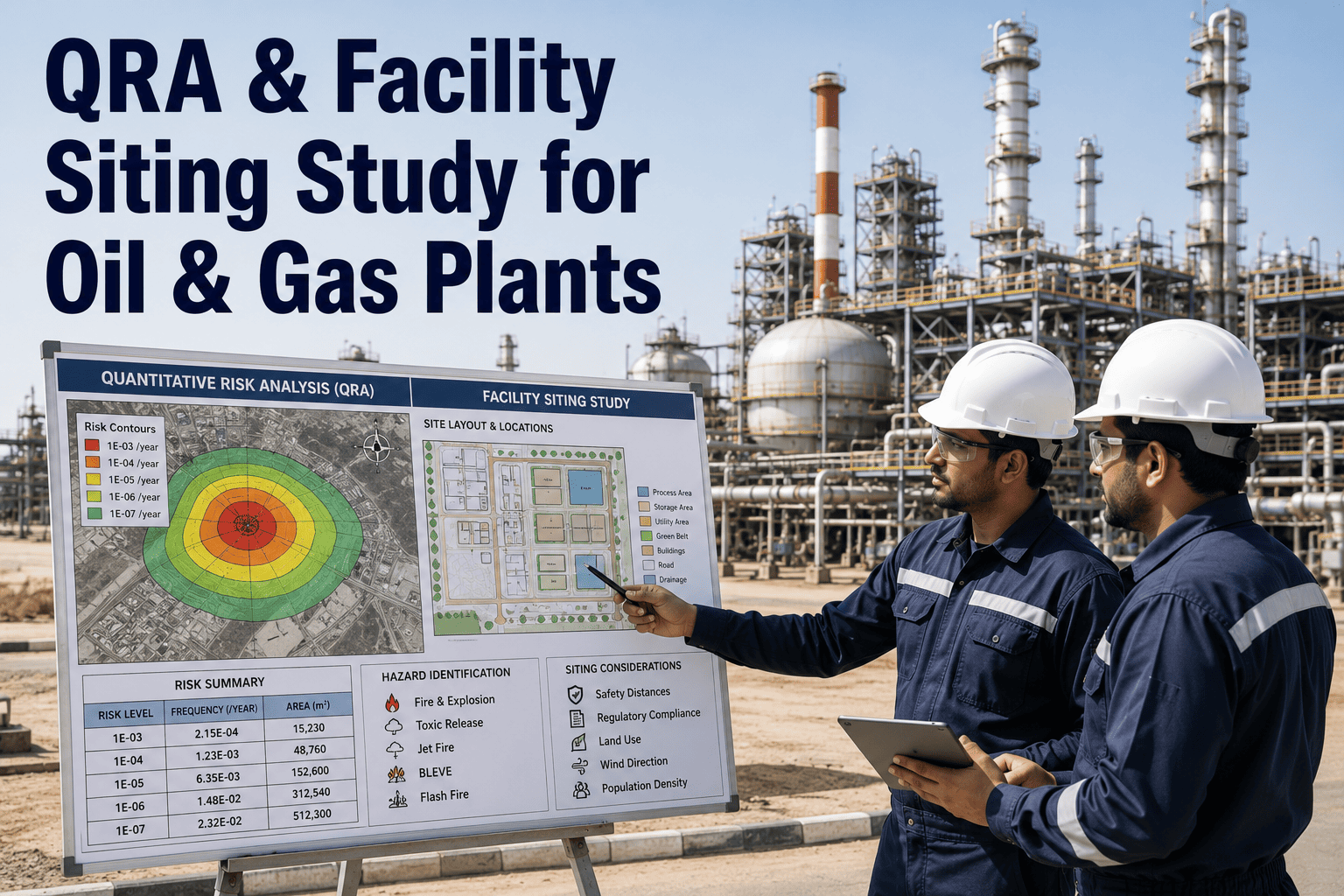
A control room built in the wrong place is not a design flaw anyone notices until the day it matters. Facility siting studies exist because occupied buildings inside a process plant sit inside blast, fire, and toxic exposure zones whether anyone has calculated the risk or not, and a quantitative risk assessment is the tool that turns that exposure into a number leadership can actually act on. Where a consequence-only study answers what could happen, QRA answers how likely it is and whether that likelihood falls inside or outside what the facility considers acceptable. Teams planning their next siting study or QRA can book a demo to see how risk data connects directly to facility layout decisions.
QUANTITATIVE RISK ASSESSMENT · API 752 / 753 · FACILITY SITING
Turn Blast, Fire, and Toxic Exposure Into a Number You Can Act On
QRA combines the frequency and consequence of every credible release scenario to show exactly which occupied buildings sit inside unacceptable risk, and what to do about it.
Two Numbers That Drive Every Siting Decision
QRA produces two core risk metrics, and confusing them is one of the most common mistakes in facility siting reviews. Individual risk answers a question about one hypothetical person; societal risk answers a question about everyone in a building or area at once. Both matter, and regulators typically require both to be presented before a building's occupancy is approved.
Individual Risk
The annual probability that a hypothetical person, continuously present at a specific location, becomes a fatality due to site hazards. Results are plotted as risk contours across the plot plan, showing exactly where risk exceeds the tolerable threshold.
Societal Risk
The frequency of events causing a given number or more of fatalities across the whole exposed population, plotted as an F-N curve. This captures the aggregate risk to groups occupying a building rather than any single individual.
API 752
Governs siting of permanent occupied buildings on process plant sites
API 753
Governs siting of portable buildings, including trailers and offices
API 756
Addresses management of hazards from flare and vent stack siting
2 metrics
Individual and societal risk must both be evaluated and reported
From Scenario to Risk Contour
A QRA is not a single calculation but a sequence of modeling steps, and the quality of the final risk contour depends on every step before it being done carefully rather than approximated. Skipping straight to consequence modeling without first establishing realistic scenario frequencies is the fastest way to produce a technically impressive report that still gets the siting decision wrong.
1
Identify Scenarios
Pull credible release scenarios from HAZID, HAZOP, bow-ties, and incident history across the site.
2
Estimate Frequencies
Assign initiating event rates using failure data, human error rates, and protection layer demand rates.
3
Model Consequences
Run dispersion, thermal radiation, and overpressure models against site-specific weather and terrain.
4
Calculate and Compare
Combine frequency and consequence into IR contours and F-N curves, then compare against acceptance criteria.
Consequence-Only Study Versus Full QRA
| Factor | Consequence-Only Study | Quantitative Risk Assessment |
|---|---|---|
| Inputs | Severity of worst-case scenarios | Severity plus frequency of every credible scenario |
| Output | Pass or fail against a fixed hazard distance | Risk contours and F-N curves against tolerability criteria |
| Effort | Faster to complete, less data required | More time-intensive, requires frequency data |
| Best Fit | Simple sites with few occupied buildings | Complex sites needing to prioritize mitigation spend |
FACILITY SITING SUPPORT
Know Which Buildings Sit Inside the Risk Contour
Walk through how QRA results connect to layout decisions, building hardening, and occupancy limits at your facility.
When a Building Exceeds the Risk Criteria
A QRA finding that a building exceeds tolerable risk is the start of a decision, not the end of one. The earlier this finding surfaces in a project, the more options remain on the table, since facility siting studies conducted before layout is finalized allow hazards or occupied buildings to be relocated at a fraction of the cost of retrofitting a completed site.
What Facility Engineers Are Saying
We ran our facility siting study after the layout was already locked in, and every finding turned into an expensive retrofit. On the next expansion we ran the QRA during early design instead, and relocating two buildings cost a fraction of what hardening them later would have.
Facility Engineer, Crude Processing Terminal
Why Generic Risk Criteria Do Not Transfer Across Sites
A risk contour is only as meaningful as the acceptance criteria it is measured against, and importing a generic tolerable risk threshold from another company or another country without adapting it to local regulatory expectations is a common source of disputed siting studies. Some jurisdictions publish explicit individual risk criteria and contour values tied directly to land-use decisions, while others expect facilities to justify their own criteria against a recognized framework such as the UK HSE tolerability of risk approach or CCPS guidelines. A QRA that presents strong technical modeling but applies the wrong acceptance criteria can still lead a facility to the wrong siting decision.
Societal risk criteria carry an added layer of complexity because F-N curves are typically evaluated against a risk-aversion slope that penalizes low-frequency, high-fatality scenarios more heavily than the equivalent expected value would suggest. Two scenarios with identical expected fatalities per year can land on opposite sides of an acceptance line depending on whether the fatalities are concentrated in a single rare event or spread across more frequent smaller incidents. Facilities evaluating a proposed building or process change should confirm which acceptance framework applies to their site before the QRA begins, not after the results are already in hand.
Building the Business Case for an Early QRA
Facility siting studies are often treated as a late-stage regulatory checkbox rather than a design input, largely because their cost is easiest to justify once a building's occupancy is already being questioned. This framing gets the economics backward. A QRA completed while a site layout is still in early design costs a fraction of the same study run after construction, because the available mitigation options at that stage include the cheapest one of all: not building in the wrong place to begin with. Once concrete is poured and equipment is installed, the same finding forces a choice between expensive structural hardening, added safety systems, or restricted occupancy, each of which carries an ongoing operational cost that a relocation decision would have avoided entirely.
Frequently Asked Questions
Is a QRA mandatory for every oil and gas facility?
QRA is not universally mandatory but is typically required for new greenfield plants, significant plant modifications or expansions, siting of occupied buildings near process units, and sites near high-density public areas, in addition to any regulatory or insurance request. Some jurisdictions accept a simpler consequence-only study for lower-complexity sites, while others require the full quantitative approach as a matter of course. Facilities uncertain which applies to their situation can review their requirements through support.
How does QRA relate to LOPA?
LOPA typically evaluates a single scenario, checking whether existing interlocks and relief systems provide sufficient independent protection against one specific event like a reactor overpressure. QRA takes a wider view, considering the overall risk across an entire facility, including that same reactor alongside nearby storage tanks and pipelines, to calculate cumulative individual and societal risk. LOPA findings often feed directly into the frequency estimates used inside a QRA.
What inputs most affect the accuracy of a QRA?
Site-specific meteorology, population distribution, and terrain characteristics all materially shift consequence modeling results, so using generic default values instead of facility-specific data is a common source of inaccurate risk contours. Congestion zones that affect explosion overpressure and accurate ignition probability assignments are similarly important and are often underweighted in rushed studies. High-quality inputs at every stage are what separate a defensible QRA from one that simply looks complete.
When in a project should facility siting studies happen?
Facility siting studies are most valuable when conducted before the site layout is finalized, since relocating a hazard or an occupied building is dramatically cheaper during early design than after construction is complete. Waiting until layout is mature typically limits mitigation options to hardening buildings or adding safety systems rather than removing the exposure altogether. Teams planning an early-stage siting study can book a demo to see how risk data can inform layout decisions directly.
What is the difference between API 752 and API 753?
API 752 governs the siting of permanent occupied buildings, such as control rooms and administration offices, against explosion, fire, and toxic release hazards from nearby process equipment. API 753 addresses the same categories of risk but specifically for portable buildings, including trailers and temporary offices that are common during turnarounds and construction projects. Both recommended practices require quantitative evaluation of both individual and aggregate risk when a full QRA approach is used.
QRA & FACILITY SITING
Get Ahead of Your Next Siting Review
Talk through how QRA results can guide layout, hardening, and occupancy decisions before construction locks them in.