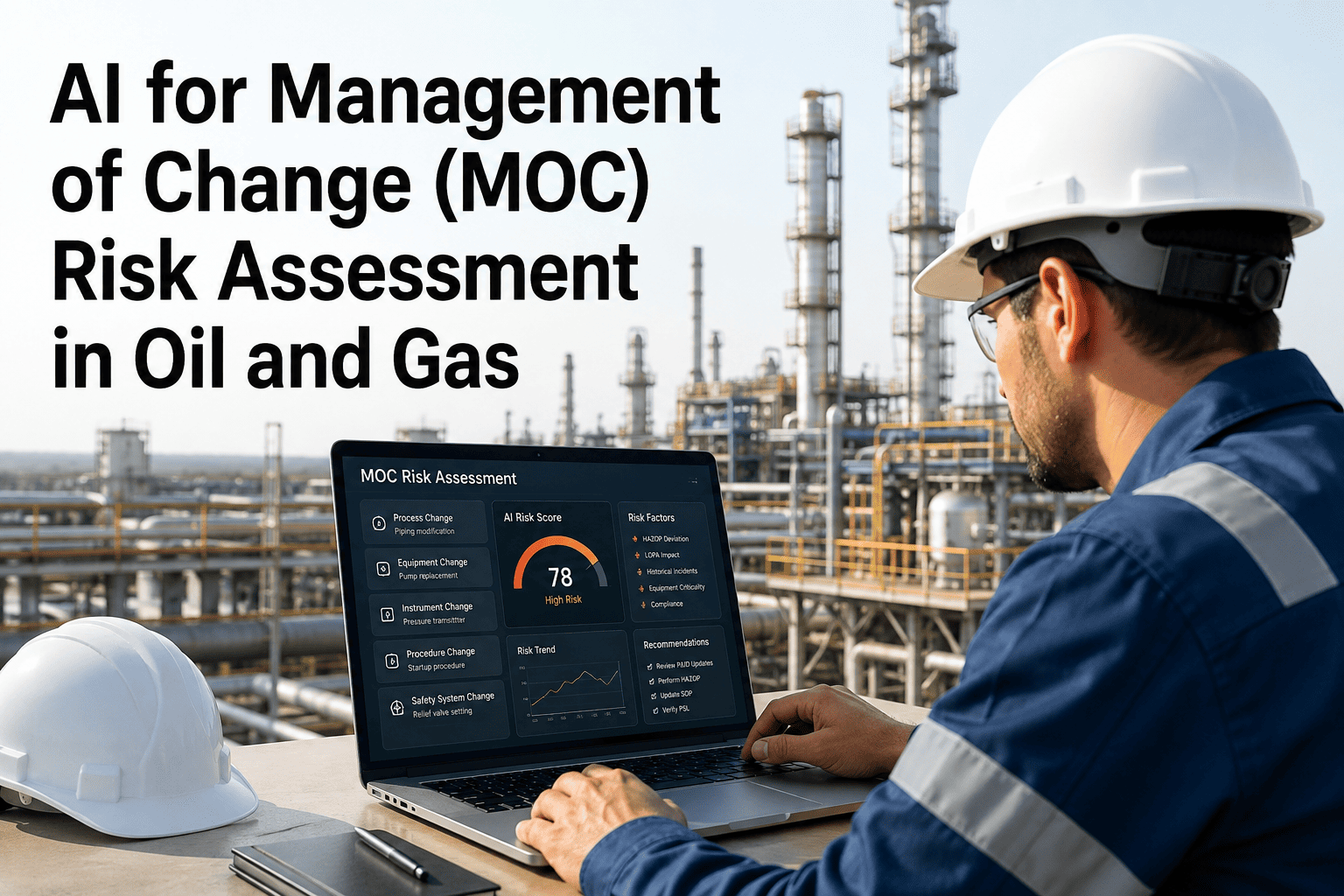
When a facility replaces a valve, changes a setpoint, or swaps a chemical supplier, that single administrative decision can quietly outdate the process safety information, P&IDs, and hazard analysis the entire safety case was built on. Investigators have repeatedly traced major incidents back to changes that were approved without anyone checking whether the existing safeguards were still valid for the new conditions. A manual MOC review depends on an engineer holding the entire process safety picture in their head while reading a stack of documents that may not have been touched in years. That is a difficult way to catch a pressure rating that no longer matches, or a relief valve sized for a chemical the process no longer uses. Book a demo to see how AI reads your MOC proposal against your actual process safety information before it ever reaches the approval stage.
Oil & Gas · Process Safety AI
Every MOC Proposal Deserves a Reviewer Who Never Skims a Page
iFactory reads every management of change proposal against your process safety information, P&IDs, and historical incident data, and surfaces the gaps a rushed manual review is most likely to miss, before the change reaches startup.
40%Of major process safety incidents linked to inadequate change management
12 wks → 5 daysTypical AI-assisted reduction in cross-document safety review time
Top-CitedMOC ranks among the most frequently cited PSM elements in OSHA inspections
The Documentation Gap
The Risk Was Never the Change. It Was What the Change Left Out of Date.
A management of change form asks an engineer to describe what is changing. It rarely forces anyone to confirm that every downstream document, from the P&ID to the relief valve sizing calculation, still reflects reality once the change goes in. Over months and years, that gap between the paperwork and the plant widens quietly, one approved change at a time, until an investigation is the first time anyone notices.
The "Like-for-Like" Swap That Isn't
A pump or motor gets replaced with a higher-capacity unit during an outage because it was what was available, and the change is logged as routine maintenance instead of a process change requiring review.
The Temporary Bypass That Became Permanent
A bypass valve installed during a turnaround to keep a unit running is never formally closed out, and months later nobody on shift knows it was ever meant to be temporary.
The Setpoint Change With No Paper Trail
An alarm or trip setpoint gets adjusted to reduce nuisance trips during a difficult shift, and the change quietly erodes the margin an earlier hazard analysis assumed was still in place.
The Instrumentation Swap Nobody Escalated
Changing the number or location of thickness measurement or condition monitoring points on a pipe is one of the most commonly overlooked categories of change requiring formal MOC review.
The Control Room Modification Filed as Facilities Work
Changes to a control room located within a PSM-covered process unit are frequently routed through a facilities or IT work order process instead of the safety-focused MOC path the standard actually requires.
Why the Stakes Are Higher in Oil & Gas
MOC Is One of Fourteen PSM Elements, and One of the Most Cited
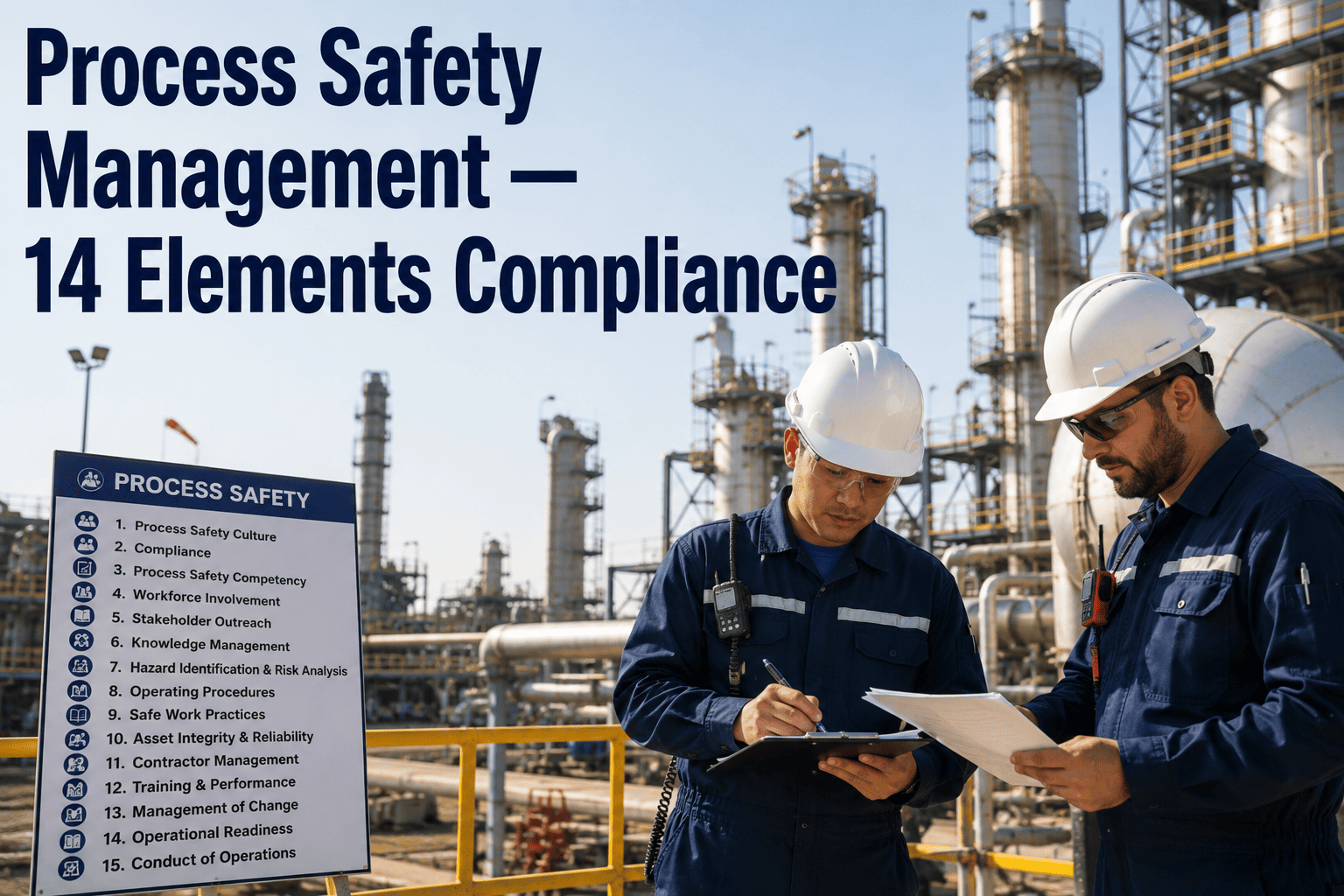
OSHA's Process Safety Management standard, 29 CFR 1910.119, sets out fourteen elements that facilities handling highly hazardous chemicals must maintain, from process safety information and hazard analysis through mechanical integrity and incident investigation. Management of change sits inside that list as a written requirement, not a best practice, and inspectors consistently find it among the elements cited most often once an inspection begins. That pattern holds across refineries, gas processing plants, and upstream facilities alike, which is part of why regulators treat a weak MOC program as a signal that the rest of the process safety management system may be weaker than the paperwork suggests.
OSHA Civil Penalties
Serious violations carry penalties into the tens of thousands of dollars per citation, with willful or repeat violations reaching well over a hundred thousand dollars per violation under current adjusted OSHA penalty schedules.
Pipeline-Specific Enforcement
For pipeline operators, PHMSA enforces separate integrity management requirements, and a change that alters pressure or flow dynamics without a corresponding MOC and integrity review can trigger its own civil penalty track.
Permit and Emissions Exposure
A change that shifts throughput, fuel source, or emissions profile can require an updated environmental permit, and MOC failures uncovered during a root cause investigation can trigger enforcement well beyond the original incident.
What Gets Cross-Referenced
Three Documents That Have to Agree Before a Change Is Actually Safe
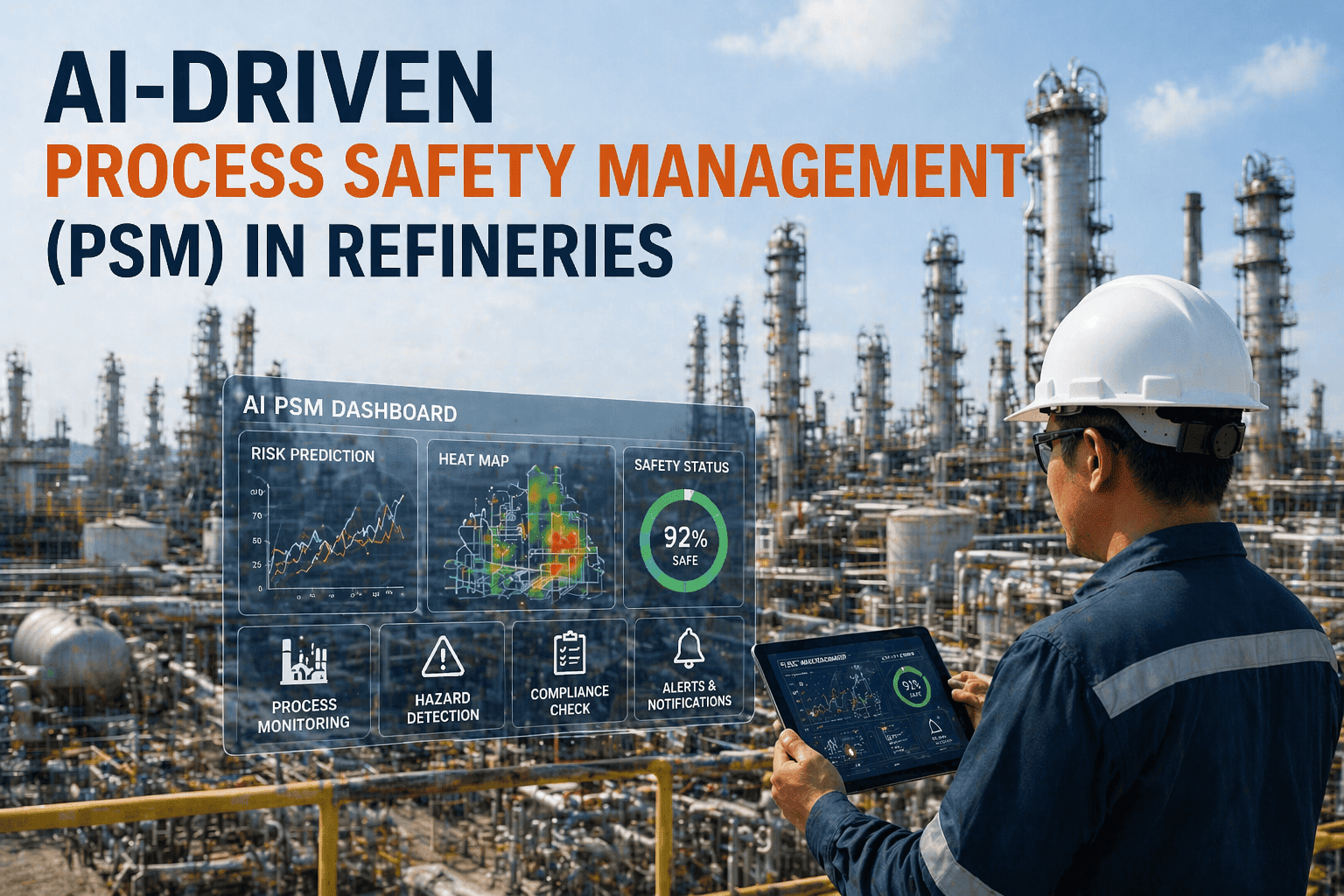
A single MOC proposal can touch process chemistry, piping, instrumentation, and operating procedure all at once. AI risk assessment reads across all of it at the same time, instead of relying on one reviewer's memory of a P&ID revision from three years ago.
01
Process Safety Information
Material hazard data, equipment design basis, and safe operating limits are checked against what the proposed change would actually require the process to do, flagging any limit the change would push past.
02
P&IDs and Engineering Drawings
Tag numbers, line ratings, and instrument ranges are read directly from the drawing set and checked for logical consistency with the change, the same way an AI validation pass catches a pressure rating conflict between two linked documents.
03
Historical Incident and Near-Miss Data
Past incidents, near misses, and prior MOC records for the same equipment or unit are searched for a pattern that suggests this specific type of change has caused problems here, or somewhere similar, before.
How It Works
From Submitted Proposal to Ranked Risk Findings
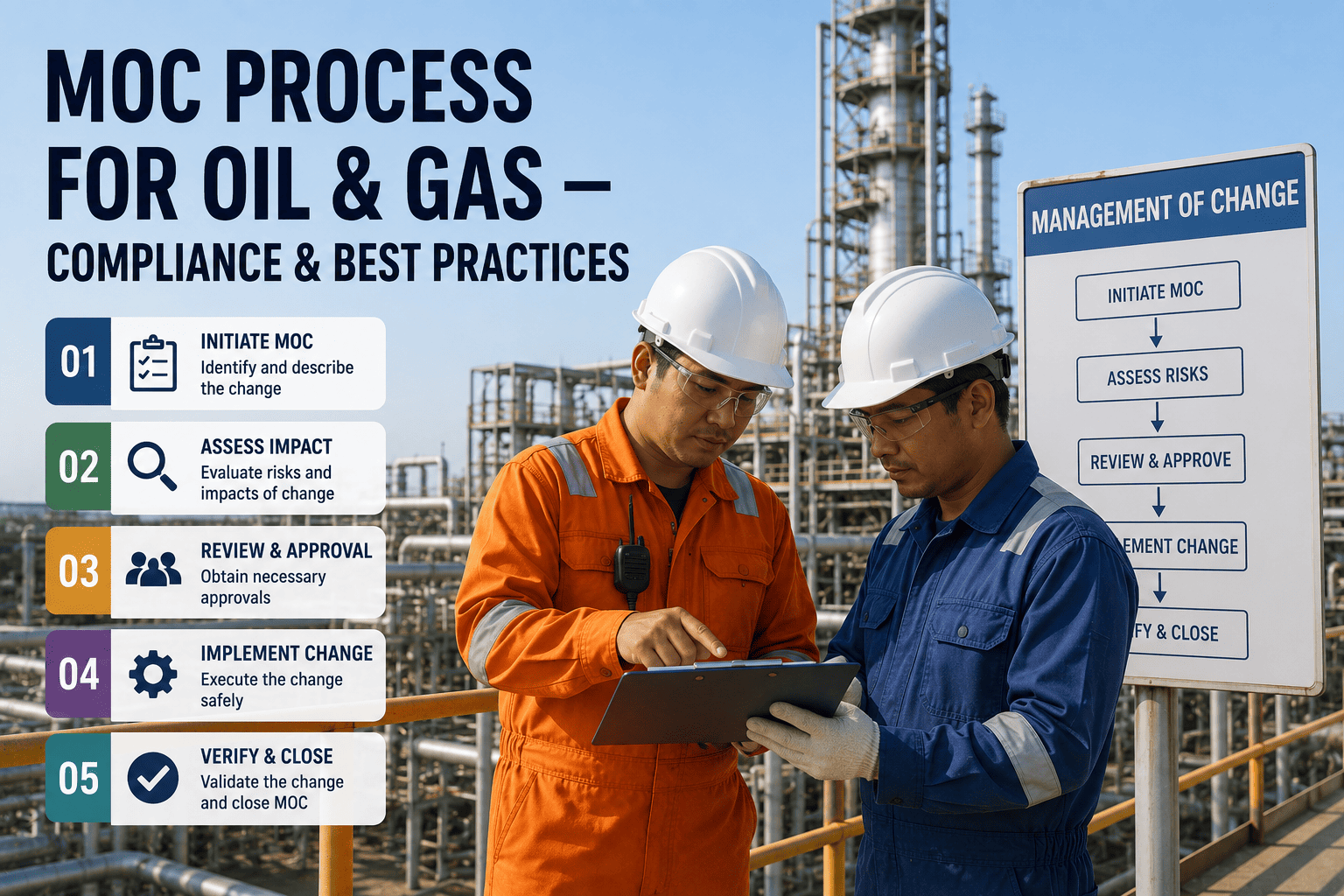
The goal is not to remove the human reviewer from the process. It is to make sure that by the time the proposal reaches process engineering, mechanical integrity, or operations, the routine cross-referencing has already been done, and the discussion can start on the findings that actually matter instead of the ones that were simply never checked.
1
Proposal Intake
The MOC request is parsed for what is actually changing — equipment, chemical, procedure, or operating condition — instead of relying on a free-text description alone.
2
Document Linking
The affected equipment tag is matched against the current P&ID, process safety information, and any prior PHA or LOPA on record for that line or vessel.
3
Consistency Checking
Design limits, ratings, and safeguard assumptions are compared against what the change proposes, surfacing conflicts a rules engine can catch that a page-by-page read often cannot.
4
Historical Pattern Match
Prior incidents, near misses, and previous changes to the same asset are searched for precedent, so a reviewer knows if this exact change has caused an issue before.
5
Ranked Findings for Review
Findings are ranked by severity and routed to the right reviewer — mechanical integrity, process engineering, or operations — with the source document attached to each flag.
Find Out What Your Last Ten MOC Approvals Would Have Flagged
See how iFactory reads a real MOC proposal against your process safety information and P&IDs, and what it surfaces that the original review didn't.
Manual vs. AI-Assisted
What Changes When a Rules Engine Reads the MOC First
| Review Step |
Manual MOC Review |
AI-Assisted Review |
| Cross-Document Checking |
Depends on one reviewer remembering related documents |
Every linked P&ID and PSI record is checked automatically |
| Historical Precedent |
Rarely searched unless a reviewer recalls a similar case |
Prior incidents on the same asset are surfaced automatically |
| Review Turnaround |
Often several weeks per proposal, longer during outages |
Initial findings ready within hours of submission |
| Consistency Across Reviewers |
Varies by reviewer experience and available time |
Same rules and document set applied to every proposal |
| Audit Trail |
Reconstructed from emails and meeting notes after the fact |
Every finding is timestamped and linked to its source document |
What Manual Review Tends to Miss
The Risks a Time-Pressed PHA Rarely Catches on Its Own
None of these risks require a reviewer to be careless. They are the kind of thing that slips through when someone reviewing a proposal in the middle of a busy week does not have every related document open at once.
Safeguard Degradation From an Earlier Change
A layer of protection assumed adequate in the original hazard analysis may have already been weakened by a change approved months earlier, and nothing in a fresh review points that out on its own.
Cumulative Small Changes
Several minor, individually low-risk changes to the same unit can combine into a condition none of them would have created on its own, and each one was reviewed in isolation.
A Rating Mismatch Buried in a Linked Document
A relief valve, gasket, or instrument range designed for the original process conditions may no longer match once a change alters temperature, pressure, or chemical composition.
Misclassified "Replacement in Kind"
A part that looks equivalent on a purchase order can carry a different capacity, material, or rating that only becomes visible when it is checked against the original engineering specification, which is exactly the check a busy procurement-driven replacement is least likely to receive.
Contractor-Introduced Changes
With contractors making up a large share of the workforce on many sites, a field substitution made during execution can go unrecorded if it is never routed back through the formal MOC process, and it often surfaces only when someone notices the installed part does not match the drawing during a later inspection.
Emissions and Permit Impact
A change that alters throughput or fuel source can shift a facility's emissions profile enough to require a permit update that a process-focused reviewer may not think to check.
A Realistic Scenario
How This Plays Out on an Actual MOC Queue
A mid-size gas processing facility submits an MOC to replace a control valve during a planned outage, logged as routine like-for-like maintenance. An AI risk assessment pass cross-references the new valve's specification sheet against the original process safety information and finds the replacement carries a different fail-safe position than the valve it replaces. That single detail changes how the unit would respond during a loss-of-signal event, something the routine maintenance classification would never have triggered a full PHA review to catch. The finding is routed to process engineering before the valve is installed, not after a trip investigation asks why it failed closed instead of open. In the version of this scenario without an automated cross-check, the mismatch typically surfaces only once the unit actually experiences the loss-of-signal event the original design was supposed to handle safely, at which point the question is no longer how to prevent the outcome but how to explain it.
Illustrative scenario based on common MOC failure patterns in gas processing operations
Before Your Next Review
Five Questions Worth Asking About Your Current MOC Process
A team that can answer all five of these for its last approved change already has a stronger MOC program than most facilities relying on paper forms and email approvals.
01
Is every "like-for-like" replacement actually checked against the original design specification before it is classified as routine?
02
Can a reviewer see every prior change made to the same equipment, or only the change in front of them right now?
03
Are temporary changes, like a bypass installed during a turnaround, tracked with a formal closeout date and owner?
04
Does your MOC form require confirmation that the P&ID and process safety information were updated, or just that the change was made?
05
How long does a typical MOC proposal sit in queue, and does that timeline change during a turnaround or outage?
Frequently Asked Questions
AI for MOC Risk Assessment — Common Questions
How is AI-assisted MOC risk assessment different from a standard MOC workflow tool?
A workflow tool routes a form for approval and tracks who signed off on it, which solves the process problem but not the analysis problem. AI risk assessment goes a step further by actually reading the content of the proposal against your process safety information, P&IDs, and prior incident records, and flagging conflicts a reviewer would otherwise have to catch by memory. The two are complementary: the workflow ensures the review happens, and the risk assessment ensures the review is thorough.
Contact support to see how the two work together on your existing MOC process.
Does this replace the process hazard analysis or the pre-startup safety review?
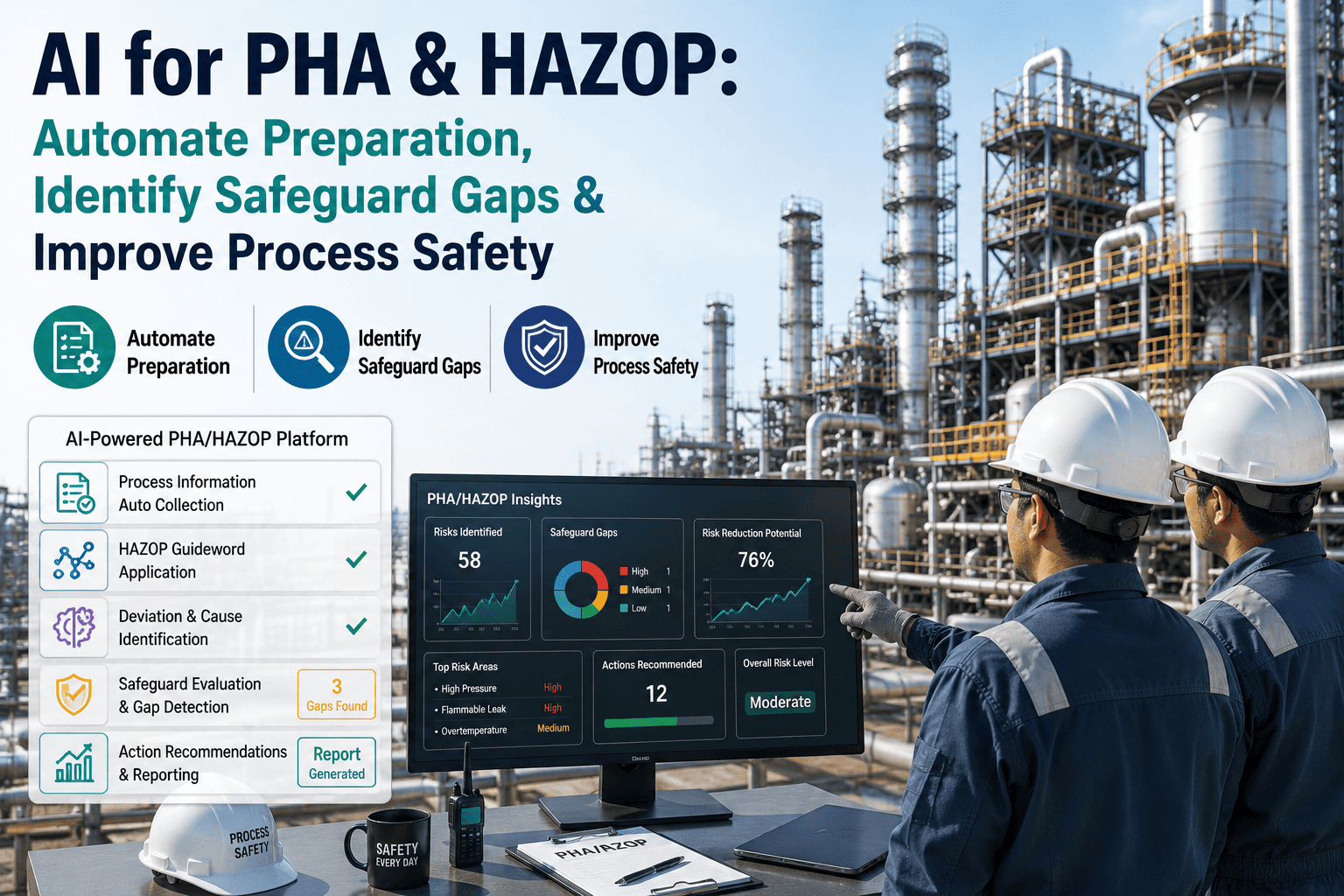
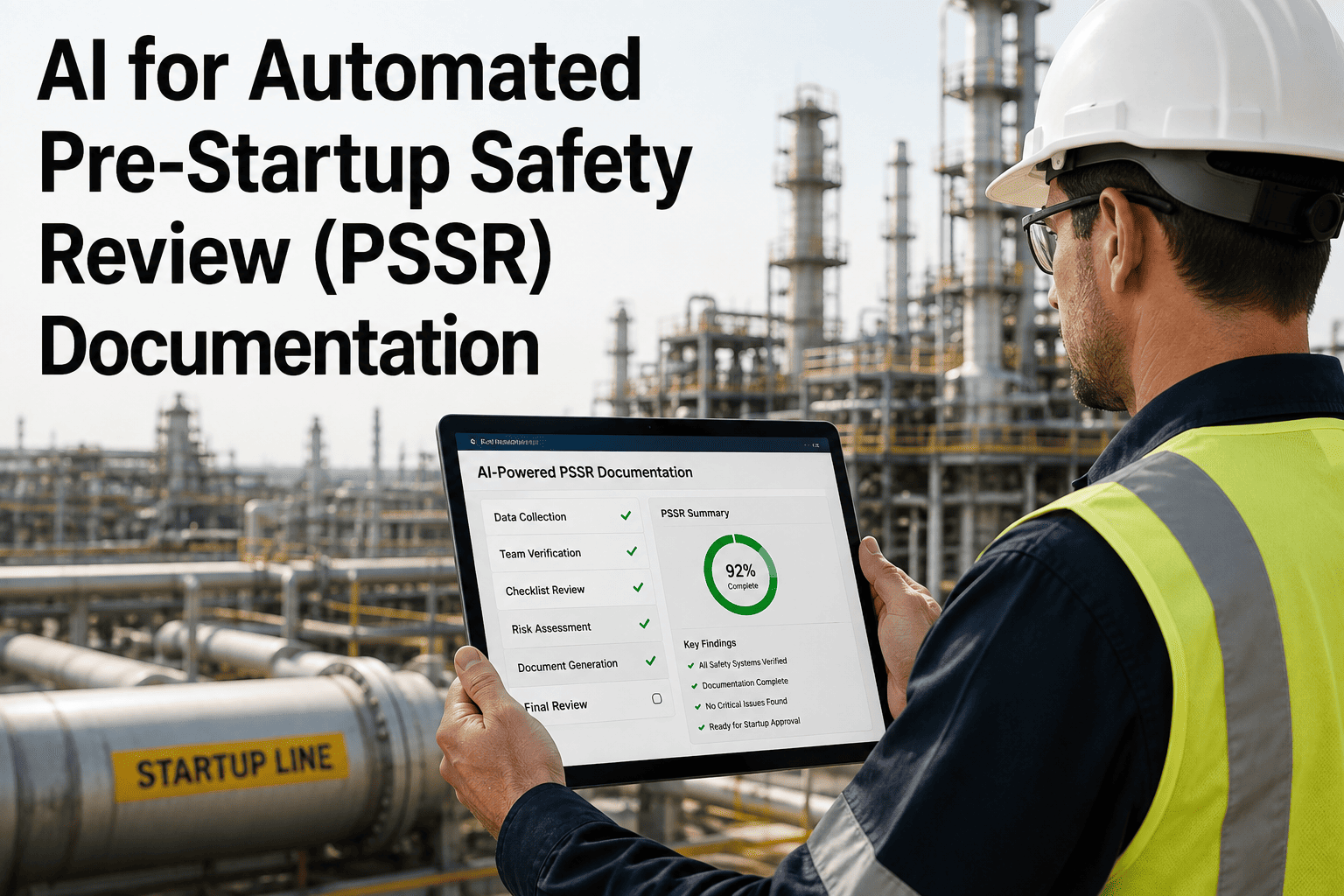
No. It is designed to make both of those steps more effective, not to replace them. By surfacing document conflicts, rating mismatches, and historical precedent before a human review begins, the engineer or safety team running the PHA or pre-startup safety review starts with a clearer picture of what actually needs attention, rather than spending the bulk of their time re-reading documents to confirm nothing was missed.
What documents does the system need access to in order to work?
At minimum, it needs your current P&ID set, process safety information such as material hazard data and equipment design limits, and a record of prior MOC and incident history for the assets in scope. Most facilities already maintain this documentation in some digital form, which means implementation is usually a matter of connecting existing records rather than rebuilding a document library from scratch.
How much faster is an AI-assisted review compared to a fully manual one?
Timelines vary by facility and by how many documents are affected by a given change, but cross-document validation work that has historically taken weeks of manual reading can often be reduced to a matter of days once the comparison itself is automated. The reviewer still makes the final call, but they spend that time evaluating flagged findings instead of searching for them.
Can this help during an OSHA PSM audit or after an incident investigation?
Yes. Because every finding is timestamped and linked back to the specific document that generated it, the system produces a defensible record of what was checked and when, which is exactly the kind of evidence auditors and investigators look for when evaluating whether a management of change program was followed in practice rather than only on paper. Investigators and auditors both tend to ask the same underlying question after an incident: could this specific change have been caught earlier, and by whom. A defensible, document-linked trail makes that question much easier to answer honestly.
Book a demo to see the audit trail a real MOC review generates.
The Next Incident Investigation Shouldn't Be the First Time Anyone Reads These Documents Together
See how AI reads your MOC proposals against process safety information, P&IDs, and incident history before a change ever reaches startup.