Reciprocating compressor valve failures account for more than 60% of all unplanned compressor downtime in process industries — and yet most plants still rely on manual inspection intervals that miss the early warning signs entirely. From broken valve plates and fatigued springs to heavy hydrocarbon deposits and chronic overheating, the root causes of valve failure are well-documented, predictable, and — with the right AI-vision and condition monitoring platform — almost entirely preventable. This guide walks U.S. manufacturing and reliability professionals through the core failure mechanisms, the diagnostic workflows that matter most, and how modern industrial intelligence systems are transforming valve life from a reactive maintenance burden into a managed, measurable asset.
Is Your Valve Failure Data Working for You?
Unify valve health monitoring, root cause diagnostics, and compressor reliability workflows into one intelligent platform built for high-consequence rotating equipment.
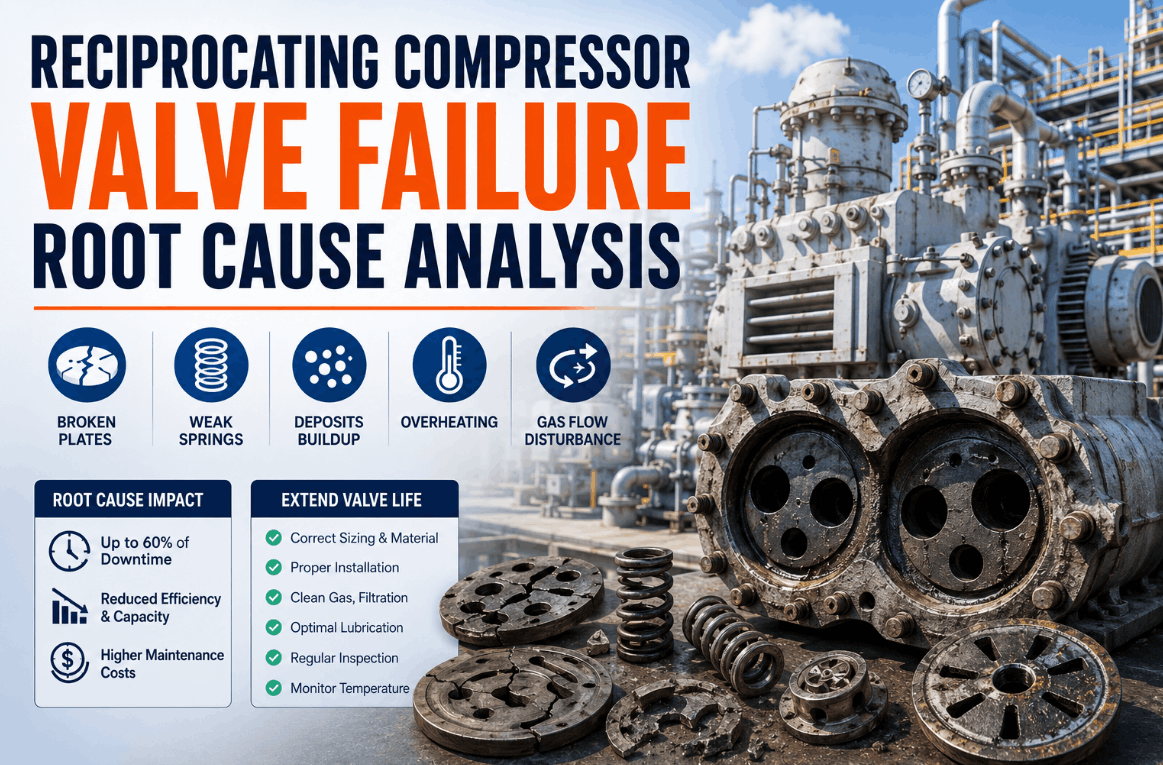
The Four Primary Root Causes of Reciprocating Compressor Valve Failure
Valve failure in reciprocating compressors is rarely a single-event failure — it is the cumulative result of process deviations, maintenance gaps, and undetected degradation that compound over operating cycles. Understanding the four dominant failure mechanisms is the foundation of any effective valve life extension program. Reliability engineers who Book a Demo with iFactory consistently identify at least two of these mechanisms operating simultaneously in their assets.
Broken Valve Plates
Impact fatigue, liquid slugging, and excessive pressure differential fracture valve plates — the most catastrophic and immediate form of valve failure. Detection before fracture propagation is critical to preventing cylinder damage.
Spring Fatigue & Failure
Spring force loss from cyclic stress, corrosion, or improper material selection causes incomplete valve closure — allowing back-flow, efficiency loss, and accelerated plate wear that compounds into full valve failure.
Hydrocarbon Deposits
Polymerized oil residues, process gas condensates, and carbon build-up on valve seats and plates restrict lift, alter flow dynamics, and accelerate thermal degradation — reducing effective valve life by 30–50%.
Valve Overheating
Elevated discharge temperatures from high compression ratios, gas bypass leakage, or inadequate cooling accelerate seal and plate material degradation — a leading indicator of impending valve failure that thermal imaging can detect weeks in advance.
Compressor Valve Failure Diagnostic Matrix: Symptoms, Causes, and Detection Methods
Accurate root cause analysis begins with mapping observable symptoms to their probable mechanical origin. The following diagnostic matrix reflects real-world failure modes documented across gas processing, petrochemical, and industrial air compression applications.
| Symptom Observed | Probable Root Cause | Detection Method | Urgency | Recommended Action |
|---|---|---|---|---|
| Elevated discharge temperature | Valve leakage / overheating | Thermal imaging, RTD sensors | Critical | Immediate inspection & replacement |
| Reduced volumetric efficiency | Broken plate / spring fatigue | P-V diagram analysis | Critical | Valve overhaul, spring replacement |
| Abnormal valve noise / knock | Plate flutter, foreign debris | Acoustic emission, vibration | High | Shutdown & visual inspection |
| High suction pressure drop | Deposit build-up on seats | Process data trending | High | Chemical cleaning, inspection |
| Increased power consumption | Gas leakage past valve | Energy monitoring, P-V analysis | Monitor | Schedule planned maintenance |
| Valve cover discoloration | Thermal overload / oil coking | Thermal camera inspection | High | Cooling system check, valve pull |
5-Stage Root Cause Analysis Process for Reciprocating Compressor Valves
Effective root cause analysis for compressor valve failures requires a structured, evidence-based workflow — not ad-hoc troubleshooting. The following five-stage process is aligned with industry reliability frameworks and can be fully supported by iFactory's AI-driven diagnostics platform. Plants that have Book a Demo and integrated this workflow report an average 40% reduction in mean time to diagnose (MTTD) for valve-related downtime events.
Baseline Performance Profiling
Establish volumetric efficiency baselines, discharge temperature norms, and P-V diagram signatures for each compressor under known-good operating conditions. This reference state is the foundation against which all anomalies are measured — without it, root cause analysis becomes guesswork.
Continuous Condition Monitoring Deployment
Install AI-vision cameras, acoustic emission sensors, and thermal imagers at valve covers and cylinder heads. Integrate data streams with iFactory's analytics platform to create a continuous real-time health index for each valve assembly — capturing drift that manual rounds miss entirely.
Anomaly Detection & Early Alert Generation
AI algorithms analyze incoming sensor data against established baselines, automatically flagging temperature exceedances, efficiency drops, and acoustic signatures associated with plate flutter, spring fatigue, or deposit accumulation — typically 2–4 weeks before a failure event.
Failure Mode Classification & Root Cause Isolation
Platform AI classifies the detected anomaly against a library of known valve failure signatures — distinguishing between mechanical fatigue, deposit fouling, thermal damage, and process upsets — and generates a ranked list of probable root causes with supporting evidence from the sensor data record.
Corrective Action Documentation & Life Extension Planning
Every root cause event is documented in a digital maintenance record linked to the specific valve ID, failure mode, corrective action taken, and post-repair performance data. This closed-loop record drives predictive replacement scheduling and informs capital planning for valve inventory optimization.
Proven Strategies to Extend Reciprocating Compressor Valve Life Beyond 12 Months
The industry benchmark for valve service life in reciprocating compressors is 12–18 months under standard operating conditions — but many plants achieve significantly shorter intervals due to avoidable process upsets and missed early interventions. The following strategies, when implemented with AI-enabled monitoring, consistently push valve life past the 12-month threshold and reduce total valve-related maintenance spend by 35% or more.
Maintain discharge temperatures below the material rating of valve components. AI thermal monitoring enables real-time alerts when temperature trends indicate approaching limits — preventing accelerated aging of PEEK, nylon, or steel plate materials.
Liquid slugging is the single most destructive mechanical event a valve can experience. Upstream suction knockout drum performance monitoring and separator efficiency tracking prevent liquid from reaching valve assemblies.
Over-lubrication is a leading contributor to hydrocarbon deposit formation on valve seats. AI-guided lube rate optimization — matched to actual operating conditions — reduces deposit formation without increasing dry-friction wear rates.
Carbon steel plates in hydrogen-rich services or standard springs in high-cycle natural gas applications are common material mismatches. iFactory's digital valve records capture material specifications and flag service-condition mismatches during planning cycles.
Replace fixed time-based valve replacement intervals with condition-based triggers derived from AI health scoring. Plants using this approach average 22% fewer valve replacements per year while maintaining the same or better reliability performance.
Incorrect valve lift — too high or too low — introduces impact fatigue on plates and seats. Precise dimensional tracking during each valve overhaul, stored in the digital maintenance record, ensures that assembly specifications are consistently achieved.
"In 20 years of compressor reliability work, the most consistent finding is that valve failure is an information problem as much as a mechanical one. Plants that connect their thermal data, vibration signatures, and process historian into a single diagnostic layer stop guessing about root cause — they start managing it. AI platforms like iFactory bring that capability to plants that previously couldn't afford a dedicated condition monitoring team. The ROI on valve life extension alone typically justifies the investment within one maintenance cycle."
Common Operational Gaps That Accelerate Compressor Valve Failure
Most plants experiencing chronic valve failure problems share a predictable set of process and documentation gaps. Identifying these gaps before implementing a reliability improvement program dramatically improves outcomes and helps maintenance managers allocate limited budgets more effectively. Reliability teams who Book a Demo with iFactory consistently benchmark their programs against these known gaps and find at least three active in their operations.
Relying solely on operator rounds and fixed-interval inspection leaves a large detection window during which valve degradation advances unchecked — often until a forced outage occurs.
Valve failure history stored in paper logs or disconnected CMMS entries makes it impossible to trend failure modes, identify chronic problem valves, or build defensible replacement cost forecasts.
Time-based valve replacement ignores actual condition — replacing serviceable valves early or, worse, running degraded valves past their safe operating limit due to calendar-driven schedules.
Pressure-volume diagram analysis is the most sensitive indicator of valve health but requires automated collection and trending to deliver actionable insight — a capability most plants lack without a dedicated analytics platform.
When valve failures are not systematically documented with root cause classification, the same failure modes recur — and the organization loses the institutional knowledge needed to break the cycle.
Unplanned valve failures without predictive lead time force emergency part sourcing — extending outage duration and inflating total maintenance cost well beyond what condition-based planning would require.
How iFactory AI Transforms Reciprocating Compressor Valve Reliability
iFactory's industrial AI platform integrates thermal imaging, acoustic emission monitoring, vibration analysis, and process data historian connectivity into a unified valve health management layer. Every compressor in your fleet receives a continuously updated digital health profile — enabling early intervention, condition-based maintenance scheduling, and a complete audit trail of valve performance history from first installation to final replacement.
Key Platform Capabilities for Valve Failure Prevention
Continuous thermal camera coverage of valve covers detects temperature exceedances and asymmetric heating patterns — early indicators of leakage or overheating — before any mechanical failure occurs.
Automated pressure-volume diagram collection and AI-based deviation detection identify reduced valve efficiency, leaking suction or discharge valves, and late valve opening — all without manual interpretation.
Every valve overhaul, failure event, material specification, and corrective action is captured in a linked digital record — enabling root cause trending, repeat failure analysis, and CMMS integration.
AI health scores drive condition-based replacement recommendations with lead time sufficient for planned parts procurement and outage scheduling — eliminating emergency breakdowns and reducing total maintenance cost.
From Reactive Replacement to Predictive Valve Life Management
Reciprocating compressor valve failure is not an inevitability — it is a consequence of information gaps that modern AI-vision and condition monitoring platforms are specifically designed to close. Broken plates, fatigued springs, deposit fouling, and thermal overload all leave measurable signatures long before a failure event, and every one of those signatures can be captured, classified, and acted upon with the right diagnostic infrastructure in place. The plants achieving 12-month-plus valve life with lower total maintenance cost are not operating fundamentally different equipment — they are operating with fundamentally better visibility.
iFactory's industrial AI platform provides that visibility: continuous thermal and acoustic monitoring, automated P-V diagram analysis, digital valve records, and AI-driven condition-based scheduling — all in a unified system designed for the complexity and compliance demands of U.S. process industry operations. The shift from reactive to predictive compressor valve management begins with a single conversation. Book a Demo today and benchmark your current valve reliability program against a proven industrial intelligence architecture.
Reciprocating Compressor Valve Failure — Common Questions Answered
What is the most common cause of reciprocating compressor valve failure?
Broken valve plates from liquid slugging and mechanical fatigue account for the highest share of catastrophic valve failures, but spring fatigue and hydrocarbon deposit build-up are more frequent in day-to-day operations. AI condition monitoring identifies all four failure modes continuously.
How can I tell if a valve is leaking without pulling it?
Elevated discharge temperature, reduced volumetric efficiency on P-V diagrams, and asymmetric valve cover temperatures detected by thermal imaging are the three most reliable non-intrusive indicators of valve leakage. iFactory's platform automates all three.
What valve life is achievable with AI-driven condition monitoring?
Plants deploying continuous AI monitoring and condition-based maintenance strategies consistently achieve 12–24 month valve service life — compared to 6–10 months in reactive maintenance programs — while reducing unplanned outage frequency by 40% or more.
Can iFactory integrate with our existing CMMS or process historian?
Yes. iFactory provides standard APIs that connect to SAP, Oracle, Maximo, and common process historians, automatically pushing valve health data and maintenance recommendations into your existing work order and planning workflows.
How quickly can root cause analysis be completed with AI diagnostics?
AI-driven RCA reduces mean time to diagnose from days to hours by automatically correlating thermal, vibration, and process data against known failure signatures — delivering a ranked root cause report at the time of alert, not after a manual investigation cycle.
Modernize Your Compressor Valve Reliability Program Today
Deploy a unified AI platform integrating thermal monitoring, acoustic diagnostics, digital valve records, and condition-based scheduling — built specifically for reciprocating compressor operations.