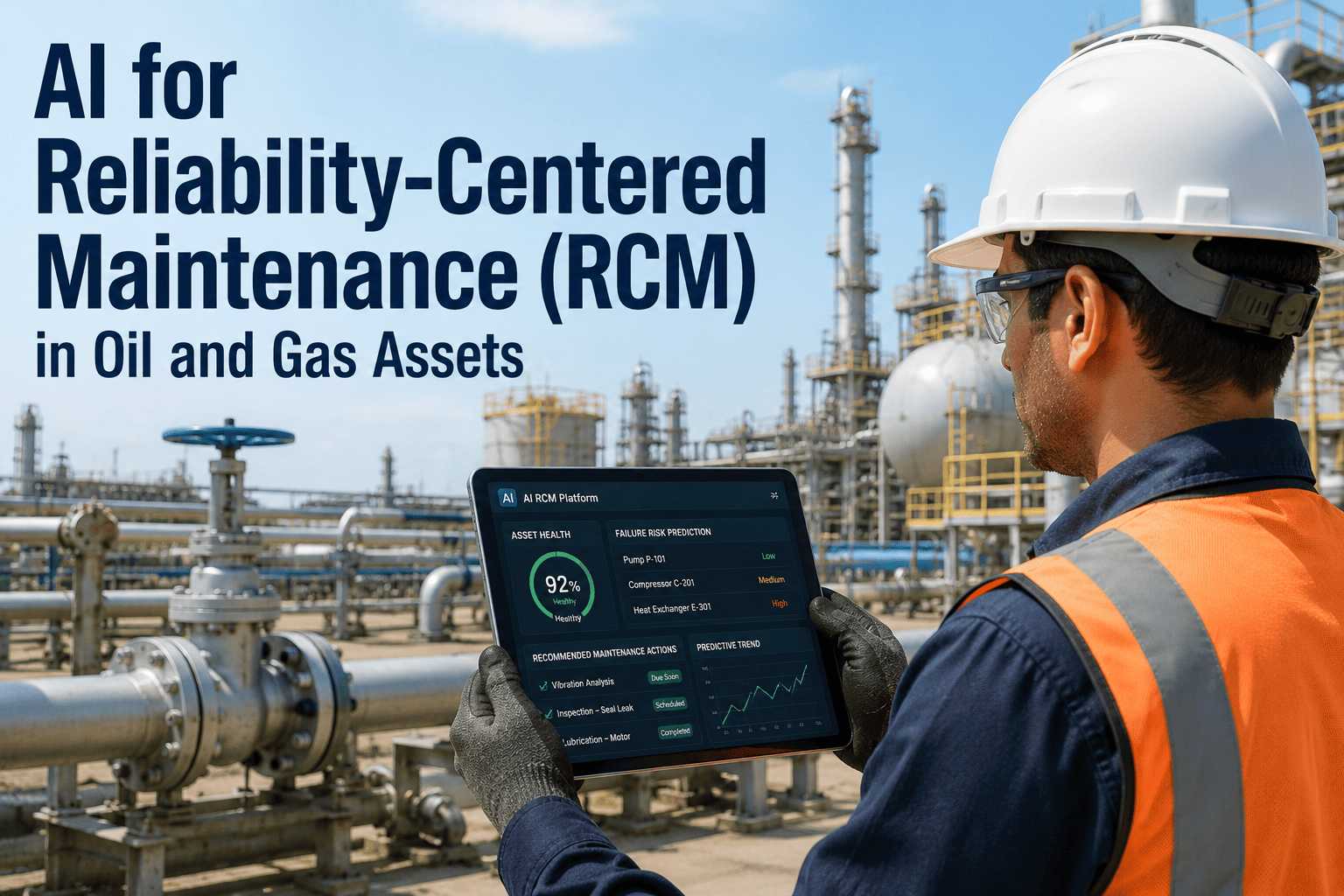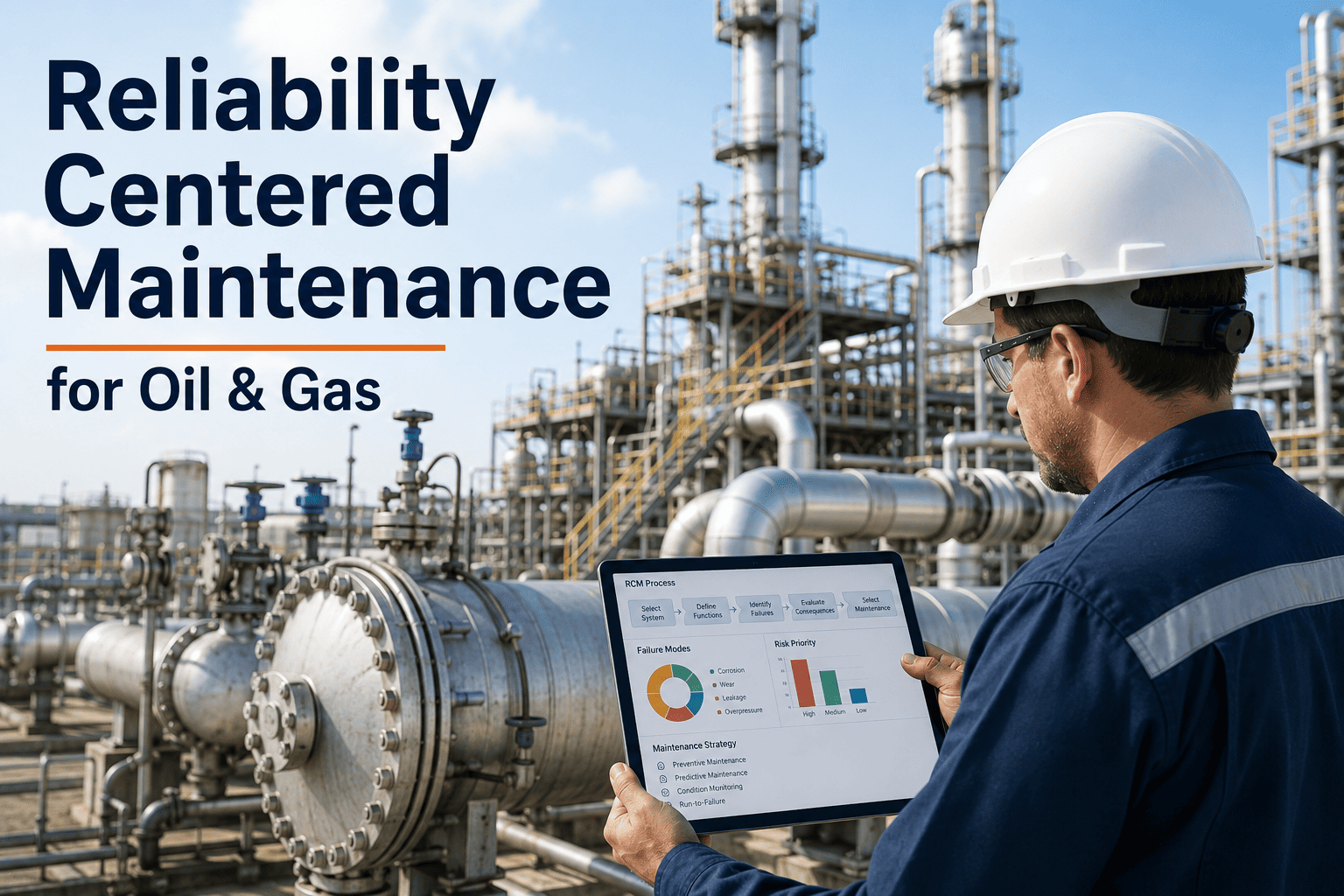
In the high-stakes environment of oil and gas operations, unplanned downtime can cost upwards of $500,000 per day for a single offshore platform. Reliability Centered Maintenance (RCM) offers a systematic, FMEA-driven framework to identify the most effective maintenance strategy for every critical asset, balancing cost, safety, and operational risk. Unlike traditional time-based approaches, RCM prioritizes failure modes and their consequences, enabling engineers to select the optimal mix of predictive, preventive, and run-to-failure tasks. This guide provides a deep-dive into RCM methodology tailored for upstream, midstream, and downstream facilities, covering everything from initial system selection to task packaging and implementation. Whether you are a plant manager, maintenance director, or reliability engineer, you will learn how to leverage RCM to reduce unplanned outages by up to 70% and extend asset life by 30%. Book a Demo to see how iFactory's AI-driven platform accelerates RCM analysis and task optimization.
Transform Your Maintenance Strategy with RCM
Reduce unplanned downtime by 70% through systematic FMEA-driven task selection tailored for oil & gas assets.
Why RCM is Critical for Oil & Gas Operations
Oil and gas facilities operate under extreme conditions—high pressure, corrosive environments, and remote locations. Traditional preventive maintenance schedules often lead to either excessive overhauls (wasting resources) or missed failure modes. RCM provides a structured methodology to analyze each asset's functions, functional failures, failure modes, and failure effects. By focusing on consequences—safety, environmental, operational, and non-operational—RCM ensures that maintenance tasks are both effective and efficient. For example, a gas compressor's bearing failure might have severe operational consequences but low safety risk, leading to a predictive monitoring task rather than a costly time-based replacement. This precision reduces unnecessary interventions and maximizes asset availability.
The 7-Step RCM Process for Oil & Gas
System Selection & Boundary Definition
Identify critical systems such as compressors, pumps, pipelines, and separators. Define system boundaries, inputs, outputs, and interfaces with other systems. Use criticality ranking based on safety, production impact, and repair cost.
Functions & Performance Standards
Document each system's primary and secondary functions. For a centrifugal pump, primary function is fluid transfer at a specified flow rate and head. Secondary functions may include containment, lubrication, and cooling. Define performance standards with measurable parameters.
Functional Failures
List all ways a function can fail. For example, a pump might fail to deliver required flow (total failure) or deliver reduced flow (partial failure). Each failure is a functional failure that must be analyzed.
Failure Mode Analysis (FMEA)
Identify all failure modes for each functional failure. A failure mode is the specific event causing the failure, such as bearing seizure, impeller erosion, or seal leakage. Use FMEA to document causes, mechanisms, and effects.
Failure Consequences
Categorize consequences into hidden, safety/environmental, operational, and non-operational. This drives the selection of proactive tasks versus run-to-failure. For example, a safety-critical failure demands a predictive or preventive task, while a minor leak might be run-to-failure.
Task Selection
Choose appropriate tasks: condition-based (predictive), scheduled restoration (preventive), scheduled discard (replacement), or failure-finding. For each failure mode, select the most cost-effective task that reduces risk to an acceptable level.
Task Packaging & Implementation
Group tasks into maintenance packages by schedule, craft, and system. Implement through CMMS and train personnel. Continuously review and update based on operating experience.
Key RCM Deliverables for Oil & Gas
Critical Equipment Ranking
Rank assets by risk priority number (RPN) based on severity, occurrence, and detection. Focus resources on high-risk equipment like gas turbines, compressors, and ESPs.
FMEA Worksheets
Detailed documentation of each failure mode, cause, effect, and current controls. Essential for audit trails and regulatory compliance (e.g., OSHA, API).
Task Selection Matrix
Matrix linking each failure mode to the selected maintenance task (predictive, preventive, or run-to-failure). Includes task frequency, craft, and tools required.
Maintenance Task Packages
Optimized work packages that bundle tasks by schedule and resource availability. Reduces downtime and improves workforce productivity.
Implementation Plan
Roadmap for rolling out RCM across multiple facilities, including training, CMMS integration, and KPI tracking.
Continuous Improvement Loop
Process for updating RCM analysis based on failure data, new technologies, and changes in operating conditions.
Maintenance Task Selection Criteria
| Failure Consequence Type | Example Failure Mode | Recommended Task Type | Task Example |
|---|---|---|---|
| Safety/Environmental | Gas leak from flange | Predictive (Condition-Based) | Acoustic emission monitoring |
| Operational (High Impact) | Compressor bearing seizure | Predictive (Condition-Based) | Vibration analysis & oil debris monitoring |
| Operational (Low Impact) | Pressure gauge drift | Run-to-Failure | Replace upon failure |
| Hidden (Safety-Related) | Emergency shutdown valve fails to close | Failure-Finding | Functional test every 6 months |
| Non-Operational | Paint peeling on structural steel | Run-to-Failure | Repair during major turnaround |
Ready to Optimize Your Maintenance Strategy?
Leverage AI-driven RCM analysis to reduce downtime and extend asset life. Our platform automates FMEA and task selection for oil & gas facilities.
FMEA-Driven Maintenance Strategy Selection: A Deep Dive
Failure Mode and Effects Analysis (FMEA) is the backbone of RCM. For each failure mode, engineers must evaluate the likelihood of occurrence, severity of consequences, and detectability. These three factors combine to form the Risk Priority Number (RPN). In oil and gas, typical high-RPN failure modes include compressor blade fatigue, pipeline corrosion, and seal failures. Once RPN is calculated, the team selects a maintenance task that reduces risk to an acceptable level. For example, if a centrifugal pump's impeller erosion has an RPN of 200 (high severity, moderate occurrence, low detection), a predictive task like ultrasonic thickness measurement every 3 months can reduce occurrence and increase detection, lowering the RPN to 40. This systematic approach ensures that maintenance resources are allocated to the most critical risks, avoiding both over-maintenance and under-maintenance.
RCM vs. Traditional Maintenance Approaches
Reactive Maintenance
Fix equipment after failure. High downtime, safety risks, and costs. No systematic analysis. Suitable only for low-consequence, non-critical assets.
Preventive Maintenance (Time-Based)
Schedule tasks at fixed intervals. Often leads to unnecessary interventions or missed failures. Does not consider actual equipment condition.
Predictive Maintenance (Condition-Based)
Monitor asset health using sensors and analytics. RCM identifies which parameters to monitor and at what thresholds. Highly efficient for high-consequence failures.
Run-to-Failure
Deliberately allow failure for low-impact assets. RCM justifies this decision based on consequence analysis, saving costs on unnecessary tasks.
RCM Implementation Roadmap for Oil & Gas Facilities
Case Study: RCM Reduces Downtime by 60% at Gulf Coast Refinery
A major refinery in Texas implemented RCM across its crude distillation unit. By analyzing failure modes on pumps, heat exchangers, and control valves, the team identified 40% of preventive tasks as unnecessary. They shifted to predictive monitoring for high-consequence failures (vibration, thermography) and run-to-failure for low-impact components. Result: unplanned downtime dropped from 12 days per year to 4.8 days, saving $3.6 million annually. Maintenance costs decreased by 25% due to eliminated overhauls. The refinery now plans to expand RCM to all units using iFactory's AI-driven platform for automated FMEA and task optimization.
Frequently Asked Questions
What is the difference between RCM and FMEA?
FMEA (Failure Mode and Effects Analysis) is a core tool used within the RCM process. While FMEA focuses on identifying failure modes, causes, and effects, RCM is a broader methodology that includes function analysis, consequence evaluation, and task selection. In oil and gas, FMEA is often conducted as part of RCM to systematically document and rank failure modes. For a comprehensive guide, contact our support team for resources on integrating FMEA with RCM.
How long does it take to implement RCM in a large oil & gas facility?
Implementation timeline depends on facility complexity and team experience. A pilot system can be analyzed in 4-6 weeks with a dedicated team. Full deployment across a large refinery may take 12-18 months. Key factors include data availability, cross-functional collaboration, and use of software tools. To accelerate your implementation, Book a Demo of our AI-driven RCM platform that automates FMEA and task selection.
What assets should be prioritized for RCM analysis?
Start with assets that have the highest risk in terms of safety, environmental impact, and production loss. Typical candidates in oil and gas include gas turbines, compressors, pumps, heat exchangers, pressure vessels, and emergency shutdown systems. Use a criticality ranking matrix to prioritize. For assistance with asset prioritization, visit our support page for expert guidance.
How does RCM integrate with predictive maintenance technologies?
RCM identifies which failure modes are best addressed by predictive maintenance (PdM). For each failure mode, the RCM team selects appropriate PdM techniques such as vibration analysis, oil analysis, thermography, or ultrasonic testing. RCM also defines monitoring frequencies and alarm thresholds. This integration ensures that PdM investments are targeted at the highest-risk failures. Learn more about PdM integration by scheduling a demo with our experts.
What are the common pitfalls in RCM implementation?
Common pitfalls include lack of management commitment, insufficient training, overly complex analysis, and failure to update RCM studies. Teams often spend too much time on low-consequence failure modes, leading to analysis paralysis. Another pitfall is not integrating RCM outputs into the CMMS, resulting in unused task packages. To avoid these, follow a phased approach and use software tools. For best practices, contact our support team for a free consultation.
Transform Your Maintenance Strategy Today
Implement RCM across your oil & gas facilities with AI-powered automation. Reduce downtime, lower costs, and improve safety.