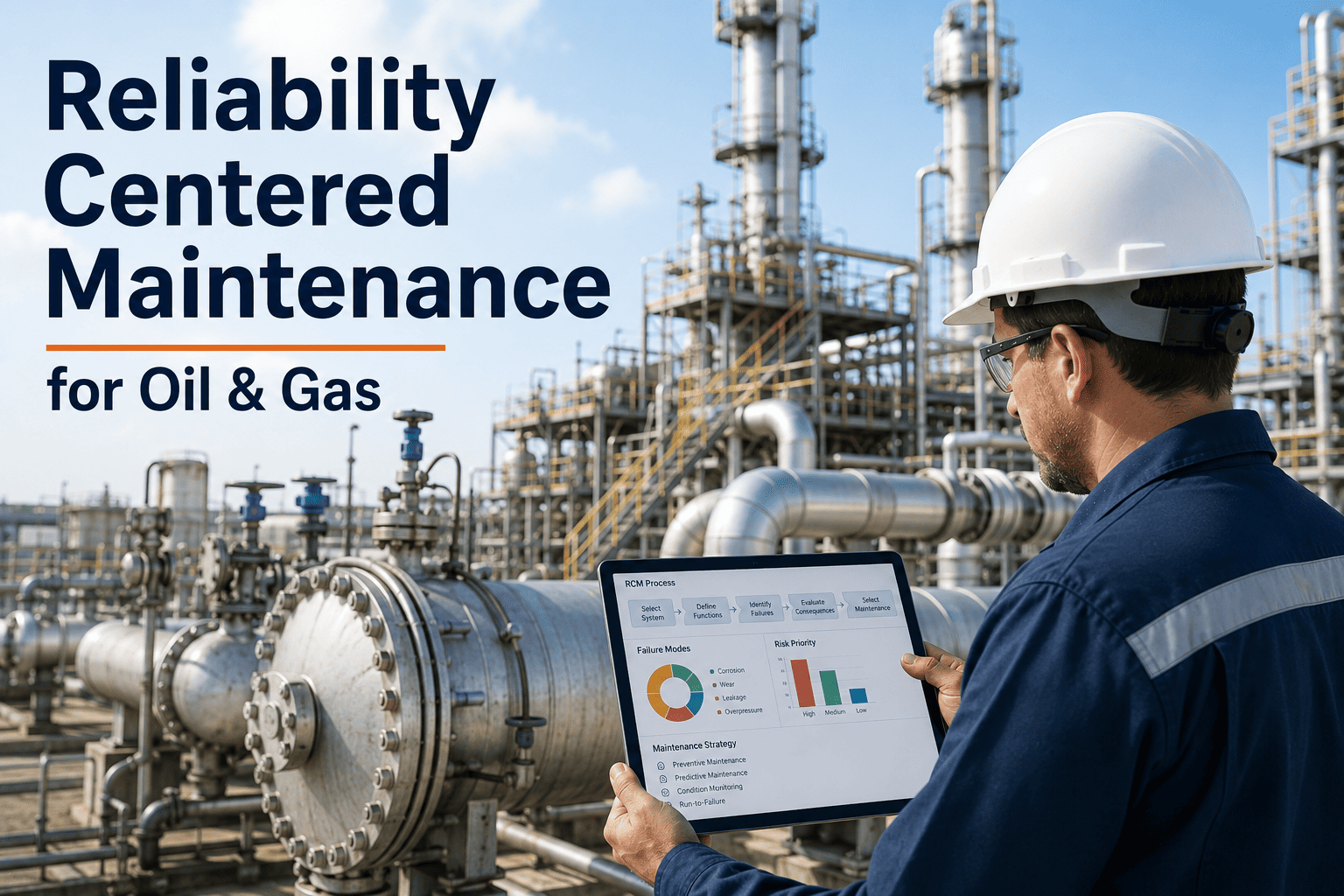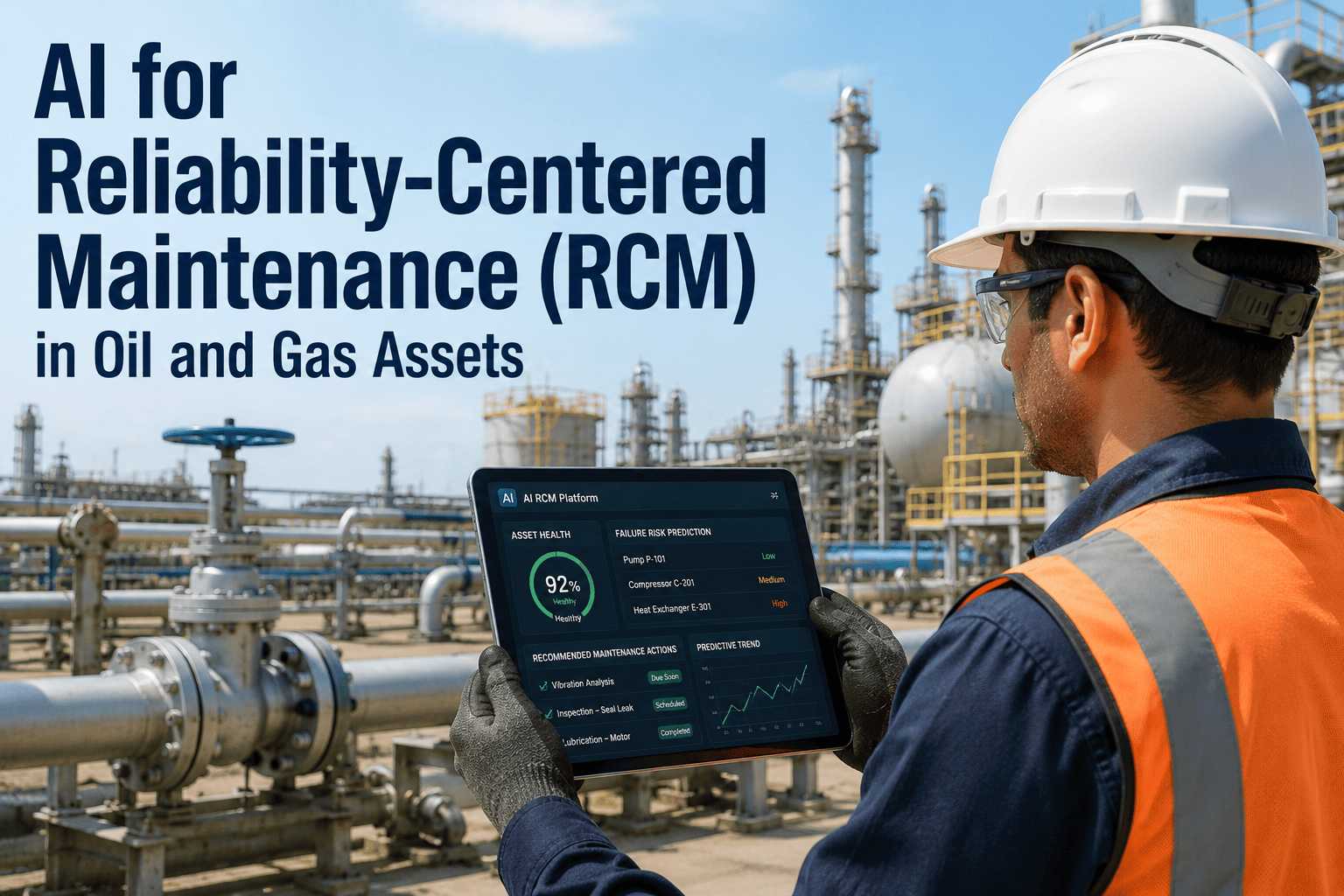
Most oil and gas facilities have a maintenance strategy on paper that gets called "RCM" in a planning meeting, and most of those programs are not actually reliability-centered maintenance under the definition that matters. SAE JA1011 sets the minimum bar: a process only qualifies as RCM if it answers seven specific questions about every asset's functions, failure modes, effects, and consequences, in that order, before a single maintenance task gets selected. Skip a question or answer it from memory instead of data, and what you have is a maintenance schedule with an RCM label on it, not the real thing. AI changes what's actually possible here by mining failure history, sensor data, and work order records to answer those seven questions with evidence instead of assumption, and you can book a demo to see it run against your own asset register.
Your RCM Program Answers Seven Questions. Is It Answering Them With Data, or With Whoever's in the Room?
iFactory automates the SAE JA1011 evaluation criteria by mining failure history, condition data, and work order records across your oil and gas assets, turning a months-long facilitated workshop into a data-driven task selection process for every piece of critical equipment.
Oil and Gas Is Still Running Mostly Reactive, and It Shows Up on Every Financial Statement
Reliability-centered maintenance exists because the alternative, either fixing things after they break or servicing everything on a fixed calendar regardless of actual failure behavior, is measurably more expensive and less safe. Yet across oil and gas, roughly three out of four organizations still run primarily reactive or time-based maintenance programs, with fewer than a quarter reporting a genuinely predictive, data-driven strategy. The gap between where the industry is and where SAE JA1011-compliant RCM would put it is not a technicality, it is the difference between planned work orders and emergency mobilizations.
SAE JA1011 Exists Because Not Everything Labeled RCM Is RCM
By the late 1990s, dozens of methodologies were being sold under the RCM name, many skipping the analytical steps that made the original Nowlan and Heap approach effective in the first place. SAE JA1011, "Evaluation Criteria for Reliability-Centered Maintenance Processes," resolved that by defining a clear, auditable threshold: it does not prescribe a specific toolset, it defines the minimum outcomes any process must achieve and the seven questions it must answer, in sequence, for every significant asset. A process that skips a question, answers it informally, or reorders the sequence is not RCM under the standard, regardless of what the maintenance plan is titled internally.
The practical consequence for oil and gas operators is that a genuinely compliant RCM program requires a defensible answer, grounded in the asset's actual operating context and failure history, to every one of the seven questions below. That is a heavy analytical lift when it depends entirely on facilitated workshops and institutional memory, which is exactly where most programs quietly fall short of the standard they claim to follow. A companion document, SAE JA1012, explains how to implement a JA1011-compliant process in practice, but neither document tells you where the evidence for each answer is supposed to come from when the people who lived through a given failure have since moved on or the incident happened before anyone in the current room was on site.
The Seven Questions Every Compliant RCM Analysis Must Answer, in Order
These questions are not a checklist to answer in any order that's convenient, the standard specifies the sequence because each answer depends on the one before it. Function has to be defined before a failure to deliver that function can be identified, and consequences cannot be classified until the failure mode and its effects are already understood.
Stop Guessing at Question Six Because Nobody Fully Answered Questions One Through Five
See how iFactory builds a defensible, data-backed answer to all seven SAE JA1011 questions for your critical assets, without months of facilitated workshops standing between you and a compliant program.
Facilitated Workshops Were Never Built to Scale Across Hundreds of Assets
The classical RCM process, a cross-functional team working through each question in a facilitated room, produces genuinely rigorous results when it is done properly. The problem is not the method, it is that the method depends entirely on the people in the room, their memory of past failures, and the hours available to work through every asset on a critical equipment list one at a time. Reliability engineers, operations leads, and maintenance supervisors all have other jobs, and a proper RCM session for even a single complex asset can run for a full day or more once you account for functional decomposition, failure mode brainstorming, and consequence classification debate.
Mining the Data That Was Always There, Just Never Connected
AI does not replace the reliability engineer's judgment on any of the seven questions, it removes the bottleneck of manually assembling evidence for each one across every asset in the register. The table below maps each JA1011 question to the data source AI mines to build a defensible answer.
| JA1011 Question | Primary Data Mined | What AI Produces |
|---|---|---|
| Functions & standards | Design specs, P&IDs, operating envelopes | A structured function statement per asset, drawn from source documentation |
| Functional failures | Sensor trends, process deviation logs | Data-confirmed deviation patterns showing where function was actually lost |
| Failure modes | Work order failure codes, inspection records | Ranked failure mode list per asset, based on actual historical frequency |
| Failure effects | Downtime logs, production impact records | Quantified operational and cost impact tied to each specific failure mode |
| Failure consequences | Incident reports, safety and environmental logs | Consequence classification flagged and cross-checked against incident history |
| Proactive tasks | Condition monitoring feasibility, task effectiveness data | Recommended task type and interval matched to the specific failure mode's pattern |
| Default actions | Redesign history, hidden-function inventories | Flagged assets where no proactive task is effective, routed for engineering review |
Facilitated Workshop RCM vs. AI-Assisted RCM
Both approaches are working toward the same SAE JA1011 outcome. The difference is in coverage, consistency, and how current the analysis stays as new failure data comes in.
What Changes When the Seven Questions Are Answered With Evidence
A midstream operator running a critical gas compressor train has it flagged as high priority for RCM analysis, but the reliability team's facilitated workshop schedule means it will be six months before that specific train gets its turn. In the meantime, the train stays on a generic time-based overhaul interval inherited from the OEM manual, which does not reflect the specific vibration and seal-wear pattern this unit has actually shown over the past three years of work orders sitting untouched in the CMMS. Nobody on the team has done anything wrong, the workshop queue simply has forty other assets ahead of it, and every one of them is arguably just as deserving of the reliability team's limited facilitated hours.
With AI-assisted RCM, the same compressor train's failure history, condition trends, and downtime records are mined immediately, surfacing a seal failure mode that accounts for most of its unplanned downtime, a pattern the generic OEM interval was never designed to catch. The reliability engineer reviews the AI-generated answers to all seven questions, confirms the recommended condition-monitoring task and interval, and the train moves onto a failure-mode-specific maintenance plan in weeks instead of waiting six months for its slot in the workshop queue. The underlying failure behavior was the same the entire time, the only difference is how long it took to actually see it.
Common Questions About AI-Assisted RCM for Oil and Gas Assets
Does AI-assisted RCM actually meet the SAE JA1011 evaluation criteria, or is it a shortcut around them?
It is built to meet the criteria, not bypass them. SAE JA1011 defines the seven questions that must be answered and the sequence they must be answered in, but it does not mandate that every answer come from a live facilitated workshop rather than from systematically mined evidence. AI-assisted RCM answers the same seven questions in the same sequence, the difference is that each answer is grounded in actual failure history, condition data, and work order records rather than what a room full of people can recall in a few hours. Book a demo to see the full seven-question output for a sample asset.
Does this replace the reliability engineer's role in the RCM process?
No. The reliability engineer still reviews, validates, and where necessary overrides every AI-generated answer, especially on consequence classification and task selection, which require engineering judgment the standard explicitly expects a qualified analyst to apply. What changes is that the engineer starts from a data-grounded draft answer to each question instead of assembling failure history and effects from memory and scattered records, which shifts their time toward validation and judgment calls rather than data gathering.
What data sources does the system need to mine failure history effectively?
The core inputs are your CMMS work order history with failure codes, condition monitoring or historian sensor trends, and any incident or near-miss records tied to safety and environmental consequences. The richer and more consistently coded that historical data is, the sharper the failure mode ranking and consequence classification the system can produce, though even partially structured data provides a meaningfully stronger starting point than a workshop working from memory alone. Contact support to review what your current CMMS and historian setup can already provide.
Can this scale RCM analysis beyond the small set of critical assets most workshops cover?
Yes, and that is one of the most significant practical differences from the traditional approach. Because each asset's analysis is generated from mined data rather than hours of dedicated facilitated time, the same process that would take a workshop team months to complete for a handful of critical assets can be applied across a much larger portion of the asset register, surfacing failure-mode-specific maintenance plans for equipment that would otherwise sit indefinitely on a generic default interval.
How does the analysis stay current as new failures and operating data come in?
Unlike a workshop-based analysis, which is a snapshot that goes stale the moment operating conditions or failure patterns shift, the AI-assisted analysis updates continuously as new work orders, condition data, and incident records accumulate. That means a failure mode ranking or task interval recommendation reflects the equipment's most recent behavior rather than a picture that was accurate two or three years ago and never revisited. Book a demo to see how the analysis updates as new failure data comes in.
Every Asset in Your Register Deserves an Answer to All Seven Questions, Not Just the Critical Few
iFactory mines your failure history, sensor data, and work order records to build a data-driven, SAE JA1011-aligned RCM analysis across your oil and gas assets, so maintenance task selection is grounded in evidence instead of whoever happened to be in the workshop.