Pre-shutdown preparation in oil and gas turnarounds accounts for roughly sixty to seventy percent of the total planning effort but receives less than half the attention it deserves during project reviews. The two to four weeks immediately before a plant goes offline determine whether the execution phase starts on schedule or loses its first three days to avoidable delays like missing scaffolding, unverified materials, and incomplete isolation certificates. Plants that treat pre-shutdown as a separate, managed phase with its own checklist and completion gates consistently outperform those that let preparation bleed into execution without clear boundaries. Teams looking to digitize their pre-shutdown workflow can book a demo to see how a structured readiness platform changes the first day of a turnaround.
PRE-SHUTDOWN PREPARATION · OIL & GAS · TURNAROUND READINESS
Pre-Shutdown Preparation Activities: The Checklist That Determines Everything
Every hour of pre-shutdown preparation completed before the plant goes offline saves three to five hours during execution. This is the complete activity breakdown, timing sequence, and readiness gating framework used by plants that start their turnarounds on time.
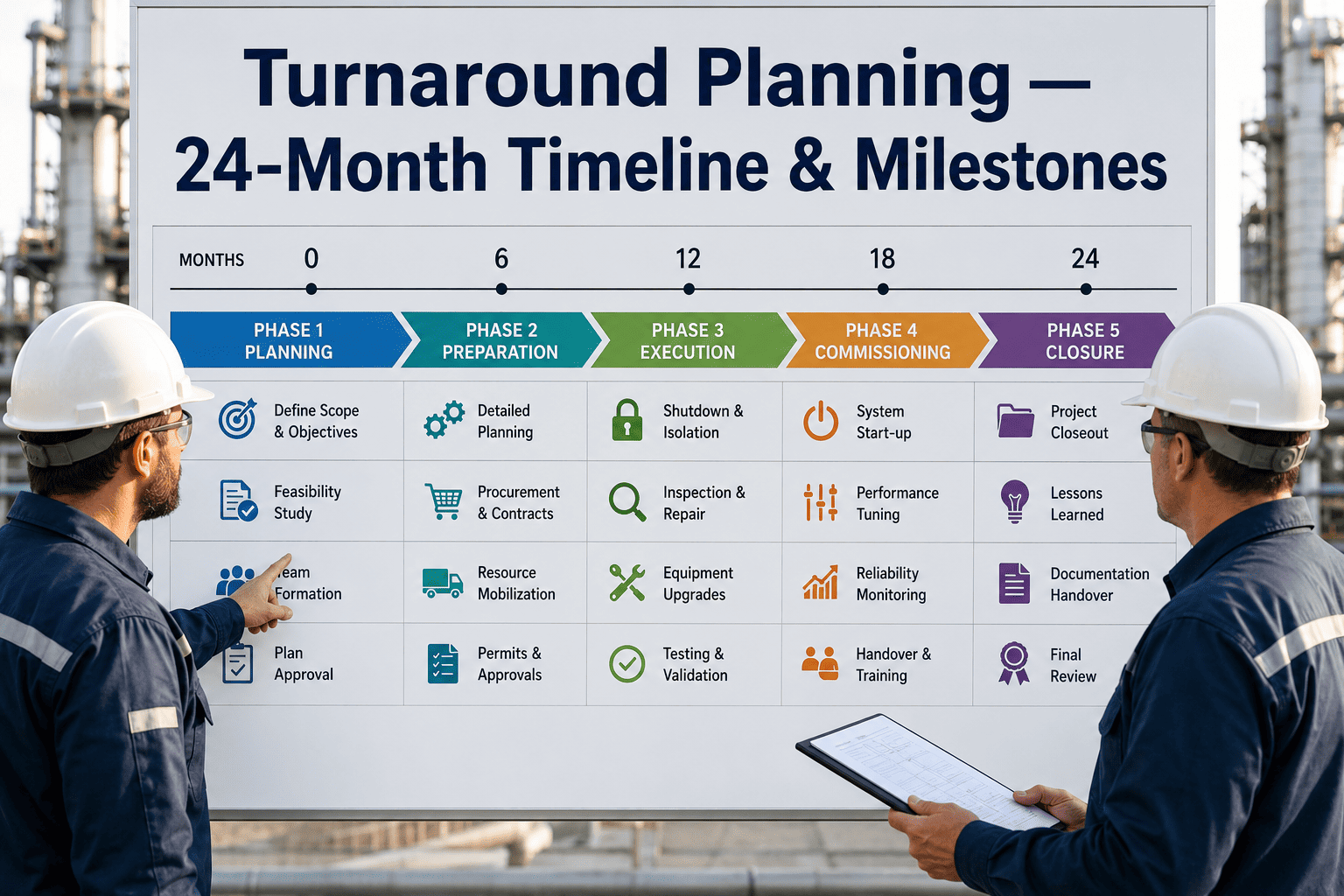
The Pre-Shutdown Phase Gate Timeline
Effective pre-shutdown preparation follows a phased sequence where each phase has a defined completion gate that must be signed off before the next phase begins. Plants that skip these gates or run them in parallel without signoff consistently report first-day delays that cascade through the entire turnaround schedule. The timeline below represents the industry-standard phase structure adapted for both refinery and upstream facility turnarounds.
4-6 Weeks Out
Scope Freeze & Work Package Release
All work packages are finalized, reviewed by engineering, and released to the procurement and scaffold teams. No new scope items are accepted after this gate without a formal change request process. Material requisitions are verified against the bill of materials, and any long-lead items that have not arrived are escalated with documented fallback plans. This is the single most critical gate because every subsequent phase depends on locked scope.
2-4 Weeks Out
Scaffold Pre-Build & Material Staging
Scaffold erection begins on all accessible equipment while the unit is still online. Materials received from procurement are inspected, tagged with work package references, and positioned in designated laydown areas mapped to the unit layout. Any materials failing inspection are flagged for replacement with a tracked expedite order. The staging verification process confirms that every work package has its complete material kit physically present and verified before the shutdown date.
Final Week
Equipment Isolation & Decontamination
Process isolations are prepared with spades, blinds, and spectacle plates positioned at their flange locations. Electrical and instrumentation isolations are documented on the permit system with lockout points identified. Decontamination procedures are executed according to the cleaning plan, including chemical circulation, steaming, purging, and gas testing. Each isolation point is verified and signed off by operations and maintenance jointly before the isolation certificate is issued.
Final 48 Hours
Readiness Review & Gate Closure
The turnaround manager conducts a formal readiness review against the pre-shutdown checklist. Every scaffold is inspected and tagged green. Every material kit is verified complete. Every isolation certificate is signed. Every contractor crew is confirmed mobilized with confirmed headcount by trade. Any open items are assigned to specific owners with completion deadlines that fall before the scheduled shutdown start time. The gate does not close until every item is resolved.
Equipment Isolation Preparation by Category
Isolation preparation is the most safety-critical pre-shutdown activity and the one most likely to be incomplete when the shutdown begins. Each isolation category requires a distinct set of preparation steps, verification methods, and signoff authorities. The following breakdown covers the four primary isolation categories that must be completed and certified before any mechanical work can begin on process equipment.
Process Isolation
Spades, blinds, and spectacle plates procured and matched to flange specifications
Double block and bleed valves verified functional with upstream and downstream pressure test
Positive isolation drawings updated to reflect current as-built piping configuration
Isolation points physically walked and verified by operations supervisor before shutdown
Energy isolation certificates prepared with exact valve positions and lockout points documented
Electrical Isolation
Motor control centers identified with exact breaker numbers for each piece of equipment
Lockout tagout devices procured and assigned to specific work packages and craft personnel
Voltage verification procedures documented with calibrated test equipment assigned
Temporary power requirements mapped for lighting, welding, and tool connections
Electrical isolation certificates linked to work packages in the permit system
Instrument Isolation
Instrument impulse lines identified and isolation procedures documented for each device
Control valve bypass arrangements prepared where process isolation alone is insufficient
DCS and SIS loop removal procedures coordinated with control room operations
Instrument air supplies mapped with isolation valves identified for each pneumatic device
Calibration requirements documented for instruments that will be reinstalled after the turnaround
Utility Isolation
Steam, cooling water, nitrogen, and fuel gas isolation points identified and verified
Temporary utility connections planned for hydrotesting, flushing, and catalyst loading
Utility tie-in points physically marked with corresponding isolation valve numbers
Drain and vent connections verified open and clear for equipment depressurization
Utility isolation certificates prepared with cross-reference to affected equipment list
Decontamination Preparation Sequence
Decontamination is the bridge between operations and maintenance, and it is where pre-shutdown schedules most frequently break down. A piece of equipment cannot be opened until decontamination is verified complete, and every hour spent waiting for gas tests or additional cleaning is an hour of idle contractor labor burning through the turnaround budget. The decontamination sequence must be planned, resourced, and executed as a dedicated sub-project within the pre-shutdown phase.
Step 1
Chemical Circulation & Washing
Circulate cleaning solvents or caustic solutions through process piping and vessels according to the cleaning procedure. Duration varies from four to forty-eight hours depending on the product handled and the level of hydrocarbon or chemical residue. The cleaning solution is sampled at multiple points to verify that contaminant levels have dropped below the threshold specified in the decontamination plan before moving to the next step.
Step 2
Steam Purging & Water Flushing
Introduce steam into the system to displace residual chemical cleaning solutions and volatilize remaining hydrocarbons. Follow with water flushing to remove dissolved solids and carryover from the steam purge. Drain points are monitored for clarity, pH, and hydrocarbon content. This step typically requires temporary steam and water connections that must be staged and tested during the pre-shutdown phase, not improvised after the unit is down.
Step 3
Nitrogen Purging & Displacement
Displace air from the system with nitrogen to create an inert atmosphere that prevents flash fires during equipment opening. Nitrogen supply must be confirmed at the required flow rate and pressure, with temporary hoses and connections staged at each entry point. Oxygen levels are monitored continuously during the purging process and must read below the threshold specified in the hot work and confined entry permits before any flange is broken.
Step 4
Gas Testing & Certification
Certified gas testers measure LEL, oxygen, hydrogen sulfide, and carbon monoxide at every planned opening point. Results are documented on the gas test certificate with the tester's name, timestamp, and instrument serial number. Any point that fails gas testing is re-purged and re-tested until it passes. The gas test certificate is the final document that releases a piece of equipment for mechanical work, and it must be issued before the work permit is activated.
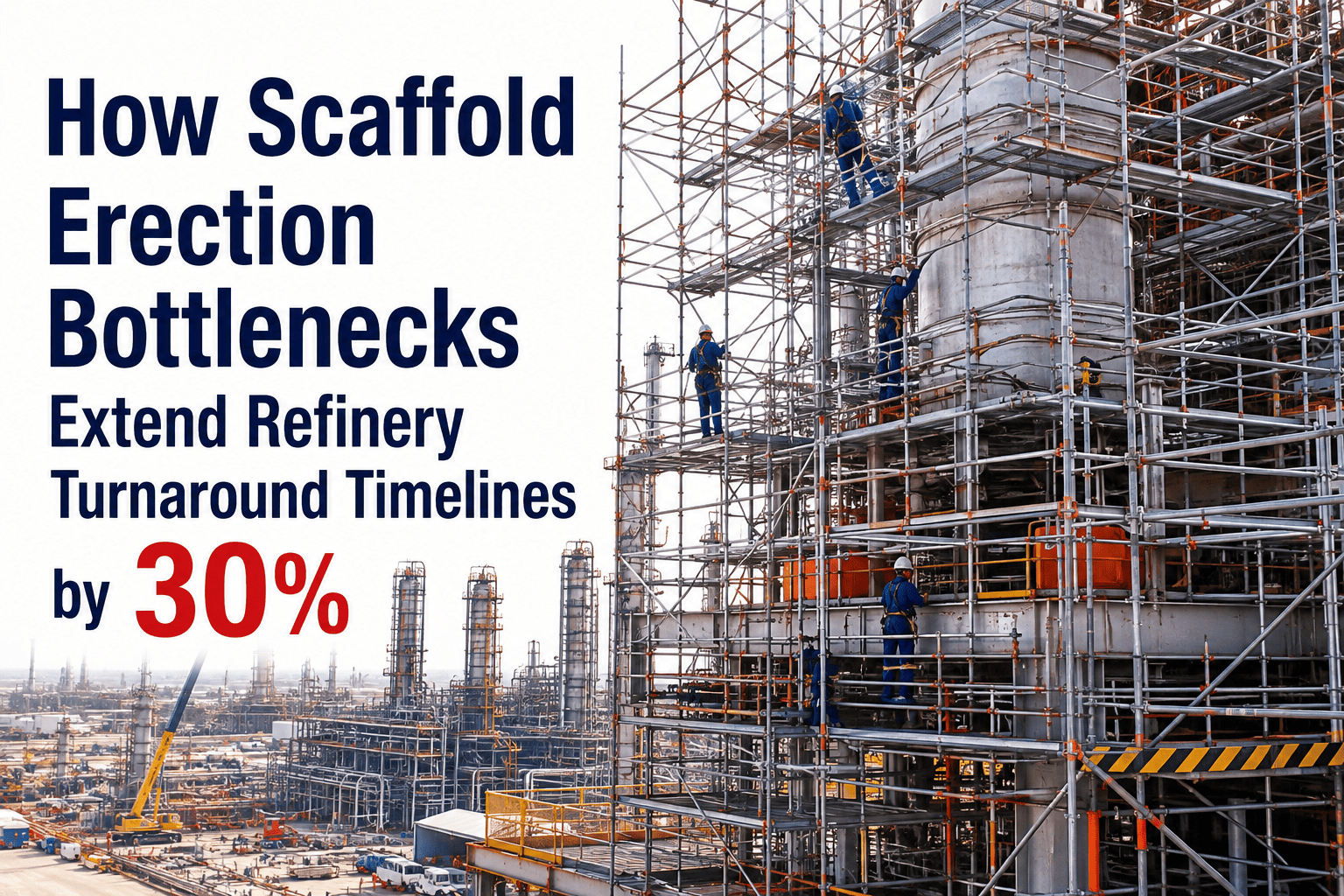
Scaffold Pre-Build Coverage Targets
Scaffold pre-build is the single most visible indicator of pre-shutdown readiness. When a turnaround begins and crews arrive to find scaffold already erected, inspected, and tagged green at their work locations, the first shift starts productively. When scaffold is not ready, crews stand down, contractor costs accumulate, and the schedule loses ground before any mechanical work has started. The following targets represent the pre-build coverage levels that high-performing plants achieve before the shutdown date.
85-95%
Ground-Level & Low-Elevation Scaffold
Scaffold at grade and below five meters that can be built while the unit is running. This includes vessel bottom access, heat exchanger bundle pull areas, and pump foundations. High-performing plants target near-complete coverage at this level because the safety and logistical barriers are lowest.
60-75%
Mid-Elevation Scaffold
Scaffold between five and fifteen meters including column access, platform extensions, and piping rack walkways. Pre-build at this level requires closer coordination with operations for hot work permits and fire watch coverage, but the time saved during execution justifies the additional planning effort.
30-50%
High-Elevation & Tower Scaffold
Scaffold above fifteen meters including tower internal platforms, distillation column tray access, and elevated flare stack work. Pre-build at this level is constrained by wind, structural loading, and proximity to live process equipment, but even partial completion before shutdown significantly reduces the critical path duration for tower work.
100%
Scaffold Inspection & Tagging
Every scaffold built before shutdown must pass a formal inspection by a certified scaffold inspector and receive a green tag before the turnaround start date. Scaffolds built but not inspected are not available for use and create a false impression of readiness that disappears when crews arrive and find red or missing tags.
Material Staging Verification by Category
Material staging is where the planning phase either delivers value or creates field chaos. A work package released to a crew without its complete material kit staged and verified is a guaranteed delay. The following verification levels show what plants measure at each material category during the pre-shutdown phase. These are not aspirational targets but the minimum verification standards required to prevent material-related delays during the first three days of execution.
Gaskets & Bolting
95% Verified
Valves & Specialty Fittings
88% Verified
Tray Components & Internals
82% Verified
Catalyst & Chemical Charges
90% Verified
Pump & Compressor Parts
78% Verified
Instrumentation & Electrical Devices
85% Verified
Temporary Piping & Hoses
72% Verified
Consumables & Welding Supplies
91% Verified
Pre-Shutdown Readiness Scorecard
The readiness scorecard provides a single-number assessment of whether the plant is prepared to go offline on the scheduled date. Each category is weighted based on its impact on first-shift productivity, and the overall score must meet the minimum threshold before the turnaround manager authorizes the shutdown to proceed. Plants that enforce this scoring system report significantly fewer first-day delays than plants that rely on informal go-no-go assessments.
Scope & Work Packages
94%
Material Staging Verification
86%
Scaffold Pre-Build & Inspection
78%
Equipment Isolation Certificates
91%
Decontamination Completion
70%
Contractor Mobilization Confirmation
88%
Safety Permit Preparation
83%
Overall Readiness Threshold
84%
Minimum threshold for authorized shutdown: 80%. Categories below 75% trigger mandatory corrective action plans before the gate can close.
PRE-SHUTDOWN PREPARATION · TURNAROUND READINESS
Replace Your Pre-Shutdown Spreadsheet With a Readiness Platform
See how digital phase gating, material verification tracking, and readiness scoring eliminate first-day turnaround delays.
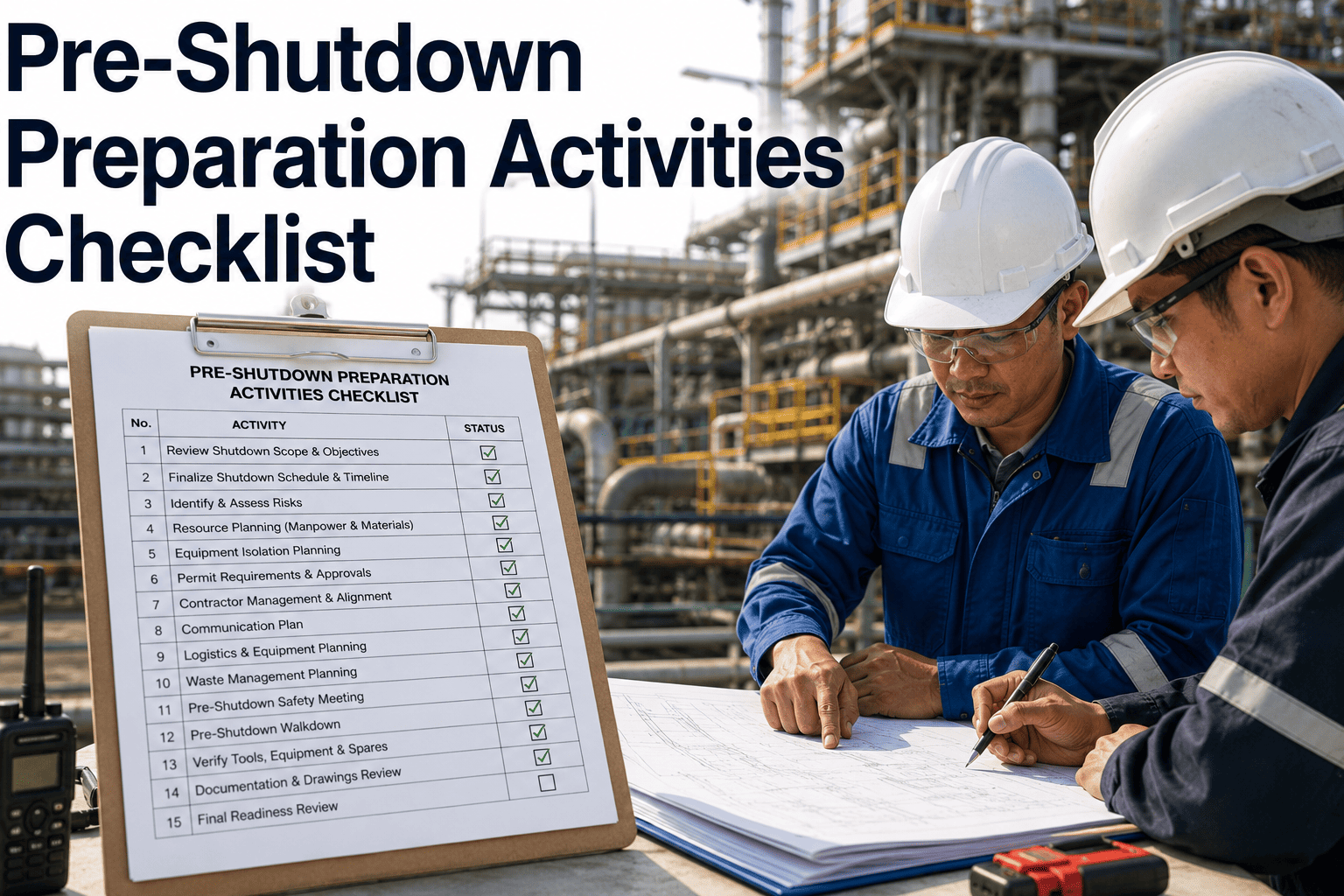
Complete Pre-Shutdown Activities Checklist
The following checklist consolidates every pre-shutdown activity into a single reference organized by category and timing. Each activity has a defined owner, a completion deadline relative to the shutdown date, and a verification method that confirms the activity was completed to standard. This is the checklist that should be loaded into a digital tracking system rather than managed as a shared spreadsheet that nobody updates after the first week.
| Activity |
Category |
Timing |
Verification Method |
| Finalize and freeze all work packages |
Scope |
T-6 weeks |
Engineering signoff on each package |
| Verify all materials received against BOM |
Materials |
T-4 weeks |
Warehouse receipt vs work package BOM reconciliation |
| Begin scaffold pre-build at grade level |
Scaffold |
T-4 weeks |
Scaffold inspection log with green tags issued |
| Stage materials in laydown areas by work package |
Materials |
T-3 weeks |
Material kit verification checklist signed by staging lead |
| Prepare positive isolation drawings |
Isolation |
T-3 weeks |
Operations and maintenance joint walkdown signoff |
| Position spades, blinds, and spectacle plates |
Isolation |
T-2 weeks |
Physical verification at each flange location |
| Execute chemical circulation and washing |
Decontamination |
T-10 days |
Sample analysis results below contaminant threshold |
| Complete steam purging and water flushing |
Decontamination |
T-7 days |
Drain point monitoring logs with clarity and pH records |
| Issue electrical isolation certificates |
Isolation |
T-5 days |
LOTO device assignment log with craft personnel signoff |
| Complete nitrogen purging and gas testing |
Decontamination |
T-3 days |
Gas test certificates with LEL, O2, H2S, CO readings |
| Confirm contractor crew mobilization by trade |
Mobilization |
T-3 days |
Contractor headcount confirmation with names by trade |
| Conduct formal readiness review |
Readiness |
T-48 hours |
Readiness scorecard above 80% threshold with all items closed |
What Happens When Pre-Shutdown Gates Are Skipped
The difference between a plant that enforces pre-shutdown phase gates and one that does not becomes visible within the first six hours of the shutdown. The following comparison is drawn from post-turnaround reviews across multiple refinery and upstream facilities, and it represents the consistent pattern that emerges when preparation is treated as optional rather than mandatory.
Gates Enforced
First shift crews find scaffold erected, inspected, and green-tagged at every work location
Material kits are staged and verified so crews begin work immediately upon permit issuance
Isolation certificates are complete and gas tests are current, so permits are issued without delay
Contractor headcount matches the plan so the staffing curve is accurate from hour one
First-day productivity exceeds 85% of plan, setting the pace for the entire turnaround
Gates Skipped
Crews arrive to find scaffold not built or built but not inspected with no green tags
Material kits are incomplete so crews spend the first shift tracking down gaskets and fittings
Isolation certificates are incomplete so permits cannot be issued and crews stand by
Contractor headcount is below plan because mobilization was not confirmed in advance
First-day productivity drops below 40% and the schedule never recovers the lost time
Safety Preparation Activities Before Shutdown
Safety preparation during the pre-shutdown phase goes beyond updating the emergency response plan. It includes a specific set of activities that must be completed, documented, and verified before any worker enters the unit during the execution phase. Each activity below has a direct link to incident prevention during the turnaround, and skipping any of them creates a gap that shows up in the safety statistics after the event.
01
Emergency Response Plan Update
Update the emergency response plan to reflect the specific hazards present during the turnaround, including confined space entry points, hot work locations, crane lift zones, and temporary fire watch positions. Conduct a tabletop exercise with the emergency response team that walks through a simulated incident at the most high-risk work location in the turnaround scope.
02
Permit-to-Work System Configuration
Configure the permit system with all turnaround-specific permit types, hazard classifications, and approval workflows before the first permit is requested. Verify that every isolation certificate is linked to its corresponding work package so that permit issuers can confirm isolation status in real time rather than relying on paper certificates that may not reflect current field conditions.
03
Gas Monitoring Equipment Deployment
Deploy fixed gas monitoring systems at all confined space entry points and hot work zones. Verify calibration on all portable gas detectors assigned to turnaround personnel. Confirm that the continuous monitoring alarm thresholds match the values specified on the gas test certificates and that alarm response procedures are communicated to every shift supervisor before the shutdown begins.
04
Contractor Safety Orientation Completion
Verify that every contractor worker scheduled for the turnaround has completed the facility-specific safety orientation within the past twelve months. Cross-reference the contractor personnel roster against the orientation completion records. Any worker without a current orientation record must complete the orientation before receiving a site badge, and this verification must happen before the shutdown date, not at the gate on the first morning.
Turnaround Planners Ask
What is the single most impactful pre-shutdown activity for reducing turnaround duration?
Material staging verification consistently shows up as the highest-impact pre-shutdown activity because it directly determines whether the first shift of execution can start work immediately or spends hours tracking down materials. Plants that verify every material kit against its work package bill of materials before the shutdown date report first-day productivity rates fifteen to twenty points higher than plants that rely on warehouse receipts alone, since a material can be received by the warehouse but not staged at the correct laydown location for the work package that needs it. Teams can
book a demo to see how digital material verification tracking automates this process.
How do we handle pre-shutdown preparation when the shutdown date shifts?
Shutdown date shifts are common in oil and gas, and they destroy pre-shutdown timelines when the preparation schedule is managed as a static list. The solution is to link every pre-shutdown activity to the shutdown date using relative timing rather than absolute dates, so that when the shutdown date moves, every activity deadline moves with it automatically. A digital platform handles this natively, but in a spreadsheet environment it requires manual recalculation of every deadline, which is error-prone and frequently results in activities being completed at the wrong time or missed entirely. Reach out to
support to learn how relative scheduling works in a pre-shutdown module.
Who should own the pre-shutdown readiness review and what authority do they need?
The readiness review should be owned by the turnaround manager with authority to delay the shutdown if the readiness scorecard does not meet the minimum threshold. This authority is the critical element, because without it the readiness review becomes a formality where open items are noted but the shutdown proceeds regardless. The turnaround manager must have the explicit backing of plant management to hold the shutdown date when critical pre-shutdown activities are incomplete, and this backing must be documented in the turnaround charter before the preparation phase begins.
How much scaffold should we realistically pre-build while the unit is still online?
Realistic pre-build targets depend on unit layout, process hazard levels, and the availability of certified scaffold builders with active site badges. For a typical refinery unit, eighty-five to ninety-five percent of ground-level scaffold, sixty to seventy-five percent of mid-elevation scaffold, and thirty to fifty percent of high-elevation scaffold are achievable pre-build targets. The key constraint at higher elevations is not scaffold capability but the need for hot work permits and fire watch coverage while the unit is live, which requires additional coordination with operations that many plants underestimate during their pre-shutdown planning.
How does digital tracking change the pre-shutdown process compared to spreadsheets?
Digital tracking eliminates the fundamental limitation of spreadsheet-based preparation, which is that the spreadsheet is only as current as the last person who updated it. In a digital platform, material staging verification, scaffold inspection status, isolation certificate signoff, and gas test results are entered directly by the people performing the work, and the readiness scorecard updates in real time. The turnaround manager sees the current readiness score at any moment without requesting a status update from four different departments, and any category falling below the threshold triggers an automatic notification to the responsible owner with the specific items that need attention before the gate can close.
PRE-SHUTDOWN CHECKLIST · TURNAROUND PREPARATION
Stop Losing the First Three Days of Every Turnaround
See how digital phase gating and readiness scoring ensure your next turnaround starts on schedule with every activity verified complete.