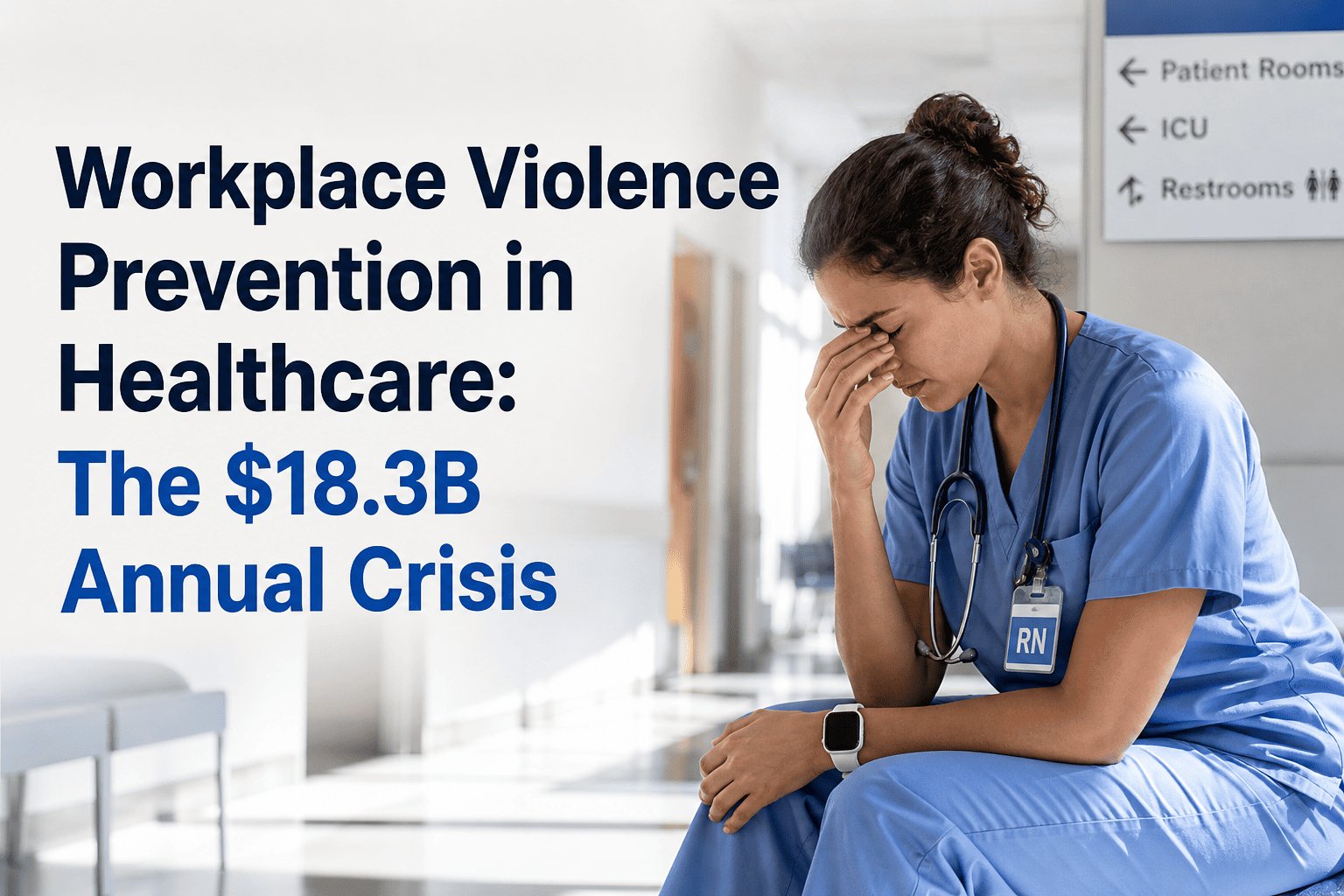
Workplace violence costs U.S. hospitals $18.3 billion annually — yet most healthcare systems still rely on reactive protocols that activate after harm is done. With 42% of nurse leaders reporting witnessed violence in their units, the question is no longer if your facility will face an incident, but how much it will cost when it does. Every hour without a structured prevention framework is a direct liability exposure — to your staff, your patients, and your bottom line.
Is Your Facility Protected Against Workplace Violence?
Deploy iFactory's Compliance Management module to automate incident tracking, enforce de-escalation protocols, and generate defensible audit trails across every unit.
The $18.3B Crisis Healthcare Leaders Cannot Ignore
Workplace violence in healthcare is not an HR issue — it is a financial and clinical operations crisis. The costs are layered, compounding, and largely invisible until a major incident forces a reckoning.
Direct Cost Per Incident
- Average workers' comp claim: $22,000+
- Litigation & settlement exposure per case
- Temporary staff backfill during recovery
- OSHA fines for non-compliant documentation
Workforce Impact
- Nurse turnover cost: $40K–$60K per RN
- 42% of nurse leaders report witnessed violence
- Burnout acceleration in high-incident units
- Recruitment brand damage over time
Regulatory Exposure
- CMS Conditions of Participation violations
- Joint Commission reporting requirements
- State-mandated prevention plan mandates
- Incomplete incident logs = legal liability
Patient Care Degradation
- Reduced staff-to-patient ratios post-incident
- Trauma-impaired clinical decision-making
- HCAHPS scores decline in unsafe environments
- Delayed care during active response events
Legacy Friction vs. iFactory Optimized Excellence
Most facilities still operate workplace violence programs built on paper logs, reactive escalations, and siloed department data. iFactory's Compliance Management module closes every one of these gaps — systematically.
| Operational Area | Legacy Friction | iFactory Optimized Excellence | Outcome Gained |
|---|---|---|---|
| Incident Reporting | Paper-based, delayed, incomplete | Real-time digital capture at point of care | 90% faster filing |
| Regulatory Audit Trail | Manually assembled, error-prone logs | Auto-generated immutable compliance records | Zero documentation gaps |
| De-escalation Tracking | No structured training verification | Protocol adherence logged per staff member | Measurable competency proof |
| Access Control Integration | Siloed badge systems with no alert logic | Unified access triggers tied to incident flags | Active threat containment |
| Leadership Visibility | Monthly aggregate reports, no trend data | Live dashboard with unit-level risk scoring | Proactive intervention |
| Staff Training Compliance | Annual checkbox sessions, no follow-up | Continuous micro-training with completion tracking | Sustained readiness culture |
Building a Defensible Prevention Framework: 5 Pillars
A compliant, effective workplace violence prevention program requires more than a policy binder. iFactory structures prevention across five operational pillars — each measurable, each auditable.
Risk Environment Assessment
- Unit-by-unit threat profiling using historical incident data
- Patient acuity scoring integrated with aggression risk flags
- Physical environment audit mapped to access control zones
Access Control & Physical Security
- Automated lockdown triggers tied to incident classification
- Visitor credentialing workflows with expiry enforcement
- Real-time badge anomaly alerts to security command
De-escalation Protocol Deployment
- Digital checklists pushed to staff devices at first warning signs
- Behavioral response logs tied to individual staff credentials
- Post-incident debrief templates auto-generated for supervisor review
Compliance Documentation & Regulatory Reporting
- Joint Commission-ready incident packets assembled automatically
- OSHA 300 log entries generated from structured incident data
- State-specific WPV prevention plan version control and attestation
Continuous Improvement & Trend Analysis
- Month-over-month incident trend visualization by unit and shift
- Predictive risk scoring to identify high-probability escalation windows
- Board-level summary reports exportable in PDF and GRC formats
How Prevention Infrastructure Drives Clinical & Operational Outcomes
Workplace violence prevention is not siloed from clinical performance — it is a direct driver of care quality, staff retention, and patient satisfaction scores. Here is how iFactory's Compliance Management module delivers measurable clinical impact.
- Safe environment signals improve staff engagement scores
- Documented protection protocols reduce post-incident PTSD rates
- Transparent incident tracking builds management trust
- Faster response containment reduces unit downtime
- Automated reallocation alerts maintain staffing ratios
- Structured post-incident recovery restores normal operations faster
- Always-on documentation eliminates surprise audit gaps
- Proof of training compliance per staff member on demand
- CMS and Joint Commission submission packages auto-generated
The 6 Integration Gaps That Expose Hospitals to Maximum Liability
Most hospitals are not failing at workplace violence prevention because of a lack of intent — they are failing because of structural gaps in how prevention programs are designed, documented, and enforced. These are the six most common failure points iFactory eliminates.
- No early warning scoring system in place
- Staff escalate to security only after aggression occurs
- Zero predictive intervention capability
- Incident reports across 3–5 disconnected systems
- No cross-unit trend analysis possible
- Regulatory submissions assembled manually from scattered logs
- Paper sign-in sheets cannot prove competency
- No per-staff adherence tracking to protocol steps
- Training gaps invisible until a sentinel event surfaces them
- Badge systems not connected to clinical incident flags
- Manual lockdown processes too slow during active events
- Visitor management disconnected from patient risk profiles
- CNO and CMO relying on lagging monthly reports
- No real-time unit-level risk scoring available
- Board-level reporting requires manual compilation
- No structured debriefing workflow for affected staff
- Root cause analysis not tied to documentation trail
- Corrective action plans not monitored for completion
Close Every Workplace Violence Gap — Before the Next Incident
iFactory's Compliance Management module gives your leadership team real-time visibility, automated documentation, and a legally defensible audit trail — from ED to behavioral health to surgical suites.
Frequently Asked Questions — Workplace Violence Prevention in Healthcare
Does iFactory integrate with our existing EHR and access control systems?
Yes. iFactory uses vendor-neutral APIs to connect with major EHR platforms and physical security infrastructure. Incident flags can trigger access control responses and pull relevant patient behavioral history — all within one unified dashboard.
How does iFactory help us meet Joint Commission and CMS requirements?
The Compliance Management module auto-generates structured incident records, training attestations, and regulatory submission packages aligned to Joint Commission EC and HR standards and CMS Conditions of Participation — always audit-ready. Book a Demo to review our compliance mapping.
What is the typical ROI timeline for a WPV prevention platform?
Most health systems see measurable ROI within 6–12 months via reduced workers' compensation claims, avoided OSHA penalties, and lower nurse turnover costs. Predictive analytics further reduce capital exposure by preventing high-cost sentinel events. Book a Demo to model your facility's ROI.
Can the platform scale across a multi-campus health system?
Absolutely. iFactory is architected for enterprise-scale deployment, supporting system-level dashboards with campus-level drill-down, unified policy management, and consolidated regulatory reporting across all facilities from a single control layer.
How does iFactory support staff after a violent incident?
The platform includes structured post-incident debriefing workflows, automatic escalation to Employee Assistance Programs, and root cause analysis templates — ensuring staff receive timely support and every corrective action is tracked to completion.
Build a Compliant, Scalable WPV Prevention Program Today
Join health systems that have replaced reactive incident management with proactive, AI-informed compliance infrastructure — protecting staff, patients, and institutional standing.