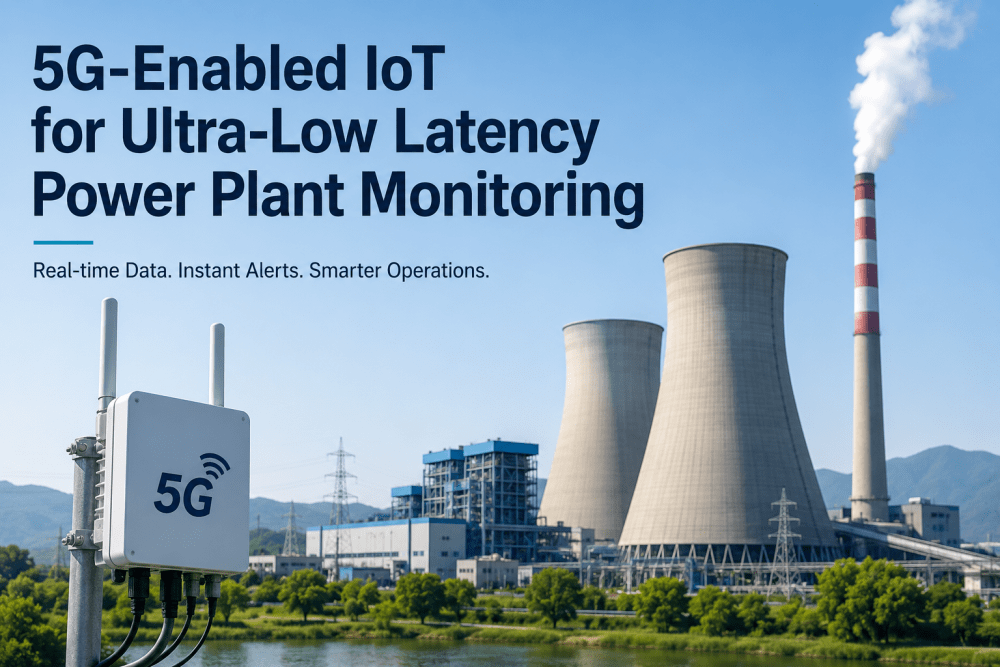
5G cellular technology is redefining what is possible for power plant monitoring by delivering sub-10-millisecond latency, massive device density, and deterministic reliability that previous wireless standards could not guarantee.Private 5G networks operating in the CBRS band or licensed spectrum deliver the deterministic performance that power generation assets demand — enabling plant operators to deploy comprehensive instrumentation across turbines, generators, transformers, and balance-of-plant equipment without the civil works cost of wired systems. Book a Demo to see how iFactory's 5G-enabled IoT platform delivers ultra-low latency monitoring for your power plant configuration.
Transform Your Power Plant Monitoring with 5G-Connected IoT Intelligence
iFactory's platform integrates private 5G connectivity, edge AI processing, and real-time sensor analytics to deliver the latency, bandwidth, and reliability that power generation monitoring demands — all from a single unified dashboard.
Why Power Plant Monitoring Needs 5G Connectivity
Power generation assets — gas turbines, steam turbines, generators, transformers, and balance-of-plant systems — generate rich streams of vibration, temperature, pressure, and emissions data that operators and reliability engineers need to monitor in real time. A single combined-cycle plant may have 500 to 2,000 permanent sensing points across its turbine halls, heat recovery steam generators, cooling towers, and electrical balance-of-plant. Running dedicated copper or fiber cabling to every sensor point imposes installation costs of $500 to $2,000 per point, creates single points of failure in cable trays and junction boxes, and makes reconfiguration expensive when monitoring priorities shift. Book a Demo to learn how iFactory's 5G IoT platform closes the connectivity gap and unlocks continuous real-time monitoring for every critical asset in your plant.
5G vs Traditional Connectivity for Power Plant Monitoring
Selecting the right connectivity medium for power plant IoT monitoring requires balancing latency, bandwidth, range, device density, and installation cost across the specific requirements of generation asset monitoring. The table below compares the four primary connectivity options available to plant operators.
| Parameter | 5G (Private) | 4G LTE | Wi-Fi 6 | Wired (Copper/Fiber) |
|---|---|---|---|---|
| Round-trip latency | 1-10 ms | 30-50 ms | 10-30 ms | 1-5 ms |
| Peak throughput per cell | 1-10 Gbps | 100-300 Mbps | 1-2 Gbps | 1-100 Gbps |
| Device density per km² | 1,000,000 | 100,000 | 2,000 | Limited by switch ports |
| Deterministic QoS | Network slicing | Best effort | Best effort | Dedicated |
| Installation cost per point | $100-300 | $100-300 | $150-400 | $500-2,000 |
| Mobility support | Seamless handover | Seamless handover | Limited | None |
| Security model | SIM-based + network slicing | SIM-based | WPA3 + VLAN | Physical isolation |
| Scalability for 500+ nodes | Excellent | Good | Constrained | Cost-prohibitive |
Evaluate which connectivity architecture fits your plant's monitoring requirements — Book a Demo to review your instrumentation plan with iFactory's 5G IoT specialists.
5G-Enabled IoT Application Areas in Power Plants
iFactory's 5G-enabled IoT platform supports a comprehensive set of monitoring applications across the power plant. Each application leverages the specific capabilities of private 5G — low latency, high bandwidth, or massive device density — to deliver continuous real-time visibility that wired or legacy wireless approaches cannot achieve at comparable cost.
High-Frequency Vibration Monitoring
Continuous streaming of 3-axis vibration data at sampling rates up to 50 kHz from gas turbine bearings, generator bushings, and steam turbine shaft sensors. 5G's sub-10ms latency and dedicated throughput enable real-time envelope analysis, bearing fault detection, and shaft orbit tracking that previously required direct cabling to a centralized data acquisition system.
Real-Time Thermal and Visual Inspection
Wireless thermal camera nodes positioned at turbine access covers, transformer bushings, and boiler wall panels stream 640×480 thermal images at 30 fps over the 5G network. Edge AI processes frames in real time to detect hot spots, refractory degradation, and steam leaks, while the 5G backhaul delivers processed alerts and retained image clips to the operations dashboard.
Transformers and Electrical Asset Monitoring
Dissolved gas analysis sensors, partial discharge detectors, and bushing capacitance monitors transmit data over the 5G network from step-up transformers, auxiliary transformers, and switchgear. The massive device density of 5G supports deployment of comprehensive electrical monitoring without the high cost of dedicated cable routes across the switchyard and transformer compound.
Emissions and Environmental Monitoring
CEMS analyzers, opacity monitors, and ambient air quality sensors across the plant site connect via 5G IoT modules, eliminating the need for dedicated serial cabling to each monitoring point. Continuous emissions data streams to compliance dashboards in real time, with AI-driven drift detection alerting operators to sensor degradation or calibration requirements before they affect reporting accuracy.
Asset Tracking and Workforce Safety
Ultra-wideband and 5G-based real-time location services track critical tools, spare parts, and personnel across the plant footprint with sub-meter accuracy. Geofencing alerts notify supervisors when workers enter hazardous zones, and lone-worker monitoring ensures rapid response to safety incidents — all operating over the same private 5G infrastructure that carries sensor data.
Private 5G Architecture for Power Plant Monitoring
Deploying private 5G for power plant IoT monitoring follows a layered architecture that separates the radio access network, edge compute, and application layers while maintaining deterministic quality of service across the full data path. The architecture supports both greenfield installations and overlay deployments on existing plant networks.
Sensor Layer and 5G Radios
Vibration sensors, thermal cameras, environmental monitors, and electrical asset sensors integrate with 5G IoT modules or customer-premises equipment that connect to the plant's private 5G small cells or macro base stations deployed in the turbine hall, switchyard, and balance-of-plant areas.
Private 5G Core and Edge
A compact 5G core (AMF, SMF, UPF, UDM) runs on-premises in the plant's data center or edge server rack, keeping user-plane traffic local for sub-10ms latency. Network slicing allocates dedicated resources to time-critical monitoring streams while sharing capacity for less demanding IoT applications.
AI Analytics and Processing
Edge AI servers ingest real-time sensor streams, performing inference for anomaly detection, vibration signature classification, thermal image analysis, and emissions drift monitoring. Time-series data is stored locally with selective replication to cloud or corporate data centers for long-term trend analysis.
Operations and Alerts Dashboard
Role-based dashboards present real-time asset health, trend charts, and predictive alerts to operators, reliability engineers, and plant management. Integration with iFactory's CMMS and work order management enables automated notification and dispatch when monitoring algorithms detect developing faults.
Ready to Deploy 5G-Enabled IoT Monitoring at Your Power Plant?
Power generation facilities across North America are deploying private 5G networks to unlock continuous real-time monitoring, eliminate wired infrastructure costs, and improve asset reliability with iFactory's AI-driven analytics platform.
Measurable ROI — What 5G-Enabled IoT Monitoring Delivers
The financial case for 5G-enabled IoT monitoring in power plants is built on three primary value drivers: reduced instrumentation and installation costs compared to wired alternatives, avoided failure costs from continuous real-time monitoring of previously unwired assets, and improved operational efficiency from comprehensive data visibility across the full generation fleet.
Infrastructure Cost Reduction
- Wireless sensor deployment eliminates $500-2,000 per point in cabling and conduit costs
- Private 5G covers entire plant footprint without repeaters or trenching
- Sensor addition and reconfiguration completed in hours rather than weeks
- Typical 500-point deployment saves $250,000-750,000 in installation costs vs wired
Failure Avoidance and Reliability
- Continuous monitoring of previously unwired assets detects faults 2-6 weeks earlier
- Real-time vibration streaming catches bearing degradation before catastrophic failure
- Thermal imaging over 5G enables continuous transformer hot-spot monitoring
- Emergency outage costs of $200,000-500,000 avoided per severe event
Operational Efficiency Gains
- Comprehensive data visibility reduces forced outage duration by 20-35%
- Condition-based maintenance replaces calendar-based schedules for unwired assets
- Workforce productivity improves with real-time location and safety monitoring
- Annual O&M cost reduction of $150,000-400,000 per plant through optimized maintenance
Conventional vs 5G-Enabled Monitoring Approaches
The table below illustrates how 5G-enabled IoT monitoring transforms every dimension of power plant condition monitoring — from deployment speed and coverage flexibility to data granularity and maintenance outcomes.
- Dedicated copper or fiber cabling to each sensor point
- Sensor deployment requires outage windows for cable routing
- Fixed monitoring points — reconfiguration requires new cabling
- Vibration data sampled at 10 kHz due to cable bandwidth limits
- Thermal imaging limited to fixed camera positions with wired backhaul
- Sensor additions cost $500-2,000 per point in installation
- Wireless 5G connectivity — no cabling required for sensor backhaul
- Sensors deployed during normal operation without outage planning
- Flexible sensor network — nodes added or moved in hours via software
- Vibration data streamed at 50 kHz over 5G for full bearing analysis
- Wireless thermal camera nodes deployed at any inspection point
Industry Perspective — 5G's Role in Power Generation Monitoring
"The power generation industry has been slow to adopt wireless monitoring because the available technologies — Wi-Fi and 4G LTE — simply could not deliver the deterministic performance that turbine and generator protection systems demand. I spent fifteen years as a reliability engineer at a major independent power producer, and every time the controls team evaluated wireless for a new monitoring application, we hit the same wall: Wi-Fi had too much latency jitter for vibration envelope analysis, and 4G introduced 40-50 millisecond round-trip delays that made real-time alarming unreliable. The result was that we only monitored about 60 percent of our critical assets with permanent instrumentation — everything else relied on monthly walk-downs with handheld data collectors. We missed a generator bushing failure at one of our plants that cost over $800,000 in repair costs and lost revenue because the monthly thermal scan caught the hot spot only a week before the bushing failed — too late to schedule an orderly replacement. "
5G IoT Deployment Roadmap — From Assessment to Full Operation
Deploying a private 5G IoT monitoring solution follows a structured four-phase methodology that delivers incremental value at each stage while building toward comprehensive plant-wide coverage.
Connectivity Assessment and Spectrum Planning
Comprehensive RF survey of the plant site to identify coverage requirements, interference sources, and optimal small-cell or macro-cell placement. Spectrum selection — CBRS GAA or PAL in the United States, or licensed spectrum in other jurisdictions — based on plant size, device count, and latency requirements. Bandwidth planning for simultaneous sensor streams, thermal video, and RTLS traffic.
Network Deployment and Sensor Integration
Installation of 5G small cells or macro base stations at planned locations, deployment of the on-premises 5G core and edge compute nodes, and provisioning of IoT modules for initial sensor deployment. Integration with existing plant DCS, PLC, and CMMS systems using OPC-UA and MQTT gateways. Network slicing configuration for differentiated QoS across monitoring applications.
AI Model Training and Dashboard Activation
Baseline data collection for 4-6 weeks to train AI models on normal operating signatures for each monitored asset — turbine vibration profiles, transformer thermal gradients, and emissions sensor patterns. Deployment of iFactory's monitoring dashboard with real-time asset health scores, trend charts, and tiered alert thresholds validated against historical failure data.
Expansion and Continuous Optimization
Incremental addition of sensor nodes to expand coverage to remaining assets and balance-of-plant systems. Continuous model retraining as new operating data accumulates. Monthly ROI reviews tracking installation cost savings, avoided failures, and operational improvements. Expansion to additional generating units or sister plants using the proven deployment template.
The Future of Power Plant Monitoring Is 5G-Connected and AI-Driven
Private 5G networks represent a generational leap in what is possible for power plant IoT monitoring — delivering the latency, bandwidth, device density, and deterministic quality of service that generation assets require, at a fraction of the installation cost of wired alternatives. Power plants that deploy 5G-enabled monitoring achieve comprehensive instrumentation coverage across turbines, generators, transformers, and balance-of-plant systems that was previously cost-prohibitive, enabling continuous real-time condition awareness that reduces forced outages, extends equipment life, and improves operational efficiency.
Book a Demo to start your 5G-enabled monitoring journey with iFactory.
Transform Your Power Plant Monitoring with 5G-Connected IoT Intelligence
iFactory's platform integrates private 5G connectivity, edge AI processing, and real-time sensor analytics to deliver the latency, bandwidth, and reliability that power generation monitoring demands — all from a single unified dashboard.
5G-Enabled IoT for Power Plant Monitoring — Frequently Asked Questions
5G delivers three capabilities that Wi-Fi and 4G LTE cannot match for industrial monitoring applications: sub-10-millisecond deterministic latency that enables real-time vibration envelope analysis and control-loop applications, massive device density supporting up to one million devices per square kilometer for comprehensive sensor deployment across the entire plant footprint, and network slicing that guarantees dedicated bandwidth and latency for time-critical monitoring streams even when the network is carrying other traffic.
A private 5G network for a power plant consists of small cells or macro base stations deployed in key areas — turbine hall, generator deck, transformer compound, cooling tower area, and balance-of-plant — connected to an on-premises 5G core that handles authentication, mobility management, and user-plane routing. The on-premises core keeps all sensor data traffic local, ensuring sub-10ms latency without backhaul to a remote data center. Network slicing allocates dedicated radio resources to time-critical monitoring applications — for example, turbine vibration streaming receives higher priority than environmental monitoring or asset tracking traffic.
Applications that require high bandwidth, low latency, or massive device density benefit most from 5G. High-frequency vibration monitoring — sampling at 25 to 50 kHz for bearing fault detection, gearbox analysis, and shaft orbit tracking — requires the deterministic throughput that 5G delivers. Real-time thermal imaging cameras streaming 640x480 or higher resolution at 30 frames per second benefit from 5G's multi-gigabit cell throughput. Dissolved gas analysis, partial discharge monitoring, and bushing capacitance tracking on transformers and switchgear benefit from the ability to deploy comprehensive electrical monitoring across the switchyard without dedicated cabling. Emissions monitoring with multiple CEMS analyzers and ambient sensors across the plant site benefits from 5G's device density and wide area coverage. Asset tracking and workforce safety applications benefit from the unified infrastructure that carries both sensor data and location services over the same 5G network.
iFactory's 5G IoT platform is designed for overlay deployment on existing plant infrastructure without replacing or disrupting current control systems. The platform integrates with plant DCS and PLC systems through industry-standard OPC-UA and MQTT gateways, enabling sensor data collected over the 5G network to be fed into existing HMIs and historian databases alongside data from wired instruments. The iFactory dashboard runs alongside the plant's existing monitoring systems, providing AI-driven analytics and predictive alerts without requiring changes to control system configuration. Integration with existing CMMS platforms enables automatic work order generation when predictive analytics detect developing faults, and the platform's REST APIs support custom integration with plant-specific reporting and compliance tools.