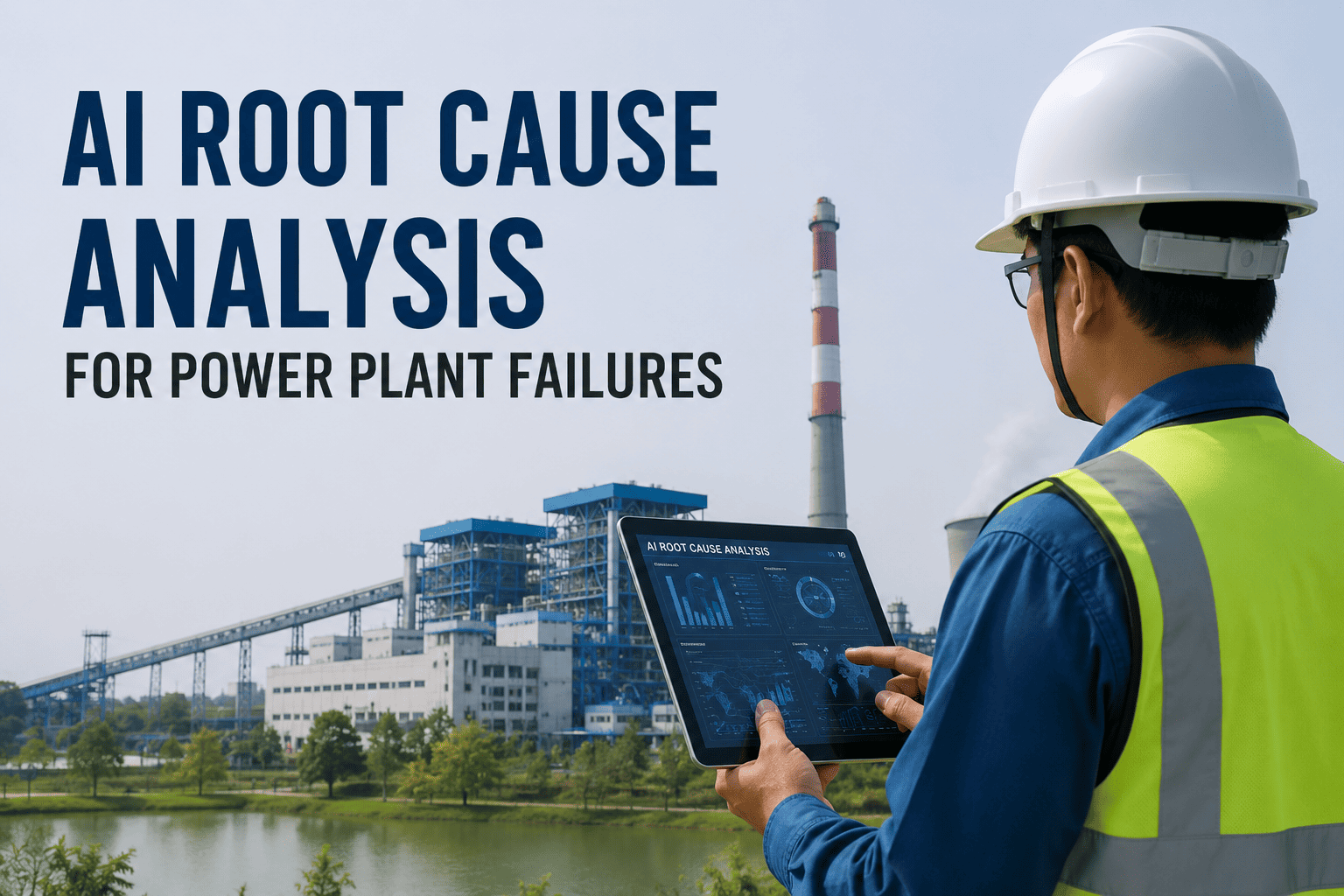
A root cause investigation that takes three weeks to complete is not slow because the underlying cause was hard to find. It is slow because the evidence, sensor trends, maintenance logs, prior work orders, and operator notes, lives scattered across systems that were never built to talk to each other, and someone has to manually stitch that evidence together before any actual analysis can begin. By the time a report reaches the review committee, the plant has often already had a second, unrelated failure that could have benefited from the same pattern the first investigation eventually uncovered. Book a demo to see how that evidence-gathering step can happen automatically instead of manually.
Slow Root Cause Analysis · AI-Assisted RCA
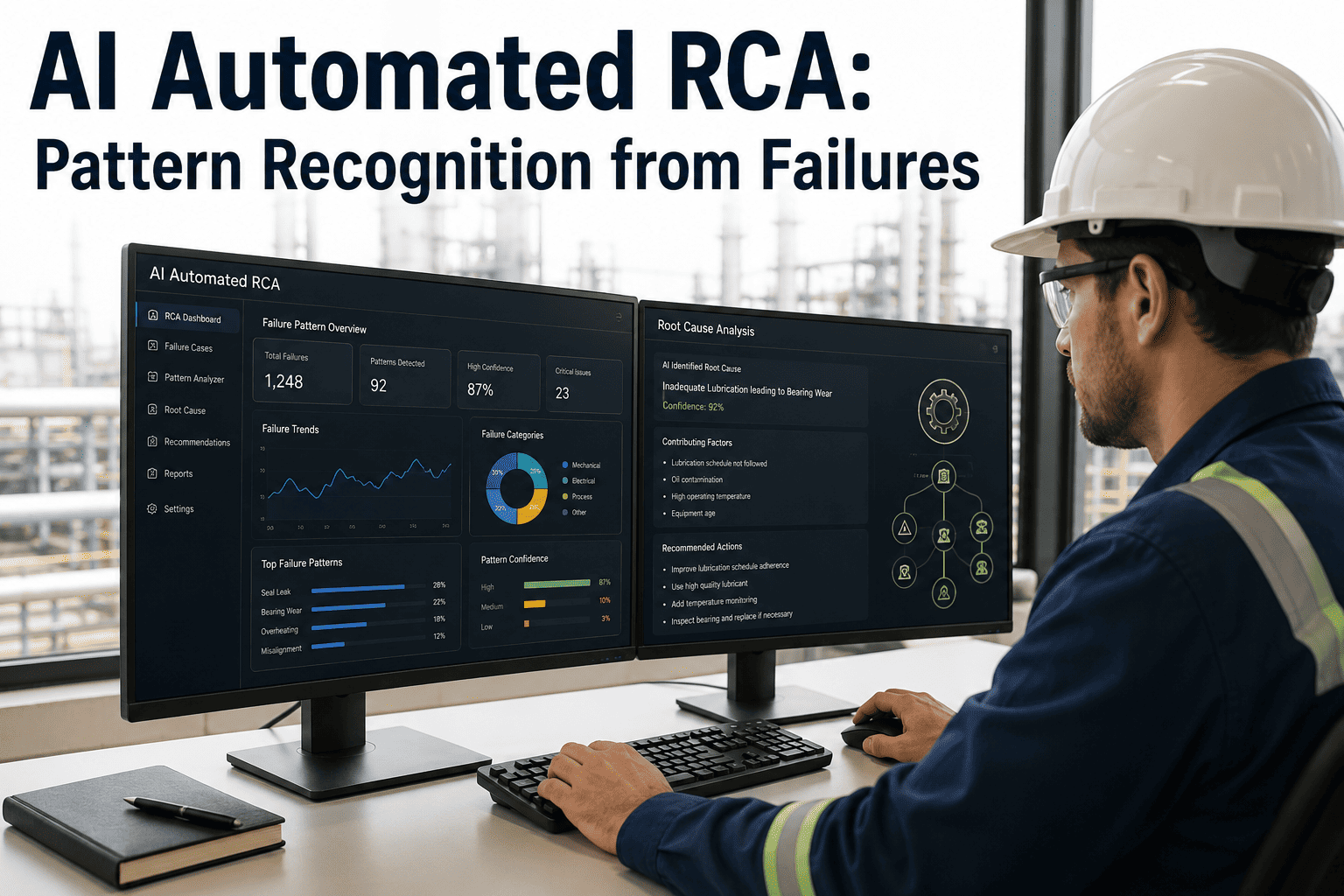
AI Automated RCA: Pattern Recognition From Historical Failure Data
The bottleneck in most root cause investigations is not analytical skill. It is the time spent assembling scattered evidence before analysis can even start. Pattern recognition against historical failure data closes that gap.
From Raw Data to Root Cause
All Failure Records
Pattern Clusters
Causal Candidates
Root Cause
How It Works
What Pattern Recognition Actually Adds to an Investigation
AI-assisted RCA does not replace the engineering judgment that closes out an investigation. What it changes is how quickly relevant evidence surfaces and how much historical context is available when that judgment gets applied, which is where most of the time in a manual investigation actually goes.
Failure Mode Clustering
Past failures with similar symptom signatures, whether that is a specific vibration pattern, a sequence of alarms, or a combination of process conditions, are grouped automatically, surfacing related incidents a manual search would likely miss.
Causal Factor Correlation
Conditions that consistently precede a given failure type across many historical events, such as a specific maintenance gap or a recurring process excursion, are identified statistically rather than relying on one investigator's memory of similar past events.
Cross-System Evidence Assembly
Sensor trends, work order history, and prior investigation findings tied to the same asset are pulled together automatically, eliminating the manual step of logging into multiple systems to reconstruct a timeline.
Pipeline
From Raw Event Data to a Ranked Set of Causal Candidates
1
Ingest Data Across Sources
Sensor history, maintenance records, and prior investigation reports tied to the affected asset are pulled together automatically as soon as a new failure event is logged, rather than requested manually from each system owner.
2
Extract Signature Features
Specific characteristics of the failure event, such as the sequence of alarms leading up to it or the trend shape of a relevant sensor in the hours beforehand, are identified as the features used to compare this event against historical ones.
3
Cluster Against Historical Failures
The current event's signature is compared against a library of past failures on similar equipment, surfacing the closest historical matches and any causal factors that were confirmed in those prior investigations.
4
Present Ranked Causal Candidates
Rather than a single automated answer, the investigator receives a ranked list of plausible causal factors backed by the supporting evidence and historical precedent, ready for engineering judgment to confirm or rule out.
iFactory Assembles the Evidence So Investigators Start With Context, Not a Blank Page.
Historical failure patterns, related work orders, and prior investigation findings surface automatically the moment a new failure is logged, cutting the evidence-gathering phase from days to minutes.
What It Catches
Patterns a Manual Investigation Often Misses
Cross-Asset Recurrence
The same failure mode occurring on different equipment across a plant or fleet is easy to miss when each investigation is filed separately, but stands out immediately once patterns are compared across the full historical record.
Slow-Developing Precursors
A condition that developed gradually over months before a failure, such as a slowly rising vibration trend, is far more visible when compared programmatically against a full historical baseline than when reviewed manually in isolation.
Institutional Knowledge Gaps
When the engineer who investigated a similar failure five years ago has since left the plant, that precedent is only useful if it was captured in a way that can still be found and matched against a new event today.
Before vs. After
Manual RCA vs. AI-Assisted RCA
Category
Manual RCA
AI-Assisted RCA
Evidence Gathering
Investigator manually pulls records from multiple disconnected systems
Relevant evidence assembled automatically the moment a failure is logged
Historical Comparison
Limited to what the investigator personally remembers or can search manually
Full historical failure library compared automatically for similar patterns
Time to First Findings
Often one to three weeks before a preliminary causal hypothesis is formed
Ranked causal candidates available within hours of the event being logged
Cross-Site Patterns
Rarely visible unless someone happens to remember a similar case elsewhere
Surfaced automatically when the same failure signature recurs across assets
Knowledge Retention
Tied to individual investigators, at risk when experienced staff leave
Captured in a searchable pattern library that persists beyond any one person
Validation
Why Engineering Judgment Still Closes Out the Investigation
A ranked list of causal candidates is a starting point for investigation, not a final answer, and treating it as one without validation undermines the credibility of the entire program. The following checks keep AI-assisted findings grounded in engineering reality before they go into a final report.
A
Confirm that the top-ranked causal candidate is physically plausible for the specific equipment and operating conditions involved, not just statistically correlated in the historical data.
B
Review the supporting evidence behind each ranked candidate directly, since the underlying sensor trends or work order history should make sense to an engineer familiar with the equipment.
C
Check whether the matched historical failures were themselves confirmed through a completed investigation, rather than an open or inconclusive one that could propagate an unverified assumption.
D
Document any disagreement between the ranked candidates and the investigator's final conclusion, since that discrepancy itself is useful feedback for refining future pattern matching.
Avoid These
Common Mistakes When Adopting AI-Assisted RCA
Treating the Top Match as a Confirmed Cause
A statistically strong pattern match is a lead worth investigating, not a conclusion, and skipping the confirmation step risks closing out a report based on correlation rather than verified causation.
Feeding It Incomplete Historical Data
Pattern recognition is only as good as the historical record it draws from, and gaps in past investigation documentation limit how much useful precedent the system can actually surface.
Skipping the Physical Plausibility Check
A pattern that correlates strongly in the data but does not make physical sense for the specific failure mechanism involved needs to be ruled out explicitly rather than accepted at face value.
Not Feeding Confirmed Findings Back In
Each closed investigation is a data point that improves future pattern matching, and skipping that feedback loop means the system never gets better at recognizing the specific failure signatures your plant actually experiences.
From the Field
A Bearing Failure That Matched a Pattern From a Different Unit
We had a bearing failure on one of our pumps and the vibration signature looked unusual enough that we expected a long investigation. The pattern match came back pointing to a nearly identical failure on a different pump three years earlier, on a different system entirely, that had been traced to a lubrication supplier change. Nobody on the current team remembered that investigation. We checked our lubrication records and found the same supplier change had happened on this pump's system about four months before the failure. That single match saved us what would have been at least a week of testing oil samples and chasing other theories first.
— Reliability Engineer, Process Manufacturing Facility, Southeast Region
3 yrsAge of the matched historical investigation
1Lubrication supplier change confirmed as the link
1 wk+Investigation time saved versus starting from scratch
Conclusion
Faster RCA Comes From Faster Evidence, Not Faster Judgment
The slowest part of most root cause investigations has never been the final analytical step. It is the days spent tracking down scattered evidence and trying to remember whether something similar happened before, somewhere else, to someone who may no longer be on the team. Pattern recognition against historical failure data closes that specific gap without replacing the engineering judgment that ultimately confirms the finding.
iFactory assembles cross-system evidence and surfaces matched historical patterns automatically the moment a failure is logged, so investigations start with context instead of a blank page. Book a demo to see how this applies to your RCA process.
Frequently Asked Questions
AI-Automated RCA — Common Questions
Does AI-assisted RCA replace the need for an investigator?
No. Pattern recognition surfaces likely causal candidates and the historical evidence behind them, but confirming physical plausibility and closing out the investigation still requires engineering judgment specific to the equipment and event involved. The value is in cutting the time spent gathering and comparing evidence manually, not in removing the investigator from the process.
Contact support for details on how findings are presented for engineering review.
How much historical data is needed before pattern matching becomes useful?
Useful pattern matching can begin with a modest historical record, though accuracy and the range of matched precedents improve as more investigations are documented and fed into the system over time. Plants with even a few years of reasonably complete investigation records typically see meaningful matches from the outset, with results improving further as the library grows.
Can pattern recognition catch a failure mode that has never happened before?
A genuinely novel failure mode with no historical precedent will not produce a strong pattern match, since there is nothing similar in the historical record to compare against. In that case, the system's value shifts toward assembling and organizing the current event's evidence quickly, still saving investigation time even without a matched precedent to point toward.
How is a ranked causal candidate actually validated before it goes into a report?
Each ranked candidate should be checked against physical plausibility for the specific equipment and reviewed against its supporting evidence directly by an engineer familiar with the system, rather than accepted purely on the strength of the statistical match. Matched historical failures should also be confirmed rather than open or inconclusive investigations, since propagating an unverified prior finding compounds the risk of an incorrect conclusion.
Book a demo to see how validation fits into the investigation workflow.
Does this approach work across different types of equipment and failure modes?
Pattern recognition is generally applicable across equipment types and failure modes as long as there is enough relevant historical data for that specific category, since the underlying approach is about comparing signatures and correlating causal factors rather than being built around one specific failure mechanism. Coverage and accuracy naturally improve fastest in equipment categories with the most historical investigation data available.
Turn Historical Failures Into a Searchable Pattern Library
Cross-system evidence assembled automatically and matched against past investigations, so root cause investigations start with context instead of a blank page.