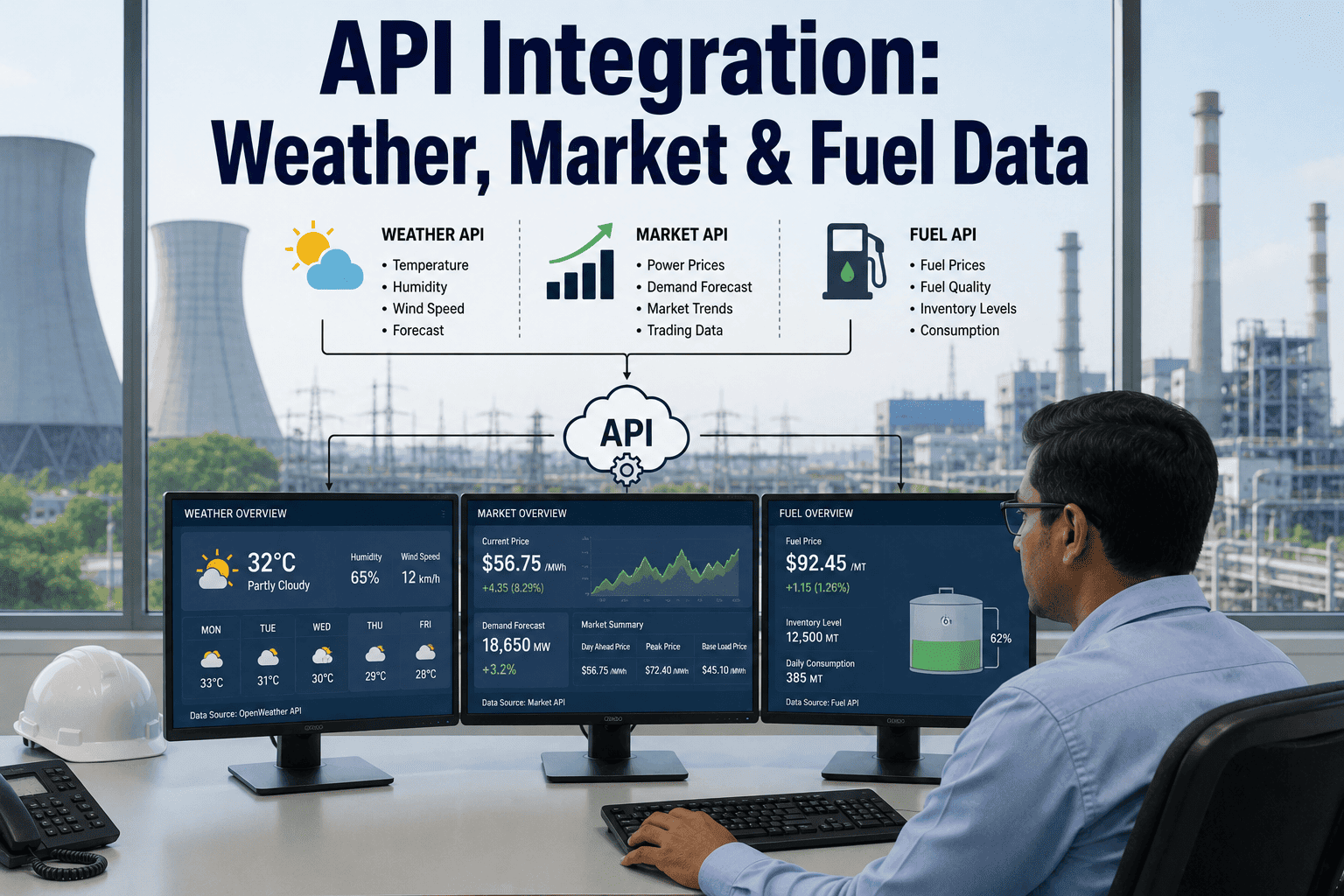
A power plant's most important decisions of the day rarely come from inside its own control room — they come from what the weather is about to do, what the market is about to pay, and what the next fuel delivery actually contains. A dispatcher deciding whether to ramp a unit, a trader deciding whether to bid into the day-ahead market, and an operator deciding how to trim combustion for a lower-quality fuel batch are all making decisions based on data that originates outside the plant boundary. When that external data arrives late, manually, or not at all, every one of those decisions gets made with a stale picture of reality. iFactory connects weather, market, and fuel data directly into plant systems through API integration, so the external signals that actually move plant economics arrive in time to act on.
API Integration: Bringing Weather, Market, and Fuel Data Into Plant Decisions
iFactory integrates external weather forecasts, electricity market prices, and fuel quality data directly into your plant's operational systems through API connections — turning outside signals your team currently checks manually into inputs your dispatch and combustion decisions can act on automatically.
Three External Signals That Change Plant Economics Every Hour
Not every external data source deserves the same integration priority. Three feeds consistently move the financial and operational outcome of a plant's day the most — and each one changes the picture on a different timescale, which is exactly why manual, once-a-shift checking leaves so much value on the table.
How the Integration Actually Works: From External API to Operational Decision
The technical path from a public or vendor API to a decision an operator or trader actually acts on involves several stages most plants currently perform manually, one browser tab and one spreadsheet at a time. API integration collapses that path into a continuous automated pipeline.
Where Each Data Feed Changes a Specific Operational Decision
The value of integrating an external feed is easiest to justify when it is tied to a specific decision it improves, rather than treated as a generic data source. The table below maps each feed to the operational calls it most directly informs.
| Operational Decision | Without Integrated External Data | With API-Integrated External Data |
|---|---|---|
| Ramp Rate and Start Timing | Dispatchers react to demand shifts after they appear on the load curve, often after a weather-driven swing has already begun | Weather-driven demand shifts are anticipated ahead of time, allowing ramp and start decisions to be planned rather than reactive |
| Day-Ahead Market Bidding | Bids are built from end-of-day price snapshots and manual research, missing intraday volatility that develops after the bid is submitted | Bidding incorporates continuously updated price forecasts correlated with weather and demand signals for the same window |
| Combustion Tuning Per Fuel Batch | Combustion settings are adjusted only after a quality issue shows up in emissions or efficiency data, well after the batch is already burning | Incoming fuel quality data adjusts combustion parameters proactively as each new batch is received and characterized |
| Reserve and Standby Planning | Standby capacity decisions rely on generic seasonal assumptions rather than the specific forecast for the coming days | Reserve planning reflects the actual near-term weather and demand forecast, avoiding both under- and over-provisioning |
| Extreme Weather Response | Storm or heat-wave preparation begins once conditions are already visible locally, leaving a narrow window to adjust staffing and fuel stock | Forecast-driven alerts give operations days of lead time to pre-position fuel, staffing, and maintenance schedules ahead of extreme conditions |
iFactory integrates weather, market, and fuel data providers directly into your dispatch, trading, and combustion workflows through API connections calibrated to your existing systems — no manual data pulls, no stale spreadsheets.
Manual Data Pulls vs Integrated API Feeds: The Daily Operational Difference
Plant teams that move from manually checking external sources to fully integrated API feeds consistently describe the change as less about convenience and more about how much earlier a decision can be made with confidence.
Expert Perspective: What Changes Once External Data Stops Being Manual
Before we integrated weather and market data directly into our dispatch workflow, our shift supervisors were checking three or four different websites and cross-referencing them against a spreadsheet built years earlier by someone who has since left the company. Nobody trusted it completely, and everybody knew it, but it was what we had. The thing that convinced leadership to prioritize the integration project was a single event — a fast-moving cold front that our weather provider had flagged nearly six hours ahead of when it actually hit our region, but that lead time never made it to the trading desk because the manual process only refreshed twice a day. We left significant margin on the table that day bidding into a market that moved against us right as the front arrived. Once the API feed was live, the same kind of forecast update reached the trading desk within minutes instead of hours, and our bidding accuracy on weather-sensitive days improved almost immediately. The fuel quality piece surprised us more than we expected — once intake data started flowing straight into our combustion tuning parameters, we stopped discovering fuel-batch problems after the fact through an efficiency dip, and started adjusting before the batch was even fully unloaded.
Frequently Asked Questions
iFactory integrates the external weather, market price, and fuel quality feeds that move your plant's economics directly into your dispatch, trading, and combustion workflows — so the team making the decision has the same current picture the market already does.