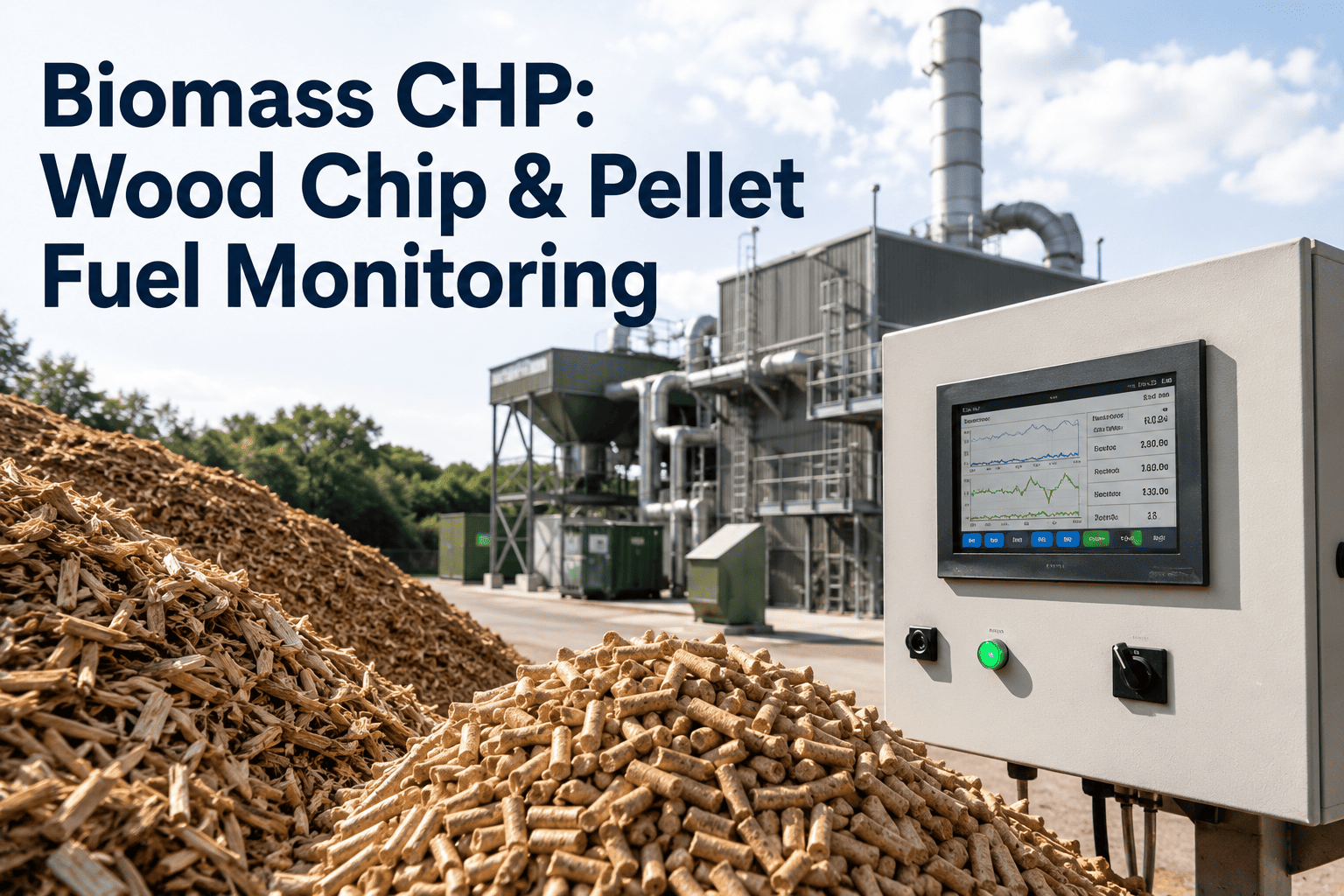
A biomass CHP plant is only as predictable as the fuel feeding it, and biomass is the least predictable fuel most plants ever burn. Moisture content can swing ten points between two deliveries from the same supplier, calorific value drops as storage time increases, and particle size distribution determines whether the feed system chokes or runs clean. Every one of these variables shows up downstream as steam output variability, unplanned derates, or heat-power imbalance that leaves either the process host or the grid short. Plants that book a demo with iFactory replace supplier certificates and periodic lab samples with continuous fuel quality monitoring tied directly into combustion and CHP dispatch decisions.
Biomass Fuel Quality Monitoring for Wood Chips & Pellets
Moisture, calorific value, ash content, and particle size all move independently — and every one of them changes how much heat and power your CHP plant can reliably deliver on a given hour.
Why Biomass Fuel Variability Drives CHP Heat-Power Imbalance
Combined heat and power plants are built around a design assumption: a given fuel input produces a predictable ratio of steam extraction for process heat and electrical output for the grid or host facility. Biomass breaks that assumption more than any other common CHP fuel, because wood chips and pellets are a biological product, not a manufactured one. A single truckload can contain wood from different tree species, harvested at different times, stored under different conditions, and chipped to different specifications — and the boiler has no way to sort any of that out before it hits the grate.
This variability is compounded by the fact that most biomass CHP plants source fuel from multiple suppliers simultaneously, each drawing from different forestry residue streams, sawmill byproducts, or dedicated energy crops, all of which carry distinct baseline quality characteristics before storage and handling variability is even added on top. A plant blending three or four supply streams in a given week is effectively trying to hold a stable combustion process against a moving target that changes composition every time the feed system draws from a different point in the yard.
When moisture content is higher than the combustion system was tuned for, more of the fuel's energy goes into evaporating water instead of generating steam, which shows up as reduced steam output at the same fuel feed rate. When calorific value drops because the fuel has degraded in storage, the boiler needs more mass flow to hold the same firing rate, straining the fuel handling system and often triggering feed rate alarms operators have learned to just override. Both failure modes ultimately land in the same place: the plant cannot hold its intended heat-to-power ratio, and either the host process goes short on steam or the electrical output has to be curtailed to compensate.
The heat-power ratio problem is particularly acute for CHP plants with a contractual steam supply obligation to a host industrial process. Unlike a standalone power plant, where a fuel-driven output shortfall simply reduces revenue, a CHP host process often cannot absorb a steam shortfall without its own production line slowing or stopping. That asymmetry means biomass fuel variability at a CHP plant carries a downstream cost that extends well past the plant fence line, which is exactly why fuel quality visibility matters more here than at a comparable standalone biomass power station burning the same fuel.
The Four Fuel Parameters That Actually Matter
Biomass fuel specifications list dozens of parameters, but four of them explain nearly all of the operational variability a CHP plant experiences day to day. Monitoring these continuously — rather than trusting a supplier certificate written weeks before delivery — is what turns biomass from an unpredictable input into a manageable one.
Moisture Content
The single biggest driver of usable calorific value. Fresh wood chips can range from 30% to over 55% moisture depending on species and season, while pellets are typically manufactured to a tight 8–10% specification — until they absorb ambient humidity in storage.
Calorific Value
The actual energy content delivered per unit mass, which moves inversely with moisture and degrades further with storage time as biological decomposition consumes energy content before the fuel ever reaches the boiler.
Ash Content
Bark, soil contamination, and certain biomass species carry significantly more mineral content than clean stemwood, driving higher ash loading, faster fouling, and increased bottom ash handling requirements.
Particle Size Distribution
Oversized chips bridge in feed hoppers and burn incompletely, while excessive fines create dust handling hazards and can blow through the grate before combusting fully.
These four parameters rarely move independently in practice. A wet delivery is often also a higher-ash delivery, because moisture and soil contamination frequently arrive together when a supplier is harvesting under poor ground conditions. A monitoring program that tracks all four together, rather than spot-checking one and assuming the others follow a typical relationship, catches the compounding cases where two or three parameters shift unfavorably in the same load — which is exactly when combustion problems tend to be most severe and hardest to diagnose after the fact from boiler-side symptoms alone.
Stop Discovering Fuel Quality Problems After They Hit the Boiler
iFactory continuously tracks moisture, calorific value, ash, and particle size trends against your CHP dispatch targets — so fuel quality shows up as a leading indicator, not a post-mortem explanation for a missed steam target.
Wood Chips vs. Pellets: Different Fuel, Different Monitoring Priorities
Wood chips and pellets fail in different ways, which means a monitoring program built for one does not automatically cover the other. The comparison below highlights where each fuel form demands the closest attention.
| Factor | Wood Chips | Pellets |
|---|---|---|
| Typical moisture range | 30–55%, highly variable by source and season | 8–10% at manufacture, drifts up with storage humidity |
| Primary quality risk | Species mix, bark content, moisture swings | Fines generation from handling, moisture pickup, binder breakdown |
| Storage sensitivity | High — biological decomposition and self-heating risk | Moderate — mainly moisture absorption if not sealed |
| Particle size concern | Oversize bridging in feed hoppers | Fines and dust from pellet breakdown during transfer |
| Testing frequency needed | Per delivery, ideally per load | Per delivery batch, spot-checked more than tested continuously |
| Combustion tuning impact | Frequent air/fuel ratio adjustment needed | More stable, but degrades if moisture drifts undetected |
Building a Continuous Fuel Quality Monitoring Program
A monitoring program that only samples fuel when a problem is already suspected will always be reactive, catching quality issues after the boiler has already responded to them. iFactory's approach ties fuel quality data directly into the CHP dispatch and combustion control layer, so quality trends inform decisions before they become steam shortfalls. The program runs in four stages, moving from the receiving dock through stockpile management and into the combustion control room and procurement office.
Receiving Inspection & Rapid Testing
Every incoming load is checked against moisture, calorific value estimate, and visual contamination criteria at the point of receipt, using rapid near-infrared or microwave moisture sensing rather than waiting on a full lab turnaround.
Stockpile Zone Tracking
Fuel from different suppliers or moisture ranges is tracked by stockpile zone rather than blended immediately, so the combustion team knows which zone is being drawn from and can anticipate the quality profile before it reaches the feeder.
Feed-Rate Correlation Modeling
Moisture and calorific value data feed a live model that adjusts expected fuel feed rate needed to hold target firing rate, so combustion control is working from an accurate fuel energy estimate rather than a fixed nominal value.
Supplier Scorecarding
Delivery-level quality data rolls up into a supplier scorecard tracking consistency over time, giving procurement teams objective grounds to renegotiate contracts or shift volume away from suppliers whose fuel consistently underperforms specification, replacing anecdotal supplier reputation with a documented performance record.
Storage Management: Where Fuel Quality Actually Degrades
Receiving inspection only captures fuel quality at the moment of delivery — but biomass continues to change after it hits the pile, and storage duration is often a bigger driver of delivered quality than anything the supplier controls. Fresh wood chips left in an outdoor pile for more than a few weeks begin biological decomposition that consumes stored energy content and, in worst cases, generates enough internal heat to create spontaneous combustion risk. Pellets are more chemically stable but degrade physically, absorbing ambient moisture through uncovered storage and breaking down into fines during repeated handling and reclaiming.
A first-in-first-out inventory discipline, informed by the receiving inspection data, keeps the oldest and most degraded fuel from sitting at the bottom of a pile until it becomes both a quality problem and a safety hazard. Plants that track stockpile age alongside quality data can set reclaiming priorities based on actual degradation risk rather than an assumed rotation schedule, catching a self-heating event in its early stages instead of discovering it during a routine walkdown when internal pile temperatures have already climbed into a dangerous range.
Pile geometry also affects how quickly quality degrades. Taller, more compacted piles retain heat and moisture longer, accelerating both decomposition in wood chips and moisture migration in pellets, while wider, shallower piles shed heat more effectively but require more storage footprint than many sites can spare. Plants balancing limited yard space against fuel quality preservation often find that combining pile geometry discipline with active temperature monitoring — rather than relying on either alone — gives the earliest and most reliable warning of a developing storage problem, well before it would be visible from the pile surface during a walking inspection.
Seasonal storage strategy compounds these considerations further. Plants in colder climates often build larger reserve stockpiles ahead of winter to buffer against delivery disruptions from weather-affected logging and transport, which means winter-drawn fuel is frequently the oldest fuel in inventory at exactly the time of year when heat demand — and the cost of an unplanned derate — is highest. Coordinating stockpile build strategy with the seasonal demand curve, rather than simply maximizing on-hand inventory year-round, is one of the less obvious but most consequential decisions a biomass CHP fuel management program makes.
Connecting Fuel Quality to CHP Dispatch Economics
Most biomass CHP plants operate under some form of dispatch obligation — a power purchase agreement, a steam supply contract, or a renewable energy credit structure that rewards consistent output more than peak output. Fuel quality volatility works directly against every one of these arrangements, because a plant that cannot predict its own steam and power output an hour in advance cannot reliably commit to a dispatch schedule, and repeated shortfalls against contracted obligations carry financial penalties that compound over a contract term far more than the underlying fuel cost variance ever would. Regulators and offtake counterparties increasingly expect documented fuel quality records as part of contract compliance reporting, which adds a compliance dimension to what might otherwise be treated as a purely operational concern.
Tying continuous fuel quality data into the dispatch planning process changes this dynamic. When the plant knows, hours ahead of combustion, that an upcoming stockpile draw carries elevated moisture, dispatch planners can proactively adjust the committed output schedule, blend in a higher-quality reserve stockpile, or communicate an anticipated derate to the host process before it becomes an unplanned event. This shift — from discovering a fuel-driven shortfall in real time to anticipating it hours in advance — is often the single highest-value outcome of a fuel quality monitoring program, because it converts an unplanned reliability event into a planned, communicated adjustment that carries a much smaller financial and relationship cost than an unannounced steam interruption would.
The same data also supports longer-horizon fuel procurement planning. Plants that can see a full season of moisture and calorific value trends by supplier and by delivery month can negotiate volume commitments that account for known seasonal quality patterns — for example, securing a higher proportion of drier, pre-seasoned fuel during winter months when moisture-driven derates are most costly against peak heating demand, and accepting higher-moisture fresh-cut fuel during shoulder seasons when the plant has more operating margin to absorb the reduced calorific value without affecting contractual commitments.
Sensor Technology Options for Continuous Monitoring
Continuous biomass fuel quality monitoring depends on sensing technology that can deliver a usable reading fast enough to inform receiving and stockpile decisions, without requiring the multi-hour turnaround of traditional laboratory analysis. Near-infrared spectroscopy is the most widely deployed technology for moisture and, increasingly, calorific value estimation, using the way biomass absorbs specific infrared wavelengths to infer composition without physically altering the sample. Microwave moisture sensors offer an alternative that performs well even on inconsistent particle sizes, penetrating deeper into a sample than surface-focused optical methods.
For ash content and contamination detection, X-ray fluorescence and optical sorting systems — borrowed from the mining and recycling industries — are increasingly finding their way into biomass receiving lines, particularly at larger CHP facilities where contamination risk from mixed waste-wood feedstock is higher than at plants burning virgin forestry residue exclusively. None of these technologies replace periodic laboratory calibration entirely; rather, they extend a smaller number of precise lab measurements across every delivery by continuously calibrating the faster field sensors against them, giving plants both the speed of real-time sensing and the accuracy backstop of laboratory-grade analysis.
Frequently Asked Questions
How quickly can moisture content be measured on an incoming delivery?
Rapid near-infrared and microwave moisture sensors can return a moisture reading within minutes of a load arriving, fast enough to inform a receiving decision before the truck is unloaded. This is a significant improvement over traditional oven-drying lab methods, which are more accurate for calibration purposes but take hours to complete — too slow to influence which stockpile zone a given load should be directed to.
Can fuel quality monitoring actually prevent a CHP heat-power imbalance, or only explain it after the fact?
When fuel quality data feeds directly into the combustion control and dispatch model, it becomes predictive rather than purely diagnostic. Knowing that the next few hours of feed will be drawn from a higher-moisture stockpile zone lets operators pre-adjust firing rate targets or plan a dispatch shift before steam output actually falls short, which is a fundamentally different capability than reviewing quality data after an imbalance has already occurred.
What ash content level typically starts causing fouling problems?
The threshold varies by boiler design and ash chemistry, but most wood-fired units begin seeing accelerated fouling once ash content consistently exceeds the 1.5–2% range on a dry basis, particularly when the ash carries elevated potassium or chlorine content from bark or contaminated feedstock. Continuous ash tracking lets plants correlate fouling rate trends with specific supplier deliveries rather than treating fouling as a generic operational nuisance. Support on setting ash content alert thresholds is available through support.
Do pellets really need the same level of quality monitoring as wood chips?
Pellets are more consistent at the point of manufacture, but they are not immune to quality drift, particularly moisture pickup from inadequate storage and fines generation from repeated conveying and reclaiming. Plants that assume pellets are a "set and forget" fuel often discover fines-related feed system issues or moisture-driven calorific value drops only after they have already affected boiler performance, which is exactly the blind spot continuous monitoring is designed to close. Sealed, covered storage combined with periodic moisture spot-checks is usually sufficient for pellets, though high-throughput plants handling large volumes still benefit from the same receiving-inspection discipline applied to wood chips.
How does supplier scorecarding change fuel procurement decisions?
Once delivery-level quality data accumulates across multiple loads per supplier, procurement teams can see which suppliers consistently meet specification and which ones have quality variance wide enough to be operationally disruptive. This turns fuel purchasing conversations from a price-only negotiation into one grounded in delivered energy content and consistency, which often reveals that a nominally cheaper supplier is actually more expensive once feed rate and combustion tuning penalties from poor consistency are accounted for. Book a demo to see a sample scorecard built from typical supplier variance patterns.
Ready to Make Fuel Quality a Leading Indicator Instead of a Post-Mortem?
See iFactory's fuel quality monitoring running against a recent delivery history from your own biomass CHP plant.