Every ton of coal burned in a boiler leaves behind roughly a tenth of its weight as ash, and that ash splits into two physically different materials the moment it forms — fine fly ash entrained in flue gas and heavier bottom ash that drops straight into the furnace hopper. From there each stream runs through its own chain of scraper conveyors, vacuum extractors, pneumatic lines, slurry pumps, and disposal ponds, and a failure anywhere in either chain has the same effect: ash backs up, hoppers fill, and the unit is forced to reduce load or trip within hours rather than days. Ash handling rarely gets the attention turbines and boilers get, yet it is one of the few systems that can force a derate purely from a stuck valve or a worn impeller with almost no warning, which is exactly the kind of failure pattern reliability teams start tracking once they see it repeat — something iFactory's plant teams walk through in a Book a Demo session against real ash system data.
Three Ash Streams, Three Different Failure Modes
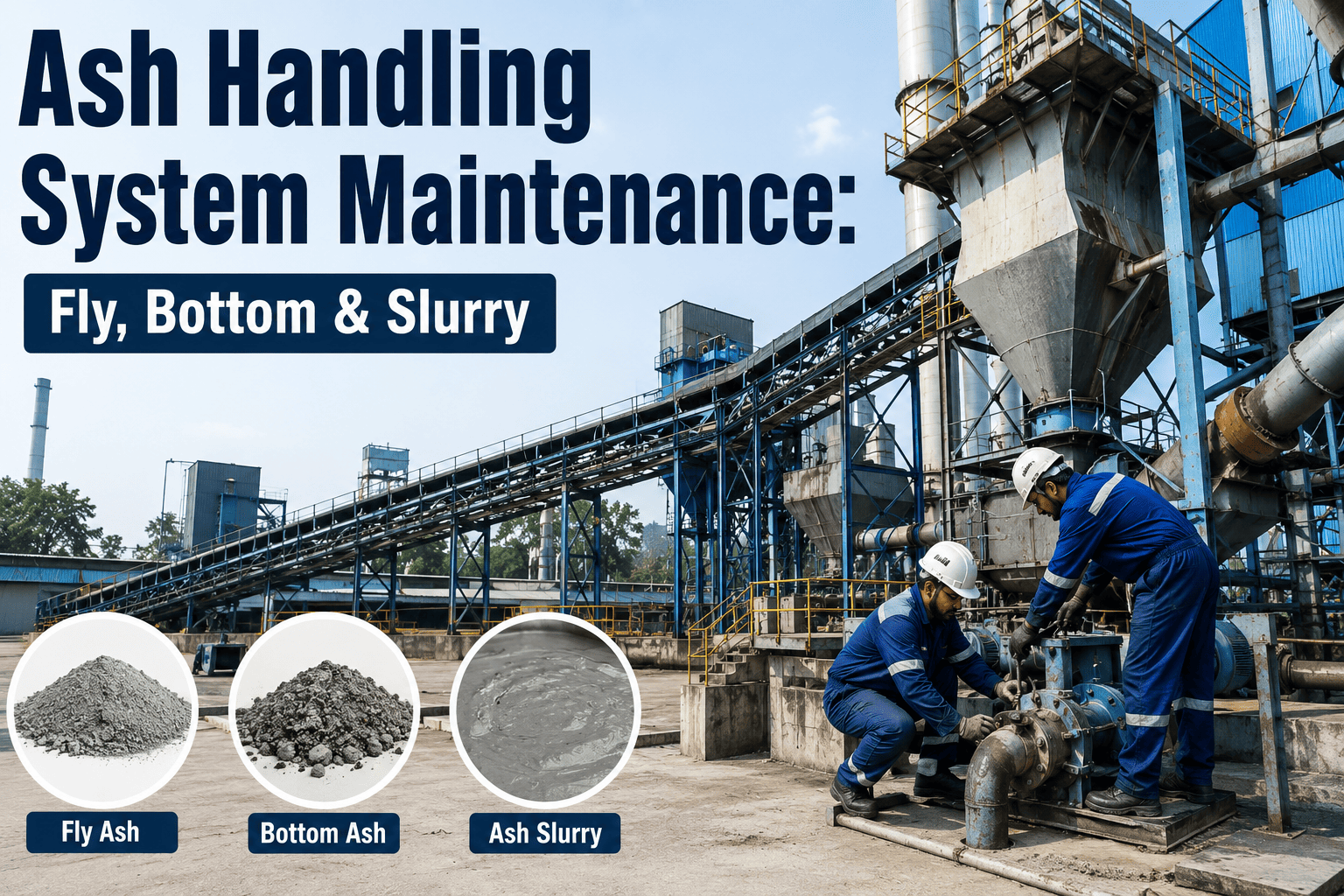
Fly ash and bottom ash are not the same maintenance problem wearing two names — they are different materials, moved by different equipment, failing in different ways. Fly ash is fine, low-density dust pulled from ESP or baghouse hoppers and almost always moved pneumatically, so its failure modes center on vacuum leaks, blocked hoppers, and pneumatic line wear. Bottom ash is coarse, hot, and heavy, dropped continuously into a water-filled hopper and dragged out by a submerged scraper conveyor, so its failure modes center on chain wear, clinker jams, and refractory damage. Both streams eventually meet in the slurry system, where abrasive, high-solids slurry destroys pump impellers and seals faster than almost any other fluid handling equipment in the plant. Treating all three as one generic ash system is how a plant ends up with a maintenance plan that fits none of them well.
Roughly 50% to 70% of total ash generated leaves as fine particulate collected across ESP or baghouse fields and pulled to silos under vacuum or low-pressure air rather than water, since fine ash rarely separates cleanly from a slurry stream.
Coarser, heavier ash falls continuously into a refractory-lined, water-filled hopper that quenches material at furnace-exit temperatures before a submerged chain conveyor drags it to a grinder that sizes clinkers for slurry transport.
Fly ash, bottom ash, and economizer ash combine in a common slurry sump and are pumped through pipelines to an ash pond, with slurry pumps carrying the heaviest wear burden of any rotating equipment in the ash system.
The Scale Behind Every Ash Handling Decision
Ash handling equipment is sized and specified against a small set of figures that show up across nearly every plant's ash balance, and they explain why the system carries the wear and failure risk it does.
What Actually Fails, and Why It Fails There
Ash handling failures rarely come as a surprise to anyone who has walked the system after a trip — the same handful of components fail in the same handful of ways, because they operate continuously against abrasive, hot, or corrosive material with very little margin for deferred maintenance. Mapping cause to effect is what turns a reactive call-out into a scheduled repair.
Wet Ash Handling vs Dry Ash Handling
Most operating plants still run wet bottom ash systems, but the industry has been shifting toward dry conveyance for reasons that go beyond water use. The comparison below reflects how the two approaches differ on the factors that matter most to a maintenance team.
| Factor | Wet Bottom Ash Handling | Dry Bottom Ash Handling |
|---|---|---|
| Ash quenching method | Water-impounded hopper cools ash on contact | No quenching volume required; ash cools via conveyor design |
| Water consumption | High, requires continuous makeup and treatment | Substantially lower, improving water balance compliance |
| Disposal method | Slurry to ash pond, subject to impoundment regulation | Dry material loaded directly for landfill or beneficial reuse |
| Ash marketability | Wet ash is harder to recover for cement or construction use | Dry ash is more readily usable in concrete and building products |
| Primary wear equipment | Submerged scraper chains, clinker grinders, slurry pumps | Dry drag conveyors and mechanical handling equipment |
A Maintenance Cadence Built Around How Each Component Actually Wears
Ash handling equipment does not fail on a fixed calendar, but a structured inspection cadence is still what catches wear before it becomes an outage. These groupings reflect how frequently the highest-risk components in each ash stream typically need eyes on them.
- Confirm fly ash extraction cycle completed across all ESP or baghouse fields
- Monitor scraper conveyor trough water level and seal height
- Listen for chain skip sound or unusual noise during operation
- Verify hopper heaters are energized where installed
- Inspect drag flight condition at the discharge point for wear
- Check vacuum pump seal water for contamination and flow rate
- Review slurry pump discharge pressure trend against baseline
- Walk pneumatic line elbows for visible erosion or thinning
- Measure chain elongation against manufacturer wear limits
- Inspect clinker grinder rolls for wear and tramp material damage
- Pull and inspect a representative slurry pump impeller sample
- Check ash pond decant structures and water recovery system flow
- Full internal inspection of bottom ash hopper refractory lining
- Replace or rebuild scraper conveyor chain sections at wear threshold
- Overhaul or replace slurry pump volutes and mechanical seal assemblies
- Survey ash pond capacity and dyke condition against disposal plan
Where Ash System Maintenance Plans Break Down
The gap between a documented PM schedule and an ash system that actually runs reliably usually comes down to a small set of recurring gaps. Most of these are not a matter of missing procedures — plants generally have a PM plan on paper — they are a matter of how consistently that plan gets followed under outage pressure, how well condition data is actually reviewed once it is collected, and whether the two ash streams get the differentiated attention their different failure mechanisms require.
Reading Condition Data Against Pass/Fail Only
A single vacuum reading or discharge pressure check that passes today can still be trending toward failure — it is the trend across readings, not the individual data point, that predicts the next failure window on wear-driven equipment like slurry pumps.
Treating Fly Ash and Bottom Ash Maintenance as One Program
A generic ash handling PM plan that does not separate pneumatic fly ash equipment from wet bottom ash conveyance equipment ends up under-serving both, since the failure drivers and inspection points are genuinely different.
Deferring Chain and Impeller Replacement Past the Wear Limit
Pushing a scraper chain or slurry pump impeller past its documented wear threshold to stretch a cycle usually costs more than the deferred replacement saved, once the resulting emergency repair and load reduction are factored in.
Not Tracking Ash Pond Capacity as a Reliability Metric
Ash pond and dyke capacity is often managed as an environmental compliance item alone, when in practice a pond nearing capacity limits how the plant can respond to a slurry system upset, making it a reliability constraint as much as a regulatory one.
Ash Pond Management and the Push Toward Beneficial Reuse
Ash disposal has shifted meaningfully over the past decade, driven as much by regulation as by economics. Ash ponds and dykes remain the endpoint for most wet-handled slurry, but they carry ongoing obligations that extend well past the day ash is deposited — structural integrity monitoring, water recovery and recirculation, and capacity planning against a fixed disposal footprint that cannot simply be expanded on short notice. A pond nearing its design capacity does not just create an environmental compliance flag; it removes the operating margin a plant needs if a slurry system upset forces a temporary increase in disposal rate, which is why capacity tracking belongs on the same dashboard as pump condition data rather than in a separate compliance binder.
At the same time, more plants are treating fly ash and bottom ash as a marketable byproduct rather than pure waste. Fly ash is a well-established supplementary material in cement and concrete production, where every ton substituted for cement avoids roughly a ton of associated carbon dioxide emissions, and bottom ash finds use in road embankments, block and brick manufacturing, and mine reclamation. Dry-handled ash is generally far easier to route into these beneficial reuse streams than wet ash pulled from a pond, since it arrives without the moisture content and contamination that slurry disposal introduces. Plants weighing a wet-to-dry conversion increasingly factor this resale value into the payback calculation alongside the water savings and reduced impoundment liability, which changes how quickly the capital cost of conversion equipment gets justified.
Frequently Asked Questions: Ash Handling System Maintenance
Why does a bottom ash conveyor failure force a boiler load reduction so quickly?
Bottom ash falls into the hopper continuously during firing, and the submerged scraper conveyor is the only path out of that hopper. When the chain fails or the conveyor stops, ash accumulates in the hopper with nowhere to go, and the plant has to reduce firing rate to slow ash generation before the hopper reaches its hold-up limit. There is very little buffer capacity built into most bottom ash hoppers, which is why a chain snap at any hour typically becomes an immediate operational event rather than something that can wait for the next shift.
What causes slurry pumps to wear out faster than other plant pumps?
Ash slurry combines high solids content, sharp abrasive particles, and in some cases acidic chemistry, all of which attack impellers, volutes, and mechanical seals far faster than clean water service does. Standard cast-iron impellers can lose their designed profile within weeks under continuous ash duty, and once that geometry erodes, the pump loses head and flow even though it may still appear to be running normally. Plants aiming to extend slurry pump life typically move to maximum-duty designs with abrasion-resistant materials and double mechanical seals rather than continuing to replace standard equipment on a short cycle.
Is dry bottom ash handling worth converting to from an existing wet system?
The decision depends heavily on water availability, ash disposal regulation in the plant's region, and whether recovered dry ash has a marketable use nearby, such as cement or concrete production. Dry systems substantially reduce water consumption and remove the wet impoundment compliance burden, but the conversion itself is a significant capital project. Teams weighing the tradeoff can contact iFactory Support to review how wet-to-dry conversions have played out at comparable units.
How often should scraper conveyor chains be inspected for wear?
Visual and audible checks belong in the every-shift routine, since a chain skip sound or a sudden trough water level drop can indicate a developing failure that is still hours away from a full snap. Quantitative chain elongation measurement against manufacturer wear limits is typically a monthly task, since pitch stretch develops gradually under continuous submerged, abrasive duty. Waiting for an outage to measure elongation usually means the chain has already been operating well past its safe wear window for weeks or months.
Can ash handling condition data actually be tracked the same way turbine or boiler data is?
Yes, and doing so is what separates a plant that catches ash system failures early from one that only finds out after a trip. Vacuum readings, slurry pump discharge pressure, chain elongation, and vibration data all trend meaningfully over time when logged against the asset record rather than checked once and discarded. Reliability teams interested in bringing ash handling equipment into the same condition-monitoring discipline as their rotating machinery can Book a Demo to see how the data ties together.