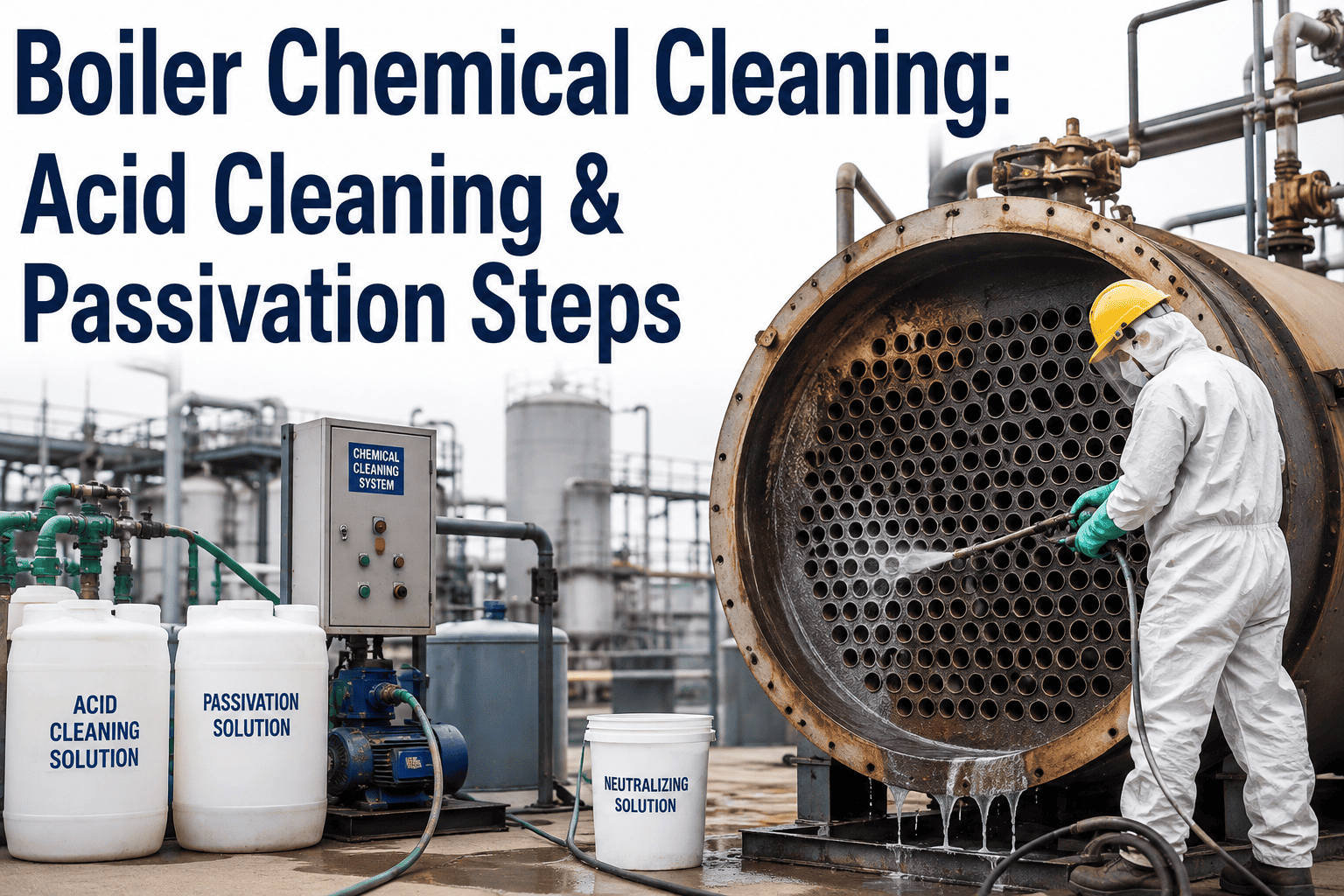
A new boiler tube looks the same on a drawing whether it ships clean or arrives carrying mill scale, welding slag, preservative oil, and construction debris that nobody accounted for in the commissioning schedule. Left inside the waterside surfaces, that residue turns into the seed layer for magnetite buildup, underdeposit corrosion, and the kind of localized pitting that shows up as a tube failure years before its design life is over. Chemical cleaning exists to strip that layer down to bare, sound metal and then immediately lock a stable magnetite film back onto it before oxygen and boiler water get a chance to start the corrosion cycle on their own terms. Getting the acid selection, the inhibitor dosing, and the passivation sequence wrong does not just waste a cleaning window — it can leave a boiler with more active corrosion risk than it had before anyone touched it, which is why plants increasingly plan this work with the same rigor iFactory brings to Book a Demo conversations about boiler chemistry programs.
Why Boiler Chemical Cleaning Is Not a One-Recipe Job
Every chemical cleaning job starts from the same question, and it is not "which acid do we use" — it is "what is actually on these tubes, and what alloy are we cleaning it off of." Magnetite, hematite, calcium carbonate, copper deposits, and silica scale all respond differently to the same acid, and a solvent chosen for speed on one deposit type can pit a tube surface it was never suited to attack. A cleaning contractor who defaults to hydrochloric acid because it is fast and familiar can be making the right call on a carbon steel economizer with heavy iron oxide, and the wrong call entirely on a unit with copper alloy condenser tubes feeding deposits back into the boiler.
The second reason this work resists a single recipe is that the boiler itself sets constraints the deposit analysis cannot override. Operating pressure, tube metallurgy, the presence of stainless or copper-bearing components, and how the unit will be brought back into service all shape which acid, which inhibitor loading, and which passivation chemistry are actually usable. A plan built from a lab deposit analysis alone, without those constraints layered in, tends to look correct on paper and run into trouble the moment acid actually starts circulating.
Deposit Composition Drives Acid Choice
Iron oxide dominant deposits behave differently under HCl than mixed iron-copper deposits or calcium carbonate water scale, and a deposit sample sent for lab analysis before cleaning starts is what keeps the acid selection grounded in fact rather than habit.
Inhibitor Loading Is Not Optional
Every mineral acid used on boiler steel is corrosive to sound metal as well as scale, and the corrosion inhibitor dosed into the solvent is what keeps that attack directed at the deposit instead of the base tube wall for the duration of the circulation.
Passivation Timing Decides the Outcome
A boiler can be perfectly descaled and still return to service with an unstable, porous oxide film if the passivation step is rushed, underdosed, or performed at the wrong temperature — the cleaning and the passivation are one job, not two.
The Numbers That Set Acid Cleaning Parameters
Chemical cleaning specifications read like a narrow band of numbers for a reason — concentration, temperature, and time interact, and moving one without adjusting the others is how a controlled descaling turns into uncontrolled metal loss. These are the reference figures that show up across boiler chemical cleaning procedures and vendor guidance most consistently.
The Chemical Cleaning Sequence, Stage by Stage
A boiler chemical cleaning job runs as one continuous sequence, and skipping the order or compressing stages to save a shift is one of the most common ways a cleaning that looked successful on the day produces tube failures within the first year of restart. The stages below reflect the sequence used across most hydrochloric and citric acid cleaning procedures, from initial water flush through final passivation.
Pre-Cleaning Water Flush
The boiler is filled and circulated with plain water at moderate flow to remove loose debris, construction dirt, and free-standing rust before any chemical is introduced, so the acid stage is spent dissolving bonded scale rather than washing out mechanical debris.
Degreasing
An alkaline solution, often a trisodium phosphate and caustic blend, is circulated to remove oil, grease, and preservative coatings applied during fabrication and shipping, since these organic films block acid contact with the scale underneath and have to come off first.
Intermediate Rinse
The degreasing solution is drained and the boiler is flushed with water until the return line shows the alkaline solution has been fully displaced, confirmed by conductivity and pH checks rather than a fixed rinse time alone.
Inhibited Acid Circulation
The selected acid — hydrochloric, citric, or EDTA depending on deposit type and metallurgy — is dosed with corrosion inhibitor and circulated at a controlled temperature, with iron concentration in the return sample tracked at intervals to determine when the reaction has plateaued.
Acid Drain and Neutralization Rinse
Once dissolved iron readings flatten out, indicating the deposit is spent, the solvent is drained completely and the boiler is refilled with water carrying a mild alkaline dose to neutralize any residual acid film left on the tube surfaces.
Full-Volume Freshwater Rinses
Two or more complete boiler-volume rinses follow, each checked against inlet water conductivity, until the returning rinse water is close enough to inlet quality to confirm the solvent and its reaction products are fully cleared from the system.
Passivation
A passivating chemistry — commonly hydrazine, sodium nitrite, or an oxygen-ammonia combination depending on the solvent used — is circulated at a controlled pH and temperature to build a tight, adherent magnetite film across the freshly exposed metal before it can flash rust or start corroding under boiler water chemistry.
Post-Cleaning Inspection and Sign-Off
Representative tubes are opened for visual inspection, coupon weight-loss data is reviewed against acceptance limits, and water chemistry is confirmed stable before the boiler is cleared to return to normal firing and startup water treatment.
Choosing Between Hydrochloric Acid, Citric Acid, and EDTA
Three solvents cover most boiler waterside cleaning jobs, and each one trades speed, cost, tolerance for error, and disposal complexity differently. The comparison below reflects how these solvents are typically weighed against each other when a cleaning plan is being scoped, based on deposit type, tube metallurgy, and how much margin the crew has for controlling temperature and time precisely.
| Factor | Hydrochloric Acid (HCl) | Ammoniated Citric Acid | EDTA |
|---|---|---|---|
| Typical use case | Heavy iron oxide scale on carbon steel, fastest dissolution rate | Light, iron-only deposits and pre-commissioning cleanings | Heavy or tenacious iron deposits where extended contact time is needed |
| Relative speed | Fastest of the three common solvents | Slower, often needs several hours of circulation | Slowest, but tolerates longer circulation safely |
| Risk profile | Higher pitting risk if inhibitor dosing or timing is off | Lower risk, more forgiving on timing | Most tolerant solvent, lowest risk of tube damage from extended contact |
| Waste disposal | Requires neutralization, generally manageable | Generally easier to dispose of than EDTA waste streams | More complex disposal due to chelation chemistry |
| Typical concentration | Around 5% to 6% by weight | Roughly 4% to 10% depending on deposit load | Set by chelating capacity needed for the deposit mass present |
Matching the Solvent to What Is Actually on the Tubes
The comparison above only becomes useful once it is applied against a real deposit analysis rather than a general assumption about what "should" be on the tubes. These are the decision patterns that show up most often once lab results come back.
Hydrochloric Acid With Inhibitor
Carbon steel waterwall and economizer tubes carrying dense magnetite and hematite scale from years of operation typically clean fastest and most completely under inhibited HCl, provided the inhibitor loading is verified against acid concentration and circulation temperature before the batch is dosed.
Ammoniated Citric Acid
Pre-commissioning cleanings and units with only a season or two of light iron deposit are strong candidates for citric acid, which handles the lighter deposit load effectively while carrying lower pitting risk if the cleaning window runs longer than planned.
Citric Acid or EDTA With Copper Complexing
Boilers receiving feedwater from copper alloy condensers often carry copper mixed into the iron scale, and the passivation step needs an oxidizing agent added specifically to complex and remove residual copper so it cannot redeposit on the freshly cleaned steel surface.
Hydrochloric Acid, Shorter Contact Time
Carbonate-dominant scale from hard makeup water typically dissolves quickly under HCl, which means the circulation time is usually shorter than an iron oxide job and needs tighter monitoring so the solvent is drained as soon as the reaction plateaus rather than left circulating on bare metal.
Passivation: Why the Last Step Decides Whether the Cleaning Was Worth Doing
A boiler can come out of acid cleaning with every trace of scale removed and still go back into service worse off than before, if the passivation step leaves the exposed steel with a thin, porous, or incomplete oxide film instead of a stable magnetite layer. Passivation is not a rinse step tacked onto the end of the process — it is the stage that determines whether the newly bare metal starts forming protective magnetite or starts corroding the moment boiler water chemistry touches it.
Confirm the Surface Is Truly Clean
Passivation only works on bare metal, so iron and acid concentration readings from the final circulation stage need to confirm the deposit reaction has fully plateaued before the passivating chemistry is introduced.
Match Chemistry to the Solvent Used
HCl cleanings typically move to a hydrazine or sodium nitrite passivation after neutralization, while citric acid and EDTA cleanings often extend the same solvent chemistry with an oxidizing agent and pH adjustment rather than switching to a separate passivating fluid entirely.
Hold Temperature and pH in Range
Magnetite formation is temperature and pH dependent, and passivation solutions are typically held at an alkaline pH with elevated temperature for a defined circulation period rather than a quick pass-through rinse.
Verify Before Startup
A written start-up water quality plan, including target iron levels, blowdown rates, and contingency actions if chemistry drifts, is what turns passivation from a hopeful last step into a verified handover back to the operations team.
Mistakes That Undo an Otherwise Correct Cleaning Job
Most chemical cleaning failures do not trace back to the wrong acid — they trace back to a step in the sequence that was rushed, skipped, or monitored on a schedule instead of on actual chemistry readings. These are the recurring issues that show up in post-failure reviews.
Dosing Acid Without a Current Deposit Analysis
Reusing last cycle's acid concentration and inhibitor loading without a fresh deposit sample assumes the scale composition has not changed, which is rarely true after a feedwater excursion, a condenser leak, or a change in makeup water source.
Ending Acid Circulation on a Timer Instead of a Reading
Draining the acid at a scheduled time rather than when dissolved iron concentration actually plateaus either leaves deposit behind or, worse, leaves the acid circulating on bare metal well past the point where the inhibitor is still doing its job effectively.
Compressing the Rinse Stages
Cutting a rinse short to save time on the outage schedule leaves residual solvent and reaction products in the system, which can interfere with passivation chemistry and leave the boiler with an unstable starting water chemistry at restart.
Treating Passivation as Optional on a Tight Schedule
A boiler brought back into service without a completed passivation cycle is effectively started up on bare, freshly reactive metal, which is one of the most common root causes of accelerated corrosion in the months immediately following a chemical clean.
Frequently Asked Questions: Boiler Chemical Cleaning
How do we know if a boiler actually needs chemical cleaning versus mechanical cleaning?
The decision usually comes down to deposit thickness, location, and accessibility rather than preference alone. Tube samples pulled from the highest heat zone are analyzed for deposit weight per unit area, and if that figure exceeds the threshold typically associated with underdeposit corrosion risk, chemical cleaning becomes the practical option since mechanical methods cannot reliably reach internal waterside surfaces on long tube runs. Teams unsure which route fits their unit can contact iFactory Support to talk through deposit data before committing to a cleaning contractor.
What is the difference between neutralization and passivation?
Neutralization is the step that removes residual acid from the system after the cleaning solvent is drained, typically using a mild alkaline rinse to bring pH back into a safe range before further work continues. Passivation is a separate, later step that forms the protective magnetite film on the now-clean and neutralized metal surface. The two are sequential and both necessary — neutralization protects the next rinse stage, while passivation protects the tube for years of subsequent operation.
Can citric acid and hydrochloric acid be used on the same boiler in different cleanings?
Yes, and it is common practice for the acid choice to change between cleaning cycles as deposit load and composition shift over the boiler's service life. A unit cleaned early in its life with citric acid for a light, fresh deposit may need hydrochloric acid on a later cycle once heavier magnetite scale has built up, and the deposit analysis taken before each cleaning is what should drive that decision rather than repeating whatever solvent was used previously.
How long does a typical boiler chemical cleaning outage take?
Total outage time varies with boiler size, deposit load, and solvent choice, but the acid circulation stage itself typically runs anywhere from thirty minutes to several hours depending on the solvent, while the full sequence including flushing, degreasing, rinsing, and passivation commonly spans one to several days. Citric acid and EDTA cleanings generally extend the schedule compared to hydrochloric acid because of their slower reaction rates, which is a factor worth weighing against the lower risk profile those solvents carry.
What post-cleaning checks confirm the passivation actually worked?
A combination of visual inspection on representative opened tube sections, corrosion coupon weight-loss data compared against acceptance criteria, and startup water chemistry monitoring for iron and pH stability together confirm whether the passivation film formed correctly. Plants that track these results against the boiler's cleaning history over multiple cycles can spot whether a particular solvent or inhibitor combination is consistently underperforming, which is exactly the kind of longitudinal record iFactory helps reliability teams maintain — details are available through Book a Demo.