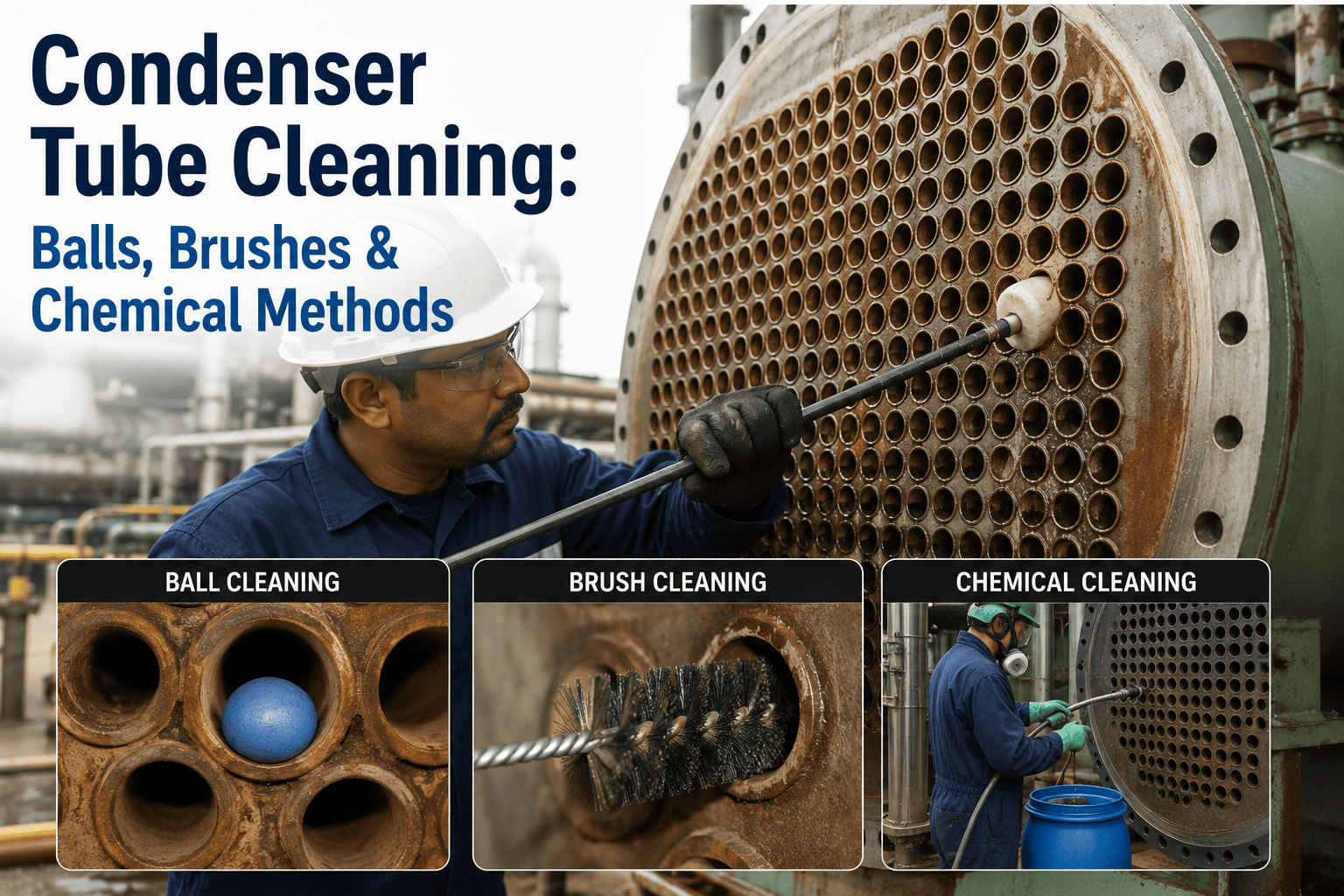
A condenser that was pulling a strong vacuum six months ago is now quietly costing you megawatts, and the culprit is almost never something dramatic — it's a thin layer of scale, silt, or biological slime building up on the inside of thousands of tubes, one micron at a time. Fouling alone can account for up to half of a condenser's total heat transfer resistance, which means half the problem sitting between you and full output isn't a design flaw or aging equipment, it's dirt you can actually remove. The question most plants get wrong isn't whether to clean their tubes, it's which method actually fits their fouling type, their outage schedule, and their budget, and that's exactly what iFactory helps plants figure out with real condenser performance data instead of a gut call — reach out to our team if you want a second opinion on yours.
Balls, Brushes, Or Chemicals: What Is Actually Fouling Your Condenser Tubes
A one psia rise in condenser back pressure can cost a large unit over ten megawatts of output at full steam flow. Most of that loss traces back to fouling that a cleaning method mismatched to your water chemistry never quite solved.
What A Fouled Tube Is Actually Costing You
Fouling doesn't announce itself with an alarm. It shows up gradually as a rising condenser pressure, a shrinking vacuum, and a turbine that needs more steam to make the same megawatts it made last quarter. The physics behind that drift is simple: scale and biofilm conduct heat roughly ten times worse than the metal tube wall underneath them, so even a thin coating meaningfully chokes the heat transfer the whole cycle depends on. Once that heat transfer drops, back pressure climbs, the turbine's enthalpy drop shrinks, and every pound of steam produces less electrical output than it should. On a large unit running around a million pounds of steam per hour, a one psia increase in back pressure translates to a loss on the order of ten megawatts — and that number climbs every week the fouling is left alone.
The Three Cleaning Methods, Side By Side
Every condenser tube cleaning approach is really solving the same equation from a different angle: how do you keep deposits from building up faster than you can remove them, without shutting the unit down every time you need to check. Sponge ball systems, brush and basket systems, and chemical treatment each answer that differently, and picking the wrong one for your fouling type is how plants end up cleaning constantly without ever fixing the underlying trend.
Matching Fouling Type To The Right Method
The single biggest mistake plants make with tube cleaning is treating it as one generic maintenance task instead of matching the method to what's actually building up on the tube wall. Biological slime, silt, and soft scale respond well to the continuous mechanical scrubbing of a ball system. Hard mineral scale that's already crystallized often shrugs off a sponge ball and needs either brush cleaning with more aggressive contact or a chemical softening pass first. Getting this wrong doesn't just waste effort — it can mean running an expensive cleaning cycle every week and still watching back pressure creep upward, because the method was never suited to the deposit in the first place.
| Fouling Type | Recommended First Approach | Why |
|---|---|---|
| Biological slime / biofilm | Continuous sponge ball system | Soft, low-adhesion deposit that mechanical scrubbing removes easily online |
| Silt and debris | Debris filter plus ball or brush system | Filtering upstream reduces the load reaching the tubes in the first place |
| Soft scale | Sponge ball system, brush as backup | Ball scrubbing action is generally sufficient before scale hardens further |
| Hardened mineral scale | Chemical softening, then mechanical clean | Mechanical methods alone struggle once scale has fully crystallized |
| Mixed / unknown fouling | Brush and basket with periodic inspection | More aggressive contact handles a wider range of deposit types |
The Cleaning Schedule That Wasn't Working
A mid-size utility running a river-water-cooled condenser had been chemically cleaning tubes at every planned outage for years, treating it as routine and never asking why back pressure kept climbing between cleanings anyway. A closer look at the fouling itself found the real problem wasn't mineral scale at all — it was biological growth accumulating steadily between outages, a deposit type that chemical cleaning wasn't designed to prevent from returning. Switching to a continuous sponge ball system running between the same outage intervals kept the biofilm from ever rebuilding, and the plant's back pressure trend flattened out instead of climbing every quarter. The chemical cleaning wasn't wrong on its own — it was solving a problem the tubes didn't actually have.
Why Cleaning Frequency Isn't A Fixed Number
A common question plants ask is simply how often condenser tubes should be cleaned, and the honest answer is that a fixed interval printed in a maintenance manual rarely fits the actual fouling rate a specific unit experiences. Cooling water source matters enormously here — a plant pulling from a river with seasonal silt loading and biological activity faces a completely different fouling curve than one running on a closed-loop cooling tower with treated water. Seasonal shifts compound this further: warmer months often accelerate biological growth, while certain mineral-heavy water sources scale faster during specific temperature and flow conditions. Treating cleaning frequency as fixed, rather than as something to adjust based on the actual cleanliness factor trend, is one of the most common reasons plants either over-clean unnecessarily or under-clean and pay for it in lost output between cycles.
Reading The Warning Signs Before The Vacuum Drops
Condenser fouling gives you signals long before it shows up as a hard efficiency number on a monthly report, and catching those signals early is what separates a routine cleaning cycle from an unplanned derate.
Stop Guessing Which Cleaning Method Your Condenser Actually Needs
iFactory tracks cleanliness factor, back pressure, and cleaning cycle results in one place, so you can see which method is actually holding your vacuum steady and which one is just keeping you busy.
What Fouling Costs Beyond The Power Bill
Lost megawatts get the attention because they're the easiest number to put on a report, but fouling has downstream costs that rarely make it into that same spreadsheet. A condenser working harder to hold vacuum puts more strain on the air removal system, whether that's steam jet ejectors or vacuum pumps, and those components wear faster under sustained load than they would on a clean condenser. Tubes that stay fouled longer are also more prone to localized corrosion under the deposit itself, since stagnant conditions beneath scale or biofilm create exactly the environment pitting corrosion needs to take hold. That turns a cleaning problem into a tube replacement problem, and tube replacement on a large condenser is an outage-scale expense, not a routine maintenance line item. Factoring in air removal system wear and long-term tube health, alongside the direct heat rate penalty, usually makes the case for proactive cleaning even stronger than the megawatt number alone suggests.
Building A Cleaning Program That Actually Holds
A cleaning method by itself isn't a program. The plants that keep their condensers consistently clean treat cleaning as a cycle with feedback built in, not a one-time fix scheduled around the outage calendar.
Frequently Asked Questions
How much can condenser fouling actually reduce plant output?
The impact scales with how severe the fouling is and how large the unit is, but the physics are consistent across plant sizes: fouling can contribute up to half of a condenser's total heat transfer resistance, and that resistance shows up directly as rising back pressure. On a unit running roughly a million pounds of steam per hour, a one psia rise in back pressure has been shown to cost on the order of ten megawatts of turbine output. Multiply that across weeks or months of unaddressed fouling and the lost generation adds up well beyond what a cleaning cycle would have cost. Book a demo to see how that back pressure trend gets tracked against your cleaning history.
Can I run a sponge ball system and a brush system on the same condenser?
Most plants standardize on one primary continuous method rather than running both simultaneously, since the systems use different hardware and the two aren't typically designed to operate together on the same tube bundle. That said, it's common to use one as the primary continuous method and fall back on the other, or on chemical treatment, during planned outages for a deeper clean the primary system doesn't reach. The right combination depends on your fouling mix and how much of it is biological versus mineral scale, which is worth confirming with a fouling analysis before committing to a dual setup.
Why does chemical cleaning sometimes fail to fix a recurring fouling problem?
Chemical treatment is built to dissolve mineral scale, and it does that well, but it isn't designed to prevent biological growth or silt from rebuilding between outages. If the actual fouling driver is biofilm rather than hardened scale, a chemical clean can leave the condenser looking clean at the moment of the outage while the underlying growth returns within weeks. This is one of the most common reasons a plant keeps chemically cleaning on schedule and still sees back pressure creep upward — the method and the deposit type were mismatched from the start.
What does a declining ball recovery rate actually indicate?
Ball recovery rate measures what percentage of the sponge balls injected into the system are successfully collected and recirculated after passing through the tubes. A healthy system typically recovers above roughly 95 percent of balls on each pass. When that number drops, it usually means balls are being lost to damaged tubes, a collection screen that isn't catching them properly, or tube blockages the balls can't pass through at all — any of which leaves sections of the tube bundle uncleaned even while the system appears to be running normally.
How do I know if my current cleaning frequency is actually enough?
The clearest signal is the cleanliness factor trend between cleaning cycles rather than the result immediately after cleaning. If cleanliness factor consistently drops to a similar low point right before each scheduled clean, the interval is roughly matched to your fouling rate. If it's dropping well before the next scheduled cleaning and staying low for an extended stretch, fouling is outpacing your current cadence and the interval needs to shorten. Talk to our team about setting up that kind of trend tracking for your condenser.
Turn Condenser Cleaning From A Calendar Task Into A Data-Backed Program
iFactory connects cleanliness factor, back pressure, and cleaning cycle history into one condenser performance record, so every cleaning decision is based on what your tubes actually need.