A single leaking condenser tube can force a plant to run at reduced vacuum for weeks while operators wait for the next planned outage to fix it, and a wall that has thinned past a safe margin without anyone noticing can turn a routine plug-and-run decision into an unplanned trip. Steam surface condensers hold thousands of tubes, and manually tracking wall condition tube by tube across every outage is where most plants lose the thread. Contact support to see how eddy current data can be tracked automatically instead of buried in a spreadsheet.
Condenser Integrity · Tube Inspection
Condenser Tube Inspection: Eddy Current Testing and Leak Detection
Wall thinning mapping, leak localization, and plugging decisions all depend on the same underlying data. Tracking that data consistently, rather than reconstructing it every outage, is what turns condenser inspection from a guessing exercise into a planning tool.
Tube Wall Condition Scale
Healthy
0-20%
Monitor
20-40%
Repair
40-60%
Plug
60%+
Wall loss percentage against nominal thickness
Why Eddy Current Testing
What Eddy Current Testing Actually Measures
Eddy current testing passes an alternating current through a probe coil drawn through each tube, inducing eddy currents in the tube wall. Changes in wall thickness, material loss, or the presence of a crack distort those induced currents in a measurable way, and the resulting signal phase and amplitude are what a technician or an automated system reads to determine tube condition without needing to cut a single tube out of the bundle.
Non-Destructive by Design
Every tube in the bundle can be tested during a single outage window without removing tubes for physical inspection, which is what makes full-bundle coverage practical on condensers with thousands of tubes.
Sensitive to Gradual Loss
Wall thinning from erosion, corrosion, or steam impingement develops gradually over years, and eddy current signal amplitude tracks that gradual change well before a tube is anywhere near failure.
Locates Damage Along the Length
The probe reads condition continuously as it travels the tube length, producing a profile that shows exactly where along the tube the worst wall loss sits, rather than a single averaged number.
Wall Thinning Mapping
Turning Individual Tube Signals Into a Bundle-Wide Map
A single tube's eddy current trace is useful, but the real value in condenser inspection comes from mapping every tested tube's worst-point wall loss onto the full bundle layout. A map like this reveals patterns that a tube-by-tube report never shows: whether thinning concentrates near the inlet waterbox, follows the steam flow path, or clusters around specific support plates.
Healthy
Monitor
Repair Candidate
Plug Now
In this pattern, worst wall loss clusters near the center of the bundle rather than at the inlet, which typically points toward a flow-induced vibration or steam impingement issue local to that zone rather than a general water-side corrosion problem affecting the whole bundle. That distinction changes the corrective action entirely, and it is only visible once individual readings are assembled into a map rather than reviewed one tube at a time.
Leak Localization
Finding the Tube Behind an Unexplained Condensate Chemistry Shift
A condenser tube leak often shows up first as a chemistry signal rather than a visible drip. Rising sodium or conductivity in the condensate is usually the first indication that cooling water is getting into the steam side somewhere in the bundle, and finding exactly which tube is responsible among thousands is the real challenge.
1
Narrow the Search With Zone Isolation
Water boxes or bundle sections can be isolated one at a time while monitoring condensate chemistry for a change, narrowing a bundle-wide search down to a smaller group of tubes before any tube-level testing begins.
2
Run Helium Leak Testing on the Isolated Zone
Helium introduced on the water side and detected on the steam side pinpoints leaking tubes with high sensitivity, making it one of the most reliable methods once the search has been narrowed to a manageable zone.
3
Cross-Check Against the Eddy Current Wall Map
Tubes already flagged as repair candidates or plug candidates from wall thinning data are a natural starting point for leak testing, since a thinned wall is a leading indicator of where a through-wall leak is most likely to develop next.
4
Confirm With Bubble or Dye Testing Before Plugging
A final confirmation test on the specific suspect tube avoids plugging a healthy tube by mistake, which matters because every plugged tube reduces condenser heat transfer surface and, past a certain count, affects turbine backpressure.
iFactory Turns Every Outage's Eddy Current Data Into a Trackable Bundle History.
Wall loss readings, tube locations, and plugging records are tracked outage over outage, so a thinning trend is visible years before a tube crosses the plugging threshold.
Before vs. After
Reactive Leak Chasing vs. Wall-Loss-Informed Inspection
Category
Reactive Approach
Condition-Based Approach
Leak Discovery
Found only after chemistry alarms trigger, with the leak already contaminating condensate
Leak-prone tubes flagged from wall data before a through-wall leak develops
Plugging Decisions
Made tube by tube during the outage with limited history to reference
Made against a multi-outage wall loss trend, avoiding both premature and delayed plugging
Bundle Coverage
Full-bundle testing scheduled reactively after a leak event forces the question
Full-bundle testing scheduled on a data-informed interval based on prior trend
Root Cause Visibility
Each leak investigated in isolation without pattern context from prior outages
Bundle-wide thinning patterns tracked over time reveal recurring root causes
Plug Count Over Time
Climbs unpredictably as undetected thinning crosses the plug threshold between outages
Managed proactively, with repair or cleaning addressing root cause before plugging is the only option
Plugging Decisions
What Actually Goes Into a Plug-or-Retain Decision
Remaining Wall Fraction
Wall loss beyond a defined percentage of nominal thickness, commonly in the range where structural margin under operating pressure differential becomes questionable, is the primary trigger for plugging over repair.
Signal Pattern, Not Just Depth
A sharp, localized signal consistent with pitting or a developing crack is treated more conservatively than a broad, gradual thinning pattern at the same average depth, since localized damage often progresses faster.
Location Within the Bundle
A damaged tube in a low-flow zone may be retained under closer monitoring, while the same damage in a high-vibration or high-velocity zone is more likely to be plugged given a higher likelihood of rapid progression.
Cumulative Plug Count
Each plug removes heat transfer area, so the decision on a marginal tube also weighs how many tubes are already plugged and how close the bundle is to a performance-limiting plug percentage.
Material Behavior
Why Tube Material Changes How Wall Loss Should Be Read
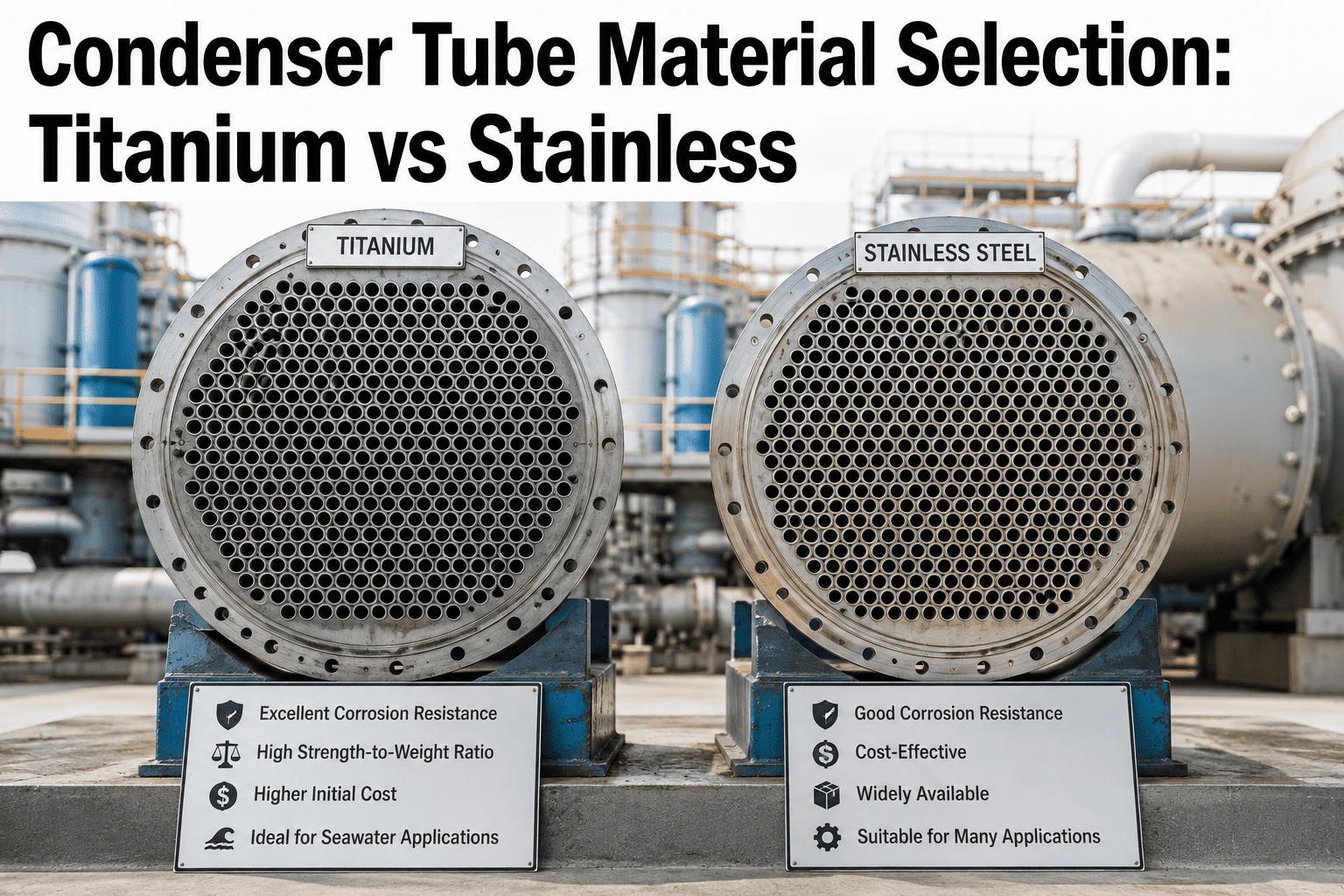
Condenser tube material has a direct effect on both how fast wall loss develops and how an eddy current signal for that material should be interpreted. Copper alloy tubes such as admiralty brass or copper-nickel respond differently to erosion-corrosion and ammonia attack than titanium or stainless steel tubes, and a signal amplitude that indicates a serious flaw in one material may represent something far less urgent in another. Programs that apply the same interpretation threshold across every material in a mixed-material bundle risk either over-plugging a resilient tube type or under-reacting to a vulnerable one.
Copper Alloys
Prone to erosion-corrosion at high velocity zones and ammonia grooving where cooling water chemistry allows it, with wall loss often progressing gradually until a threshold velocity or chemistry condition accelerates it sharply.
Stainless Steel
More resistant to general erosion but susceptible to localized pitting and chloride-driven stress corrosion cracking under the right water chemistry conditions, which shows up as a sharp, localized signal rather than gradual thinning.
Titanium
Highly resistant to most corrosion mechanisms found in condenser service, meaning a titanium tube showing significant wall loss usually points toward mechanical damage, such as debris impact or fretting, rather than a chemistry-driven cause.
Knowing which mechanism is most plausible for a given material narrows the investigation considerably once a wall loss signal is flagged, and it also shapes how conservative the plugging threshold should be set for that specific tube type within the bundle.
Between Outages
What Can Be Monitored Without Pulling the Condenser Offline
Full eddy current testing requires an outage, but several indicators worth tracking continuously between outages can give early warning that a bundle's condition is changing faster than expected. Watching these signals closely narrows down where to focus testing effort once the unit does come offline, rather than starting the next outage with no prior indication of where problems are likely to be found.
A
Track condensate conductivity and sodium trends continuously, since a slow upward drift often precedes a confirmed leak by weeks and can point toward a specific zone if isolation valves allow partial sectioning.
B
Monitor cooling water inlet temperature and flow against historical baselines, since a shift in operating conditions can accelerate erosion-corrosion in zones that were previously stable at lower velocity.
C
Review condenser backpressure trend relative to expected performance curves, since a gradual rise beyond what ambient conditions explain can reflect a growing plug count or fouling that deserves investigation before the next planned outage.
D
Log any operational events, such as a water hammer incident or a debris intrusion report, that could explain localized mechanical damage, so that zone can be prioritized during the next eddy current survey.
Avoid These
Common Mistakes in Condenser Tube Inspection Programs
Testing Only a Sample of the Bundle
Sampling a fraction of tubes each outage saves time but leaves gaps that can hide a developing leak in an untested tube until it fails, particularly in bundles with known high-wear zones.
Comparing Readings Without a Consistent Baseline
Wall loss trends are only meaningful when compared against the same calibration standard and probe setup outage over outage, since inconsistent calibration can make a stable tube look like it is thinning or vice versa.
Plugging Without Investigating Root Cause
Plugging a leaking tube solves the immediate problem but not the underlying erosion, vibration, or chemistry issue that caused it, which often continues damaging neighboring tubes unless it is separately addressed.
Losing Prior Outage Data Between Inspections
When wall loss records live in separate outage reports rather than a continuous tube history, the trend that would have flagged a tube early is invisible until the tube has already crossed the plug threshold.
From the Field
A Chemistry Alarm That Traced Back to a Vibration Pattern
We had an intermittent sodium excursion that would show up for a few hours and then clear, which made it hard to pin down. Zone isolation eventually narrowed it to one water box, and helium testing found two tubes leaking near a support plate rather than at the tube sheet, where we usually expect leaks. Pulling the eddy current history on those two tubes showed a wall loss pattern that had been accelerating for three outages in a row, consistent with flow-induced vibration at that support location rather than general corrosion. We ended up adding a support modification in that zone during the next outage instead of just plugging and moving on.
— Plant Reliability Engineer, Combined Cycle Facility, Gulf Coast Region
2Leaking tubes located near a support plate
3Outages of accelerating wall loss visible in hindsight
1Support modification addressed the root cause
Conclusion
Wall Loss Data Is Only Useful If It Survives Between Outages
Eddy current testing gives an accurate read on tube condition at a single point in time, but the real diagnostic value comes from comparing that reading against every prior outage for the same tube. A tube that looks fine in isolation but has been losing wall thickness steadily for three outages tells a very different story than a tube with the same reading and no prior history.
iFactory keeps that tube-level history connected across outages automatically, mapping wall loss, leak locations, and plugging records onto the full bundle so patterns are visible the moment they start forming, not after a plug count forces the question. Book a demo to see how this applies to your condenser inspection program.
Frequently Asked Questions
Condenser Tube Inspection — Common Questions
How often should condenser tubes be eddy current tested?
Full-bundle eddy current testing is commonly performed during major outages, typically on a multi-year interval depending on cooling water quality, tube material, and prior wall loss trends. Condensers with known active degradation mechanisms, brackish or contaminated cooling water, or a history of leaks often warrant a tighter interval than a condenser with clean, stable cooling water and a flat wall loss trend.
Contact support for guidance on setting an interval that matches your specific water chemistry and tube material.
What wall loss percentage typically triggers plugging?
Plugging thresholds vary by tube material, diameter, and operating pressure differential, but many programs treat wall loss beyond roughly forty percent of nominal thickness as a plugging candidate rather than a repair candidate, with the exact figure set by engineering calculation for the specific tube design. Localized, sharp-signal damage is often treated more conservatively than the same average depth spread broadly across a longer section of tube.
Can a condenser tube leak be found without taking the unit offline?
Some leak localization steps, such as monitoring condensate chemistry trends and narrowing suspect zones, can begin while the unit is still running, but confirming and physically testing a specific tube typically requires an outage to isolate water boxes and access the tube sheet safely. Early chemistry-based narrowing still shortens the outage time needed once the unit is down.
Why does wall thinning often cluster in specific bundle zones?
Localized thinning usually points to a mechanism tied to flow conditions in that specific zone, such as steam impingement near an inlet, flow-induced vibration near a support plate, or turbulence-driven erosion near a water box entrance, rather than a uniform corrosion process affecting the whole bundle equally. Mapping wall loss across the full bundle is what makes this kind of pattern visible in the first place.
Book a demo to see how bundle-wide mapping applies to your condenser.
How many plugged tubes affect condenser performance?
Every plugged tube removes heat transfer surface area, and the cumulative effect becomes measurable in turbine backpressure once the plugged percentage climbs into a range specific to that condenser's design margin, often somewhere in the low single digits of total tube count for units already running close to design limits. Tracking cumulative plug count alongside wall loss trends helps a plant see how much margin remains before performance is affected.
Keep Every Tube's Wall Loss History in One Place
Eddy current readings, leak locations, and plugging records tracked outage over outage, so thinning trends and recurring root causes are visible before the next chemistry alarm.