A condenser retube is not a decision plant staff get to revisit every few years — pick the wrong tube material and you are looking at a 10 to 15 year replacement cycle instead of 25 to 30, plus the unplanned outages that come with tube leaks in between. The material that performed fine for decades can suddenly fall short after a cooling tower blowdown change, a new water source, or a shift toward treated wastewater makeup, and by the time pitting or erosion shows up as a leak, the damage is already done across hundreds of tubes. Titanium, stainless steel, copper-nickel, and duplex alloys each hold up differently depending on chloride levels, flow velocity, and galvanic pairing with the tubesheet, so the right choice is never one-size-fits-all. Getting this decision right the first time protects decades of condenser reliability and avoids a second retube outage before its time. You can book a demo to see how iFactory tracks tube condition data across your fleet to support that decision with real trend history.
Choose the Condenser Tube Material That Actually Fits Your Water, Not Just Your Budget
iFactory tracks tube wall loss, pitting trends, and leak history by material and water zone, so your next retube decision is backed by data instead of a single vendor recommendation.
A Bad Material Match Doesn't Show Up Until It's Already in Hundreds of Tubes
Condenser tube failures rarely announce themselves early. Pitting, crevice corrosion, and erosion-corrosion develop slowly along the water side of the tube wall, and by the time a leak is detected through condensate conductivity or dissolved oxygen readings, the same conditions have usually been quietly attacking every other tube in the bundle. Because a full retube means pulling the unit offline, removing the old bundle, and re-rolling or welding thousands of new tube-to-tubesheet joints, a material that fails at year 10 instead of year 25 effectively forces the plant to absorb that outage cost twice as often.
A cooling tower blowdown adjustment, a new makeup water source, or a shift toward reclaimed water can push chloride and ammonia levels well beyond what the original tube material was ever selected to handle.
Choosing a more noble tube material like titanium without accounting for the existing tubesheet alloy can accelerate galvanic corrosion of the tubesheet itself, sometimes faster than the original tubes were ever corroding.
Every tube alloy has a maximum design velocity before erosion-corrosion sets in at inlet ends and tube bends, and running above that limit to squeeze more capacity out of an existing bundle shortens tube life fast.
Copper-nickel and standard stainless tubing carry a lower purchase price than titanium or duplex alloys, but that gap disappears quickly once a second retube outage lands ten years earlier than it should have.
How the Five Common Tube Materials Actually Stack Up
Every tube alloy on this list has a proven track record in the right application and a well-documented failure mode in the wrong one. The comparison below focuses on the factors that actually decide which material fits your cooling water, not just headline corrosion resistance ratings.
| Material | Best Suited For | Primary Weakness | Relative Cost |
|---|---|---|---|
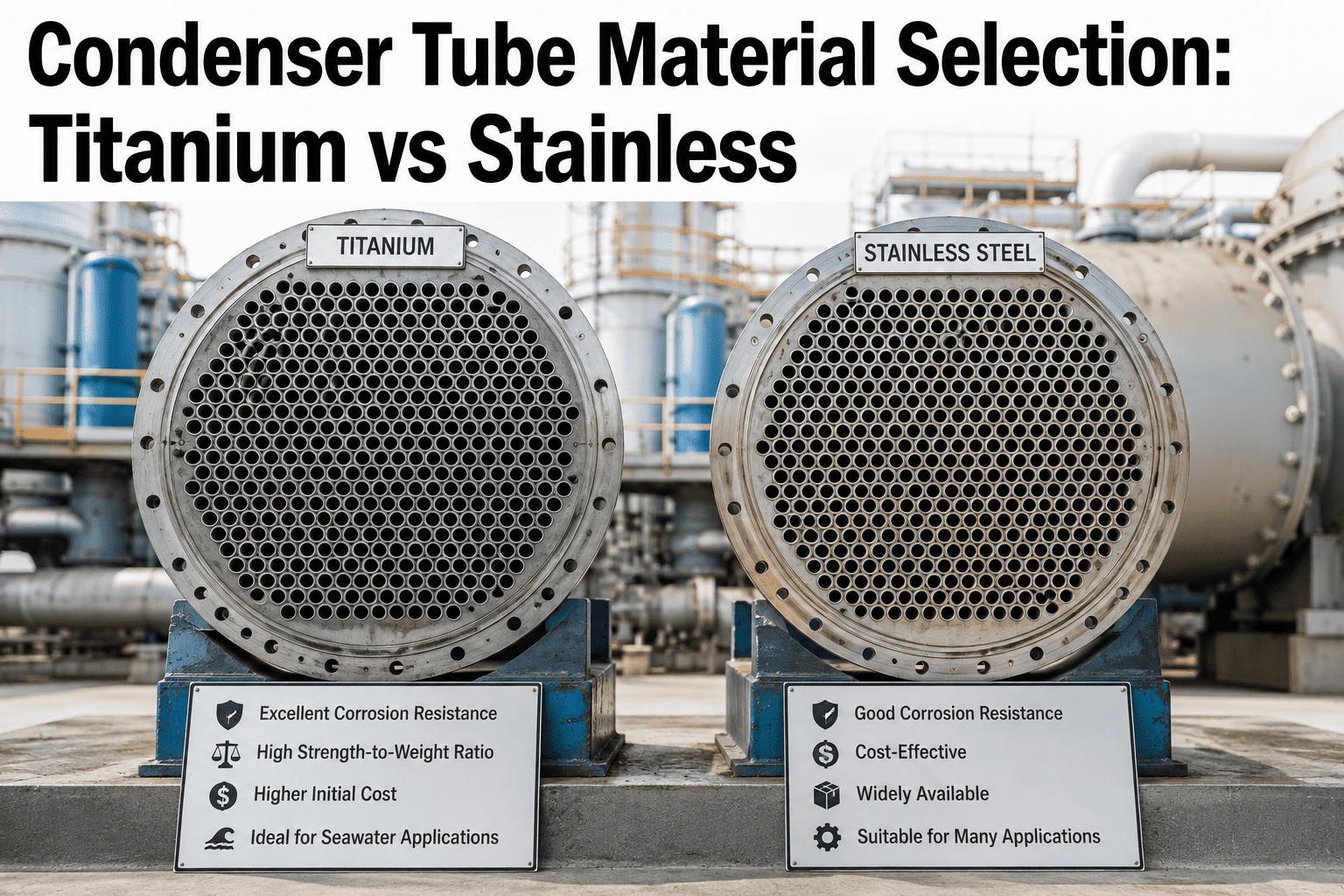
| Titanium Grade 2 | Seawater, brackish water, and high-chloride cooling towers where long-term reliability matters most | Can galvanically accelerate corrosion of less noble tubesheet or waterbox materials if not isolated | Highest |
| Super Duplex / AL6XN / SEA-CURE | Aggressive freshwater and brackish applications with high chloride and microbiologically influenced corrosion risk | Requires careful tube-to-tubesheet joint qualification due to higher strength and stiffness | High |
| 90-10 Copper-Nickel | Moderate-chloride seawater and brackish water with established biofouling resistance | Erosion at higher flow velocities and shortened life if water chemistry becomes more aggressive over time | Moderate |
| Aluminum Brass | Freshwater and lower-chloride cooling water where cost is a primary driver | Vulnerable to dezincification and ammonia attack, with a lower erosion velocity limit than copper-nickel | Lower |
| TP304 / TP316 Stainless Steel | Treated freshwater cooling towers with well-controlled, low-chloride chemistry | Prone to pitting and crevice corrosion once chloride levels climb, particularly at stagnant or low-flow points | Lower |
The Selection Decision Really Starts With Your Cooling Water Source
Material selection charts are useful, but the real starting point is an honest look at the water the condenser actually sees, including how that water chemistry has drifted since the unit was originally built. The four water source categories below cover most plant situations and point toward the materials that consistently hold up in each.
High and constant chloride exposure makes titanium the default choice for new installations, with super duplex and 90-10 copper-nickel as established alternatives depending on budget and biofouling control strategy.
Variable chloride levels combined with higher biological activity favor titanium or high-performance stainless alloys like AL6XN, since copper alloys tend to see accelerated corrosion in polluted coastal and estuary water.
Cycles-of-concentration increases or a switch to reclaimed makeup water can push chloride past 500-700 ppm, moving the plant out of standard stainless steel's comfort zone and into duplex or titanium territory.
Low, stable chloride and good chemistry control keep standard TP304/TP316 stainless or aluminum brass viable, provided the water program keeps chloride levels from creeping upward year over year.
Why the Tubesheet and Waterbox Matter as Much as the Tube Itself
Titanium and high-alloy stainless steels are more noble than copper alloys and carbon steel, which means pairing new titanium tubes with an existing copper-alloy tubesheet or a coated carbon-steel waterbox can set up a galvanic cell that eats away at the less noble component far faster than expected. This is one of the most common and most expensive mistakes in a condenser retube project, because the tubesheet and waterbox are far more difficult to replace than the tubes themselves.
The cathode-to-anode area ratio can approach 1,000:1, driving severe galvanic corrosion of the tubesheet unless cathodic protection is designed in from the start.
Matched materials eliminate the galvanic mismatch entirely, which is why many new marine condenser designs specify titanium clad or solid titanium tubesheets.
Generally manageable with a properly maintained coating, but any pinhole or coating damage exposes a small anode of steel to a much larger cathodic area and corrodes quickly.
Similar electrochemical potential between the two copper-based alloys keeps galvanic activity minimal, which is part of why this pairing has such a long service history.
Five Factors That Belong in Every Retube Material Decision
Pull several years of water chemistry data, not just a single sample, since cycles-of-concentration changes and makeup water shifts can move chloride levels significantly over time.
Compare the design flow velocity against each candidate material's erosion-corrosion limit, particularly at tube inlet ends where turbulence is highest.
Confirm galvanic compatibility before finalizing a tube alloy, since a mismatch can force an expensive tubesheet cladding or cathodic protection retrofit.
Ammonia-bearing water attacks copper alloys aggressively, while biofouling control programs can influence how well certain alloys hold up over time.
Weigh purchase price against realistic service life for the specific water conditions, since a cheaper tube that fails in half the time rarely saves money once outage costs are included.
Common Mistakes That Undermine a Material Selection Decision
Re-specifying the same material the plant has always used without checking whether the water chemistry has changed since the original design misses shifts that make the old choice obsolete.
Selecting a more corrosion-resistant tube material without evaluating its pairing against the existing tubesheet and waterbox can shift the corrosion problem instead of solving it.
A single chloride reading taken on a calm day doesn't capture seasonal variation, blowdown cycling, or upset conditions that can push chemistry well outside the normal range.
Switching to a higher-strength alloy like titanium or duplex without re-evaluating wall thickness and tube-to-tubesheet pullout strength can leave the joint under-designed for the new material.
A Water Source Change That Cut Tube Life in Half, and What Fixed It
A coastal power plant retubed its condenser with standard 90-10 copper-nickel, matching the material that had lasted over 20 years in the original bundle. A cooling tower operational change and a shift in makeup water source pushed chloride levels well above historical norms, and eddy current inspections found accelerated wall loss across the bundle within eight years instead of the expected two decades.
A full water chemistry review comparing current chloride and manganese levels against historical data confirmed the water had become significantly more aggressive since the original design. The next retube specified AL6XN high-performance stainless, chosen for its documented resistance to the specific chloride and microbiologically influenced corrosion conditions now present, avoiding a repeat of the early failure pattern.
Building a Retube Specification You Won't Have to Redo Early
Pull multi-year water chemistry data, not a single sample, to establish the real chloride and ammonia trend the condenser has actually been exposed to.
Confirm tubesheet and waterbox material before finalizing tube alloy selection, and flag any galvanic mismatch for a cathodic protection review.
Compare design flow velocity against the erosion-corrosion limit of each candidate material at inlet ends and tube bends.
Document expected service life and total cost per material option, so the specification decision is based on lifecycle cost rather than purchase price alone.