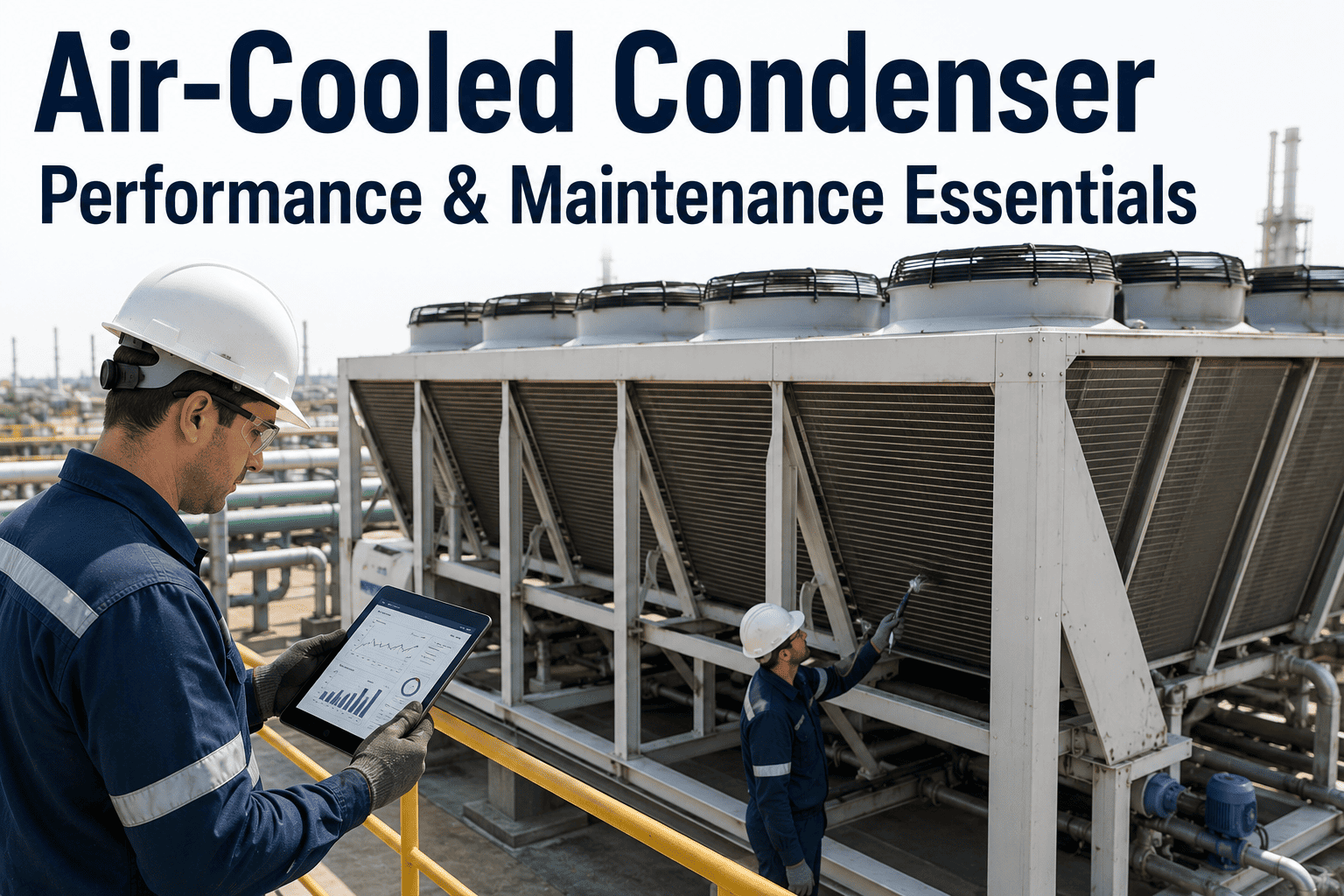
An 860MW combined-cycle plant in the UK once watched its output fall to around 500MW purely because pollen and dust had progressively clogged the fin-fan units of its air-cooled condenser, and the built-in cleaning system simply could not keep pace with the fouling rate. That is not a rare failure mode — it is the default trajectory for any ACC left to run without a disciplined maintenance and monitoring program, since fouling accumulates quietly and the performance loss is easy to attribute to hot weather until someone actually inspects the fins. Book a session with the iFactory team to see how condition monitoring catches this earlier.
Cooling System Optimization · Dry Cooling
Air-Cooled Condenser Performance: Maintenance Essentials for Water-Scarce Plant Sites
Fan performance, fin cleaning, and ambient temperature management — the disciplines that keep an ACC delivering its design vacuum instead of quietly costing megawatts on every hot day.
What Poor Maintenance Costs
15%
More electricity consumed by fans running with fouled or misaligned blades for the same airflow
2–3%
Plant performance loss from just a 5% drop in heat transfer efficiency
Why ACC Performance Degrades Quietly
The Failure Modes That Erode Vacuum Long Before Anyone Notices
Fin Fouling From Dust, Pollen, and Debris
Airborne particles build up on the finned tube surfaces and steadily reduce heat transfer rate, with the effect compounding as ambient temperature climbs and the plant needs full cooling capacity most.
Fan Inefficiency From Wear and Tip Clearance
Blade wear and increased tip clearance cause turbulent leakage flow that reduces effective airflow while fan power draw stays the same or increases, quietly turning the fan into a larger parasitic load.
Wind Effects on Fan Performance
Ambient wind crossing the ACC bundle reduces the vertical airflow the axial fans can deliver, increasing turbine back pressure precisely on the hot, windy days when cooling capacity is most needed.
Duct and Plenum Air Leakage
Pressure drop and air leakage in the duct system reduce the airflow that actually reaches the heat exchanger bundles, meaning fan power is being spent moving air that never contributes to condensing steam.
The Maintenance Program
Four Disciplines That Keep an ACC Near Its Design Performance
01
Scheduled Fin Cleaning
High-pressure water jetting or specialized fin-cleaning systems restore heat transfer surface that dust and pollen have progressively fouled. Facilities in high-pollen or high-dust regions benefit from permanent light-wash systems that clean without requiring a shutdown.
02
Fan Blade and Tip Clearance Inspection
Regular inspection of blade condition and tip clearance catches the wear that causes turbulent leakage flow before it meaningfully erodes airflow, since even small increases in tip clearance produce disproportionate efficiency losses.
03
Intelligent Fan Speed Control
Adjusting fan speed and airflow based on real-time ambient conditions and plant load, rather than running fans at a fixed setpoint, avoids both under-cooling on hot days and wasted parasitic power on cool ones.
04
Duct System and Wind Mitigation Review
Periodically checking the air duct system for leakage and pressure drop, and evaluating wind screening or guide devices, addresses the airflow losses that happen before air ever reaches the heat exchanger bundle.
Catch Fouling Before It Costs You Megawatts
iFactory Tracks Approach Temperature and Fan Power Trends Continuously
Instead of discovering ACC fouling only when vacuum can no longer be maintained on a hot afternoon, continuous approach temperature and fan power trending flags the gradual efficiency loss while it is still a cleaning task, not an output loss.
What to Track
Condition Indicators for Air-Cooled Condenser Health
| Indicator | What It Signals | Response Trigger |
|---|---|---|
| Approach temperature (ITD) | Gap between steam and ambient air temperature | Rising trend indicates fouling or airflow loss |
| Fan power per unit airflow | Fan and blade mechanical condition | Increasing ratio points to wear or tip clearance issues |
| Backpressure at fixed load | Overall condenser effectiveness | Deviation from baseline at matched ambient conditions |
| Cell-to-cell temperature variance | Localized fouling or fan failure | One cell diverging from its neighbors flags a targeted issue |
Well-maintained air-cooled condensers can run efficiently for 25 or more years, while units left to degrade without a disciplined cleaning and inspection cadence often need major component replacement within 8 to 10 years — the difference is almost entirely maintenance practice, not equipment quality. The plants that get this right treat approach temperature as a leading indicator worth trending continuously, not a number they check when someone complains about vacuum on a hot day. By the time backpressure has visibly degraded output, the fouling that caused it has usually been building for months, and the cleaning job needed is far more extensive than it would have been if caught early.
Odalys Feinberg-Achterberg
Power Generation Reliability Specialist · 18 years supporting cooling system optimization and heat exchanger maintenance programmes across combined-cycle plants
Beyond Manual Inspection
Predictive Technologies That Catch ACC Degradation Between Scheduled Inspections
Infrared Thermal Imaging
Periodic thermal scans of the fin bundle surface reveal uneven heat rejection patterns that point to localized fouling or airflow blockage long before it shows up in aggregate backpressure readings.
Fan Bearing Vibration Analysis
Trending vibration signatures on fan motor bearings catches developing mechanical wear well ahead of a failure that would otherwise take an entire cell offline unexpectedly.
Differential Pressure Monitoring
Tracking pressure drop across the fin bundle over time isolates fouling-driven airflow restriction from other causes of rising backpressure, pointing maintenance teams to the right corrective action faster.
Acoustic Leak Detection
Ultrasonic monitoring around duct joints and expansion sections identifies air leakage paths that would otherwise only be found through a manual walk-down, often after airflow loss has already reduced output.
Reliability Team Questions
Air-Cooled Condenser Maintenance — Frequently Asked
How often should ACC fins actually be cleaned, and does that depend heavily on the site's environment?
Cleaning frequency should be driven by trended approach temperature and backpressure data rather than a fixed calendar interval, since a site in an agricultural or high-pollen area may need cleaning every few months while a site in a cleaner environment could go a year or more between full cleanings. Continuous monitoring of the gap between steam and ambient air temperature is the most reliable way to know when fouling has progressed enough to justify a cleaning cycle, rather than guessing based on a generic schedule. Book a demo to see how approach temperature trending can inform your cleaning schedule.
Can chemical cleaning agents damage the ACC fin surfaces if used incorrectly?
Yes — chemical cleaning agents must be specifically formulated as non-corrosive to the aluminum, copper, and steel components typically used in ACC fin construction, and any chemical cleaning needs thorough rinsing afterward to prevent residual damage to the fin surfaces over time. Most facilities favor high-pressure water jetting as a safer default precisely because it avoids this risk entirely, reserving chemical cleaning for situations where water jetting alone cannot fully restore the surface.
How much does wind actually affect ACC performance, and is there anything that can be done about it?
Wind crossing the ACC bundle can meaningfully reduce the vertical airflow the axial fans deliver, particularly for lower-powered fan designs where wind has proportionally greater impact, and this shows up as increased turbine back pressure exactly when ambient conditions are already working against cooling capacity. Wind screens, flow guide devices, and site-specific ACC orientation planning during design can mitigate this, though for existing installations the more practical lever is usually intelligent fan speed control that compensates in real time rather than a physical retrofit. Contact our support team to discuss wind mitigation options for your site.
What is the relationship between fan tip clearance and energy consumption?
Increased tip clearance from blade wear or mounting drift allows turbulent leakage flow across the blade tips, which disproportionately reduces fan efficiency relative to how small the clearance change might look during a casual visual inspection — published research on axial flow fans has documented dramatic efficiency reductions from tip clearance increases that would otherwise seem minor. Because ACC fans in large installations can number in the hundreds and run virtually continuously under baseload conditions, even small efficiency losses per fan compound into significant parasitic power costs across the fleet.
Is condition-based monitoring worth the investment compared to a fixed preventive maintenance schedule?
For ACCs specifically, condition-based monitoring tends to outperform a fixed schedule because fouling and wear rates vary so much by site environment and seasonal conditions that a calendar-based schedule either cleans too early, wasting labor and downtime, or too late, after output has already been lost. Continuous trending of approach temperature, fan power ratio, and cell-to-cell variance catches the developing problem at the point it becomes worth acting on, which is a more efficient use of maintenance resources than a uniform interval applied across every site regardless of actual condition.
Don't Let Fouling Cost You Output on the Hottest Day of the Year
Track ACC Health Continuously, Not Just When Vacuum Fails
iFactory trends approach temperature, fan power, and cell-to-cell variance across your air-cooled condensers so fouling and fan wear surface as an early, actionable signal — not a hot-day output loss.