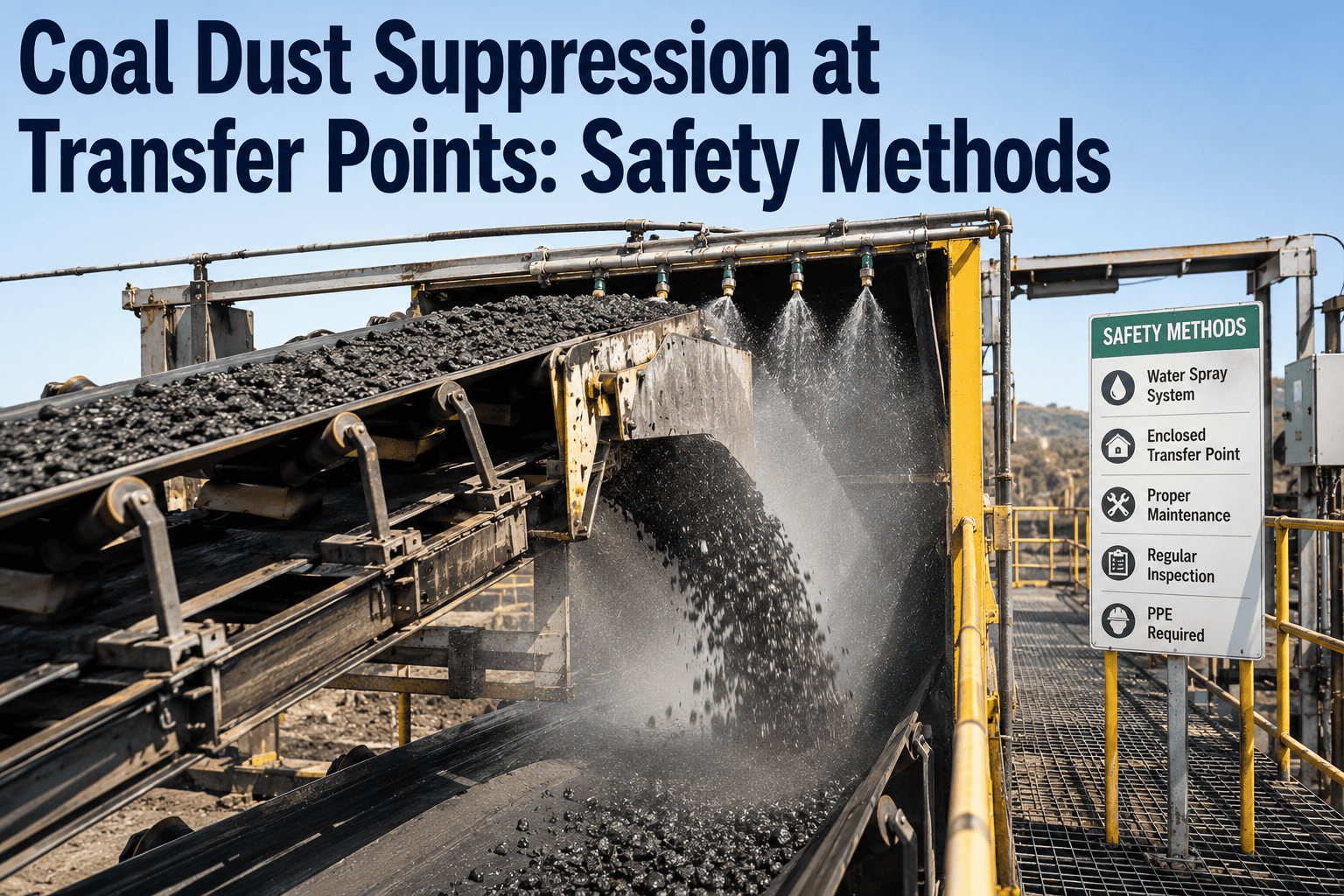
Coal handling transfer points are the single largest source of fugitive dust emissions at mines, power plants, and ports. Every time a conveyor belt drops coal onto another belt, into a crusher, or onto a stockpile, the impact fractures fine particles and entrains them in the air. Conventional dust control at these points usually means a row of fixed spray nozzles running on a timer, wetting the coal but doing little to capture the dust cloud that escapes the chute enclosure. When that dust accumulates on structural steel, catwalks, and electrical panels, it creates a combustible dust layer that MSHA and OSHA cite aggressively, and in the worst case, it provides the fuel for a secondary explosion that propagates far beyond the initial deflagration point. AI-monitored dust suppression adjusts water and foam application in real time based on actual dust concentration, and operations teams can see how it works through iFactory's material handling demo.
AI Material Handling · Dust Suppression
Coal Dust at Transfer Points Is a Ticking Combustible Hazard, Not a Housekeeping Problem
AI-monitored spray systems, enclosure pressure control, and dust collection synchronization replace fixed-timer nozzles that wet the coal but miss the dust cloud escaping the chute.
Dust Concentration Profile Along a Transfer Point
Upstream Belt
Impact Zone
Chute Enclosure
Discharge Point
After AI Suppression
Fixed Timer:
Wets Coal, Misses Cloud
AI Response:
Targets the Dust Cloud
The Combustible Dust Threat
Transfer Point Dust Is Cited as a Primary Ignition Source in Coal Handling Incidents
The hazard at coal transfer points is not merely that dust is generated, but that the conditions for a catastrophic event are consistently present. Coal dust becomes explosible when particle size drops below a certain threshold and the concentration falls within the explosive range. Transfer points create both conditions simultaneously: the impact of coal falling onto a belt or into a crusher fractures particles into the explosible size range, and the turbulent air movement at the drop point suspends those particles at concentrations that can easily exceed the minimum explosive concentration. Add an ignition source from a friction spark, an overheated bearing, or an electrical fault, and the result is a primary deflagration that displaces accumulated dust layers on surrounding surfaces, creating a secondary explosion far more destructive than the first. Regulatory agencies have intensified enforcement around coal dust at transfer points because the physics of the hazard are well understood, yet the controls in most facilities remain fundamentally inadequate.
10,000+
PM Concentration Common at Uncontrolled Transfer Points
Ambient dust monitors at uncontrolled conveyor transfer points routinely record concentrations exceeding 10,000 milligrams per cubic meter during active material flow, far above the minimum explosive concentration for coal dust which can be as low as 30 to 50 grams per cubic meter.
68%
Of Coal Handling Fires Originating at Transfer Points or Crushers
Industry incident analysis shows that the majority of fires and explosions in coal handling systems originate at transfer points, crushers, or bucket elevators where impact energy is highest and dust generation is most concentrated.
$14K/Day
Average Cost of MSHA Citations for Uncontrolled Fugitive Dust
MSHA issues significant citations for accumulated combustible dust on structural surfaces, and the per-day cost of an unwarrantable failure citation can escalate rapidly if the operator cannot demonstrate an adequate dust control and housekeeping program.
Secondary
Explosions From Accumulated Dust Layers Are Far More Destructive
A small primary explosion at a transfer point can dislodge dust layers on overhead beams, conveyors, and floors, generating a massive secondary explosion that propagates through the entire handling system and causes the majority of structural damage and fatalities in dust explosion events.
Dust Generation Mechanics
Three Physical Mechanisms That Create Dust Clouds at Every Single Transfer Point
Understanding why dust escapes at transfer points requires looking at the physics of material flow, because the dust cloud is not a single event but the result of three distinct mechanisms acting simultaneously. Each mechanism requires a different suppression approach, which is why a single row of spray nozzles cannot address the full problem. Impact-generated dust requires wetting at the point of impact. Entrained dust requires air management inside the chute. Abrasion-generated dust requires conveyor belt cleaning and sealing. AI monitoring identifies which mechanism is dominant at any given moment and adjusts the suppression system accordingly.
01
Impact Fracturing
When coal falls from one belt onto another or into a crusher, the kinetic energy of the falling stream shatters individual particles against the receiving surface and against each other. This impact fracturing generates the finest fraction of dust, particles small enough to remain suspended in air for extended periods and most likely to form explosible concentrations. Fixed spray nozzles aimed at the falling stream can wet some of this material, but much of the finest dust is generated after the coal has passed the spray zone and impacted the receiving surface.
02
Air Indraft and Entrainment
The falling coal stream drags a column of air with it into the receiving chute, creating a pressure differential that pulls ambient air through any gaps in the enclosure. When the coal impacts the receiving belt or pile, the trapped air is expelled outward, carrying the freshly fractured dust cloud with it through every crack, gap, and unsealed inspection door in the transfer enclosure. This air movement is the primary mechanism that transports dust out of the chute and into the surrounding work area, and it cannot be controlled by spray nozzles alone.
03
Belt Carry-Back and Abrasion
After coal passes the transfer point, fine particles adhering to the return belt are carried away from the enclosure and released along the entire length of the conveyor as the belt flexes around idlers. This carry-back dust is generated continuously, not just during active loading, and it is the primary reason dust accumulates on conveyor structures, walkways, and electrical equipment far from the transfer point itself. Effective control requires belt cleaners and sealing systems at the discharge point, not spray nozzles at the loading point.
Suppression Technologies
Four Dust Control Methods — And Why Relying on Any Single One Leaves the Hazard Mostly Intact
Effective transfer point dust control requires layering multiple methods that address different parts of the problem simultaneously. Water spray wets the material to reduce impact fracturing. Foam suppression provides a more effective barrier against air entrainment with less moisture addition. Enclosure design and sealing manages the air movement that carries dust out of the chute. Dust collection captures the fines that escape the other three layers. Most facilities implement one or two of these methods and accept the remaining dust as unavoidable. AI-monitored systems operate all available methods in coordination, adjusting each one based on real-time dust and flow conditions.
Water Spray Systems
Standard water spray nozzles located at the impact zone and along the chute walls wet the coal surface to reduce particle fracture and knock down suspended dust. The limitation is that adding too much water creates handling problems downstream, including belt slippage, screen blinding, and frozen material in cold climates, while adding too little leaves the finest dust suspended. Most systems run on a fixed timer or manual switch, applying the same volume regardless of coal flow rate or dust concentration.
Foam Suppression
Foam systems apply a mixture of water, surfactant, and air that expands to cover a much larger surface area than plain water droplets. The foam blanket traps dust particles on the coal surface and at the chute walls, reducing the amount of moisture added while providing more effective dust capture. Foam is particularly effective at transfer points where the dust cloud is driven by air entrainment, because the foam layer resists the turbulent air movement that strips plain water droplets away from the material surface.
Enclosure Sealing and Pressure Management
The transfer chute enclosure is the primary physical barrier between the dust cloud and the work area, but its effectiveness depends entirely on how well it is sealed. Gaps at skirt board edges, inspection doors, belt entry and exit points, and discharge openings all provide paths for the pressurized dust-laden air to escape. Proper enclosure design includes sealed skirt boards, strip curtains at discharge points, and pressure relief vents that route expelled air to a dust collector rather than into the facility.
Dust Collection and Extraction
A dust collector connected to the transfer enclosure pulls air from inside the chute, creating negative pressure that prevents dust-laden air from escaping through gaps and seals. The extracted air passes through filters that capture the fine particles before exhausting clean air. Dust collection is essential for capturing the sub-micron fraction that spray and foam cannot address, but it only works if the enclosure is sufficiently sealed to maintain negative pressure and if the collection volume matches the air displacement caused by the falling material.
Your Spray Nozzles Are Running on a Timer. The Dust Is Not.
iFactory's AI dust suppression reads real-time dust concentrations and coal flow rates to modulate spray, foam, and dust collection exactly when and where the hazard exists.
AI Suppression Logic
How AI Converts Fixed Spray Timers into Responsive Dust Suppression Systems
The core limitation of conventional dust suppression is that the control signal is a clock, not a measurement. The spray system activates when the conveyor starts and runs at full pressure until the conveyor stops, regardless of whether coal is actually flowing, whether the flow rate is 100 tons per hour or 500, or whether the dust concentration at the discharge point is 500 milligrams or 15,000. AI monitoring replaces the timer with a feedback loop that measures the actual dust concentration at multiple points around the transfer enclosure and modulates every suppression mechanism in real time to maintain concentration below the target threshold using the minimum water and energy required.
Continuous
Dust and Flow Sensing
Optical or triboelectric dust monitors at the chute discharge and enclosure exhaust measure real-time dust concentration. Belt scale data provides current coal flow rate and indicates whether material is actually moving.
T+2 sec
Suppression Demand Calculation
The AI model compares current dust concentration against the target threshold and calculates the precise suppression output needed, accounting for coal flow rate, material moisture content, and the historical relationship between spray volume and dust reduction at this specific transfer point.
T+5 sec
Actuator Modulation
Control valves on the water spray, foam proportioning, and dust collector variable frequency drive are adjusted to the calculated output. Spray nozzles are modulated by zone, applying more water at the impact zone and less at the chute walls based on where the model detects the highest dust generation.
T+15 sec
Concentration Verification
The dust monitors measure the concentration downstream of the suppression zone. If the concentration has not dropped below the target, the model increases suppression output. If it has dropped well below, the model reduces output to save water and prevent over-wetting.
Data Inputs
Six Data Sources That Feed the AI Dust Suppression Model at Each Transfer Point
1
Dust concentration monitors — optical light-scattering or triboelectric sensors installed at the chute discharge, enclosure exhaust, and downstream belt entry points provide the primary feedback signal that drives the suppression control loop, updated every one to two seconds.
2
Conveyor belt scale and speed sensors — real-time tonnage and belt speed data tell the AI model how much material is passing through the transfer point and whether the conveyor is running empty, allowing the model to reduce suppression when no coal is flowing and increase it proportionally with load.
3
Water and foam flow meters — measurement of actual liquid delivery to each spray zone confirms that the commanded valve positions are producing the expected flow rates, detecting nozzle clogging or valve failures that would otherwise cause uncontrolled dust release.
4
Dust collector differential pressure and airflow — monitoring the pressure drop across the dust collector filters and the exhaust airflow rate confirms that the collection system is operating at the required capacity to maintain negative pressure in the enclosure.
5
Incoming coal moisture content — moisture data from the upstream process or from online moisture analyzers allows the model to reduce spray volume when the incoming coal is already wet and increase it when the coal is dry and generates more dust on impact.
6
Enclosure pressure sensors — differential pressure measurements between the inside of the transfer chute and the surrounding area confirm that the enclosure is maintaining negative pressure, detecting seal failures or door openings that would allow dust to escape regardless of how much suppression is applied inside.
Measured Outcomes
What Coal Handling Teams See After Deploying AI Dust Suppression
82%
Reduction in Fugitive Dust at Transfer Points
By modulating spray and collection in real time based on actual dust concentrations rather than fixed timers, AI-supervised systems achieve far greater dust reduction with the same or less water consumption than conventional timer-based systems.
35%
Reduction in Water Consumption for Dust Control
Because the AI model applies suppression only when and where it is needed, and reduces it when coal flow is low or incoming moisture is high, total water use drops significantly while dust control performance improves.
Under 5 Sec
Response Time from Dust Spike to Suppression Adjustment
The feedback loop from dust sensor detection to valve modulation completes in under five seconds, compared to the minutes or hours it takes for an operator to notice excessive dust and manually adjust the spray system.
Zero
Unnecessary Wetting During Empty Conveyor Runs
The model automatically reduces suppression to minimum levels when the belt scale indicates no material flow, eliminating the chronic over-wetting that occurs when spray systems run on conveyor motor status rather than actual material presence.
60%
Reduction in Downstream Handling Problems from Over-Wetting
By applying the minimum effective water volume, AI suppression reduces belt slippage, chute plugging, screen blinding, and freezing problems that are caused by conventional systems applying maximum water regardless of need.
Continuous
Compliance Documentation for Dust and Moisture Control
Every dust concentration reading, suppression action, and system status is logged continuously, producing an audit trail that demonstrates active dust control to MSHA, OSHA, and environmental inspectors without manual log book maintenance.
Field Case
Reducing Transfer Point Fugitive Dust by 82% at a Powder River Basin Coal Loading Terminal
A Powder River Basin coal loading terminal with twelve transfer points had been struggling with chronic fugitive dust emissions at its primary crusher feed point and three downstream conveyor-to-conveyor transfer stations. The existing dust control consisted of fixed-pattern water spray nozzles at each transfer point, activated by conveyor motor status and running at full pressure whenever the conveyor was energized. The system applied approximately 40 gallons per minute of water per transfer point regardless of coal flow rate, which was problematic because the terminal frequently ran conveyors at partial load or empty during shift changes and train positioning. During empty runs, the spray nozzles flooded the chute with water that had no material to wet, creating standing water that froze in winter months and caused belt slippage year-round. At the same time, during peak loading when coal flow was highest and dust generation was most severe, the fixed spray volume was often insufficient to control the dust cloud, resulting in visible emissions that had drawn multiple citizen complaints and regulatory inquiries. When iFactory deployed its AI dust suppression system, it installed dust monitors at the discharge of each transfer point, connected to the existing spray valve actuators and dust collector controls, and integrated belt scale data to provide real-time flow information. The AI model learned the relationship between coal flow rate, spray volume, and dust concentration at each of the twelve transfer points over a two-week baseline period. Once active, the model reduced spray volume during empty and partial-load conveyor runs to near-zero, eliminating the standing water and freezing problems, while increasing spray volume and activating foam injection at the crusher feed point during peak loading when dust generation exceeded what water spray alone could control. Over the first six months of operation, fugitive dust emissions at the monitored transfer points dropped by 82% compared to the same period in the previous year, while total water consumption for dust control dropped by 31%. The terminal also eliminated three frozen chute incidents that had occurred in the previous winter due to over-wetting during empty conveyor runs.
82%Reduction in fugitive dust emissions at transfer points
31%Reduction in total dust control water consumption
0Frozen chute incidents after eliminating empty-run over-wetting
Frequently Asked Questions
Coal Dust Suppression at Transfer Points — What Safety and Operations Teams Ask First
Does AI dust suppression require replacing our existing spray nozzles and dust collector?
In most cases, no. iFactory's AI system connects to your existing spray valves, dust collector motor controls, and foam proportioning systems through standard industrial interfaces. The value of the AI layer is in how it controls the equipment you already have, not in replacing that equipment. If your existing spray nozzle pattern, dust collector capacity, or enclosure sealing are fundamentally inadequate for the dust generation rate at your transfer points, the AI model will identify those limitations and recommend targeted upgrades, but the system is designed to deliver significant improvement by optimizing the performance of the infrastructure that is already installed.
Book a Demo to see how the platform connects to your existing dust control equipment.
How does the system handle variable coal types and moisture contents?
The AI model continuously adapts its suppression output based on the current conditions at each transfer point, including coal type and moisture content. When the incoming coal is wet, the model reduces spray volume because less additional moisture is needed to achieve the same dust suppression. When the coal is dry, the model increases spray and may activate foam injection to compensate for the higher dust generation rate. If the facility handles multiple coal types with different dust characteristics, the model learns the specific dust generation profile of each type and adjusts its control strategy automatically when the coal source changes, using upstream process data or manual inputs to identify the current coal type.
Contact support to discuss how the model handles your specific coal variability.
What happens if a dust sensor fails or becomes coated with dust?
Dust sensors in coal handling environments are inherently susceptible to fouling, and the AI system is designed to handle this reality through several mechanisms. First, the model monitors the sensor readings for patterns that indicate fouling, such as a reading that drops to zero or becomes stuck at a constant value while the conveyor is running and coal is flowing. When fouling is detected, the model alerts maintenance to clean or replace the sensor and switches to a safe-mode operating profile that applies suppression based on belt scale flow rate rather than dust concentration feedback. If multiple sensors at the same transfer point fail simultaneously, the model reverts to a conservative default suppression level and notifies operators that manual oversight is required until the sensors are restored.
Book a Demo to review the sensor fault tolerance architecture.
Can this system help with MSHA compliance and inspection readiness?
Yes, and compliance readiness is one of the most frequently cited benefits of AI dust monitoring. MSHA inspectors evaluate both the physical condition of dust control equipment and the documented evidence that the equipment is being operated and maintained effectively. The AI system provides continuous documentation of dust concentrations at each transfer point, suppression system activation and output levels, and any alarms or maintenance alerts that were generated. This digital log replaces the manual paper records that inspectors often find incomplete or inconsistent, and it demonstrates that dust control is being actively managed based on measured conditions rather than passive timer operation. During inspections, this continuous record provides compelling evidence of an active and effective dust control program.
Contact support to discuss MSHA reporting integration.
How quickly can AI dust suppression be deployed across multiple transfer points?
A single transfer point with existing spray valves and a dust collector can typically be connected to the AI platform and brought into active optimization within one to two weeks, including sensor installation, actuator connection, baseline data collection, and initial model training. Deploying across an entire facility with multiple transfer points is usually approached in phases, starting with the highest-dust points first and expanding to lower-priority locations as the model builds facility-wide knowledge. A facility with eight to twelve transfer points can typically have the full system operational within six to eight weeks, with each additional transfer point requiring less time as the model leverages the patterns learned from earlier deployments.
Book a Demo for a deployment timeline specific to your facility.
The Dust Cloud Is Escaping Your Chute Enclosure Right Now. Your Fixed Timers Cannot See It.
See real-time dust monitoring and responsive suppression at your coal transfer points — deployed in as little as two weeks.