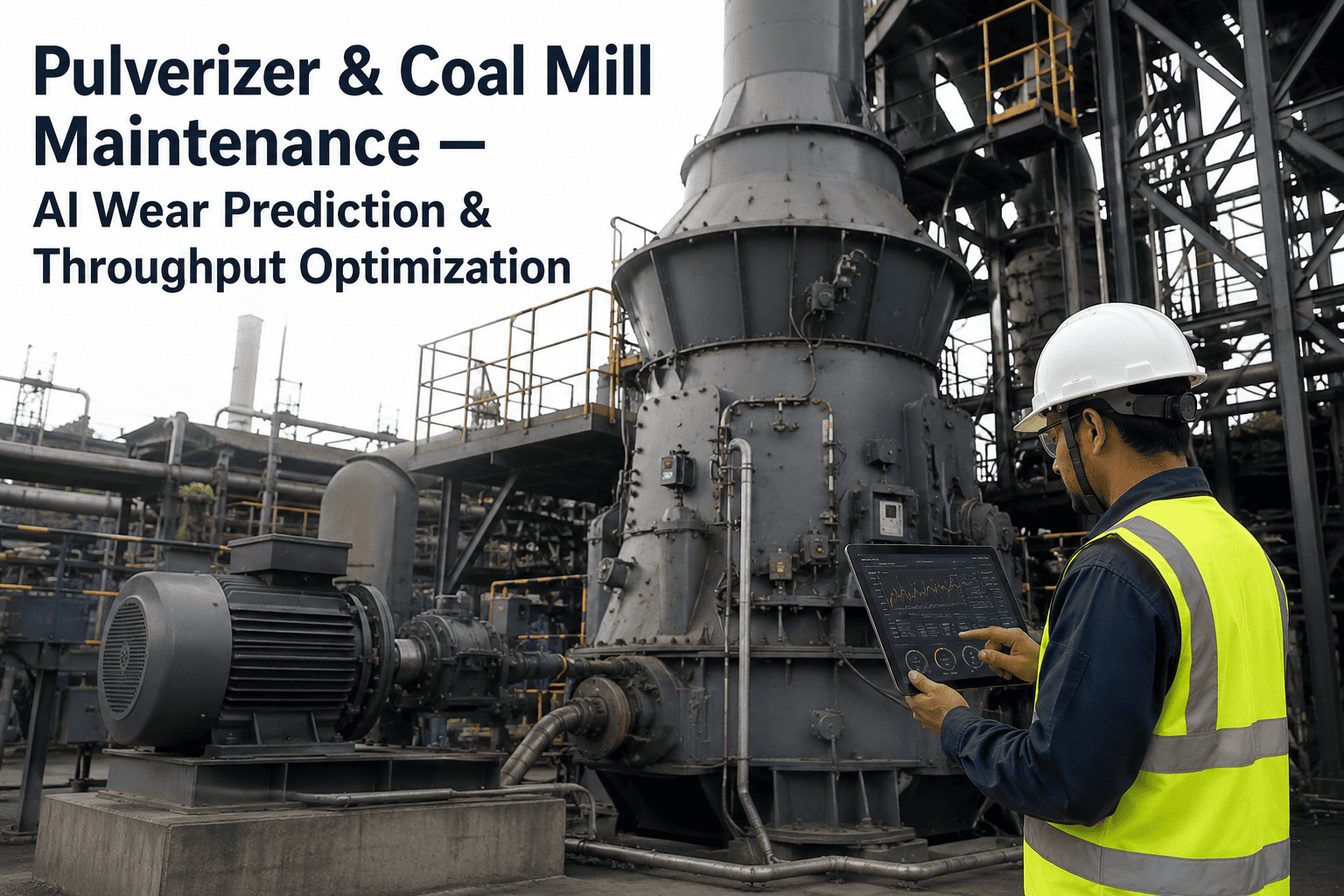
Coal pulverizers sit at the center of a tradeoff that many plants never resolve well: grinding coal too fine wastes mill power and shortens the life of grinding elements, while grinding coal too coarse hurts combustion efficiency, raises unburned carbon, and drives up emissions. Getting fineness right at minimum energy consumption requires continuously balancing classifier settings, grinding element condition, primary air flow, and coal quality, all of which drift over time in ways that manual mill audits catch far too late. Plants that optimize this balance systematically recover fuel efficiency and mill life that most operators assume is simply the cost of burning coal. Book a demo to see how AI-driven mill optimization finds this balance automatically.
Get Optimal Coal Fineness at Minimum Mill Power
iFactory's AI mill optimization continuously balances classifier settings, primary air, and grinding condition to hit target fineness while cutting mill power consumption.
Why Fineness and Energy Consumption Pull in Opposite Directions
Every pulverizer has an efficiency curve where the energy required per ton of coal ground rises sharply as target fineness increases. Understanding where a mill sits on that curve is the starting point for any optimization effort.
Four Variables That Control Mill Fineness and Power Draw
Mill performance is governed by four interacting variables. Adjusting any one without accounting for the others usually just shifts the problem rather than solving it.
Manual Mill Tuning vs AI-Optimized Mill Control
The difference between periodic manual adjustment and continuous AI optimization becomes clear when you compare how each approach responds to changing coal quality and equipment wear.
A Practical Roadmap to Mill Optimization
Plants that successfully optimize their mill fleet typically follow a structured sequence rather than adjusting every mill simultaneously.
What Mill Optimization Typically Delivers
Signals That a Mill Is Drifting Out of Its Efficient Zone
Mills rarely fail suddenly. They drift gradually, and the earliest signals usually show up in data long before anyone notices a physical symptom on the plant floor.
Frequently Asked Questions
How is coal fineness actually measured, and can it be monitored continuously?
Traditional coal fineness measurement uses physical sampling from the pulverized fuel pipe followed by sieve analysis in a lab, typically reported as the percentage passing through 200 mesh and remaining on 50 mesh screens, a process that takes hours to produce results that reflect conditions from earlier in the shift. Continuous fineness inference instead uses AI models trained on the relationship between mill differential pressure, motor power, primary air flow, and classifier speed against historical sieve analysis results, producing a real-time fineness estimate that updates every few seconds rather than every few days. This does not eliminate the need for periodic physical sampling, which remains important for model calibration and validation, but it closes the gap between when a fineness problem develops and when the mill control system can respond to it. Book a demo to see continuous fineness inference on your mills.
How much does grinding element wear actually affect mill energy consumption?
Grinding element wear has a substantial and often underestimated effect on specific mill power consumption, since worn rollers, balls, or grinding rings lose their ability to efficiently crush coal and require significantly more mechanical work to achieve the same particle size reduction as new elements. In many roller and bowl mills, specific power consumption can rise 15 to 30 percent as grinding elements approach the end of their wear life, and beyond a certain wear threshold the mill simply cannot achieve target fineness at any reasonable power level, forcing a reduction in throughput or an increase in coarse particles reaching the burner. Tracking the trend in specific power consumption per ton of coal ground, rather than relying solely on scheduled inspection intervals, gives a much earlier and more accurate signal of when grinding elements need replacement. Contact support to review your mill wear trending approach.
Does optimizing for lower mill power risk hurting combustion efficiency?
This is the central tension that mill optimization has to manage correctly, since grinding coal too coarse to save mill power will increase unburned carbon in ash and reduce boiler combustion efficiency, often costing more in wasted fuel than was saved in mill power. Effective optimization does not simply target minimum power in isolation, it targets minimum power at or above the target fineness specification needed for good combustion, meaning the AI system respects a fineness floor as a hard constraint and only optimizes power within settings that keep fineness above that floor. This is why continuous fineness inference is a prerequisite for safe power optimization rather than an optional add-on, since without real-time visibility into actual fineness, any power reduction effort risks silently drifting coal particle size in the wrong direction. Book a demo to see how fineness constraints are enforced.
Can mill optimization adapt automatically when coal quality changes between deliveries?
Yes, and this is one of the most valuable capabilities of AI-driven mill optimization compared to fixed operating procedures, because coal hardness, moisture content, and grindability can vary meaningfully between deliveries even from the same mine, and a classifier setting that was optimal for one coal shipment may be significantly suboptimal for the next. The AI system detects these changes indirectly through shifts in the relationship between mill power, differential pressure, and achieved fineness, then adjusts classifier speed and primary air flow to re-establish the target fineness at minimum power for the new coal characteristics, typically within a few hours of a coal quality change rather than waiting for the next scheduled manual mill audit to catch the drift. Contact support to discuss handling variable coal quality at your plant.
How many mills need to be optimized before a plant sees a measurable fuel efficiency improvement?
Improvement is typically visible at the individual mill level almost immediately after optimization is enabled, since specific power consumption and fineness for that mill are tracked directly, but the plant-level combustion efficiency and unburned carbon benefit becomes clearly measurable once the majority of mills feeding a common boiler are optimized, because uneven fineness across mills feeding the same furnace can offset gains from any single well-tuned mill. Most plants start with a pilot on the two mills showing the largest gap between actual and optimal specific power consumption, validate the fineness and power improvement over several weeks, and then extend the same approach to the remaining mills once the approach and constraint settings are proven for that specific coal and mill configuration. Book a demo to plan a pilot for your mill fleet.
Hit Target Fineness at the Lowest Power Your Mills Can Deliver
iFactory continuously balances classifier speed, primary air, and grinding condition so every mill in your fleet runs at its true efficient point, not a guess from the last manual audit.