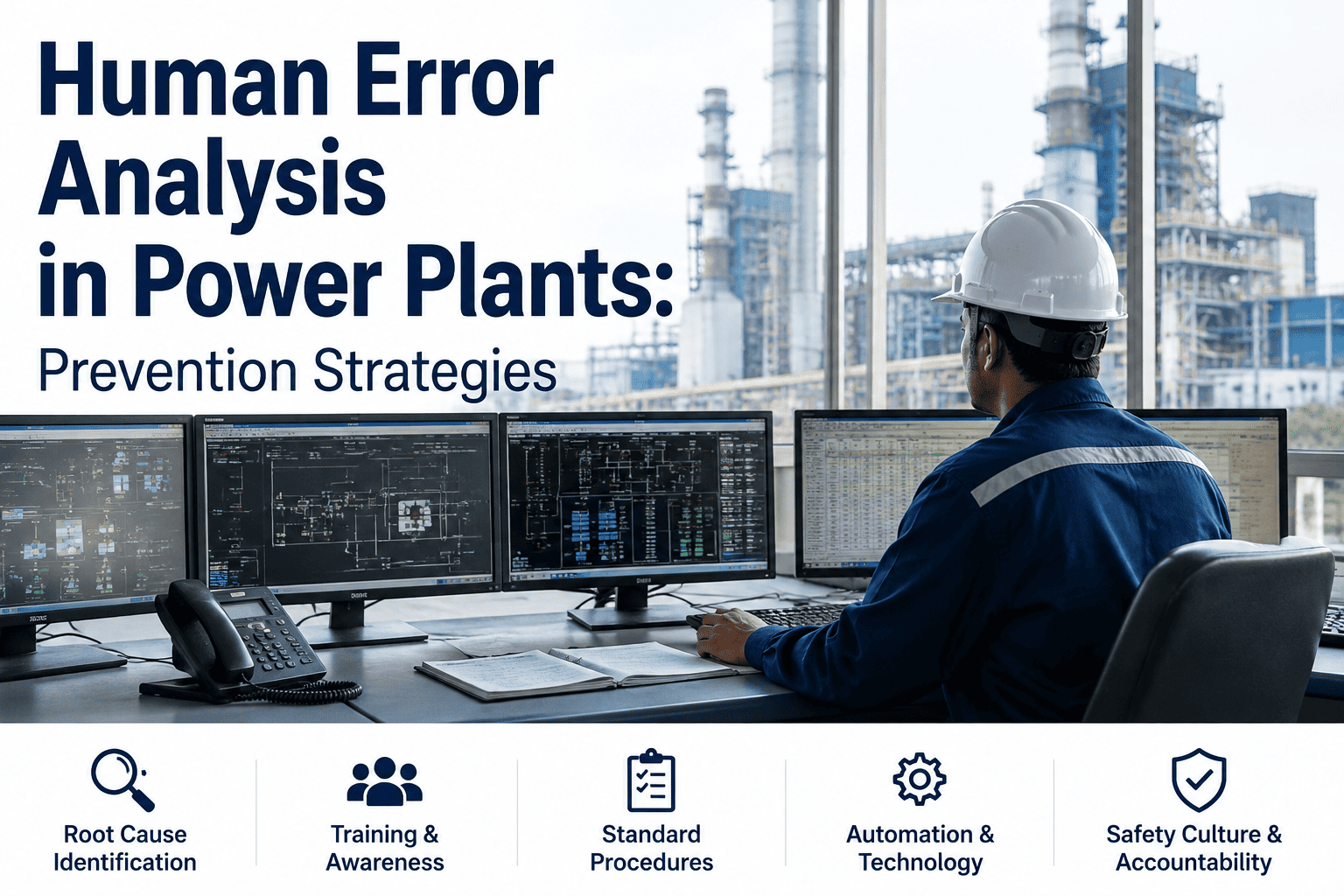
Investigation reports love the phrase "human error" because it closes a case quickly, but it rarely explains anything useful. An operator who opens the wrong valve did so for a reason — a confusing label, a rushed handover, a procedure written for a configuration the plant no longer runs. Power plants that treat human error as a root cause instead of a starting point keep getting the same incidents back, just with different names attached.
Why "Human Error" Is a Description, Not a Diagnosis
Every incident investigation eventually reaches a point where a person did something that, in hindsight, wasn't correct. It's tempting to stop there. But stopping at the individual action ignores the far more useful question: what about the task, the procedure, the training, or the environment made that action seem reasonable at the time it was taken? Nobody comes to work intending to cause an incident, which means the explanation for almost every human error sits somewhere in the system surrounding the person, not in the person alone.
This distinction matters because it changes what corrective action actually looks like. "Retrain the operator" addresses an individual. "Redesign the procedure step that has a 30% documented deviation rate across every operator who's performed it" addresses a system, and system-level fixes prevent the next ten incidents instead of just closing out the last one. Plants with mature human performance programs treat every human error as a signal that some part of the task design, information presentation, or work environment needs attention.
Human factors research consistently shows that error rates for a given task correlate far more strongly with task design quality than with individual operator competence, which is exactly why the most effective prevention strategies focus on redesigning error-prone tasks rather than simply reinforcing individual accountability after the fact.
What Incident Data Across the Industry Actually Shows
These figures point toward the same underlying conclusion from several different angles: errors cluster around predictable high-risk moments — transitions, handovers, high workload, outdated documentation — rather than occurring randomly across all tasks and shifts equally. A prevention strategy that doesn't specifically target these clustering points is spreading its effort where the data says the risk isn't concentrated.
Breaking a Task Down to Find Where Error Actually Lives
Task analysis is the discipline of breaking a procedure into its individual steps and evaluating each one for the specific conditions that make errors more or less likely. It's more granular than most incident investigations go, and that granularity is exactly what makes it useful for prevention rather than just explanation after the fact.
Practical Error-Proofing Approaches for Plant Operations
Error-proofing, sometimes called poka-yoke in a manufacturing context, aims to make the wrong action physically difficult or impossible rather than relying solely on training and attentiveness to prevent it. Plants that layer several error-proofing approaches together see meaningfully better results than plants relying on any single method alone.
Why Procedure Quality Is the Highest-Leverage Fix Available
Of all the contributing factors behind human error, procedure quality is one of the few a plant fully controls. Weather can't be fixed. Fatigue can be managed but not eliminated. But a procedure that's outdated, written for a prior equipment configuration, or ambiguous about a critical decision point is entirely within the plant's ability to correct — and correcting it prevents every future instance of the error the ambiguity caused, not just the one that already happened.
A useful discipline is treating every procedure-related incident as a mandatory trigger for procedure review, not just operator retraining. If an incident investigation reveals that a step in a procedure was genuinely ambiguous, retraining every operator to interpret that ambiguous step "correctly" only postpones the next misinterpretation — it doesn't remove the ambiguity that caused the first one. Book a demo to see how procedure deviation patterns surface automatically across your operating history.
Measuring Whether Training Actually Reduces Error, Not Just Completion Rates
Most plants track training as a completion metric — did the operator finish the module, pass the quiz, sign the attendance sheet. None of that actually measures whether the training changed real-world error rates on the task it addressed. A more meaningful measure tracks error and deviation rates on the specific task before and after a training intervention, for the same population of operators, over a comparable time period.
This kind of before-and-after comparison also reveals when a training fix was the wrong intervention entirely. If error rates on a task remain unchanged after every operator has completed refresher training, the problem was very likely never a knowledge gap in the first place — it was a task design, procedure clarity, or workload issue that training was never going to solve, regardless of how well the training itself was delivered.
Simulator-based training, where available, offers a particularly valuable data source here because it allows abnormal and high-workload scenarios to be practiced and measured directly, rather than waiting for a real abnormal event to reveal whether training transferred to actual performance under pressure.
The Reporting Culture That Makes Prevention Possible
None of the analysis described above is possible without a steady stream of reported near-misses and minor deviations, which means the single most important input to a human error prevention program is a workforce that believes reporting an error or near-miss will lead to a system fix rather than individual blame. Plants with a punitive response to reported errors reliably see reporting rates collapse, which doesn't mean errors stopped happening — it means the plant lost visibility into them until one escalates into an actual incident.
Building and sustaining that reporting culture is slow, deliberate work that has to be reinforced consistently by how leadership actually responds to each reported event, not just what's written in a policy document. A single high-profile punitive response to a reported near-miss can undo years of careful culture-building, which is why the discipline required here is as much about leadership behavior over time as it is about any specific analysis technique.
Task Types That Deserve Extra Human Factors Attention
Not every task carries equal error risk, and plants with limited time for detailed task analysis get the most value by focusing first on the categories of work that consistently show up in incident histories across the industry, rather than reviewing every procedure with equal depth.
What Sustains a Reporting Culture Over Time
A strong reporting culture isn't built by a single policy announcement — it's built and rebuilt continuously by how leadership actually responds every time someone reports an error or a near-miss. The gap between what a safety policy says and how a specific report is actually handled is where trust in the system is won or lost.
Three behaviors tend to separate plants that sustain strong reporting rates from those that see reporting quietly decline over time: closing the loop visibly on every reported issue so people can see their report led to a real change, resisting the urge to discipline the reporter even when the report reveals a clear individual mistake, and sharing de-identified lessons learned broadly so the value of reporting is visible beyond the one person who filed it.
These behaviors matter more during the first response to a serious reported error than at any other time, since that single moment tends to set the expectation for how every future report will be treated, for better or worse, across the entire workforce.