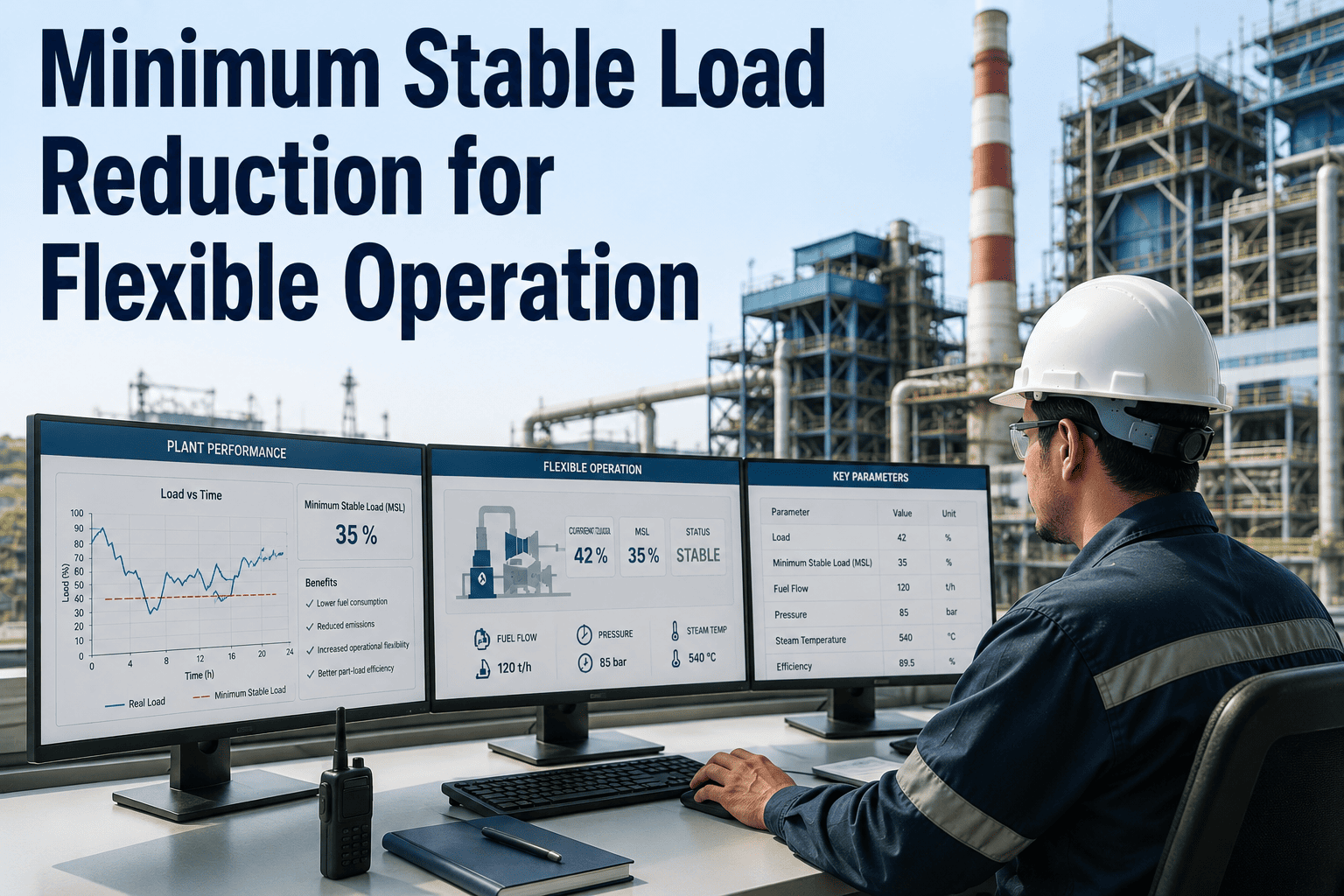
A coal or gas unit that can only turn down to 50% of maximum continuous rating is leaving flexibility revenue on the table every time the grid needs less power than that — and on renewables-heavy grids, that happens more often every year. Minimum stable load is the lowest output a unit can hold while keeping flame stability, emissions compliance, and steam or exhaust temperatures within safe operating limits, and for most conventional units it sits well above what the physics of the boiler or turbine would actually allow with the right combustion and control modifications. Pushing minimum stable load down from a typical 45–50% MCR to the 25–30% range most modern low-load burner and control packages can reach turns a unit that used to shut down or cycle overnight into one that can ride through low-demand periods and capture ancillary service revenue instead. Plant teams evaluating whether their unit has room to reduce minimum load can Book a Demo to walk through the assessment.
Why Minimum Stable Load Has Become a Revenue Question
Minimum stable load used to be a purely operational figure — the floor a unit could run at without tripping. On a grid carrying more wind and solar every year, it has become a commercial figure as well, since a unit that cannot turn down far enough either has to shut down and restart, or run above the market's actual demand and absorb the cost of doing so.
Lost Ancillary Service Revenue
Regulation, spinning reserve, and other ancillary products increasingly reward units that can operate stably across a wide load band. A high minimum load setpoint removes a unit from eligibility for exactly the products that pay the most per megawatt during low-demand hours.
Forced Cycling Wear
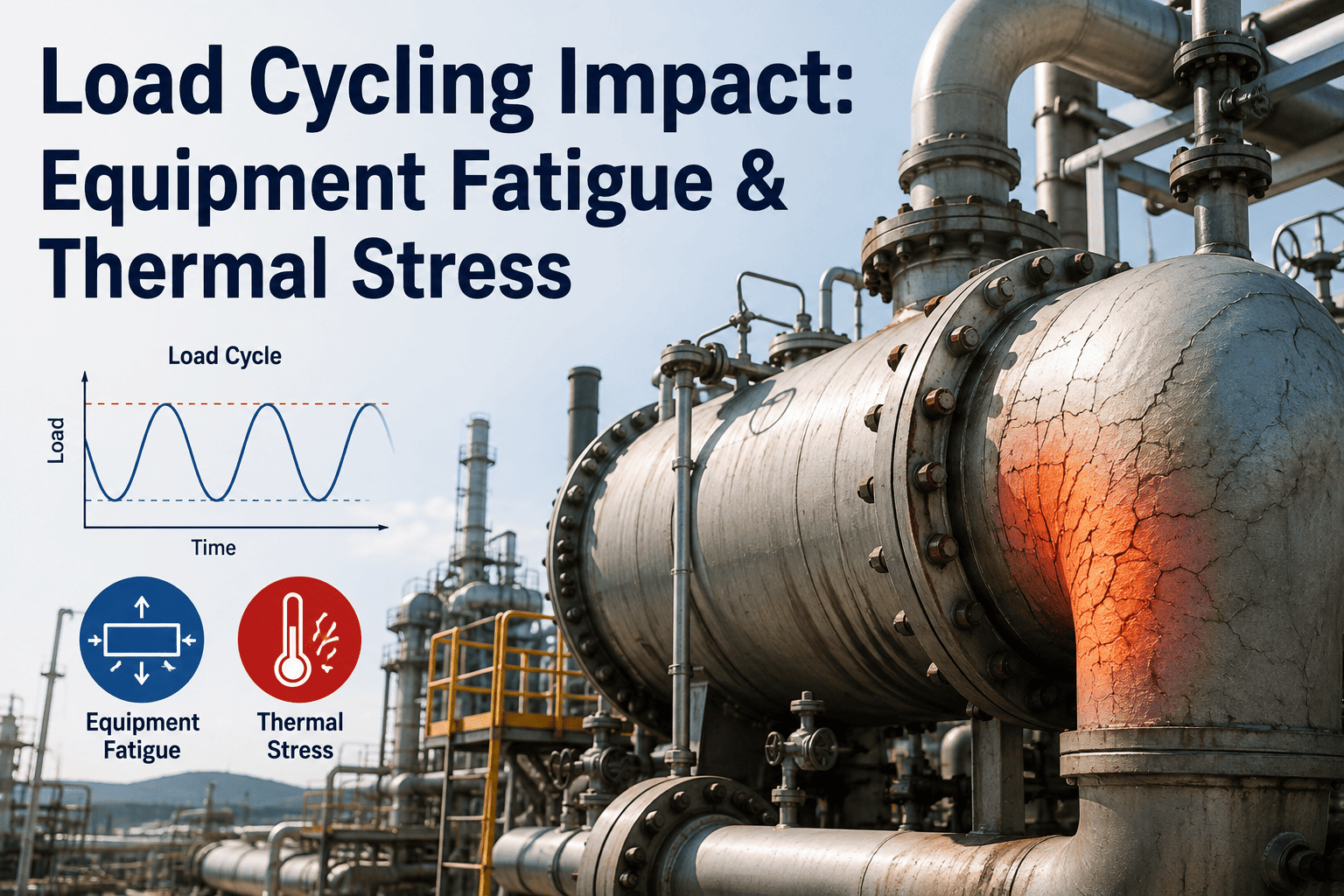
When a unit cannot stabilize low enough to ride through a demand dip, the alternative is a shutdown and hot restart — a cycle that accumulates thermal fatigue on headers, drums, and turbine components far faster than sustained low-load operation would.
Renewable Curtailment Exposure
On grids with growing renewable penetration, dispatch operators increasingly need thermal units to absorb load swings by turning down, not shutting off. Units that cannot follow that instruction risk being curtailed or dispatched out of merit order entirely.
Competitive Dispatch Disadvantage
In markets where dispatch is driven by offer flexibility as much as price, a narrow operating range is a genuine competitive disadvantage against fleet peers that have already reduced their minimum stable load.
The Technical Barriers That Actually Set Minimum Load
Four technical factors typically set the practical floor on minimum stable load, and each one responds to a different category of modification. Understanding which barrier is limiting a specific unit is the first step in any MSL reduction project.
Core Modifications That Move the Minimum Load Setpoint
Reducing minimum stable load is rarely a single modification — it is a combination of hardware and control changes that each address one of the barriers above. The following categories cover the modifications most frequently applied in low-load flexibility projects.
| Modification | What It Addresses | Typical MSL Impact |
|---|---|---|
| Low-load burner tips / swirl redesign | Flame stability at reduced fuel and air flow | 5–10 percentage points |
| Overfire air staging | NOx compliance without sacrificing flame stability | 3–7 percentage points |
| Auxiliary or igniter-assisted firing | Flame stability floor below standard burner limits | 5–15 percentage points |
| Advanced combustion control tuning | Steam temperature stability at reduced firing rate | 3–8 percentage points |
| Mill turndown / feeder upgrades | Even fuel feed at low pulverizer output | 4–8 percentage points |
Air Staging and Low-Load Burner Design
Air staging is one of the highest-leverage modifications for low-load operation because it addresses flame stability and NOx compliance at the same time. Rather than mixing all combustion air with fuel at the burner, staged systems hold back a portion of the air and introduce it downstream through overfire air ports, keeping the primary combustion zone fuel-rich enough to sustain a stable flame at reduced firing rates while still completing combustion — and controlling NOx formation — further along the furnace.
Primary Combustion Zone
Fuel-rich conditions near the burner maintain flame temperature and stability even as total firing rate drops, avoiding the lean, unstable flame that standard burners produce at low load.
Overfire Air Introduction
Remaining combustion air enters downstream through dedicated ports, completing combustion in a cooler, more controlled zone that limits thermal NOx formation.
Burner Tilt and Swirl Tuning
Adjustable burner tilt and swirl geometry help maintain flame shape and furnace heat distribution across a wider load range, reducing the steam temperature swings that otherwise limit turndown.
Control System Modifications That Support Lower Load
Hardware changes create the physical capability to run at a lower load, but control system tuning is what makes that capability usable in day-to-day dispatch. Three control-side modifications consistently show up in successful MSL reduction projects.
Combustion Tuning Across the Full Load Range
Fuel-air ratio curves tuned only for full-load and mid-load operation often perform poorly at the new, lower minimum — retuning across the entire operating range, not just at the target setpoint, is what makes the new floor actually stable.
Sliding Pressure Operation
Allowing steam pressure to slide down with load, rather than holding constant pressure through throttling, improves part-load efficiency and gives the control system more margin to manage steam temperature at reduced firing rate.
Feedwater and Attemperation Control
Low-load operation changes the dynamics of feedwater response and spray attemperation — control loops tuned for full-load response times often overshoot or lag at low firing rates unless specifically retuned for the new operating band.
Achievable Minimum Load Ranges by Unit Type
Achievable minimum stable load varies meaningfully by fuel type and boiler design, and setting realistic targets starts with understanding where a given unit type typically lands after modification.
| Unit Type | Typical Unmodified MSL | Achievable MSL After Modification |
|---|---|---|
| Pulverized coal (PC), drum boiler | 45–55% MCR | 25–35% MCR |
| Pulverized coal (PC), once-through | 40–50% MCR | 25–30% MCR |
| Circulating fluidized bed (CFB) | 35–40% MCR | 20–30% MCR |
| Gas-fired combined cycle | 40–50% MCR | 20–30% MCR |
Assessing Whether Your Unit Has Room to Turn Down Further
Before committing to any hardware modification, a structured assessment establishes exactly which barrier — flame stability, emissions, steam temperature, or fuel feed — is actually limiting the current minimum load setpoint, and how much margin realistically exists.
Review historical low-load trip and instability events to identify which parameter reached its limit first.
Confirm current emissions margin at the lowest tested load point against permit limits, not just full-load compliance data.
Evaluate mill or fuel-feed turndown range independently from boiler and burner limitations.
Model steam or exhaust temperature behavior at candidate lower setpoints before committing to hardware changes.
Prioritize modifications by expected MSL impact against implementation cost and outage scope required.
Frequently Asked Questions: Minimum Stable Load Reduction
What is minimum stable load and why does it matter for flexibility?
Minimum stable load is the lowest output level a generating unit can sustain while maintaining stable combustion, emissions compliance, and safe steam or exhaust temperature control. It matters for flexibility because grids with growing renewable generation increasingly need thermal units to turn down rather than shut off during low-demand periods, and a unit that cannot reach a low enough minimum load either has to cycle off and restart or run above actual market demand, both of which carry real operational and financial cost.
How much can minimum stable load realistically be reduced?
Reduction potential depends heavily on unit type and current design, but pulverized coal units typically move from a 45–55% MCR baseline down to 25–35% MCR with a combination of low-load burner, air-staging, and control modifications, while gas-fired combined cycle units often see comparable percentage-point gains. Teams unsure of what's realistic for their specific unit configuration can Book a Demo for a unit-specific assessment.
Does reducing minimum load hurt combustion efficiency?
Part-load efficiency is inherently lower than full-load efficiency on most thermal designs, but a properly modified and tuned low-load configuration performs meaningfully better than an unmodified unit forced to operate near its old minimum without air staging or combustion tuning support. The efficiency comparison that matters is modified low-load operation against the alternative of cycling off and restarting, not against full-load efficiency.
Which comes first — burner hardware changes or control tuning?
Control tuning alone can sometimes recover a few percentage points of turndown on units with conservative legacy setpoints, but meaningful minimum load reduction generally requires both — hardware changes create the physical margin to run stably at lower load, and control tuning is what makes that margin usable across day-to-day dispatch conditions without manual intervention. Projects that start with a combustion and control assessment typically get a clearer picture of how much each category will contribute before committing capital to hardware changes.
What ancillary services become available with a lower minimum load?
Regulation, spinning reserve, and other ancillary products often set eligibility requirements around a unit's demonstrated operating range — a wider band between minimum and maximum load generally qualifies a unit for more product types and larger reserve commitments. The specific products and revenue available vary by market, so plant teams should confirm current market rules alongside the technical MSL assessment. Support contact iFactory Support can help connect the technical assessment to market participation questions.