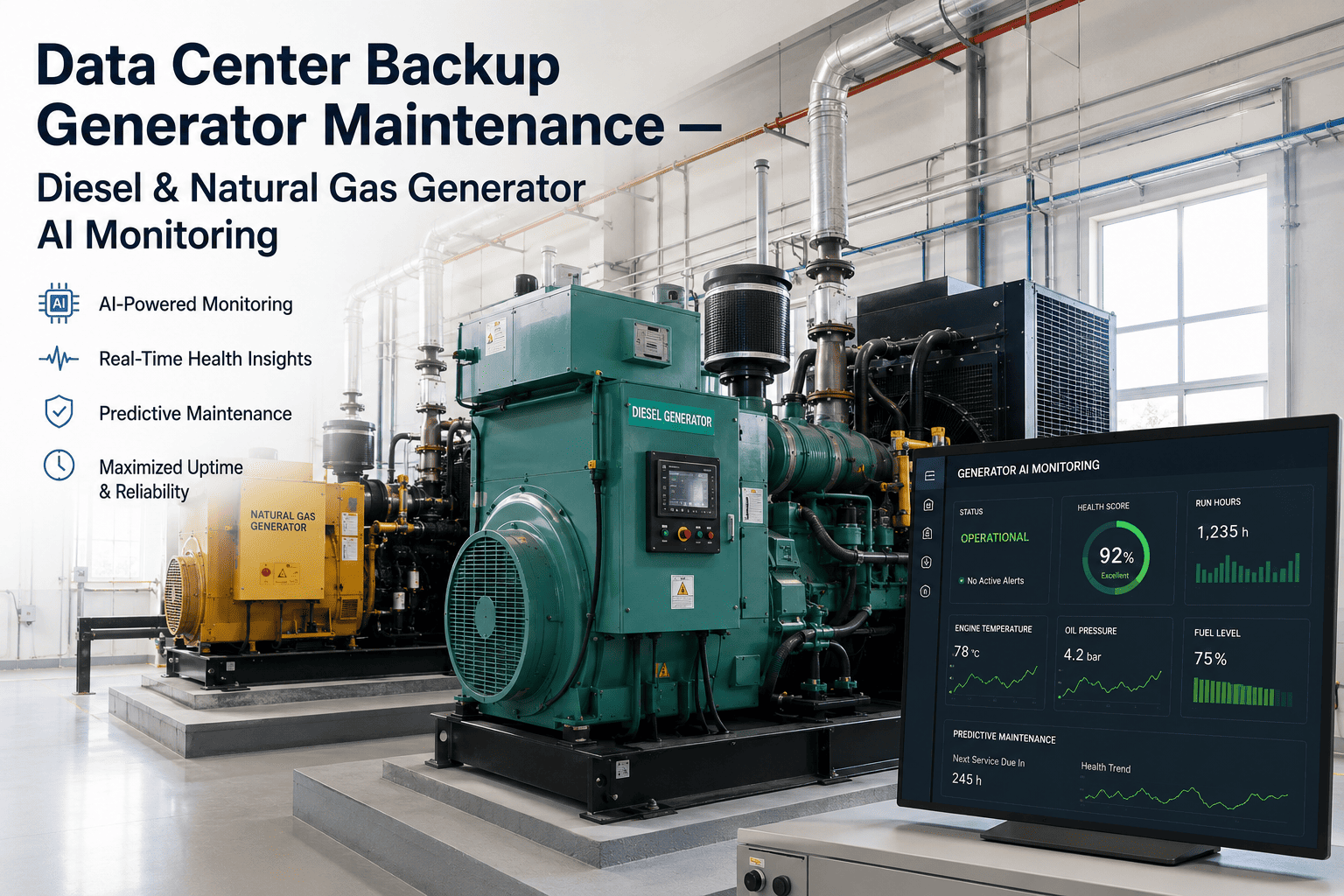
A peaking unit can sit idle for weeks and then get a dispatch call demanding full load within minutes, which means every failure mode that would simply cause a derate on a baseload unit instead becomes a missed start on a peaker. Most peakers run under 1,500 hours a year, some closer to a few hundred, so a plant manager is maintaining equipment that spends the overwhelming majority of its life in standby, where the usual signals of developing trouble, vibration, temperature drift, control response, never get the chance to show themselves during actual operation. The plants that stay reliable treat standby readiness as its own discipline rather than an afterthought between runs, because the call to start rarely arrives with any warning about which system might not be ready. Book a demo to see standby readiness tracked continuously for your peaking fleet.
AI-Driven · Peaking Generation · Rapid-Start Reliability
The Dispatch Call Doesn't Wait for a Slow Start. Neither Should Your Readiness Data.
iFactory tracks standby system health across your peaking units continuously, so a fuel system issue, a control fault, or a vibration trend gets caught while the unit is sitting idle, not discovered the moment dispatch calls for full load.
The Readiness Clock
Four Stages Between Standby and Full Load, and Where Each One Breaks
Standby
Idle, Weeks Between Runs
Fuel system components sit unused, batteries and control systems draw down slowly, and lubrication settles, all conditions that erode start readiness without ever tripping an alarm.
Dispatch Call
Minutes to Respond
The control system has to initialize, permissives have to clear, and every standby subsystem has to confirm ready status simultaneously, with no time built in to troubleshoot a fault that surfaces now.
Fire and Roll
Ignition Through Acceleration
Igniters, flame detectors, and fuel valves all have to perform correctly on the first attempt, since a failed light-off during a genuine dispatch event has no scheduled retry window.
Full Load
Sustained Output
Vibration, exhaust temperature, and generator parameters all have to hold within limits under sustained load, the point where deferred maintenance from the idle period finally shows itself.
<1,500 hrs
Typical annual run hours for a peaking unit, with some plants operating as little as a few hundred hours per year
Minutes
The window a peaker typically has to reach full rated load once a dispatch call requesting rapid loading comes in
5°F/sec
A commonly cited exhaust temperature rate-of-rise threshold beyond which turbine control systems intervene to protect hot-gas-path components during a start
Life Penalty
The cost of frequent fast starts without adequate warmup, which accelerates wear on combustion-section parts over the unit's service life
A Peaker That Fails to Start Isn't a Maintenance Problem. It's a Grid Reliability Problem.
Continuous standby system health monitoring across fuel, ignition, control, and vibration systems, so start-on-demand reliability is a known quantity, not a hope.
Standby Failure Reference
What Actually Causes a Peaker to Miss a Dispatch Call
| Symptom |
Likely Cause |
Typical Response |
| Failed or Delayed Light-Off |
Worn igniter, degraded flame detector, or fuel valve that hasn't cycled recently |
Inspect and test ignition components on a rotating schedule tied to actual idle time, not just calendar interval |
| High Vibration on Startup |
Bearing wear or rotor imbalance that only manifests once the unit reaches operating speed |
Schedule vibration analysis during the next planned exercise run before the next real dispatch event |
| Slow Response to Load Commands |
Control system calibration drift accumulated over an extended standby period |
Verify control loop tuning and actuator response against baseline during a scheduled test |
| Battery or Starting System Fault |
Battery charge drawn down during standby without adequate trickle charge monitoring |
Verify charging system function and battery health continuously, not only at the next physical check |
| Trip During Load Acceleration |
Rate-of-rise protection engaging due to fuel control or temperature sensor drift |
Review recent start data against control system rate limits and recalibrate affected sensors |
How the Platform Works
From Idle-Period Data to Confirmed Start Readiness
Most of what determines whether a peaker starts successfully happens during the idle period, long before dispatch calls, which is exactly when most monitoring programs pay the least attention.
1
Continuous Standby Monitoring
Battery health, fuel system condition, control calibration, and lubrication status are tracked continuously through every idle period, not just checked before a planned test.
2
Start History Analysis
Every start and load acceleration event is analyzed against the unit's own historical performance, surfacing gradual drift in light-off time, ramp rate, and vibration signature.
3
Readiness Scoring
Each unit gets a current readiness status based on standby system health and recent start performance, so a plant manager knows which units are dispatch-ready before the call comes in.
4
Maintenance Window Alerts
Flagged issues get scheduled into planned exercise runs or maintenance windows, keeping the fix off the critical path of an actual dispatch event.
Readiness Check
Six Questions to Ask Before the Next Dispatch Call
1Has every unit in your peaking fleet actually started and reached full load within the last thirty days
2Is battery and starting system health tracked continuously through standby, not just checked during a physical walkdown
3Would a slow trend in light-off time or ramp rate surface as an alert before the next real dispatch event
4Is vibration data captured and reviewed from every start, or only when a test happens to catch a problem
5Can you see the current readiness status of your entire fleet from one view before dispatch calls
6Are spare igniters, flame detectors, and other single-point-failure items confirmed in stock right now
From the Field
What a Plant Learned From a Missed Start During Peak Summer Demand
We got the dispatch call on one of the hottest days of the summer, exactly the kind of event our peaker existed for, and one of our two units failed to light off on the first attempt. By the time we diagnosed a worn igniter and got the second attempt going, we had lost close to ten minutes during a window where the grid needed that capacity immediately. The frustrating part was that the unit had been sitting idle for almost seven weeks before that call, and nothing about its standby condition had been checked in that entire stretch beyond a visual walkthrough. Once we started tracking igniter cycle history and fuel system condition continuously through the idle periods instead of only before scheduled tests, we caught a second igniter showing the same wear pattern nearly a month before it would have caused the same failure, and swapped it during a routine maintenance window instead of during a live dispatch event.
— Plant Manager, Simple-Cycle Peaking Facility
Conclusion
A Peaker's Reliability Is Decided During Standby, Not During the Start
By the time a peaking unit gets a dispatch call, its readiness has already been determined by everything that happened, or didn't happen, during the weeks it sat idle. A worn igniter, a slowly draining battery, or a control calibration drift all develop quietly during standby and only announce themselves at the worst possible moment, during an actual start.
iFactory's AI-driven platform keeps standby system health and start performance trending continuously across your peaking fleet, so a plant manager knows which units are truly dispatch-ready before the phone rings, not after a failed start during peak demand.
Across a fleet of peaking units, that same continuous readiness view rolls up into one status board, so operations can confirm fleet-wide dispatch readiness at a glance instead of relying on the last scheduled test date for each unit. Book a demo to see it configured for your peaking fleet.
Frequently Asked Questions
Peaking Plant Reliability — What Plant Managers Ask
Why is standby monitoring more important for peakers than for baseload units?
A baseload unit runs continuously, so developing problems like vibration drift, control calibration issues, or fuel system degradation tend to show up gradually during normal operation, giving a maintenance team time to notice and respond before the problem becomes severe. A peaking unit spends the vast majority of its life idle, so those same developing problems have no opportunity to surface until the unit actually starts, and by then there is no time left to troubleshoot since the dispatch event that triggered the start is usually the exact moment the grid needs that capacity most urgently.
Book a demo to see standby health tracked continuously for your fleet.
How often should a peaking unit actually be exercised if it isn't being dispatched?
Exercise frequency varies by unit type and manufacturer guidance, but many peaking fleets run scheduled test starts on a monthly or bi-monthly basis specifically to confirm start reliability rather than relying on an actual dispatch event as the first real test. The value of continuous standby monitoring is that it extends visibility into the weeks between those scheduled tests, so a battery or fuel system issue developing between exercise runs gets caught rather than waiting for the next scheduled start to reveal it.
Does frequent fast starting actually shorten a gas turbine's service life?
Yes, in most cases. Starting a gas turbine without an adequate warmup period, particularly from a cold standby condition, is discouraged by many manufacturers because it reduces the life of combustion-section parts, since those components need a reasonable heat-soak period to avoid accelerated thermal fatigue. This creates a real tension for peaking plant operators between meeting rapid dispatch demands and preserving turbine component life, which is exactly why tracking start performance data over time matters, since it lets a plant manager see the actual wear pattern developing rather than guessing at how much life a given starting regimen is costing.
Contact support to discuss start data tracking for your specific turbine model.
Can this monitor a mixed fleet of gas turbines and reciprocating engine peakers together?
Yes. Gas turbines and reciprocating engine or diesel generator peakers fail in different ways and are modeled against their own equipment-specific baselines within the platform, but both feed into the same fleet-wide readiness view. This matters for plant managers overseeing mixed technology fleets, since a single readiness dashboard covering every unit type removes the need to check separate systems for turbines versus reciprocating units before confirming the whole fleet's dispatch readiness.
What instrumentation does a peaking unit need before this kind of readiness monitoring can start?
Most peaking units already have control system data, vibration sensors, and starting system instrumentation in place as part of their standard turbine or engine control package, and this existing instrumentation is typically what the platform connects to rather than requiring a new sensor package. Because peaking units already log detailed data during every start event as part of normal control system operation, a typical fleet can begin generating trend visibility from that existing start history within the early weeks of connection.
Know Which Units Are Truly Dispatch-Ready Before the Call Comes In.
Continuous standby health and start performance monitoring across your peaking fleet, configured for your specific turbine or engine technology.