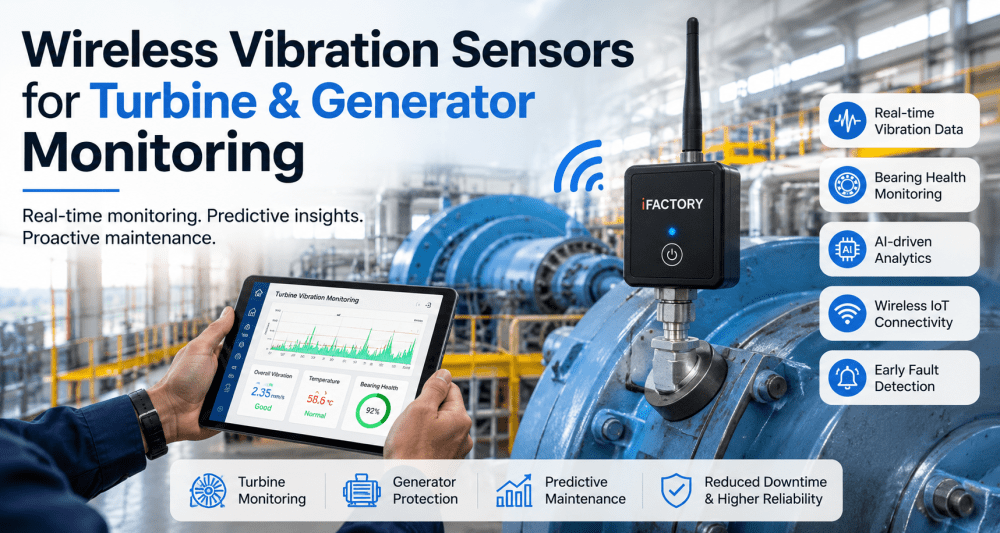
Turbines and generators are the most critical rotating assets in power generation, oil and gas, and industrial processing — and they fail through vibration. Wireless vibration sensors make continuous condition monitoring economically feasible for these assets by eliminating the wiring costs, conduit runs, and junction box installations that have historically limited permanent vibration monitoring to the largest and most critical machines. iFactory AI's industrial IoT platform — spanning wireless sensor integration, edge-based vibration analytics, predictive maintenance, and automated reporting — provides turbine and generator operators with a unified technology stack for deploying wireless condition monitoring across their rotating equipment fleet. Book a Demo to see the platform configured for your specific turbine and generator monitoring requirements.
Deploy Wireless Vibration Sensors on Your Turbines and Generators — Continuous Monitoring Without the Wiring Cost
iFactory's wireless vibration monitoring platform combines industrial-grade wireless accelerometers, edge-based AI analytics, and turbine-specific predictive maintenance models to deliver continuous bearing health, shaft alignment, and rotor balance monitoring — without the installation cost of wired condition monitoring systems.
Why Conventional Vibration Monitoring Falls Short for Turbines and Generators
Turbine and generator condition monitoring has historically faced a fundamental trade-off between data quality and deployment cost. Wired accelerometer systems connected to online condition monitoring platforms deliver continuous, high-bandwidth vibration data — but at installation costs of $2,000 to $5,000 per measurement point when accounting for sensor hardware, cabling, conduit, junction boxes, termination panels, and integration labor. A steam turbine with ten bearing housings and a generator with four bearing housings represents $28,000 to $70,000 in monitoring installation cost alone, before any analytics platform or data storage infrastructure is added.
The cost per measurement point drops to $400 to $800 including sensor, gateway infrastructure amortization, and installation labor — making continuous vibration monitoring economically feasible for every turbine and generator in the facility rather than only the critical path assets. Book a Demo to explore iFactory's wireless vibration monitoring framework for your rotating equipment.
Triaxial Wireless Accelerometers
MEMS-based triaxial accelerometers measure vibration in X, Y, and Z axes simultaneously, providing complete bearing housing vibration data from a single sensor. Frequency response from 0.5 Hz to 10 kHz covers the full spectrum of turbine and generator fault frequencies including subsynchronous vibration, rotational speed harmonics, and high-frequency bearing defect signatures. Integrated temperature sensing provides bearing condition cross-correlation data.
Wireless Displacement Probes
Non-contact eddy current displacement sensors measure shaft relative vibration and axial position — critical parameters for journal bearing turbines where bearing housing acceleration alone does not capture shaft orbit changes or thrust bearing wear. Wireless displacement probe interfaces connect existing proximity probe systems to the wireless network for retrofit installations.
Wireless Temperature and Process Bridges
Multi-variable wireless sensor nodes integrate bearing temperature, lubricating oil temperature, and cooling water temperature measurements alongside vibration data in a single field device. Temperature trend correlation with vibration data improves fault diagnosis accuracy for bearing degradation, lubrication starvation, and cooling system degradation — conditions that produce thermal effects before they produce vibration changes.
5 Critical Application Areas for Wireless Vibration Monitoring on Turbines and Generators
Wireless vibration sensors address five distinct monitoring challenges across turbine and generator asset classes — from gas turbines and steam turbines to generators, hydro turbines, and mechanical drive turbines. Each application area requires specific sensor placement, measurement configuration, and analytics logic that iFactory's platform delivers through turbine-specific AI models trained on each asset class's vibration characteristics and failure mode signatures.
Wireless Bearing Condition Monitoring for Turbine and Generator Bearings
Rolling element and journal bearing degradation is the most common failure mode across all turbine and generator types, accounting for 40 to 55 percent of all unplanned rotating equipment outages. Wireless accelerometers mounted directly on bearing housings capture the high-frequency vibration signatures — bearing pass frequencies, cage modulation, and lubrication film instability — that indicate the onset of spalling, raceway fatigue, and clearance wear. iFactory's AI models classify bearing condition into four severity bands: normal, developing defect, advanced degradation, and critical — with trend analysis that estimates remaining useful life at each severity level.
- Triaxial accelerometer placement on each bearing housing captures radial and axial vibration data for complete bearing force analysis
- Envelope acceleration processing extracts high-frequency bearing defect signals from background rotational vibration
- AI remaining useful life model trained on bearing-specific degradation curves from turbine operating history
- Temperature cross-correlation detects lubrication degradation and cooling system issues that accelerate bearing wear
Shaft Misalignment and Coupling Degradation Detection
Shaft misalignment between turbine and generator, between turbine stages, or across flexible couplings produces distinct 1X and 2X rotational frequency vibration patterns that wireless accelerometers detect before the misalignment generates sufficient heat or wear to trigger conventional alarm thresholds. AI models trained on each shaft train's baseline alignment signature detect angular misalignment, parallel offset, and coupling wear progression from wireless accelerometer data at bearing housings adjacent to each coupling.
- 1X and 2X rotational frequency amplitude trend analysis distinguishes misalignment from imbalance
- Phase correlation between adjacent bearing housing sensors identifies misalignment direction and severity
- Coupling wear detection from high-frequency vibration components generated by coupling element degradation
- Real-time alignment drift tracking enables planned alignment corrections during scheduled outages
Rotor Imbalance and Blade Pass Monitoring
Rotor imbalance — caused by blade erosion, fouling, ice accumulation, or balancing weight migration — manifests as elevated 1X rotational frequency vibration that increases with rotational speed. In gas turbines and steam turbines, blade pass frequency vibration indicates individual blade degradation, nozzle block fouling, or flow path damage that conventional bearing housing acceleration measurements may not detect until significant damage has occurred.
- 1X amplitude trend analysis at each bearing plane identifies imbalance progression and distinguishes gradual from sudden imbalance events
- Blade pass frequency monitoring for gas turbine and steam turbine blade health assessment
- Speed-dependent vibration analysis identifies critical speeds and resonance condition changes
- Imbalance severity classification supports planned balancing during scheduled maintenance windows
Gearbox and Coupling Health Monitoring
Turbine-generator gearboxes — in gas turbine mechanical drive applications, hydro turbine speed increases, and generator excitation systems — introduce gear mesh frequencies and sidebands that wireless accelerometers detect as indicators of tooth wear, pitting, cracking, and misalignment. Coupling health monitoring detects elastomer degradation, grid spring fatigue, and diaphragm coupling cracking through vibration pattern changes at the coupling location.
- Gear mesh frequency and harmonic amplitude trending detects tooth surface degradation progression
- Sideband analysis identifies modulation caused by eccentricity, tooth spacing errors, and localized damage
- Coupling-specific vibration signatures distinguish flexible element degradation from shaft misalignment
- Wireless sensor placement between gearbox bearing housings captures gear mesh vibration at source
Generator Electrical and Mechanical Fault Detection
Generators produce unique vibration signatures from electrical as well as mechanical sources — pole pass frequency vibration from rotor winding shorts, twice-line-frequency vibration from stator core and winding issues, and cooling fan vibration from blade or duct degradation. Wireless accelerometers on generator bearing housings and stator core frames capture both mechanical and electrical vibration components, enabling AI models to distinguish electrical faults from mechanical faults based on frequency signature and load correlation.
- Pole pass frequency vibration analysis detects rotor winding inter-turn shorts and diode failures
- 100 / 120 Hz vibration trend analysis for stator core and winding mechanical degradation
- Load-dependent vibration correlation distinguishes electrical from mechanical fault sources
- Hydrogen seal and cooling fan vibration monitoring for generator ancillary system health
iFactory AI Platform Architecture for Wireless Vibration Monitoring — From Sensor to Insight
Deploying wireless vibration monitoring across a turbine and generator fleet requires an architecture that bridges the sensor layer — wireless accelerometers, displacement probes, and temperature bridges — with the analytics layer where AI models, trending logic, and maintenance integration run. iFactory AI is designed for this OT-IT integration, with native connectivity to industrial wireless mesh protocols, edge computing environments, and enterprise asset management systems.
Wireless Sensor Network Layer
Triaxial wireless accelerometers, displacement probe interfaces, and temperature bridge sensors install on turbine and generator bearing housings, coupling guards, and stator frames using magnetic mounts or threaded studs. Industrial wireless mesh protocol provides self-healing connectivity at ranges up to 300 meters between nodes, with Class 1 Division 2 hazardous area certification for gas turbine applications in fuel gas and process gas environments.
Edge Processing and AI Analytics Engine
Edge gateways receive raw vibration time-series data from the wireless sensor network and perform FFT processing, envelope acceleration extraction, and feature calculation at the network edge — transmitting only processed spectral data and alarm events to reduce network bandwidth requirements. iFactory's AI analytics engine runs turbine-specific machine learning models that classify vibration patterns against known fault signatures for bearing degradation, misalignment, imbalance, gear tooth damage, and generator electrical faults.
Condition Assessment and Alerting Layer
AI-generated condition assessments surface in iFactory's operations dashboard with severity classification, estimated remaining useful life, and recommended maintenance actions. Operators receive early-warning notifications for bearing degradation onset, alignment drift, imbalance progression, gear tooth damage, and generator fault events — with enough lead time to plan corrective actions during scheduled maintenance windows rather than reacting to emergency shutdowns.
CMMS Integration and Maintenance Planning
Vibration condition data flows directly into iFactory's CMMS platform, automatically generating work orders when condition thresholds are breached and supporting maintenance planning with asset-specific vibration history, trend reports, and remaining useful life projections. Integration with existing enterprise asset management and ERP systems provides a single source of truth for turbine and generator condition data across the organization.
- Wired accelerometers installed on select critical assets only; cost limits coverage to 10–20% of rotating equipment fleet
- Installation costs of $2,000–$5,000 per measurement point including cabling, conduit, junction boxes, and terminations
- Continuous monitoring bandwidth available but constrained to fiber-connected assets within SCADA infrastructure reach
- Vibration data analyzed manually or through threshold-based alarm systems with high false positive rates
- Wireless sensors deployed on every turbine and generator in the facility; coverage expanded to 100% of rotating equipment
- Installed cost of $400–$800 per measurement point including sensor, gateway amortization, and magnetic mount installation
- 10 kHz vibration bandwidth, three-axis measurement, and 2–5 year battery life matching wired sensor performance
- AI analytics classify vibration patterns against turbine-specific fault libraries; false alarm rate reduced by 75% vs. threshold alarms
- Remaining useful life predictions generated for each monitored component; maintenance actions planned to scheduled outages
- New measurement points added by mounting sensor on bearing housing and joining wireless mesh network — no wiring required
Measurable Outcomes from Wireless Vibration Monitoring on Turbines and Generators
Measuring the business impact of wireless vibration monitoring requires KPIs spanning detection performance, maintenance cost avoidance, production impact, and deployment scalability. The benchmark table below provides the performance metrics iFactory tracks for each monitoring application, with representative before-and-after ranges from industrial rotating equipment deployments. Individual facility results depend on baseline monitoring maturity, turbine type, fuel source, and operating profile. Book a Demo to benchmark your turbine and generator monitoring maturity against iFactory's capability model.
| Monitoring Application | KPI Tracked | Baseline (Conventional) | With iFactory Wireless AI | Primary Value Driver |
|---|---|---|---|---|
| Bearing Condition | Fault detection lead time | 0 days (detected at failure or scheduled inspection) | 2–6 weeks | Bearing replacement during planned outage vs. forced shutdown |
| Shaft Alignment | Alignment drift detection frequency | Annually during scheduled outage | Continuous real-time | Coupling and seal life extended; unplanned alignment corrections eliminated |
| Rotor Balance | Imbalance detection lead time | 0 days (detected after vibration shutdown) | 4–8 weeks | Planned balancing during maintenance window |
| Gearbox Health | Gear tooth crack detection lead time | 0 days (detected at failure or borescope inspection) | 3–8 weeks | Tooth fracture avoided; gearbox replacement planned |
| Generator Electrical | Rotor winding short detection time | Weeks (manual RSO test cycle) | Hours | Generator run-back or planned outage vs. emergency trip |
| Total Coverage | Percentage of rotating equipment monitored | 10–20% (critical path assets only) | 90–100% | Fleet-wide condition visibility and maintenance planning |
What Reliability Engineers Say About Wireless Vibration Monitoring Deployment
We operate a fleet of twelve gas turbines and ten steam turbines across three combined-cycle power plants, with generators ranging from 40 MW to 280 MW. Before deploying iFactory's wireless vibration monitoring platform, our condition monitoring coverage was limited to wired accelerometers on the main bearing housings of our four largest gas turbines — approximately 15 percent of our total rotating equipment fleet. The remaining turbines and generators were monitored through weekly portable data collector routes that a single vibration analyst managed across three sites. The problem was not that our analyst lacked skill; the problem was that weekly collection routes left six days of vibration data gap between measurements, and a bearing defect that initiated on Tuesday would not be detected until the following Monday's data collection — by which point the spall could have propagated from an incipient defect to a confirmed degradation requiring urgent intervention.
The AI alert provided 19 days of advance warning before the bearing reached critical condition — enough time to procure the replacement bearing, plan the outage window, and execute the replacement during a scheduled plant shutdown period rather than as a forced outage.
Deploy Wireless Vibration Monitoring Across Your Turbine and Generator Fleet
From wireless bearing monitoring to shaft alignment detection and generator electrical fault identification — iFactory AI delivers the complete wireless condition monitoring intelligence stack for rotating equipment in one platform built for power generation and industrial turbine operations.
Wireless Vibration Monitoring for Turbines and Generators Is a Present Reliability Advantage
The case for wireless vibration monitoring on turbines and generators is built on a cost and coverage reality that every reliability engineer already understands: wired condition monitoring systems priced at $2,000 to $5,000 per measurement point will never cover the full rotating equipment fleet, leaving the majority of turbines and generators invisible between manual data collection routes. The cost gap between wired and wireless systems — 60 to 80 percent reduction in installed cost per point — closes this coverage gap permanently, making continuous condition monitoring economically feasible for every bearing housing, every coupling, and every gearbox in the facility.
iFactory AI provides the integrated platform that connects wireless sensor data to turbine-specific AI models, operations dashboards, and CMMS maintenance workflows in a single system. Book a Demo with iFactory's rotating equipment team to build a site-specific wireless vibration monitoring assessment for your turbine and generator fleet.
Deploy Wireless Vibration Monitoring for Your Turbines and Generators with iFactory
iFactory registers every wireless vibration sensor, monitors bearing condition and alignment in real time, detects rotor imbalance and gearbox faults from AI analytics, and generates maintenance-ready work orders — in one platform built for rotating equipment reliability.
Wireless Vibration Sensors for Turbine and Generator Monitoring — Frequently Asked Questions
How do wireless vibration sensors compare to wired accelerometers in measurement accuracy and bandwidth for turbine monitoring?
Modern industrial wireless accelerometers deliver measurement performance that matches wired sensors across the frequency range relevant to turbine and generator fault detection. MEMS-based wireless accelerometers provide 0.5 Hz to 10 kHz bandwidth with 0.01 mg resolution and ±16 g dynamic range — covering bearing defect frequencies up to 10 kHz, shaft rotational speed harmonics from subsynchronous to 8X, blade pass frequencies, and gear mesh frequencies. The primary performance gap between wireless and wired sensors is in sampling continuity: wireless sensors operating on battery power sample at configurable intervals (continuous to once per hour) rather than streaming continuously, which is appropriate for turbine monitoring where fault progression occurs over days to weeks rather than seconds.
What battery life can operators expect from wireless vibration sensors on turbine and generator bearing housings?
Wireless vibration sensor battery life depends on measurement interval, data transmission frequency, and ambient temperature at the installation location. At typical turbine monitoring configurations — data capture every 10 to 30 minutes with FFT spectrum and overall vibration level transmission — industrial wireless accelerometers deliver 2 to 5 years of battery life from a single internal lithium battery pack. Sensor nodes operate across the full industrial temperature range (-40°C to +85°C), enabling installation on turbine bearing housings that reach 60°C to 90°C during normal operation.
Can wireless vibration sensors integrate with existing turbine control system and protection systems?
Yes. iFactory's wireless vibration monitoring platform is designed for OT integration with turbine control systems, protective relaying, and plant SCADA infrastructure. The edge gateway provides analog output (4-20 mA) and relay contact options for direct interface with turbine protection systems, enabling wireless vibration data to serve as backup or supplemental input to existing vibration trip circuits. For supervisory control and data acquisition integration, the platform supports Modbus TCP, OPC-UA, and REST API protocols that connect to existing plant control room dashboards and historian systems.
What is the typical ROI timeline for wireless vibration monitoring deployment on a turbine and generator fleet?
Operators deploying wireless vibration monitoring on turbine and generator fleets typically recover platform investment within 6 to 14 months through a combination of avoided forced outage costs, extended bearing replacement intervals from condition-based replacement, reduced portable data collection labor, and elimination of emergency replacement logistics costs. A single avoided forced outage on a 100 MW gas turbine — with replacement power cost at $80/MWh, balance-of-plant startup costs, and bearing replacement expense — can exceed $400,000 to $800,000 in total economic impact. Preventing one such event recovers the full deployment cost for a multi-unit monitoring system. Book a Demo to begin an ROI assessment tailored to your specific turbine fleet configuration and outage cost profile.
How does the AI analytics layer distinguish between different turbine fault types from wireless accelerometer data?
iFactory's AI analytics engine uses a multi-stage classification approach that combines frequency-domain analysis, time-domain feature extraction, and speed-and-load correlation to distinguish between turbine fault types. The AI model is pre-trained on vibration data libraries covering the major turbine and generator fault categories — bearing defects (inner race, outer race, cage, rolling element), shaft misalignment (angular, parallel, combined), rotor imbalance (static, couple, overhung), gear tooth damage (spalling, pitting, cracking), and generator electrical faults (rotor winding shorts, stator core vibration, cooling fan imbalance). Each fault type produces a distinct multi-variable signature: bearing faults generate specific bearing pass frequencies in the envelope acceleration spectrum; misalignment produces elevated 2X vibration with directional correlation; imbalance produces 1X vibration that increases with rotor speed squared; gearbox faults generate gear mesh frequency sideband patterns; generator electrical faults produce vibration that varies with field current and load angle. The AI model correlates these patterns across all wireless sensor nodes on the asset to classify fault type, severity, and progression rate. Book a Demo to see the fault classification dashboard configured for your specific turbine and generator models.