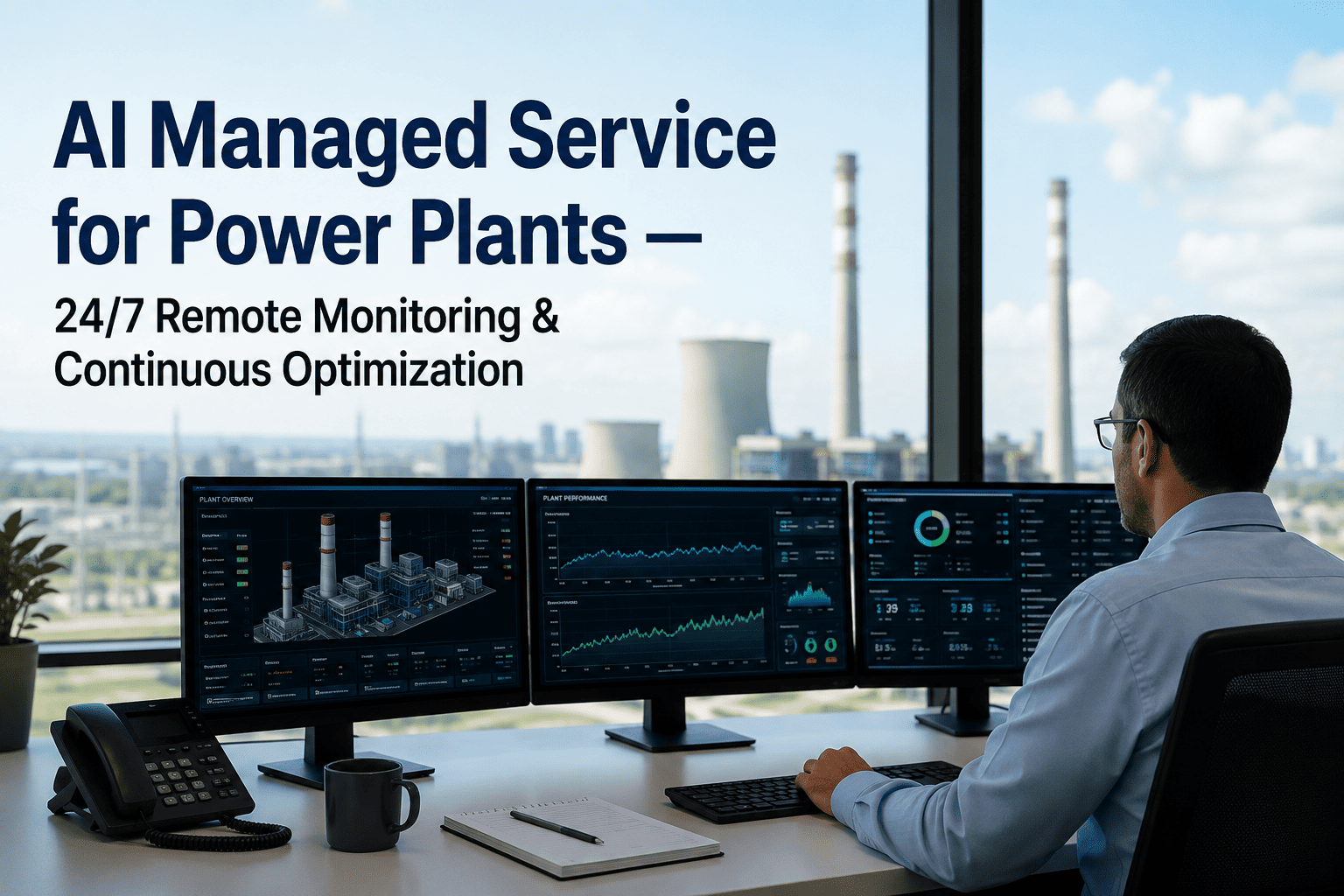
Building an in-house AI team sounds simple until you try it: hire two data scientists, wait eight months while they learn your turbines and your historian, watch one of them leave for a hyperscaler, and start the clock over. Most generation fleets don't have eighteen months to spare on a hiring problem when a bearing is already trending toward failure this quarter. A managed AI service sidesteps that entirely — the models, the monitoring, and the retraining cycle arrive already running, watched around the clock by people who do this for a living. Book a demo to see the managed service dashboard your operators would actually use.
Managed AI Service
24/7 Remote Monitoring Without Building a Data Science Team
iFactory runs predictive maintenance, model retraining, and continuous optimization as a managed service across your fleet — so your operations team gets the outcomes of an AI program without carrying the headcount, the tooling sprawl, or the retraining backlog that comes with owning it internally.
Why Most In-House AI Programs Stall Before Year Two
The pattern repeats across the industry: a plant stands up a pilot model, it works reasonably well for the first few months, and then accuracy quietly drifts as seasons change, sensors get replaced, and operating conditions shift. Nobody owns the retraining cadence because the person who built the model has moved to a different project, or the platform team is now three people short. What started as a promising predictive maintenance win turns into a dashboard nobody trusts anymore, and the fleet reverts to calendar-based inspections. A managed service exists specifically to prevent that decay, because retraining and monitoring are not a side project for the vendor — they are the entire job.
24/7
continuous monitoring coverage across every connected asset, not just business hours
Zero
additional data science headcount required on your side to sustain the program
Ongoing
model retraining cadence that adapts to seasonal and equipment changes automatically
What's Actually Inside the Managed Service
A managed AI service is not a black box that occasionally emails an alert. It is a defined set of responsibilities, each one owned end to end so your plant leadership has a single point of accountability instead of a patchwork of internal owners chasing each other for updates. Below is what iFactory takes on when your fleet moves to a managed model.
Remote 24/7 Monitoring
A dedicated monitoring team watches vibration, thermal, and process data continuously, escalating anomalies to your maintenance team before they become forced outages rather than waiting for a morning shift review.
Model Retraining & MLOps
Every model is retrained on a defined cadence as equipment ages, sensors are swapped, or operating patterns shift, so prediction accuracy doesn't quietly decay the way it does with a one-time pilot deployment.
Continuous Optimization
Beyond failure prediction, the service tunes setpoints and operating envelopes on an ongoing basis, translating raw sensor data into specific, actionable recommendations your engineers can approve and apply.
Dedicated Success Team
A named team that knows your fleet's history, quirks, and prior incidents, replacing the churn of internal hires with a group that has continuity across every retraining cycle and every escalation.
How the Managed Service Runs Week to Week
1
Sensor and historian data streams continuously into the monitoring platform from every connected unit across the fleet.
2
The remote team reviews flagged anomalies daily, filtering noise so your plant only sees alerts worth acting on.
3
Confirmed findings are packaged into a work order recommendation with severity, urgency, and supporting evidence attached.
4
Models are revisited on a fixed retraining schedule, incorporating new failure data and seasonal shifts automatically.
See It Running Live
Watch a Managed Fleet Dashboard in Real Time
Every alert, retraining cycle, and optimization recommendation is visible in one place — see exactly what your operations team would look at each morning.
Managed Service vs. Building an In-House Team
| Consideration | In-House Team | Managed AI Service |
| Time to first working model |
Six to twelve months of hiring and onboarding |
Weeks, using pre-built industrial models |
| Retraining discipline |
Depends on whoever owns it staying employed |
Built into the service, never optional |
| Coverage hours |
Business hours unless overtime is budgeted |
24/7 monitoring as a standing commitment |
| Headcount risk |
Program stalls if a key hire leaves |
Team continuity is the vendor's responsibility |
| Cost structure |
Fixed salaries regardless of model performance |
Scales with fleet size and monitored assets |
What Fleet Size Means for the Economics
The math behind a managed service shifts depending on how many units you're running, and it's worth being direct about where it makes the most sense. A single-site operator with a handful of critical assets often can't justify a full-time reliability data scientist at all — the managed model is frequently the only realistic way to get continuous AI coverage without over-hiring for one plant's workload. A multi-site fleet operator faces the opposite problem: the in-house option looks more attractive on paper because fixed costs spread across more assets, but coordinating consistent monitoring standards across sites without a dedicated team almost always turns into exactly the kind of fragmented, inconsistent coverage a managed service is built to prevent.
Small Fleet
managed service is typically the only path to continuous coverage without over-hiring for one site
Mid-Size Fleet
managed service standardizes monitoring across sites that would otherwise each build it differently
Large Fleet
managed service scales monitoring faster than hiring and training an internal team fleet-wide
Common Concerns We Hear From Operations Leaders
Before committing to a managed model, most operations leaders raise the same handful of questions, and it's worth addressing them directly rather than glossing over them in a sales conversation.
Who owns our data?
Your plant data remains yours under the agreement, used only to monitor and optimize your fleet — it is never pooled anonymously or shared across unrelated customers without explicit agreement.
Does this replace our CMMS?
No. The managed service reads from your historian and writes recommended work orders back into your existing CMMS, so your system of record for maintenance history stays exactly where it is today.
What if we want to bring it in-house later?
Contracts are structured so models, historical findings, and documentation remain accessible to you, making a future transition to an internal team a planned option rather than a lock-in risk.
How disruptive is onboarding to daily operations?
Onboarding runs in parallel with existing operations using read-only data access, so there is no operational downtime or process change required just to get monitoring started.
What Shows Up in Your Monthly Review
Plant leadership shouldn't have to guess what a managed AI program is actually doing behind the scenes. Every account receives a structured monthly review that ties directly back to maintenance and reliability outcomes rather than abstract model metrics nobody on the operations side can act on.
Anomalies detected and confirmed, broken down by asset and severity level
Work order recommendations issued, along with which ones were acted on
Model accuracy trends and any retraining events completed that month
Optimization recommendations applied and their estimated impact on output or cost
Coverage summary confirming every connected asset was monitored continuously
Frequently Asked Questions
Do we still need our own data science staff once this is running?
No. The managed service is built specifically to remove that dependency — the monitoring team, retraining cadence, and optimization work are all owned by iFactory. Your engineers stay involved in reviewing and approving recommendations, which is where their plant expertise adds the most value, but they are not responsible for maintaining models or chasing retraining schedules.
Ask about staffing implications in a demo.
How is this different from a one-time predictive maintenance software purchase?
A software license gives you a tool and leaves the operating discipline to you — someone still has to monitor alerts, retrain models, and keep the platform current. A managed service includes the people and process around the tool, so the accuracy and coverage you get in month one is still there in month eighteen, rather than decaying as conditions change.
What systems does the managed service need access to?
Typically the plant historian, SCADA or DCS tag data, and your CMMS for closing the loop on work orders. Access is read-only for monitoring data, and any write-back to your CMMS happens only for approved recommendations, so your existing systems of record remain fully in your control throughout the engagement.
How quickly can the service start monitoring our fleet?
Most fleets are onboarded within a few weeks once historian and sensor access is confirmed, starting with the highest-criticality assets first. Full fleet coverage typically follows over the following one to two months as additional units are connected and validated.
Contact support for a fleet-specific onboarding timeline.
What happens if the managed service flags something that turns out to be a false alarm?
False positives are tracked as part of the monthly review, and the underlying model is adjusted as part of the standard retraining cycle rather than left unaddressed. Because retraining is continuous rather than a one-time event, alert quality tends to improve steadily over the engagement instead of staying static.
Stop Carrying the Program Alone
Let a Dedicated Team Run Your Fleet's AI Program
24/7 monitoring, continuous retraining, and ongoing optimization — delivered as a service, not a project your team has to sustain internally.




.png)