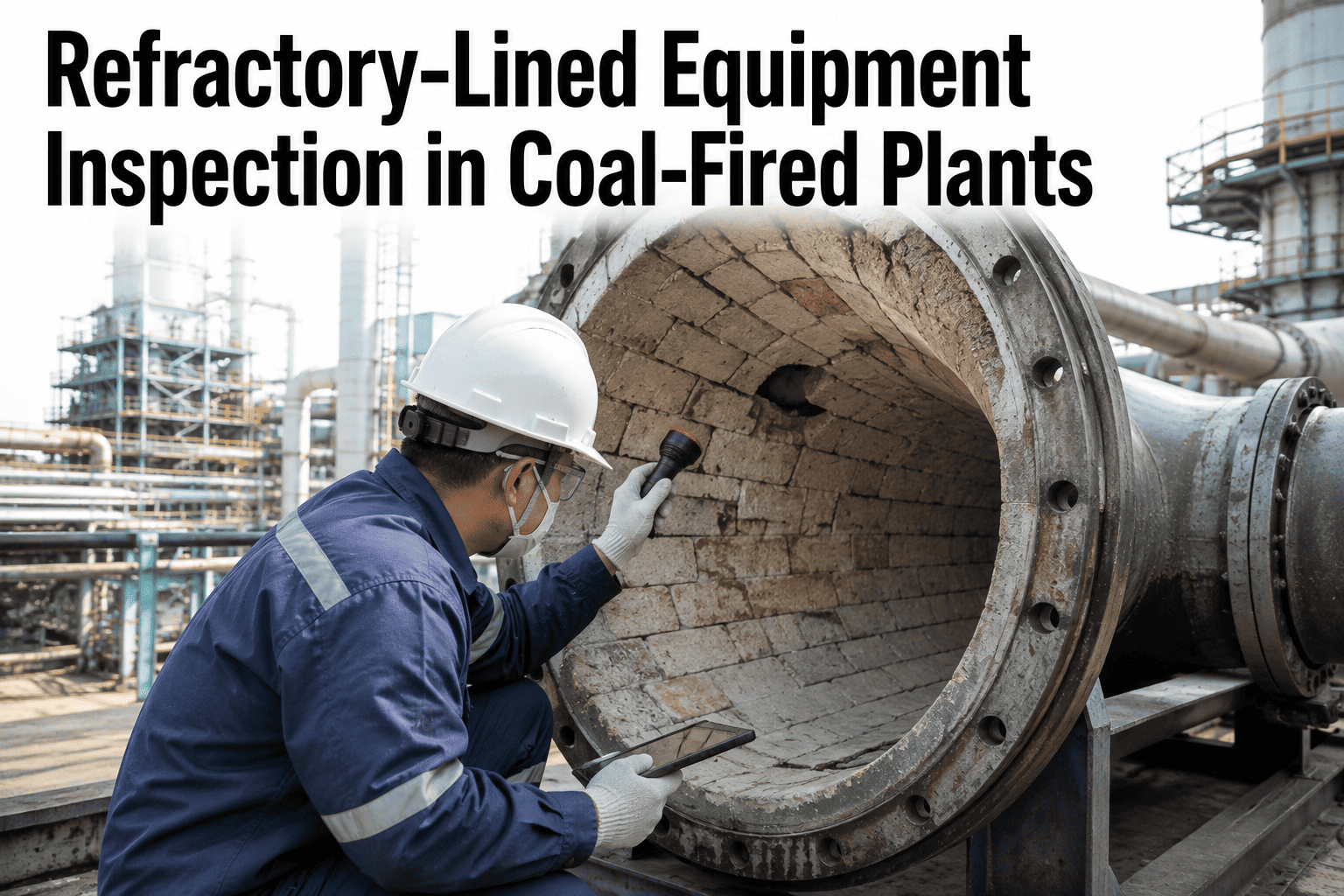
Refractory failure in a coal-fired plant rarely announces itself as a single dramatic event. It shows up first as a hot spot on the outer shell that nobody notices during a routine walkdown, then as a shell temperature that keeps creeping up over months, and eventually as a burn-through that forces an emergency shutdown of ductwork, a windbox, or a cyclone separator. Refractory linings protect steel shells from temperatures they were never designed to see directly, and once a lining thins or loses anchor integrity, the steel behind it starts absorbing heat it cannot tolerate. This guide covers refractory inspection across ductwork, windboxes, cyclones, and burner throats, and how thermal scanning turns a guessing game into a documented trend.
Why Refractory Failure Is Hard to Catch Early
Refractory-lined equipment sits between two extremes plants inspect very differently. The hot face — the inside surface exposed to combustion gas, fly ash, or coal particles — is essentially inaccessible during operation and can only be examined visually during a full outage with the unit cooled and opened. The cold face — the outer steel shell — is accessible any time but only tells part of the story, because a shell can run at a locally elevated temperature for a long time before it reaches a level anyone would flag as urgent on a routine hand-scan. The result is a common blind spot: refractory can degrade steadily for months between outages with no reliable signal reaching the maintenance team until shell temperature crosses an obvious threshold, by which point the lining loss behind that hot spot is often already severe.
Ductwork & Flue Gas Path
Long refractory-lined runs carrying flue gas from the boiler through the air quality control system. Thermal cycling during startup and shutdown is the dominant stressor, causing refractory to crack and spall at expansion joints and support points over repeated cycles.
Windbox
Distributes combustion air to burners and sits directly adjacent to the highest-temperature zone in the boiler. Refractory here experiences both thermal stress and mechanical erosion from air velocity, with failure typically concentrated at burner penetrations and corner sections.
Cyclone Separator
Handles high-velocity particulate-laden gas, subjecting refractory to continuous erosive wear on top of thermal cycling. Cyclones typically show the fastest refractory wear rates of any equipment class in a coal plant due to the combination of abrasion and heat.
Burner Throat & Nose
Operates at the highest sustained temperature of any refractory-lined component in the plant, often above 1,400°C at the flame front. Refractory grade selection and anchor system design matter more here than almost anywhere else, since failure at the burner throat directly threatens burner mounting hardware.
See Where Your Refractory Is Losing Thickness
iFactory's thermal scanning program maps shell temperature across ductwork, windbox, cyclone, and burner refractory to flag thinning zones months before a hot spot becomes an emergency.
Reading Shell Temperature as a Refractory Health Signal
Shell temperature and refractory thickness have a direct, calculable relationship for a given insulation design, heat flux, and internal process temperature. As refractory thins or a section loses anchor integrity and shifts out of position, the insulating path shortens and shell temperature at that location rises predictably. Infrared thermal scanning converts this relationship into an inspection tool by capturing shell temperature across the full external surface of ductwork, windbox, and cyclone shells in a single pass, turning a property that used to require spot-checking with a handheld pyrometer into a complete thermal map that shows every hot zone at once, not just the ones an inspector happened to walk past.
Baseline Scan at Commissioning or Post-Relining
Establishes the expected shell temperature profile for a fully intact lining, giving every future scan a reference point to compare against rather than relying on absolute temperature alone.
Routine Operating Scans
Repeated at defined intervals — commonly quarterly for high-risk zones like cyclones and burner throats — capturing the full shell surface under normal operating load for direct comparison to baseline.
Delta Analysis Against Baseline
Any zone showing a meaningful temperature rise relative to baseline, adjusted for current process load and ambient conditions, gets flagged for trending rather than treated as a one-off reading.
Trend-Based Action Threshold
A flagged zone that continues rising across consecutive scans triggers escalation — increased scan frequency, internal inspection at the next available access point, or repair planning for the next outage.
Refractory Degradation Modes and What Each One Looks Like
Match Repair Method to Actual Degradation Mode
iFactory documents which degradation pattern is driving each refractory finding, so repair specifications target the real cause instead of a generic patch that fails again within a year.
Deciding Between Patch Repair and Full Reline
The repair-versus-reline decision comes down to how much of the lining's remaining service life has actually been consumed and whether the damage is localized or systemic. A single hot spot found early, tied to a discrete anchor failure or localized spalling, is usually a good candidate for a targeted patch repair during the next available outage window — provided the surrounding refractory has not also lost significant thickness from the same wear mechanism operating across the wider zone. Patching a symptom while the underlying erosion or chemical attack continues unaddressed across the broader area typically buys only a short delay before the next hot spot appears nearby.
A full reline becomes the right call once thermal scanning and internal inspection show widespread thinning approaching the actionable threshold across a large fraction of the lined area, rather than isolated points. Relines are expensive and require extended outage time, which is exactly why trending shell temperature over multiple scan cycles matters — a plant that only inspects refractory during scheduled major outages, without any interim monitoring, tends to discover the need for a full reline as an unplanned finding rather than a planned capital project, forcing the decision to happen on an emergency timeline with correspondingly higher cost and schedule risk.
The Economics of Planned Reline vs Emergency Failure
A planned reline of a major refractory system — a full cyclone or a significant ductwork section — typically costs a defined amount tied to material volume, labor, and the outage days required for the work, all of which can be budgeted and scheduled well in advance once trend data shows a reline is approaching. An emergency failure of the same equipment costs meaningfully more across nearly every dimension of that same work: the outage is unplanned, forcing production loss beyond what a scheduled window would have caused, contractor mobilization happens on rush timelines that carry a premium, and collateral damage to adjacent equipment from an actual burn-through — warped steel, damaged instrumentation, or fire risk — frequently adds scope the planned version would never have needed.
The gap between those two cost profiles is the core economic argument for continuous thermal scanning over calendar-based or purely reactive inspection. A plant that only discovers refractory condition during scheduled major outages is, by definition, only finding problems that happened to align with the outage calendar — a lining that reached failure eight months before the next scheduled outage will fail unplanned regardless of how good the eventual outage inspection would have been. Continuous scanning closes that timing gap, surfacing degradation as it happens rather than whenever the calendar next permits a look, and giving planning teams the lead time to convert what would have been an emergency into a scheduled capital project.
Building a Refractory Life-Cycle Record
Refractory condition data loses most of its value when it lives only in the memory of whichever inspector walked the ductwork last outage. A defensible refractory program keeps a persistent record for every lined zone: original installation date and material specification, every thermal scan result with load and ambient conditions noted, every internal inspection finding from outages, and every repair or reline performed along with the material and method used. Without that history, a plant relying on informal knowledge loses continuity the moment a key technician retires or changes roles, and the next inspection team ends up re-establishing baseline understanding from scratch rather than building on years of accumulated trend data.
The record also matters for material performance evaluation across the plant's own operating conditions rather than generic manufacturer specifications. A refractory grade rated for a certain service life under standard test conditions may perform meaningfully better or worse in a specific plant's actual coal ash chemistry, cycling frequency, and process temperature profile. Tracking actual field performance against original specification, zone by zone, lets a plant refine material selection over successive relines instead of repeating the same underperforming specification indefinitely because nobody connected a shortened service life back to a specific material choice made years earlier. iFactory keeps this life-cycle record tied directly to each zone's thermal scan history, so material performance questions can be answered from data rather than institutional memory.
Frequently Asked Questions
Catch Refractory Failure Months Before It Becomes an Outage
iFactory's thermal scanning platform trends shell temperature across every refractory-lined system in your plant, flagging thinning zones early and prioritizing outage inspection where it matters most.