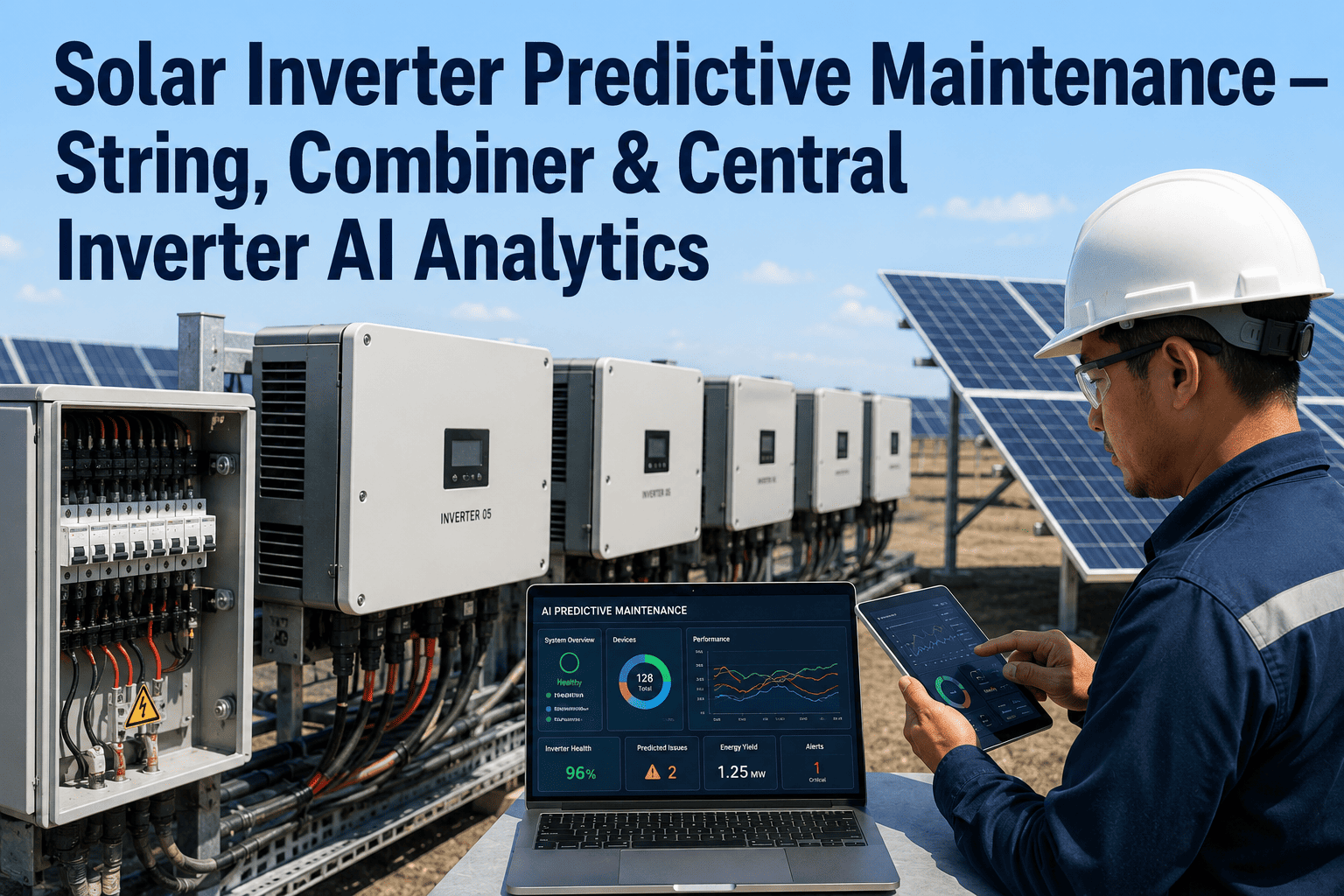
Inverters are the single most failure-prone component on a solar site, and industry research puts them behind more than half of all unscheduled maintenance events across utility-scale portfolios. Semiconductor aging, thermal cycling, capacitor drift, and cooling fan wear all build slowly, then fail suddenly, usually during the exact peak-generation hours when the lost output costs the most. Reliability engineers running string, central, and combiner-level fleets are moving from reactive swap-outs to AI models trained specifically on inverter failure signatures, and you can book a demo to see how the prediction models perform against your own fleet data.
INVERTER RELIABILITY · STRING · CENTRAL · COMBINER
Predict the Inverter Failure Before It Costs You a Generation Window
iFactory analyzes IGBT thermal behavior, capacitor degradation signatures, and cooling system performance across string, central, and combiner inverters to flag failure risk weeks before a shutdown.
Why Inverters Fail
The Failure Modes Behind Most Unscheduled Inverter Downtime
Inverter failures rarely come from a single sudden defect. They accumulate through predictable physical stress patterns — heat, current, and vibration acting on components over thousands of operating hours — which is exactly what makes them predictable if the right signals are being tracked continuously.
Mode 01
IGBT & Power Module Degradation
Repeated thermal cycling fatigues the solder joints and bond wires inside power semiconductor modules, gradually raising junction resistance until a switching failure trips the unit offline.
Mode 02
Capacitor Aging
Electrolytic capacitors lose capacitance as they age, especially under sustained heat, producing voltage ripple that climbs steadily for weeks before it crosses a threshold and forces a shutdown.
Mode 03
Cooling System Failure
Fan bearing wear or blocked heat sinks reduce cooling efficiency, driving internal temperatures higher and accelerating every other failure mode on this list simultaneously.
Mode 04
Connection & Combiner Faults
Loose or corroded terminations at combiner boxes and DC input connections create resistance heating and intermittent faults that are difficult to catch during a routine visual inspection.
Signal Layer
What the AI Model Actually Watches, Component by Component
Prediction accuracy depends entirely on the quality and granularity of the signals feeding the model. iFactory pulls operating data across three inverter tiers rather than treating every unit the same way.
String Inverters
Per-string current and voltage tracked against expected output, DC input balance across MPPT channels, and internal temperature trends that reveal early fan or thermal management issues at the individual unit level.
Central Inverters
IGBT junction temperature estimation, switching pattern anomaly detection, and DC bus voltage ripple monitoring calibrated to the higher power density and different failure economics of central inverter stations.
Combiner Boxes
Fuse status, string-level current balance, and ground fault indicators monitored continuously to catch loose terminations and early arc risk before they escalate into a safety event.
Model Accuracy
Purpose-Built Models Outperform Generic Industrial AI
Not every predictive maintenance model performs equally on solar inverter data. Generic industrial fault-detection models, trained on broader equipment categories, consistently underperform when applied to the specific thermal and electrical stress patterns unique to PV power electronics.
Prediction Accuracy by Model Type — Inverter Failure Detection
VALIDATE AGAINST YOUR OWN FLEET
See the Prediction Model Run Against Your Inverter Fleet Data
Bring recent operating and failure history from your string, central, or combiner fleet and our engineering team will show you the model's prediction accuracy live on the call.
Reliability Workflow
From Early Signal to Closed Work Order
A prediction is only useful if it turns into a scheduled intervention before the failure happens. The workflow is designed to hand reliability engineers a prioritized, evidence-backed work order rather than a raw alert to investigate from scratch.
1
Signal Deviation Detected
Voltage ripple, thermal, or switching pattern drifts outside the expected range for that unit's age, load history, and site conditions.
2
Failure Mode Attributed
The model attributes the deviation to a specific likely cause — capacitor aging, fan wear, or connection resistance — rather than a generic fault flag.
3
Risk Ranked Against Fleet
The unit is ranked against every other flagged asset in the portfolio by failure probability and generation value at risk.
4
Work Order Issued
A prioritized work order is generated with the suspected component, recommended parts, and the window before predicted failure.
Beyond the Alert
Turning Failure Prediction Into Spare Parts Planning
Knowing an inverter is likely to fail is only half the value. Reliability teams also need to know roughly when, so parts and labor can be staged ahead of the failure window instead of ordered after the unit is already offline.
Remaining Useful Life Estimate
Each flagged component gets an estimated remaining operating window based on its current degradation trajectory, updated continuously as new operating data comes in rather than fixed at the moment of first detection.
Parts Demand Forecasting
Fleet-wide remaining useful life estimates are aggregated into a rolling parts demand forecast, so capacitors, fan assemblies, and power modules can be ordered against predicted need instead of historical consumption averages.
Labor Scheduling Alignment
Predicted failure windows are grouped geographically and by crew skill requirement, letting field teams batch planned interventions into efficient service routes instead of responding to failures one at a time.
Frequently Asked Questions
Solar Inverter Predictive Maintenance — FAQ
How much historical failure data do you need before predictions become reliable?
The model can begin flagging obvious deviations almost immediately after connection, but prediction confidence improves meaningfully once ten to twelve weeks of continuous operating data has been collected, since that window typically captures a full range of thermal cycling and load conditions. If your fleet already has historical failure event records in your CMMS, those can be used to validate and accelerate model training rather than starting from a blank baseline.
Does this replace our existing inverter vendor's built-in diagnostics?
No, and it isn't meant to. Vendor diagnostics are typically built to flag faults that have already occurred or are imminent within hours. iFactory's models are built to catch the slower degradation trends — capacitor aging, thermal cycling fatigue, cooling inefficiency — that build over weeks and precede the point where a vendor alarm would ever trigger, giving your team a much wider intervention window.
Can the platform prioritize which inverters to service first across a large fleet?
Yes, this is one of the core outputs reliability teams rely on. Every flagged unit is ranked by a combination of failure probability, remaining useful life estimate, and generation value at risk, so field crews can be dispatched to the assets where a delay would cost the most rather than working through a fault list in no particular order.
What happens when a prediction turns out to be wrong?
Every prediction outcome — whether the flagged component failed as predicted, failed differently, or didn't fail at all within the expected window — is logged and fed back into the model to improve accuracy over time. Reliability engineers can review this prediction history directly, which is also what builds organizational trust in the recommendations as the false positive rate declines with more fleet-specific data.
How do we get started evaluating this against our current fleet?
The fastest path is to
book a demo and bring a sample of recent inverter operating and maintenance history so our engineering team can walk through what the model would have flagged and when, compared against what your team actually caught. For questions about data formats or integration with your existing CMMS,
contact support ahead of the call.
PREDICTIVE MAINTENANCE · SOLAR INVERTERS · 2026
Give Every Inverter in Your Fleet a Continuous Reliability Score
From string inverters to combiner boxes, see failure risk weeks in advance and turn it into a prioritized, evidence-backed work order.