Every steam turbine load change routes through a valve, and the way that valve opens determines whether the change costs the plant efficiency or barely registers on the heat rate. Throttle governing and sequential governing solve the same problem — controlling steam admission to match generator output to demand — through fundamentally different valve strategies, and the choice between them shapes everything from part-load efficiency to valve wear rates. Turbine performance and reliability teams weighing this decision can Book a Demo to see valve position tracked against load and efficiency in one view.
Two Ways to Control the Same Steam Flow
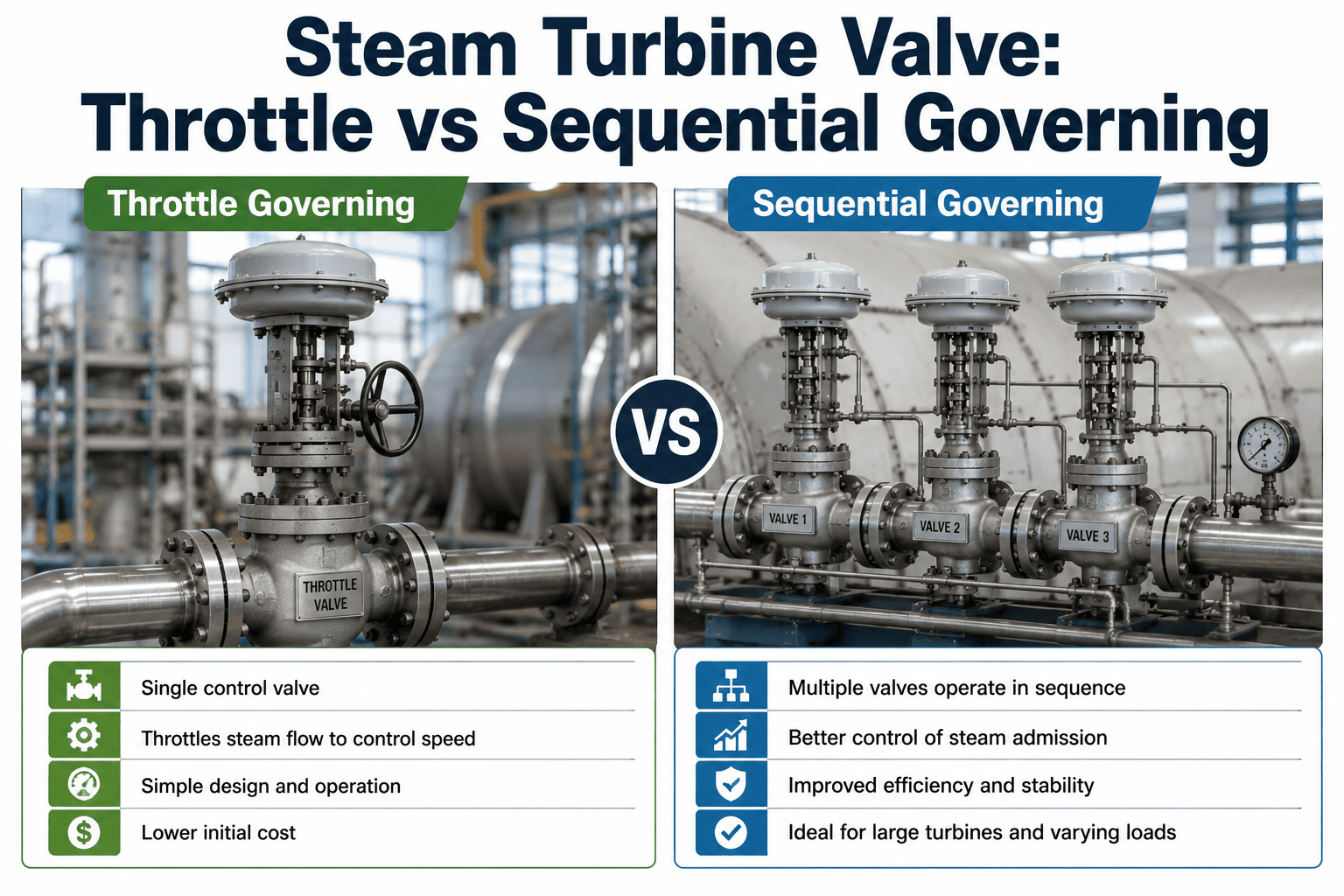
A steam turbine's governing valves exist to do one job — regulate steam admission so generator output tracks demand — but the two dominant control philosophies achieve that regulation through opposite valve behavior. Throttle governing modulates a single admission valve, or a small group acting together, restricting flow uniformly across the full valve opening range. Sequential governing instead uses multiple valves, typically four to six, that open one after another in a defined sequence as load increases, so that at any given moment most open valves sit near their fully-open position while only one valve actively throttles to fine-tune output. The practical consequence is a large difference in how much steam energy gets destroyed by throttling at any given load point, and that difference compounds into a measurable heat rate gap across a unit's operating life. Neither strategy is inherently correct in every case — the right choice depends on how a specific unit is dispatched, how frequently it cycles, and how much of the total operating profile actually sits away from full load, which is exactly the kind of question that a generic manufacturer recommendation cannot answer for an individual plant's real dispatch pattern.
Throttle Governing: Simpler Control, Steeper Efficiency Penalty
Throttle governing's appeal is mechanical and control simplicity. A single valve, or a small bank of valves moving in unison, throttles steam pressure down to whatever level produces the required flow at the current load, and the control logic needed to manage one coordinated valve position is considerably simpler than sequencing several valves through individual opening curves. That simplicity comes at a direct thermodynamic cost: throttling steam through a partially closed valve is an irreversible process that reduces steam pressure without extracting useful work, destroying exergy that a more selective admission strategy could have preserved. The efficiency penalty is smallest near full load, where the throttle valve sits close to fully open, and grows steadily worse as load — and therefore required throttling — increases toward the unit's lower operating range.
Sequential Governing: Keeping Valves Near Their Best Operating Point
Sequential governing addresses the throttling penalty directly by keeping most active valves near their fully-open position at any given load, where flow coefficient is most favorable and pressure drop across the valve is minimized. As load increases, valves open in a predetermined sequence — the first valve opens fully before the second begins to open, and so on — so that only one valve is ever in an active throttling state while the others are either fully open or fully closed. This keeps the aggregate throttling loss across the full valve arrangement much lower than a single valve modulating across its entire range would produce, particularly in the low-to-mid load region where throttle governing loses the most efficiency.
| Dimension | Throttle Governing | Sequential Governing |
|---|---|---|
| Part-load efficiency | Lower — full-range throttling loss | Higher — minimal throttling except on one active valve |
| Control complexity | Simple — single coordinated valve position | More complex — sequenced multi-valve logic |
| Valve wear pattern | Even wear, but sustained partial-throttle stress | Concentrated wear on the sequencing valve, less on fully open/closed valves |
| Thermal stress on valve chest | More uniform | Can be uneven across valve nozzles depending on sequence |
| Best fit | Units running consistently near full load | Units cycling frequently across a wide load range |
Valve Wear: The Trade-Off That Complicates a Simple Efficiency Argument
If sequential governing were purely better, every unit would already run that way, but the wear implications of each approach push in different directions and prevent a universal answer. A valve held for long periods in a partially open throttling position experiences seat erosion and wire-drawing damage from high-velocity steam passing through a narrow gap, a failure mode that both governing strategies expose at least one valve to. The difference is concentration: throttle governing spreads that stress fairly evenly if valves move together, while sequential governing concentrates the active-throttling stress onto whichever single valve currently sits in the sequencing position, meaning that valve accumulates wear faster than its neighbors that spend most of their time fully open or fully closed. Over a full operating cycle, that concentrated valve typically rotates through the load range with the unit, so the specific valve carrying the heaviest wear burden at any point in time shifts depending on where the unit currently sits in its sequencing order, which makes valve-by-valve wear tracking considerably more useful than a single aggregate valve health score for anticipating which component will need attention first.
Nozzle Groups and Admission Arcs: The Mechanical Detail Behind the Sequence
Sequential governing works because each valve controls steam admission to a distinct group of turbine nozzles rather than all nozzles sharing a single admission path. As each valve opens in sequence, it admits steam to its associated nozzle arc, and because only a portion of the turbine's full nozzle ring is active at low load, the steam that does flow does so at a pressure and velocity much closer to its design condition than it would if forced through a uniformly throttled full admission path. This partial-arc admission is precisely what limits throttling loss at reduced load, but it also introduces a mechanical consideration that throttle governing does not face: because only part of the nozzle ring is active at low load, the first stage of the turbine experiences uneven circumferential loading, which places additional bending stress on the rotor and first-stage blading that full-arc admission avoids. This is a known and generally well-managed trade-off in modern turbine design, but it is part of why sequential governing is not simply a free efficiency upgrade with no engineering considerations of its own.
Matching Governing Mode to How a Unit Actually Operates
The right governing strategy depends less on a generic efficiency comparison and more on a specific unit's load duration curve — how much time it actually spends at each load point across a representative operating year. A baseload unit that sits near full load for the vast majority of its operating hours captures relatively little benefit from sequential governing's part-load efficiency advantage, since it rarely operates in the load range where throttle governing loses the most. A cycling unit that spends significant time in the 40%–70% load range, by contrast, stands to gain considerably more from sequential admission, because that is exactly the range where throttle governing's efficiency penalty grows steepest.
This same load duration analysis should inform how aggressively a plant pursues a governing mode change versus simply tuning within its existing strategy. A unit only a few years from planned retirement may find that the capital and engineering cost of a full sequential governing retrofit does not pay back in the time remaining, even if the efficiency case looks favorable on paper, while a unit with a long remaining service life and a load profile trending toward more frequent cycling may find the opposite conclusion holds even more strongly than a static analysis would suggest.
Valve Testing and Maintenance Considerations Across Both Modes
Regardless of which governing philosophy a unit uses, periodic valve testing remains essential to confirm that valves move freely through their full range and seat properly when commanded closed, since a valve that has stuck or drifted from its calibrated position undermines the governing strategy's assumptions no matter how well the control logic was designed. This matters as much for trip reliability as it does for efficiency: a governing valve that fails to close fully on a trip command is a safety-relevant failure mode, not just an efficiency concern, which is part of why valve testing schedules are typically governed by reliability standards rather than left purely to a plant's own discretion. Under sequential governing specifically, testing needs to confirm not just that each valve operates correctly in isolation but that the sequencing itself remains accurate — a valve that begins opening earlier or later than its programmed sequence position quietly reintroduces throttling losses that the strategy was designed to eliminate, and this kind of sequencing drift is much easier to miss during a routine visual inspection than a valve that has failed outright.