Steam turbine valves sit still for most of their life. The main stop, control and intercept valves hold position for days, then must close fully in a fraction of a second when the turbine trips. A valve that sticks from deposits or a tired actuator can let a unit overspeed. That is why insurers and manufacturers call for regular valve exercising and full-stroke tests. This guide sets out a steam turbine valve testing schedule and shows how voice test logs record each result at the panel. Plan yours in a testing review.
Steam Turbine Valve Testing Schedule with Voice Test Logs
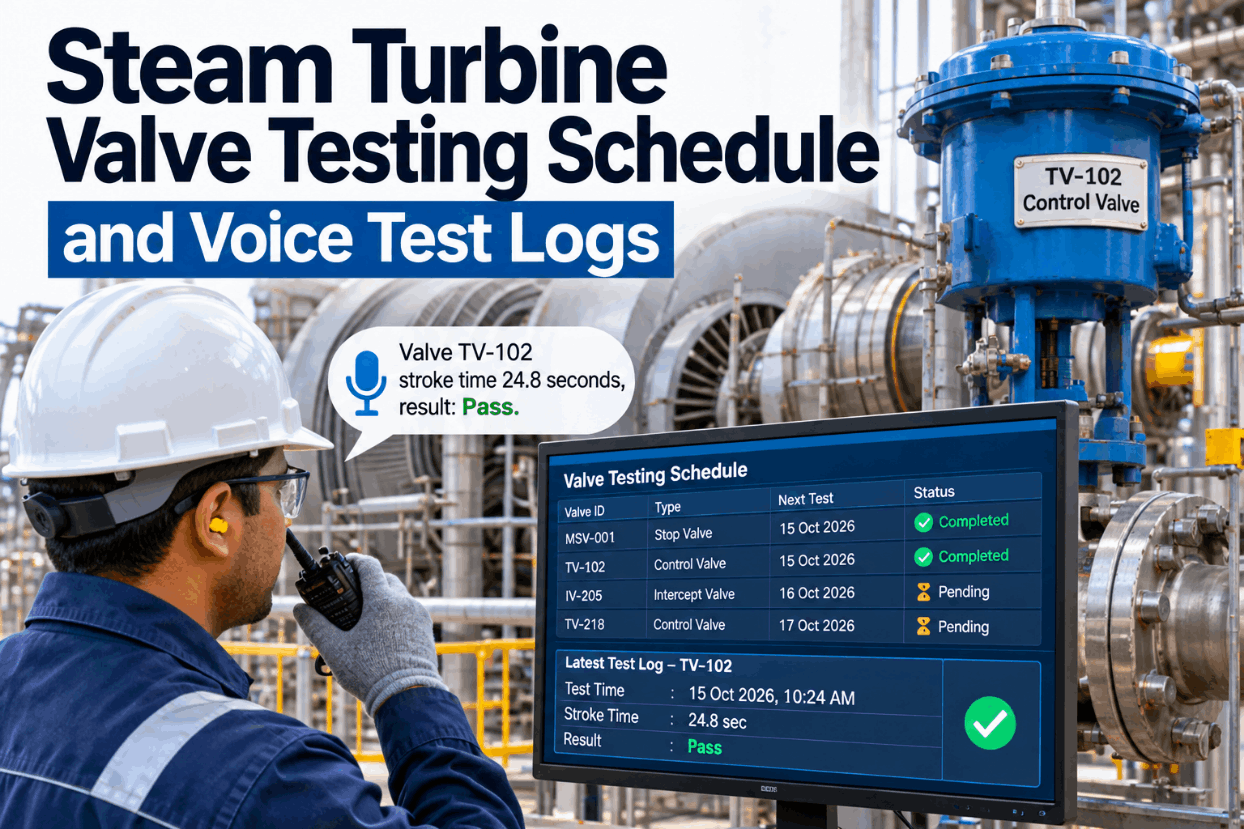
Test reminders arrive on schedule. The operator speaks the valve, the stroke time and the result at the panel, out-of-limit results open work orders and every record is kept for insurer review.
- Weekly, annual and outage tests on one calendar
- Stroke times spoken, not written later
- Slow valves become work orders
Why Steam Turbine Valve Tests Matter
Overspeed protection only works if the valves can close.
When a turbine trips, the protection system sends a signal and the steam admission valves must shut off steam fast. Speed sensors and trip devices can work perfectly, but if a stop or intercept valve is stuck open, steam keeps flowing and the rotor can overspeed. Valves stick for ordinary reasons: deposits on the stem, a worn bushing, contaminated hydraulic oil or a slow servo. None of these show while the valve is holding steady at load. A regular test that moves each valve is the simplest way to find a sticking valve before a real trip does. The record of that test matters too. If results sit on paper sheets, a valve that gets a little slower each week goes unseen. Our turbine specialists can review your current tests.
Paper test sheet
- Filled in after the test, from memory
- Stroke times rounded or left blank
- Slow results noted but not acted on
- Hard to find when the insurer asks
Voice test log
- Result spoken as the valve moves
- Stroke time stored against the valve tag
- Out-of-limit results open a work order
- Full history ready for review
What FM Global Data Sheet 13-3 Recommends
Exercise weekly, test full travel and overspeed protection every year.
FM Global Property Loss Prevention Data Sheet 13-3, Steam Turbines, gives test intervals for generator-drive turbines. It recommends exercising all emergency stop, intercept and governor valves weekly to make sure they move freely, and exercising extraction non-return valves weekly. It recommends testing steam admission valves through their full travel once a year. It also recommends testing the overspeed protection system once a year, using a functional or simulated test. For mechanical-drive turbines, the data sheet sets valve exercising monthly for large special-purpose units and quarterly for small general-purpose units. Check your schedule against the data sheet in a working session.
Exercise admission valves
Stop, intercept and governor valves moved to prove free movement.
Exercise non-return valves
Extraction non-return valves moved.
Full-travel test
Stop and governor valves moved through full travel.
Overspeed protection
Functional or simulated test of the system.
Summary for generator-drive turbines, based on the July 2026 interim revision of FM Global DS 13-3. Your OEM manual and your own insurer set the intervals that apply to your unit.
Steam Turbine Valve Testing Schedule by Valve
A routine test for each valve, and a deeper one when the unit allows.
The schedule below brings the common test types together by valve. A valve freedom test moves a valve part of its travel, or all of it, while the unit carries load, usually one valve at a time so that load is held. A full-stroke closing test with timing is often done at reduced load or during shutdown, depending on the design. The OEM procedure decides which tests are possible online, what load limits apply and what closing time counts as a pass. Confirm the right intervals for your units with our turbine team.
A starting layout only. Test methods and limits differ by turbine make and control system.
What a Valve Test Record Should Hold
Enough detail to spot a slow valve before it fails a trip.
A useful test record is more than a tick. It names the valve, the test type and the conditions, gives the measured result against the limit and says who did the test. With the same fields every time, a valve that closes a little slower each month shows up as a trend long before it fails a test. It also gives the insurer clear evidence that the tests were done on time. Agree the record fields in a short session.
Tag and type
Main stop, control, intercept or non-return.
Test type
Freedom, full stroke or overspeed.
Unit load
Load and steam conditions at the time of test.
Stroke time
Measured time against the OEM limit.
What was seen
Hesitation, noise, leaks or alarms.
Who and when
Operator name, date and time.
Log Every Turbine Valve Test by Voice
Reminders arrive when each test is due, the operator speaks results at the panel and slow or failed valves become work orders before the next shift.
Speaking Results at the Panel
The operator keeps eyes on the valve, not on a form.
During a valve test, the operator is watching position feedback, load and alarms. Stopping to write is when details get lost. With a voice test log, the operator speaks the valve tag, the stroke time and what was seen, and the agent repeats it back for confirmation. The agent checks the stroke time against the limit stored for that valve and says straight away whether it passed. If a reading sounds wrong, such as a time far from the last result, it asks the operator to confirm before saving. See a live example in a short demo.
From Out-of-Limit Result to Work Order
A slow valve should never wait for the next weekly test.
A failed or slow valve test needs action, and the action needs an owner. When a stroke time is over the limit, or the operator reports that a valve did not move fully, the agent opens a work order with the test record attached. The supervisor decides what happens next, which can mean repeating the test, checking the hydraulic oil and filters or planning repair work. The unit stays under your normal operating rules. The valve is then set for a repeat test once work is done. Map this flow for your plant in a planning call.
Remind
Test due on schedule.
Test
Operator runs it at the panel.
Speak
Stroke time and result logged.
Check
Compared with the valve limit.
Act
Work order if out of limit.
Trending Stroke Times and Insurer Records
A valve can pass every test and still be getting slower.
Pass or fail tells only part of the story. When every stroke time is stored against the valve tag, the trend shows which valves are slowing down while still inside the limit. That gives time to plan cleaning or actuator work for the next outage instead of waiting for a fail. The same records answer the questions insurers ask during a site visit: were the weekly tests done, were the annual tests done and what happened when a valve failed. Ask our team how records are kept and found.
Worked example only: (0.38 − 0.30) ÷ 0.30 = 26.7%, rounded to 27%. The OEM limit decides pass or fail, and the trend shows where to look early.
Steam Turbine Valve Testing Checklist
Eight checks before voice test logs go live.
Use this checklist for one unit first. Tick the items already in place. Get help with any gaps from our setup team.
Valve Testing Mistakes to Avoid
A test that is skipped or not recorded gives no protection.
These patterns weaken turbine valve testing programs most often. A short testing review can find them.
What works
- Intervals taken from OEM and insurer
- Stroke times measured, not guessed
- Slow valves acted on the same shift
- Trends reviewed before each outage
What fails
- Weekly tests skipped when load is high
- Only pass or fail written down
- Repeat tests not done after repair
- Overspeed test records hard to find
How iFactory Runs Steam Turbine Valve Test Logs
The Voice Test Agent, on your own network.
iFactory's Voice Test Agent sends scheduled test reminders, lets the operator speak stroke times and results, opens work orders for out-of-limit results and stores records for insurer review. It runs on an on-prem AI server inside your plant.
Test reminders
Weekly, annual and outage tests.
Voice results
Valve, stroke time and notes.
Limit check
Stroke time against the valve limit.
Work orders
Opened for out-of-limit results.
Stroke trends
Slowing valves seen early.
Insurer records
Dated results ready for review.
Test procedures, limits and decisions on the unit remain with your operations team. Figures on this page are worked examples.
Turnkey AI: Delivered, Connected and Live in 6–12 Weeks
You do not build this. It arrives ready.
iFactory ships as a pre-configured NVIDIA AI server with the software pre-loaded, racked and ready. Rack it, plug in power and Ethernet, and the AI is live on your network. Our team handles cabling, network setup, PLC, SCADA, DCS and CMMS integration, DCS and turbine control links, operator training and 24×7 remote monitoring. Data stays on your network. For a scope matched to your plant, request a turnkey quote.
Ship, network and data
Server installed. Valve list, limits and test intervals loaded. DCS and CMMS connected.
Model training and pilot
Voice test logs and reminders piloted on one unit, with limit checks and work order rules set.
Go-live and training
Voice test logs live. Operators trained. 24×7 monitoring begins.
Frequently Asked Questions
How often should steam turbine valves be tested?
FM Global DS 13-3 recommends weekly exercising of stop, intercept and governor valves on generator-drive turbines and full-travel tests once a year. Follow your OEM and insurer.
What is a valve freedom test?
A test that moves a valve part or all of its travel, often with the unit on load, to prove it is not sticking.
How often is the overspeed protection tested?
DS 13-3 recommends a functional or simulated test once a year. Your OEM and insurer may set other conditions.
What should a valve test record include?
Valve tag, test type, unit load, stroke time against the limit, notes, operator name, date and time.
How does the voice log work?
The operator speaks the valve, stroke time and result. The agent repeats it back, checks the limit and saves it once confirmed.
What happens when a valve is slow?
The agent opens a work order with the test record attached. The supervisor decides the next step.
Does the agent run the valve tests?
No. Operators run tests through your turbine controls. The agent handles reminders, logging and work orders.
Can insurers see the records?
You can export dated test records for any valve and period to share during a site visit.
How do we start?
Start with one turbine and its valve list. A 6-week pilot loads intervals and limits and sets up voice logging. To plan it, contact our team.
Never Miss a Turbine Valve Test Again
In thirty minutes we map your valve tests onto one schedule and show where records are missing or slow results went unanswered. You keep the map either way.
- 1Your turbine valve list
- 2OEM valve test procedures
- 3Recent valve test sheets
- 4Last insurer site visit report
- 5One valve that tests slow