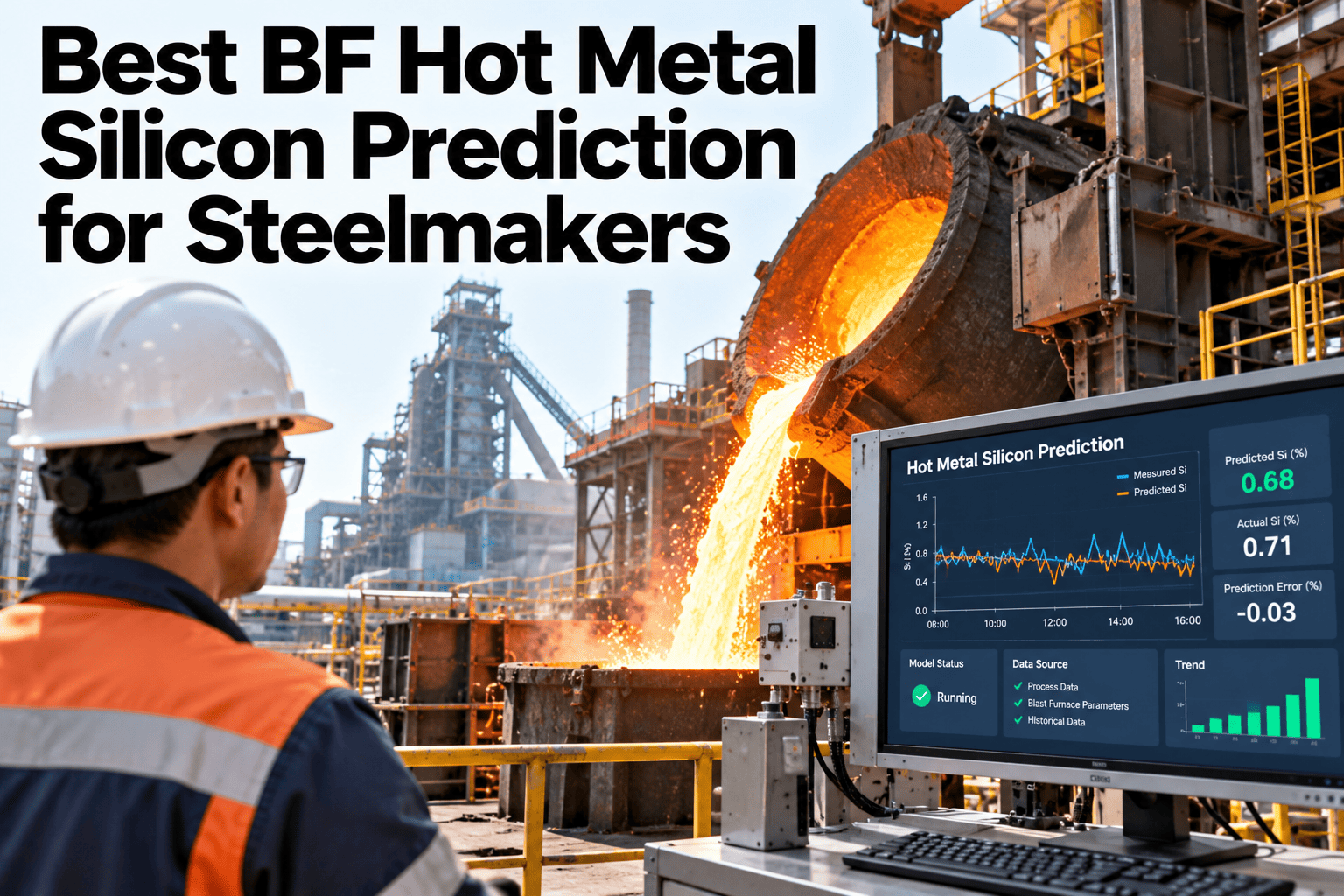
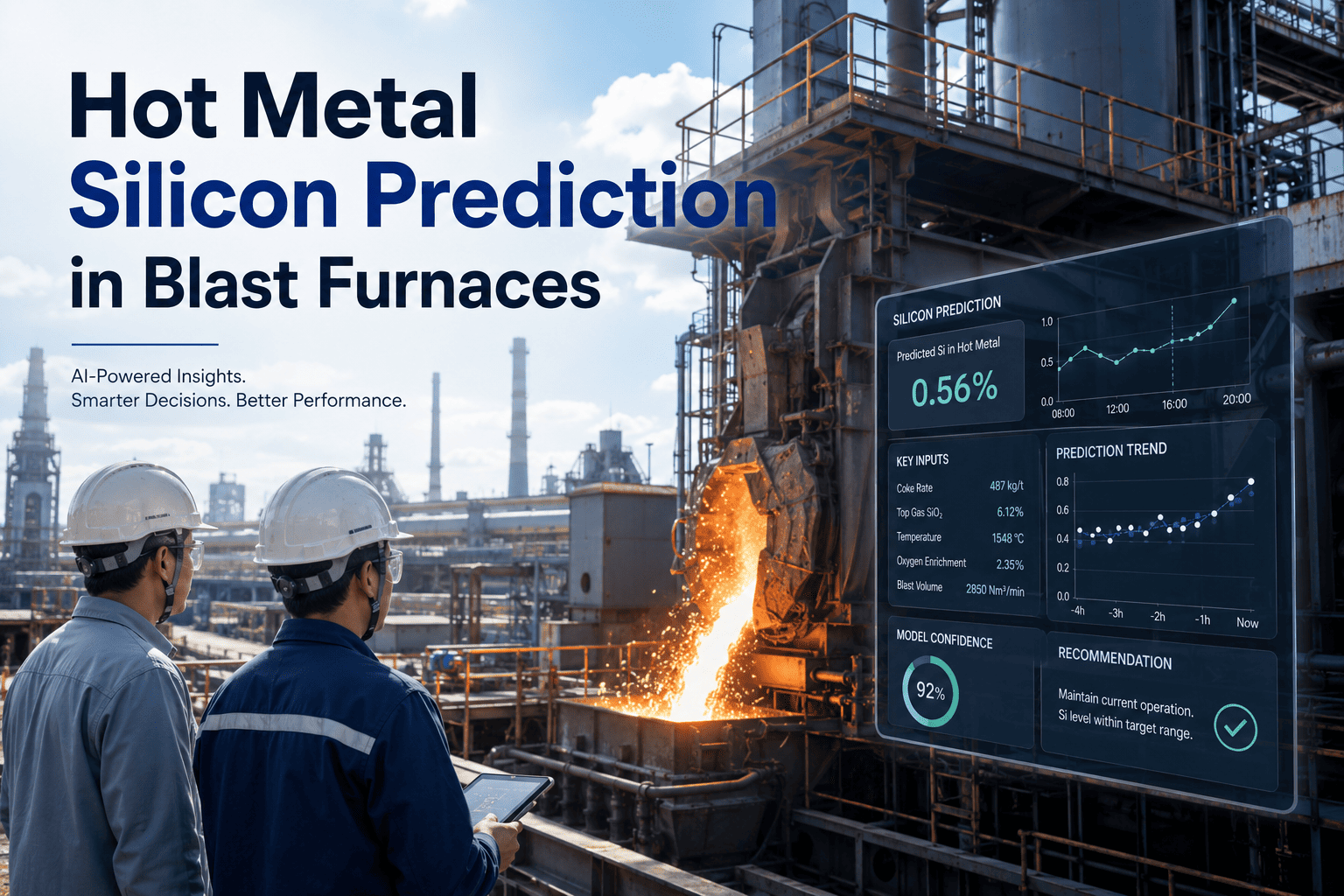
Silicon in hot metal is one of the clearest signs of the furnace thermal state, and it matters far beyond the blast furnace. When silicon swings, steelmakers adjust lime, scrap and slag practice, and operators chase the furnace with corrections that arrive too late. Forecasting silicon several hours ahead gives the furnace team time to act early and the steel melt shop time to prepare. This guide explains how thermal state modelling and burden chemistry feed a four to eight hour forecast. To see how it could work for your furnace, you can review a silicon forecast approach with our team.
Blast furnace monitoring and failure prediction
Forecast Hot Metal Silicon Hours Ahead and Stabilise Everything Downstream
iFactory AI models furnace thermal state from burden chemistry, blast and process signals, so teams see silicon trends before they reach the cast house.
What drives a good silicon forecast
Thermal stateBurden chemistryBlast conditionsTime lag
Why silicon mattersOne Number With Effects Far Down the Line
Silicon content tells the furnace team how hot the furnace is running. It also affects the steel melt shop.
Thermal state
A key signal of furnace heat
Fuel
Over-hot running burns extra fuel
Steelmaking
Lime, scrap and slag practice depend on it
Stability
Swings upset furnace and downstream balance
Because the furnace responds slowly, a silicon reading tells you about decisions made hours ago.
Thermal stateFour Layers Behind a Thermal Model
Physical heat
Hot metal and slag temperature, and the heat carried by gas.
Chemical heat
Silicon and other elements that reflect the furnace's heat balance.
Heat losses
Cooling water and shell losses that draw heat out.
Time lag
The delay between a change at the top or tuyeres and the cast house.
Models estimate thermal state from many signals. They support operators and do not replace operating procedures.
How the forecast worksFour Steps From Signals to a Silicon Estimate
1
Collect
Gather burden, blast, top gas, cooling and cast data.
2
Estimate thermal state
Combine signals into a picture of furnace heat.
3
Forecast silicon
Predict silicon for the next casts over four to eight hours.
4
Advise
Show the forecast and the likely effect of adjustments.
The forecast should always show its confidence. Operators need to know how sure the model is.
See a Silicon Forecast Built on Your Own Furnace Data
Share a few months of casting, burden and process data and see how iFactory AI would test its forecast against your history.
Model inputsWhat the Model Needs and Why
| Input | Why it matters | Typical frequency |
|---|
| Burden composition and chemistry | Sets the heat and reduction demand | Per charge or batch |
| Coke and injected fuel rates | Main sources of heat and reduction | Continuous |
| Blast volume, temperature and enrichment | Controls heat delivered at the tuyeres | Continuous |
| Top gas composition and temperature | Shows process efficiency | Continuous |
| Cooling water temperatures and flows | Shows heat losses | Continuous |
| Cast silicon, sulphur and temperature | Provides the target for learning | Per cast |
The delayFrom Charging to Casting Takes Hours
The furnace is a long, slow system. Changes at the top take hours to appear in hot metal.
Charge
Burden enters at the top
Descent
Material travels down the shaft over hours
Melting
Iron and slag form in the lower furnace
Cast
Hot metal and slag leave through the taphole
Because of the delay, a model that looks ahead four to eight hours can match the furnace's own rhythm.
Forecast confidenceAccuracy Usually Falls as the Horizon Grows
Short horizons are easier. Longer ones are less certain. This chart is illustrative.
Moderate
Four to six hours
Report forecast error in the same units as the target. Operators trust a model that shows how often it is right.
Possible responsesSix Levers Operators Consider When Silicon Is Forecast to Move
Blast temperature
Adjusts heat delivered at the tuyeres.
Injected fuel rate
Changes fuel and heat balance.
Moisture or steam
Alters the thermal profile at the tuyeres.
Oxygen enrichment
Influences flame temperature and productivity.
Coke rate and burden
Changes heat supply and reduction.
Burden distribution
Alters gas flow and heat exchange.
Any adjustment follows your furnace procedures and operator judgment. The model informs choices and does not make them.
Reactive versus predictiveWhat Changes When Silicon Is Forecast
Reactive control
Respond after silicon moves
Corrections arrive late
Swings can build into oscillation
Downstream teams learn late
Forecast-based control
Act on the expected trend
Smaller, earlier adjustments
Fewer oscillations
Downstream teams prepare in advance
Smaller, earlier actions are usually calmer than large, late ones.
Downstream valueFive Ways Stable Silicon Helps the Steel Plant
1
Lime and flux planning
Predictable silicon makes slag practice easier to plan.
2
Scrap and hot metal balance
Heat and composition become more predictable.
3
Desulphurisation planning
Hot metal handling can be scheduled with more confidence.
4
Fuel use
Avoiding over-hot running saves fuel.
5
Furnace stability
Fewer swings support steadier operation.
Before and afterWhat Better Control Looks Like
Track the spread of silicon and the number of large swings. This view is illustrative.
RolloutFive Steps From Back-Test to Daily Use
1
Prepare the data
Align casts, burden records and process signals.
2
Back-test
Test the model on past periods before using it live.
3
Run in shadow mode
Show forecasts without acting and compare with outcomes.
4
Introduce guided use
Operators consider forecasts in daily decisions.
5
Review and retrain
Update the model as raw materials and practice change.
Cast, burden and process data time-aligned
Back-test results reviewed with operators
Forecast error tracked in silicon units
Confidence shown with every forecast
Shadow mode run before guided use
Operator procedures define how forecasts are used
Retraining triggered by raw material changes
Owner from furnace operations and process engineering
Expert reviewWhat a Blast Furnace Process Engineer Would Check First
Expert review
A forecast earns trust through honest back-tests and transparent errors. If operators cannot see why the model expects a change, they will discount it.
VerdictStrong when the model is back-tested, explains its drivers and shows its confidence.
Watch forImpressive accuracy claims that ignore raw material changes and data gaps.
Do nextBack-test on six months of casts and share the errors with the operators.
Frequently asked questionsWhat Steelmakers Ask About Hot Metal Silicon Prediction
How far ahead can silicon really be forecast?
Four to eight hours is a common target because of the furnace's long delay, but accuracy falls as the horizon grows. A back-test on your own data shows what is realistic for your furnace.
Test horizons on your data.
What data is essential?
Burden composition, coke and injected fuel, blast conditions, top gas and cooling data give a good base, together with cast silicon for learning. Reliable time alignment matters as much as the sensors.
Ask about data readiness.
Will the model tell operators what to do?
It shows the forecast and, where useful, the likely effect of adjustments. Operators decide, following furnace procedures. Many plants treat the model as a second opinion.
Discuss operator workflows.
What happens when raw materials change?
Models should be monitored and retrained when burden or fuel quality changes, since the relationships shift. Track forecast error to see when retraining is needed.
Ask about retraining.
How do we know the forecast is helping?
Compare the spread of silicon values, the number of large swings and downstream adjustments before and after introduction. Use a documented baseline.
Plan a measurement approach.
Stable thermal state, stable steelmaking
Know Where Silicon Is Heading Before the Next Cast
Book a session with iFactory AI to back-test a silicon forecast on your data and plan how it could steady your furnace and your steel plant.