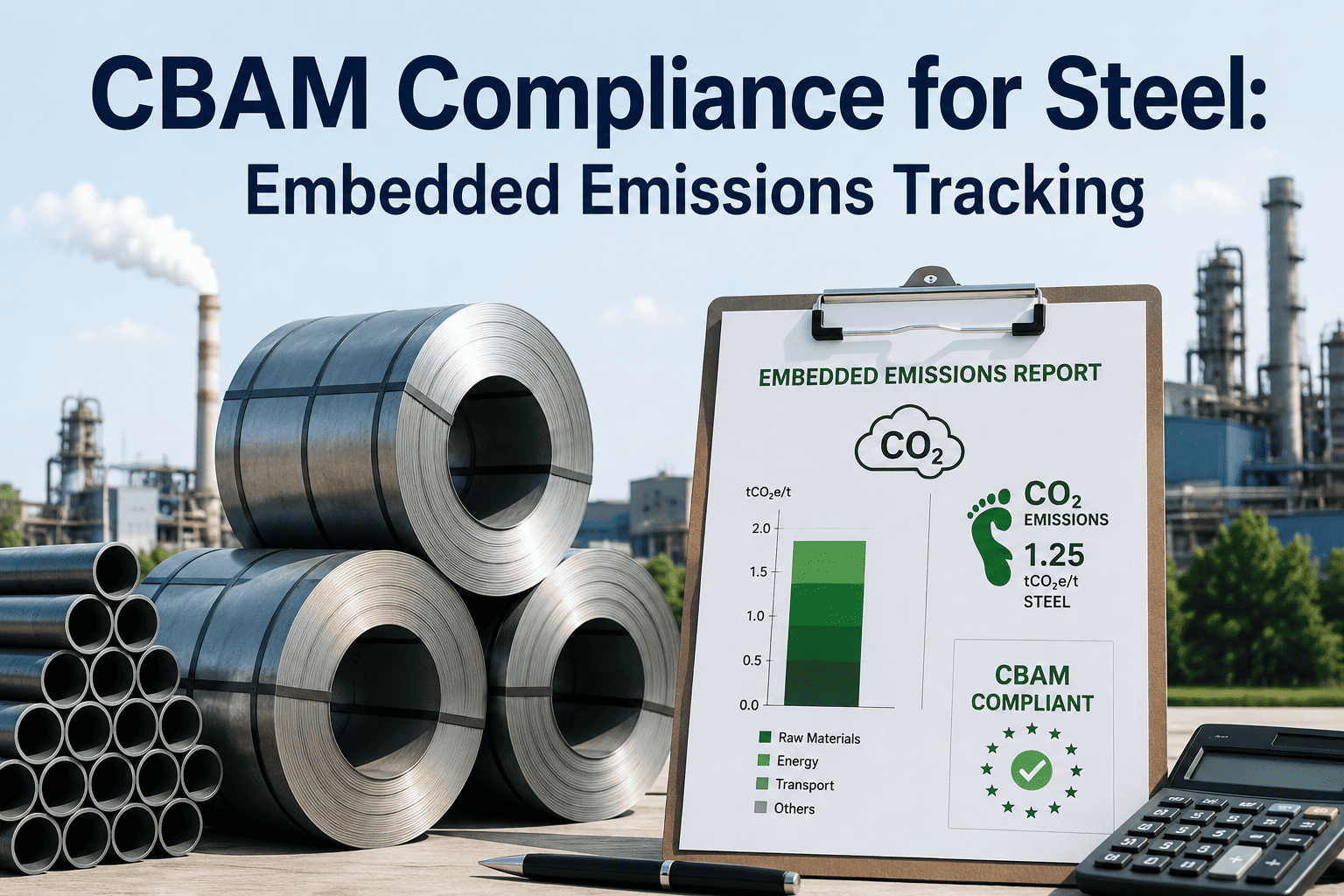
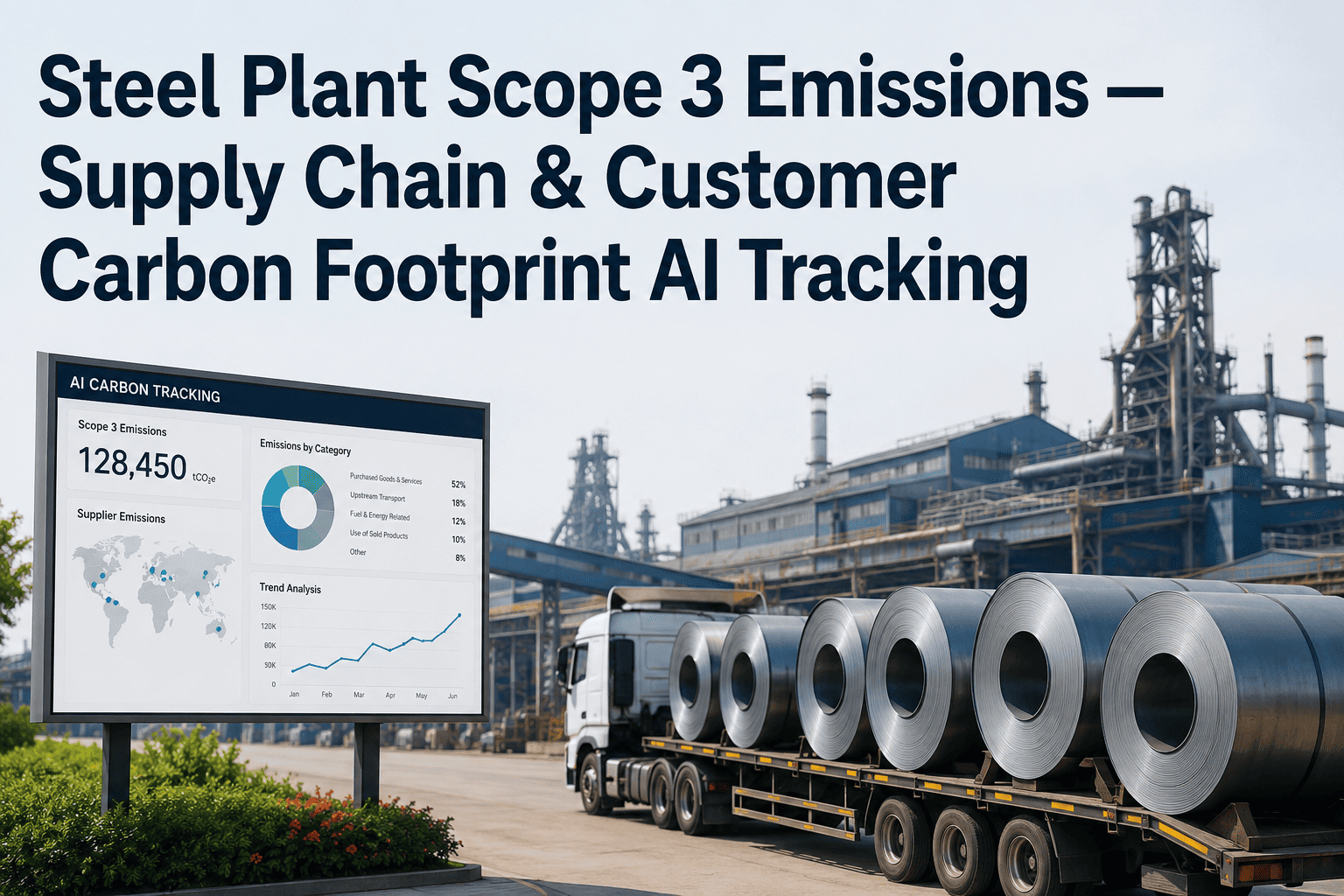
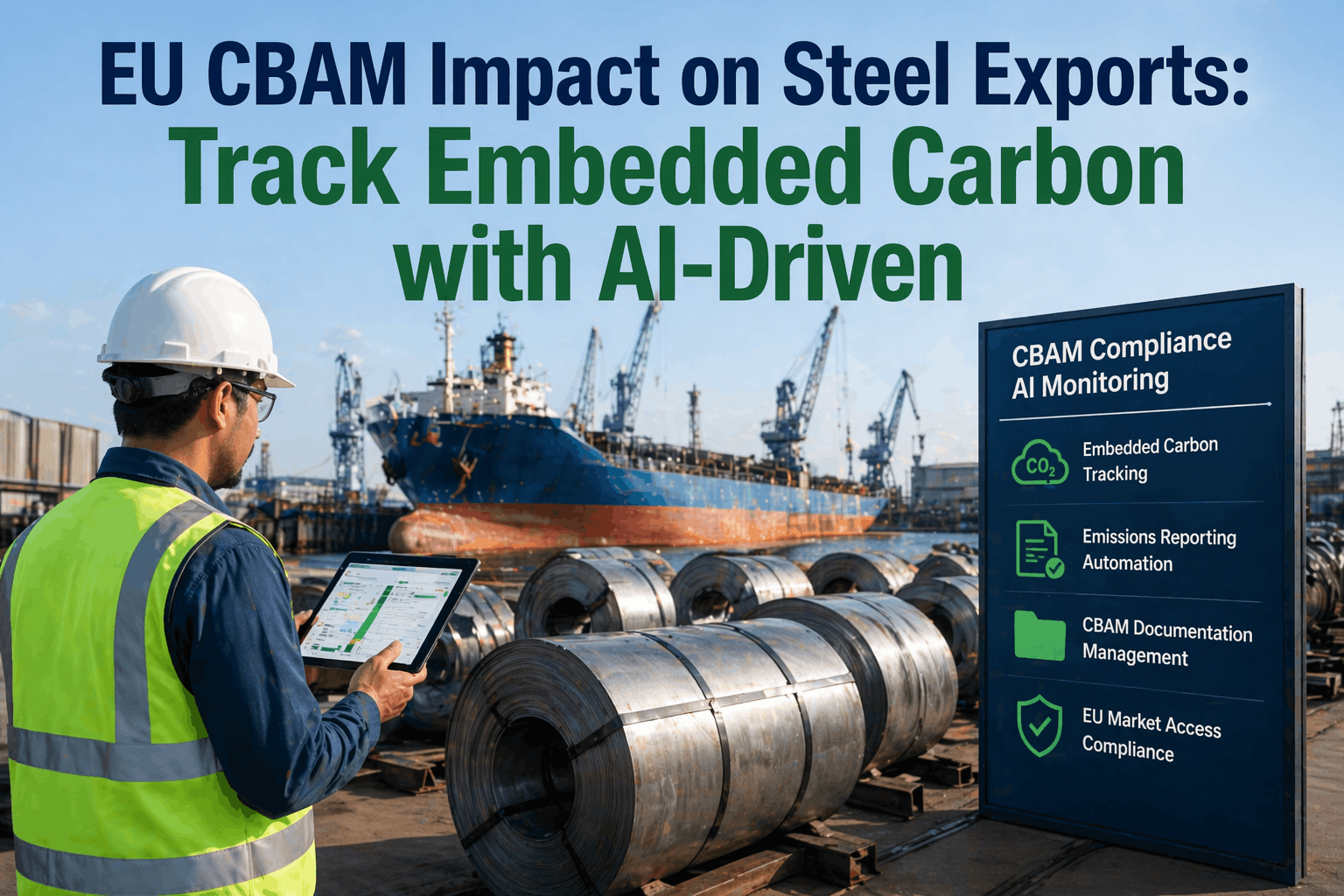
The EU Carbon Border Adjustment Mechanism is no longer a proposal — it is law. From January 2026, every tonne of steel imported into the European Union must carry a declared carbon footprint, and importers must purchase CBAM certificates matching the embedded emissions at the prevailing EU ETS price. For steel producers and exporters outside the EU, this means one thing: if you cannot measure, verify, and report your carbon intensity per product, you will either pay punitive default rates that assume worst-case emissions or lose access to the world's second-largest steel market entirely. Yet most steel exporters are still unprepared — lacking the emissions measurement systems data infrastructure, and verification processes that CBAM demands. This checklist gives you a clear, actionable roadmap from where you are today to full CBAM compliance. iFactory's AI platform provides the carbon tracking, emissions reporting, and verification infrastructure that steel producers need for CBAM compliance. Book a free consultation to assess your CBAM readiness and close compliance gaps before penalties hit.
CBAM Readiness Checklist for Steel Producers and Exporters
The EU CBAM transitional period ends and the financial obligations begin in 2026. Steel producers exporting to Europe who are not ready face three consequences: punitive default emission values that inflate their carbon cost, loss of competitive positioning against EU producers who have already priced in carbon, and ultimately exclusion from customer supply chains that require CBAM-compliant suppliers. This checklist covers every requirement — from emissions measurement through verification and reporting — so you know exactly what to do, when, and how.
Transitional reporting began
EU-approved methods only for reporting
Financial obligations begin — certificates required
Phase-in — increasing certificate requirements
Full CBAM — 100% of emissions covered
What CBAM Means for Steel Producers and Exporters
CBAM extends the EU's carbon pricing to imported goods — ensuring that steel produced outside Europe faces the same carbon costs as steel produced within the EU ETS system.
How It Works
EU importers of steel must declare the embedded carbon emissions of their imports and purchase CBAM certificates at the prevailing EU ETS price (currently €90–100+/tonne CO2). The cost is passed back to the exporting producer through procurement negotiations — making high-carbon steel significantly more expensive for EU buyers.
Financial Impact
A typical BF-BOF producer emitting 1.8–2.2t CO2 per tonne of steel faces €160–220 per tonne of steel in CBAM costs at current EU ETS prices. On a 100,000 tonne annual export volume to the EU, that is €16–22 million in additional costs — unless verified emissions data proves lower intensity.
Default Values Penalty
If you cannot provide verified actual emissions data, CBAM applies default values — typically the average of the worst-performing 10% of EU installations for that product. This means you pay maximum carbon costs regardless of your actual emissions. Verified reporting is not optional — it is the difference between competitive pricing and market exclusion.
Who Is Affected
Every steel producer who exports to the EU — directly or through intermediaries. CBAM covers iron and steel products including crude steel, semi-finished products, flat products, long products, tubes and pipes, and steel fasteners. If your steel ends up in the EU, you need CBAM-compliant emissions data.
Your 10-Step CBAM Readiness Checklist
Complete these 10 steps to achieve full CBAM compliance. Each step includes what you need to do, why it matters, and the common pitfalls that trip up producers.
Map Your Emission Sources and System Boundaries
Identify every direct emission source within your installation boundary — blast furnaces, coke ovens, sinter plants, BOF converters, EAF, lime kilns, reheating furnaces, and power generation. Define which processes are included in your CBAM installation and which are excluded. Misdefining boundaries is the most common compliance error — it either inflates your reported emissions or triggers an audit finding.
Establish Direct Emissions Monitoring (Scope 1)
Implement continuous or calculation-based monitoring for CO2 emissions from every source identified in Step 1. CBAM requires either direct measurement (CEMS — Continuous Emissions Monitoring Systems) or calculation-based methods using activity data and emission factors per the EU methodology. Most steel plants use calculation methods — tracking fuel consumption, raw material inputs, and production volumes with approved emission factors.
Calculate Indirect Emissions (Scope 2 — Electricity)
CBAM includes indirect emissions from electricity consumption in certain products. Calculate electricity-related emissions using either the actual grid emission factor for your country/region or your contractual electricity supply emission factor (if you have renewable PPAs). This is particularly impactful for EAF producers where electricity is the primary energy input — a renewable PPA can dramatically reduce your CBAM exposure.
Determine Product-Level Embedded Emissions
Allocate total installation emissions to individual products using the EU's prescribed attribution methodology. This is not a simple division — it requires mass and energy balance allocation across production routes, co-product crediting for blast furnace slag and coke oven gas, and proper handling of precursors (iron ore, pig iron, DRI). Incorrect allocation methodology is the second most common compliance failure.
Account for Carbon Costs Already Paid
If your country has a carbon pricing mechanism (carbon tax, ETS, or equivalent), those costs can be deducted from the CBAM obligation. Document the carbon price paid per tonne of CO2 under your domestic system. Countries with effective carbon pricing give their exporters a cost advantage under CBAM — every dollar of domestic carbon cost is a dollar less in CBAM certificates.
Build Data Collection and Management Infrastructure
CBAM compliance requires granular, auditable data — fuel consumption by source, raw material chemical composition, production volumes by product, electricity consumption by process, and emission factor documentation. Manual spreadsheets will not survive an audit. Implement a digital data management system that collects, validates, and stores all required data with audit-trail integrity.
Engage an Accredited Verifier
CBAM requires third-party verification of embedded emissions by an EU-accredited verifier. Engage a verifier early — accredited verifiers experienced in steel production are in limited supply and booking up fast. The verification covers your monitoring methodology, data quality, calculation accuracy, and system boundary definitions. Pre-verification readiness audits can identify gaps before they become findings.
Prepare Communication Templates for EU Importers
Your EU customers (importers) need specific data from you to fulfill their CBAM reporting obligations. Prepare standardized communication packages including: installation identification, production process description, embedded emissions per product (with methodology), and any domestic carbon price deductions. The easier you make it for importers, the more likely they are to continue sourcing from you versus switching to EU-based alternatives.
Assess Decarbonization Opportunities to Reduce CBAM Exposure
CBAM costs are directly proportional to your embedded emissions. Every tonne of CO2 reduced saves €90–100+ in CBAM cost. Evaluate quick-win decarbonization options: energy efficiency improvements, scrap ratio increases, renewable electricity sourcing, waste heat recovery, and process optimization. These investments now pay double — through operational savings AND reduced CBAM liability.
Establish Ongoing Monitoring, Reporting, and Verification Processes
CBAM is not a one-time compliance exercise — it is an ongoing quarterly and annual reporting obligation. Establish permanent processes for data collection, emissions calculation, report generation, verifier engagement, and importer communication. Automate as much as possible through your CMMS and emissions management platform to minimize the recurring labor burden.
Our CBAM compliance specialists will assess your current readiness and identify the gaps that need immediate attention.
The 6 Most Common CBAM Compliance Mistakes
These are the pitfalls that catch steel producers most often — costing them months of rework and millions in avoidable CBAM overpayments.
Wrong System Boundaries
Including or excluding processes incorrectly — particularly around co-generation, oxygen plants, and lime kilns that may or may not be within the installation boundary depending on ownership and operational control. Results in either inflated or underreported emissions, both of which trigger audit failures.
Using Non-Approved Emission Factors
Applying generic IPCC emission factors instead of EU-approved factors or facility-specific measured values. From 2025, only EU-approved methodology is accepted — regional or industry-average factors from other frameworks are not sufficient. This is the most common cause of rejected CBAM reports.
Incorrect Product Attribution
Dividing total plant emissions equally across all products instead of using proper mass and energy balance attribution. A plant producing both rebar and automotive-grade sheet has very different emission intensities per product — flat allocation misrepresents both and fails verification.
Missing Precursor Emissions
Failing to include emissions from precursor materials (pig iron, DRI, sintered ore) when these are produced at separate installations. CBAM requires cradle-to-gate emissions for the final product — if you buy pig iron from another plant, their emissions must be included in your product's embedded carbon.
Inadequate Data Quality and Audit Trail
Relying on manual spreadsheets without version control, data validation, or audit trail. Verifiers require traceable data from source measurement through to final reported number. A broken audit trail — even if the final number is correct — results in a qualified verification opinion that undermines CBAM reporting credibility.
Ignoring Indirect (Electricity) Emissions
Assuming CBAM only covers direct (Scope 1) emissions. For certain steel products, indirect emissions from electricity consumption are included. EAF producers who ignore electricity emissions significantly underreport — and face penalties when the discrepancy is caught during verification.
How AI-Powered CMMS Enables CBAM Compliance
Manual CBAM compliance is theoretically possible but practically unsustainable at scale. Here is how intelligent operational platforms automate the heavy lifting.
Automated Emissions Data Collection
IoT sensors and ERP integration automatically capture fuel consumption, raw material inputs, production volumes, and electricity usage. No manual data entry, no spreadsheet errors, no missing records. Data flows continuously from the plant floor to the CBAM reporting engine.
Real-Time Carbon Intensity Calculation
AI calculates embedded emissions per tonne of product in real time — not quarterly. Operators see the CBAM cost implication of every production decision as it happens. This enables active emissions management rather than retrospective reporting surprises.
EU-Methodology Compliant Calculations
Built-in calculation engines apply EU-approved emission factors, attribution methodologies, and co-product crediting rules automatically. When the EU updates its methodology — as it does periodically — the platform updates calculations system-wide without manual reconfiguration.
Verification-Ready Reporting
Generates CBAM reports in the format required by EU authorities and accredited verifiers. Complete audit trail from raw data through to final reported number. Digital verification workspaces allow verifiers remote access to data — reducing verification time and cost by 40–60%.
Importer Data Packages
Automatically generates the standardized data packages your EU importers need for their CBAM declarations. Product-specific embedded emissions, methodology descriptions, and domestic carbon price deductions — formatted and ready for importer submission without manual assembly.
CBAM Cost Optimization
AI identifies which operational changes — fuel switching, scrap ratio adjustments, electricity sourcing, process optimization — deliver the largest CBAM cost reductions per dollar invested. Turns CBAM from a compliance burden into an optimization opportunity.
See CBAM compliance automation in action. Book a free demo.
Steel Products Covered Under CBAM
CBAM for Steel — Frequently Asked Questions
When do CBAM financial obligations actually begin?
January 2026. The transitional reporting phase (October 2023 — December 2025) required quarterly emissions reporting but no financial payment. From January 2026, EU importers must purchase and surrender CBAM certificates corresponding to the embedded emissions of their steel imports. The cost per certificate equals the weekly average EU ETS auction price — currently €90–100+/tonne CO2. The obligation phases in gradually, reaching 100% by 2034 as free EU ETS allowances are phased out.
What happens if we cannot provide verified emissions data?
The EU applies default values — typically based on the average emission intensity of the worst-performing 10% of EU installations producing that product, plus a markup. For steel, this can mean default values 30–50% higher than your actual emissions. The financial penalty of using default values on a 100,000 tonne annual export volume to the EU is €5–10 million per year in unnecessary CBAM costs. Verified reporting is not optional — it is an economic necessity. Get help establishing verified reporting.
Does our domestic carbon tax reduce the CBAM obligation?
Yes. Any carbon price effectively paid in the country of production can be deducted from the CBAM obligation. This includes carbon taxes, emissions trading scheme costs, and equivalent carbon levies. The deduction requires documentation of the actual price paid per tonne of CO2 under the domestic mechanism. Countries with robust carbon pricing (UK, Korea, Canada, China ETS) give their steel exporters a significant CBAM cost advantage over countries without carbon pricing.
Are indirect emissions (electricity) included in CBAM for steel?
Yes — for certain steel products, indirect emissions from electricity consumption are included in the embedded emissions calculation. This is particularly important for EAF producers where electricity is the dominant energy input. The electricity emission factor used can be the country default grid factor or a contractual factor if you have a renewable PPA — making renewable energy sourcing a direct CBAM cost reduction strategy. Assess your electricity emission factor options.
How often do we need to report under CBAM?
During the transitional phase: quarterly reports within one month of each quarter end. From 2026 onward: annual declarations by EU importers covering the previous calendar year, supported by verified installation-level emissions data from producers. The practical implication is that you need continuous data collection and annual third-party verification — making automated data management systems essential for any producer with significant EU export volumes.
Will CBAM expand beyond the EU?
Almost certainly. The UK has announced its own CBAM effective 2027. Canada, Australia, and Japan are developing similar mechanisms. As carbon border adjustments proliferate, the ability to measure, verify, and report product-level carbon intensity will become a universal market access requirement — not just for EU exports. Steel producers who build CBAM compliance infrastructure now are future-proofing for global carbon pricing convergence.
Is Your Steel Operation CBAM-Ready?
Every month of delay increases your exposure to default emission values, unnecessary CBAM costs, and competitive disadvantage against producers who are already compliant. Let our CBAM specialists assess your readiness, identify gaps, and build a compliance roadmap — in a free 30-minute assessment.