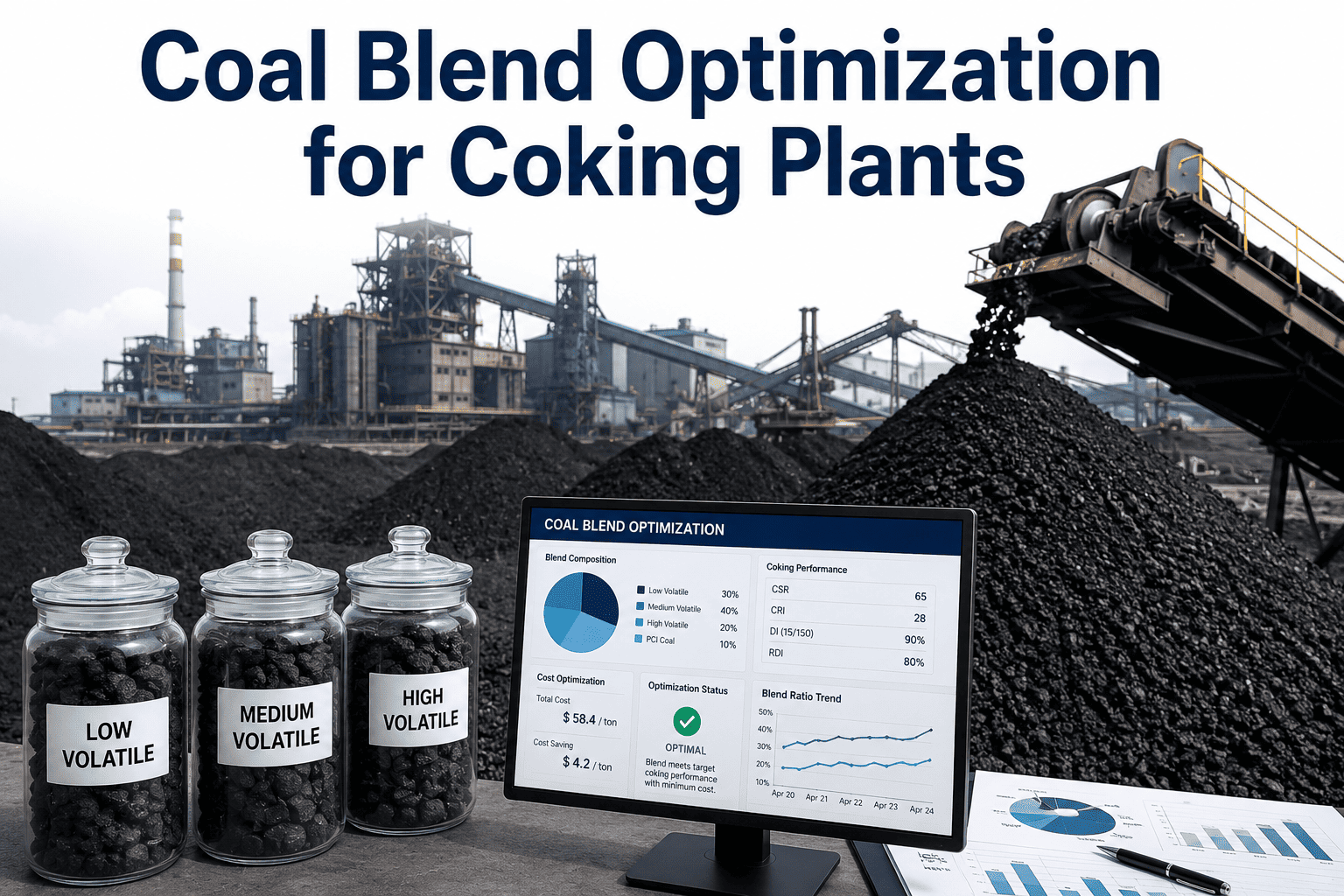
Coal blend decisions carry more cost impact than almost any other choice a coking plant makes, since coal alone typically accounts for the large majority of total coke production cost. Coal blend engineers are asked to hold CSR and CRI steady while coal markets shift week to week, premium coking coal grows scarcer, and cheaper alternatives keep appearing with question marks attached. Getting the blend wrong either wastes money on coal quality the furnace does not need, or risks coke quality the furnace cannot afford to lose. iFactory's AI models exactly how far a blend can flex toward lower-cost coals before quality targets are at risk. Book a coal blend review to see your own cost-versus-quality curve.
Coal Is 80% of Coke Cost. Your Blend Recipe Should Know It
AI-optimized coal blending finds the lowest-cost combination of available coals that still hits your CSR and CRI targets, instead of defaulting to the safest, most expensive recipe.
What Coal Blend Really Controls
Coal blend decisions ripple through cost, quality, and supply reliability all at once, which is exactly why they are hard to optimize by hand across a shifting coal market.
of total coke production cost typically tied directly to coal purchasing
potential coal cost reduction commonly available through better blend optimization
coal grades typically blended together in a single modern coking recipe
frequency at which coal market pricing and availability can shift meaningfully
Fixed Recipe vs. Dynamically Optimized Blend
Both approaches aim for the same CSR and CRI targets. The difference is whether the blend recipe adapts to what coal is actually available and affordable this week.
- Blend ratios set once and rarely revisited
- Safety margin built in by over-using premium coking coal
- New coal sources evaluated slowly, if at all
- Market price swings absorbed without recipe adjustment
- Quality risk managed by simply spending more
- Blend ratios recalculated as coal availability and pricing shift
- Premium coking coal reserved only where it actually moves quality
- New coal sources evaluated quickly against quality impact
- Market price swings turned into blend-mix opportunities
- Quality risk managed with data, not just extra spend
How the Model Optimizes Blend Cost and Quality Together
The model treats coal blend as a constrained optimization problem — minimize cost, subject to hitting the CSR and CRI targets the furnace actually needs.
Coal property database
Vitrinite reflectance, fluidity, ash, sulfur, and cost for every available coal source are maintained in a live, continuously updated database.
Quality outcome modeling
The model predicts CSR and CRI outcome for any candidate blend combination before it is ever charged, based on your historical blend-to-quality relationship.
Cost-constrained optimization
The lowest-cost blend combination that still meets quality targets is identified automatically, ranked against current market pricing.
New source evaluation
A prospective new coal source can be evaluated against the model before purchase, showing its likely quality and cost impact ahead of commitment.
See Your Blend's Cost-Versus-Quality Curve
iFactory analyzes your current blend recipe against available coal alternatives to show exactly how much cost reduction is possible without risking CSR or CRI.
Common Coal Blend Components by Role
Most coking blends combine coals playing distinct roles rather than a single homogeneous source, and each role has different substitution flexibility.
What Changes After Dynamic Blend Optimization
Figures reported by coal blend teams comparing performance before and after adopting continuous, market-responsive blend optimization.
A Coal Blend Engineer's View on Dynamic Optimization
We always treated our blend recipe as something you set carefully once and left alone, because testing new combinations was slow and risky. Having a model predict quality outcome before we ever charge a new blend combination changed that completely. We now test more alternatives in a month than we used to in a year, and our coal cost has actually come down while CSR variability went the other way.
Four Reasons Blend Recipes Stay Stuck Too Long
A blend recipe that made sense a year ago is not automatically still the best one, but changing it feels risky without a way to test the outcome first.
Fear of quality risk
Without a way to predict outcome ahead of time, any blend change feels like a gamble on coke quality, so teams default to the safest known recipe.
Slow evaluation of new sources
Testing a new coal source through trial coking runs takes weeks, so promising lower-cost alternatives often go unevaluated for too long.
Procurement and coking teams working separately
Coal purchasing decisions are sometimes made without full visibility into quality impact, leaving the coking side to react after the fact.
No live cost-versus-quality view
Without a model connecting current market pricing to predicted quality outcome, opportunities to save cost without risking CSR go unseen.
Frequently Asked Questions
How much can we realistically save on coal cost?
Most coking plants running a static blend recipe carry 5 to 15 percent avoidable coal cost, recoverable by substituting toward available lower-cost coals wherever quality models confirm it is safe to do so. The exact figure depends on current market conditions and blend flexibility.
Can this evaluate a coal source we've never used before?
Yes, based on its known chemistry properties compared against your historical blend-to-quality relationship, though accuracy improves once at least a small trial batch confirms the prediction. Book a demo to see this modeled against a real prospective coal source.
How often does the recommended blend change?
Recommendations can update as frequently as coal market pricing and availability shift, though most plants review and apply changes on a weekly cadence to keep operations manageable for procurement and blending crews.
Does this connect with our existing procurement system?
The model works alongside your procurement process, providing quality-adjusted cost comparisons that procurement teams can use directly in sourcing decisions, without requiring a change to existing purchasing systems.
What data is needed to start?
Historical coal property data, blend ratios, and matching CSR/CRI lab results, typically twelve months or more, form the strongest starting dataset. Talk to a specialist about what your plant already tracks.
Find Your Lowest-Cost Blend That Still Hits Quality
Book a 30-minute scoping call and bring your current blend recipe and coal cost data. iFactory shows exactly how much can be saved without risking CSR or CRI.