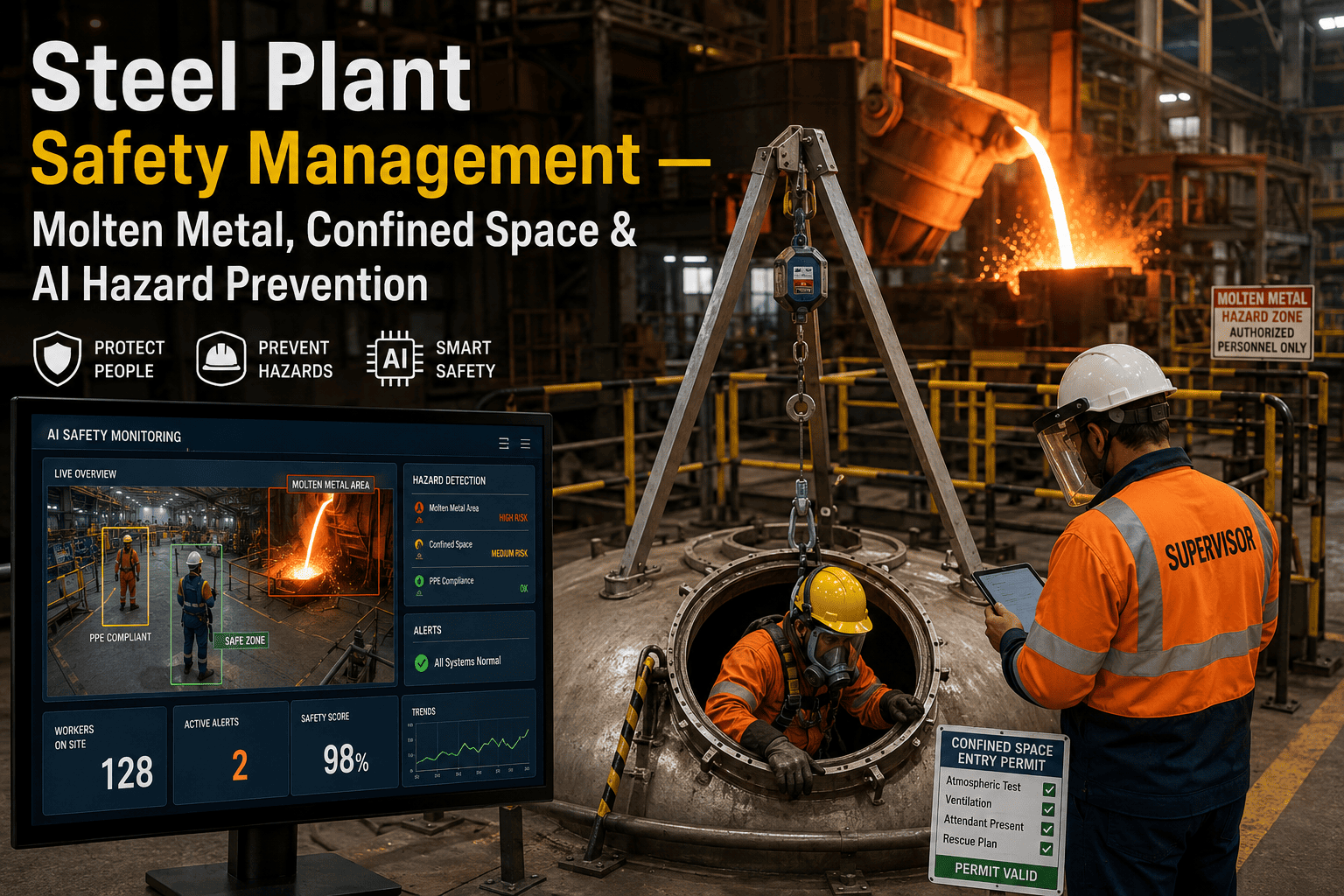
More steel plant fatalities happen in confined spaces than in any other single hazard category, and the reason is almost never that the space itself is unusual. It is that atmospheric conditions inside a furnace shell, a duct, or a storage tank can shift from safe to lethal in minutes, while the gas reading taken before entry still shows "within limits" on the paperwork. A worker who steps into a vessel for a routine refractory inspection has no way to sense a slow oxygen drop or a rising carbon monoxide level without continuous monitoring running the entire time they are inside. iFactory's AI keeps that monitoring live for every entrant, every second they are in the space, and you can book a demo to see how the alert and evacuation sequence actually works.
The Gas Reading Before Entry Tells You Nothing About What Happens Fifteen Minutes Later
iFactory's AI streams atmospheric and entrant data continuously from inside the confined space, blocking entry automatically when a reading drifts unsafe and triggering evacuation before a worker feels the first symptom.
The Space Is Not the Hazard — the Change You Cannot See Is
Picture a maintenance technician climbing into a storage tank for what looks like a routine inspection. The handheld detector reads within limits at the entry point. Ventilation appears to be running fine. A few minutes in, oxygen levels begin dropping faster than anyone accounted for, and by the time dizziness sets in, the technician is already past the point of climbing out unassisted. This is the pattern behind the majority of confined space incidents in heavy industry, and it explains why a single reading taken before entry is not the same thing as a monitoring system.
What makes this pattern so persistent is that every individual step in the process usually looks correct in isolation. The permit was signed. The pre-entry test passed. The attendant was in position. None of those steps failed on their own, yet the combination still left a gap exactly where the danger actually lived, in the minutes after entry when nobody was reading the atmosphere anymore. A confined space program built entirely around a pre-entry checklist is optimized to catch the hazard that was already there, not the one that develops while the work is happening, and steel plant vessels are exactly the kind of environment where conditions change without warning as refractory heat, residual gas pockets, and ventilation performance interact in ways a static test cannot anticipate.
Four Streams the System Watches for Every Entrant, Every Second
A credible confined space program cannot rely on a single pre-entry check. It has to track the atmosphere, the entrant, and the space itself continuously for the full duration of the work, which is exactly what a clipboard and a handheld meter checked once at the door cannot do. Each of the four streams below feeds the same live dashboard, so a supervisor watching the entry does not have to mentally combine four separate data sources under pressure. The system does that correlation automatically and only surfaces an alert when it actually matters.
O2, CO, H2S, and combustible gas levels are sampled continuously rather than once at entry, with entry blocked automatically if any parameter falls outside the configured safe range.
Wearable sensors track each entrant's position inside the space, flagging if someone remains motionless longer than expected or moves toward a restricted section of the vessel.
Airflow rate is monitored against the ventilation plan for the specific space, so a fan slowdown or blockage is caught before it shows up as a gas reading drifting toward the threshold.
The system confirms a trained attendant and rescue equipment are actively assigned and present at the entry point for the entire duration the permit remains open.
Why the Entrant's Own Vitals Matter as Much as the Air Around Them
Atmosphere is only half of the risk equation inside a confined space. Heat stress, fatigue, and the physical exertion of working in a cramped vessel can compromise a worker well before any gas reading moves, which is why continuous monitoring extends to the entrant's own condition and not only the surrounding air. A wearable that tracks heart rate, body temperature, and motion gives the system a second, independent signal that something is wrong even in a scenario where the atmosphere itself never crosses a threshold.
This matters most in steel plant vessels specifically, where residual heat from an adjacent furnace or a recently drained tank can push internal temperatures well above what a worker would encounter in a typical industrial confined space. A monitoring system that only watches gas composition would miss a heat stress event entirely, while one that combines atmospheric and physiological data catches both failure modes with the same continuous feed, giving the attendant a single unified picture instead of two disconnected data streams to interpret separately under pressure.
From Pre-Entry Test to Close-Out — the Steps the AI Enforces
Every confined space entry follows the same enforced sequence regardless of how routine the task looks on paper, because the incidents that cause the most damage are almost always the ones treated as routine right up until they were not. The five stages below run in strict order, and the system will not allow a permit to skip ahead.
Every stage is logged with a timestamp and a named person, so the permit cannot skip a step and no entry can be authorized on an assumption instead of a current reading.
Walk Through a Live Entry Sequence
See exactly how the AI blocks entry, tracks entrants, and triggers evacuation on a real confined space scenario from your plant.
What Happens the Moment a Reading Crosses a Safe Threshold
An alert is only useful if it reaches the right person fast enough to act, so the escalation sequence is built around seconds, not shift-end review. A gas reading that quietly crosses a threshold and sits in a log file until someone checks it later provides no protection to the person standing inside the vessel at that exact moment, which is why every escalation path below is designed to reach a human who can act within the same window the hazard is developing. The table shows how different parameter breaches are routed.
| Condition Detected | Immediate Action | Who Is Alerted |
|---|---|---|
| Oxygen drifting toward threshold | Countdown timer starts for controlled evacuation | Entrant, attendant, EHS manager |
| CO or H2S exceeds safe limit | Immediate evacuation signal to entrant device | Entrant, attendant, rescue team |
| Entrant motionless beyond expected window | Attendant prompted to confirm status by voice or visual check | Attendant, EHS manager |
| Ventilation airflow drop detected | Work paused pending airflow restoration verification | Attendant, area supervisor |
What Plants Report After Moving to Continuous Confined Space Monitoring
These figures reflect outcomes tracked after steel plants replaced single-point pre-entry testing with continuous, sensor-driven confined space monitoring across furnace, tank, and duct entries.
An Entry Permit Is Only as Safe as the Rescue Plan Behind It
Continuous monitoring reduces the odds a rescue is ever needed, but it does not remove the requirement to be ready if one is. Regulators and internal safety audits both treat rescue readiness as a precondition for entry, not an afterthought to document once work is already underway, and a permit that activates without every item below in place is a permit that should not have activated at all. The checklist below reflects what the system verifies before an entry permit is allowed to activate.
Bringing Continuous Monitoring to Your Highest-Risk Spaces First
Identify Priority Spaces
Furnace shells, tanks, and ducts with the highest entry frequency or worst historical incident history are equipped first.
Deploy Sensors and Wearables
Fixed atmospheric monitors and entrant wearables are installed and calibrated to the specific gas profile of each space.
Connect the Alert Chain
Attendants, EHS managers, and rescue teams are linked into the automatic escalation workflow before the first live entry.
Expand Plant-Wide
Coverage extends to remaining confined spaces once the priority areas are running cleanly and the team trusts the workflow.
Questions Safety Teams Ask About Continuous Confined Space Monitoring
A Safe Reading at the Door Was Never the Same Thing as a Safe Entry
The single most dangerous assumption in confined space work is that a clean reading at the entry point means the space will stay safe for as long as the task takes. Conditions inside a furnace shell, a tank, or a duct are not static, and the entrants most at risk are the ones whose only protection is a test result that is already minutes old by the time trouble starts.
iFactory's AI keeps the atmosphere, the entrant, and the rescue plan monitored continuously for the full duration of every entry, turning confined space safety from a single decision made at the door into a live control that runs for as long as someone is inside. That shift is what separates a program that looks compliant on paper from one that actually catches the change before it becomes an emergency.
None of this replaces the judgment of a trained attendant or the value of a well-run rescue team. What it does is remove the blind window between a signed permit and the next time anyone checks on conditions inside the space, and that window is exactly where the majority of serious confined space incidents in steel plants have historically originated. Closing it does not require replacing your existing safety program. It requires giving that program a live data feed it never had before.
Put Continuous Monitoring on Your Highest-Risk Spaces
iFactory's AI tracks atmosphere, entrant position, and rescue readiness for every confined space entry, live. Book a demo and see it on your own vessel data.