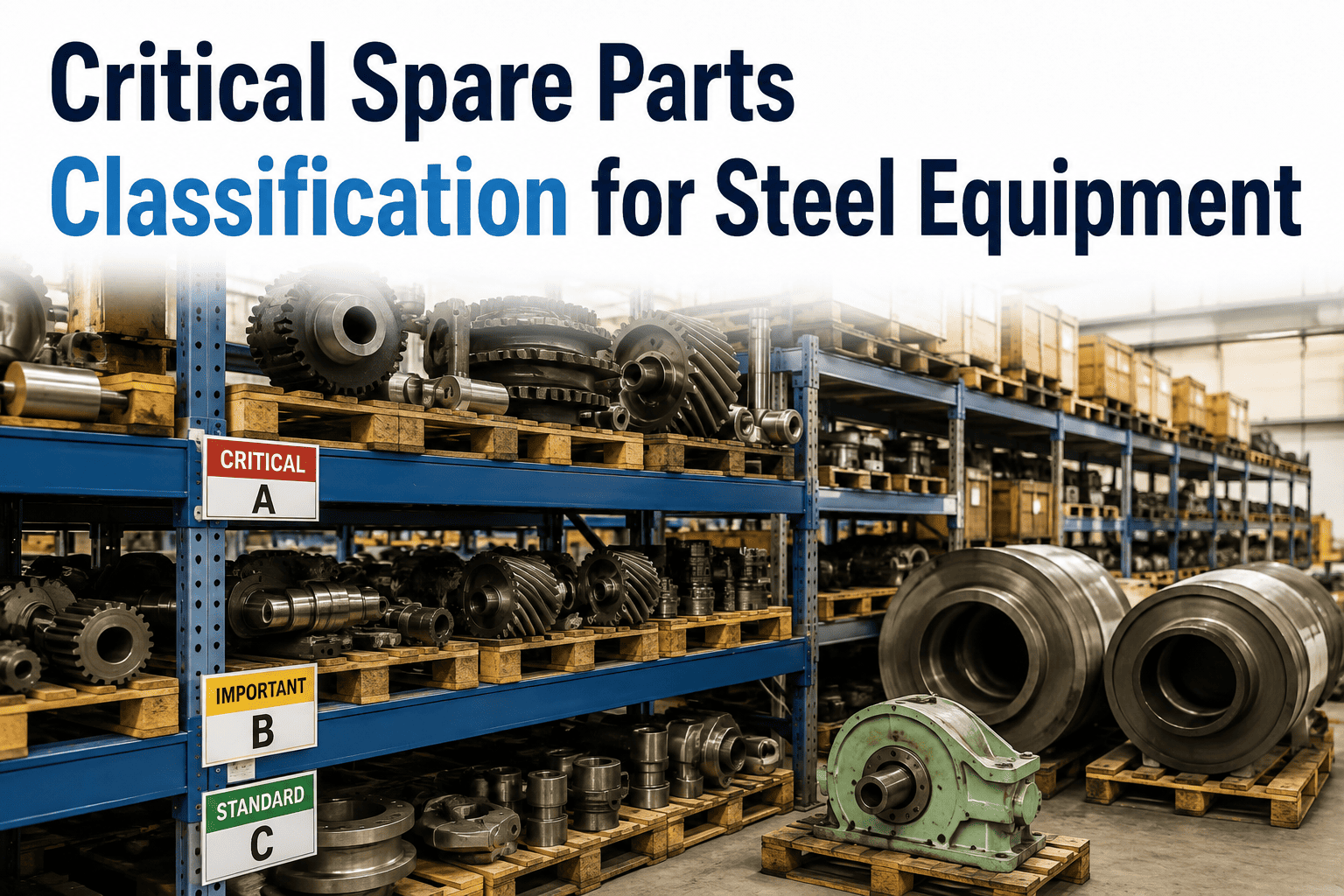
Not every spare part deserves the same shelf space, the same reorder point, or the same urgency when it runs low, yet most steel plant storerooms treat a common bearing and a custom rolling mill gearbox with the exact same inventory policy. That mismatch either ties up capital in parts that barely matter or leaves a plant exposed on the parts that actually stop production. Book a demo to see criticality-based spare parts classification applied to your equipment list.
Some Parts Stop the Whole Line, Most Parts Do Not
Treating every spare part with the same inventory policy wastes capital on the parts that rarely matter and creates blind spots on the ones that do. Criticality-based classification sorts every part by its actual production impact, lead time exposure, and failure consequence, then applies a stocking policy that matches the risk.
VED Analysis: Sorting Parts by Vital, Essential, and Desirable
VED classification alone is a starting point, not a complete answer, because it evaluates operational consequence without weighting how likely the part is to fail or how long it actually takes to replace once ordered. Combining VED with failure frequency and lead time data produces a classification that reflects real risk rather than instinct alone.
Why Lead Time Changes Everything About a Part's Criticality
A part that costs very little and rarely fails can still be a top classification priority if it takes twelve weeks to procure and has no substitute, because the real risk being managed is not the part's cost, it is the plant's exposure to downtime while waiting for a replacement to arrive. Conversely, an expensive part that fails often but can be sourced locally within a day carries far less inventory risk than its price tag would suggest.
This is why lead time assessment has to run alongside criticality scoring rather than after it. A gearbox custom-built by a single overseas manufacturer with a sixteen-week lead time belongs in a fundamentally different stocking category than a standard motor available from three regional distributors within days, even if both parts serve equally critical functions on the line.
Stop Guessing Which Parts Deserve Safety Stock
iFactory combines VED classification, historical failure data, and lead time exposure into a single criticality score for every part in your storeroom, so stocking decisions follow real risk instead of habit.
How Common Steel Plant Equipment Categories Typically Classify
| Equipment Category | Typical Criticality | Lead Time Profile | Recommended Stocking Approach |
|---|---|---|---|
| Mill drive motors | Vital | Long, often custom-wound | Hold spare unit or critical rewind components on site |
| Standard bearings | Essential to Desirable | Short, widely available | Min/max stock, local supplier agreement |
| Custom gearboxes | Vital | Very long, single source common | Dedicated safety stock, consider spare gearbox |
| Hydraulic cylinders | Essential | Moderate, some rebuild options | Stock seal kits, rebuild service agreement |
| Control system PLCs | Vital | Variable, obsolescence risk | Stock spares before end-of-life, plan migration |
This table reflects general tendencies rather than a fixed rule for every plant, since the actual classification of any specific part depends on its role in your particular process configuration and the redundancy already built into the line around it.
Five Steps to Building a Criticality-Based Spares Program
What Misclassification Actually Costs a Plant
Over-classifying parts as vital ties up working capital in a storeroom full of items that rarely turn over, inflates carrying costs, and often leads to unnoticed obsolescence as equipment gets upgraded while old spares sit on the shelf. Under-classifying parts is the more dangerous mistake, since it means a genuinely vital part with a long lead time gets managed with a casual reorder policy, and the first time it fails, the plant discovers the exposure during an actual production stoppage rather than during a planning review.
The goal of a criticality program is not to minimize inventory value, it is to align inventory investment with actual downtime risk, which frequently means carrying more of a small number of genuinely vital parts while carrying meaningfully less of the much larger number of low-risk parts that were previously stocked out of habit rather than analysis.
Common Questions About Spare Parts Classification
How often should spare parts criticality classification be reviewed once it is established?
An annual review is generally sufficient for most steel plant spares programs, though equipment upgrades, process changes, or a new supplier relationship affecting lead time can justify reclassifying specific parts outside that regular cycle. Parts tied to equipment nearing end of life or planned for replacement deserve a closer look more frequently, since their criticality profile can shift quickly as the underlying equipment strategy changes. Book a demo to see how classification review cycles are typically structured.
Should criticality classification be based on the equipment or the individual part?
Classification needs to happen at the individual part level rather than the equipment level, because a single machine can contain both vital, single-source components and generic, readily available fasteners, and treating the whole machine's parts list as uniformly critical wastes inventory investment on the low-risk components while potentially still under-stocking the genuinely vital ones. Equipment criticality is a useful starting filter, but the final classification still needs to drill down to the part. Contact support to discuss part-level classification methodology for your equipment list.
How does criticality classification account for parts with multiple possible suppliers versus single-source parts?
Single-source parts, particularly custom-engineered components like mill gearboxes or specialized control hardware, carry meaningfully more inventory risk than functionally similar parts available from multiple qualified suppliers, even when their failure consequence and frequency look similar on paper. A thorough classification approach weights sourcing risk as its own factor alongside lead time, since a part available from three suppliers with a two-week lead time is a fundamentally lower risk than an identical part available from only one supplier with the same stated lead time. Book a demo to see sourcing risk factored into your classification model.
Does a criticality classification program require new software, or can it run on existing spreadsheets?
A basic classification exercise can start on a spreadsheet, but maintaining it accurately over time, especially cross-referencing failure history, consumption trends, and lead time changes across thousands of parts, becomes difficult to sustain manually as the parts catalog grows. Most plants that maintain classification accuracy long-term connect it to their CMMS or inventory system so consumption and failure data update the classification automatically rather than requiring a periodic manual re-analysis. Contact support to discuss connecting classification to your existing systems.
How does spare parts classification interact with safety stock and reorder point calculations?
Criticality classification is the input that determines the service level target for a given part's safety stock calculation, meaning a vital part is typically stocked to a much higher service level, minimizing the chance of a stockout, than a desirable part, which can tolerate occasional stockouts in exchange for lower carrying cost. Reorder points then follow from that service level target combined with lead time and consumption variability, so classification is the strategic layer that reorder math sits on top of rather than a separate exercise. Book a demo to see classification feed directly into safety stock recommendations.
Match Every Part's Inventory Policy to Its Actual Risk
iFactory scores every spare part on production impact, failure history, and lead time exposure, giving your storeroom a classification that reflects real risk instead of habit.