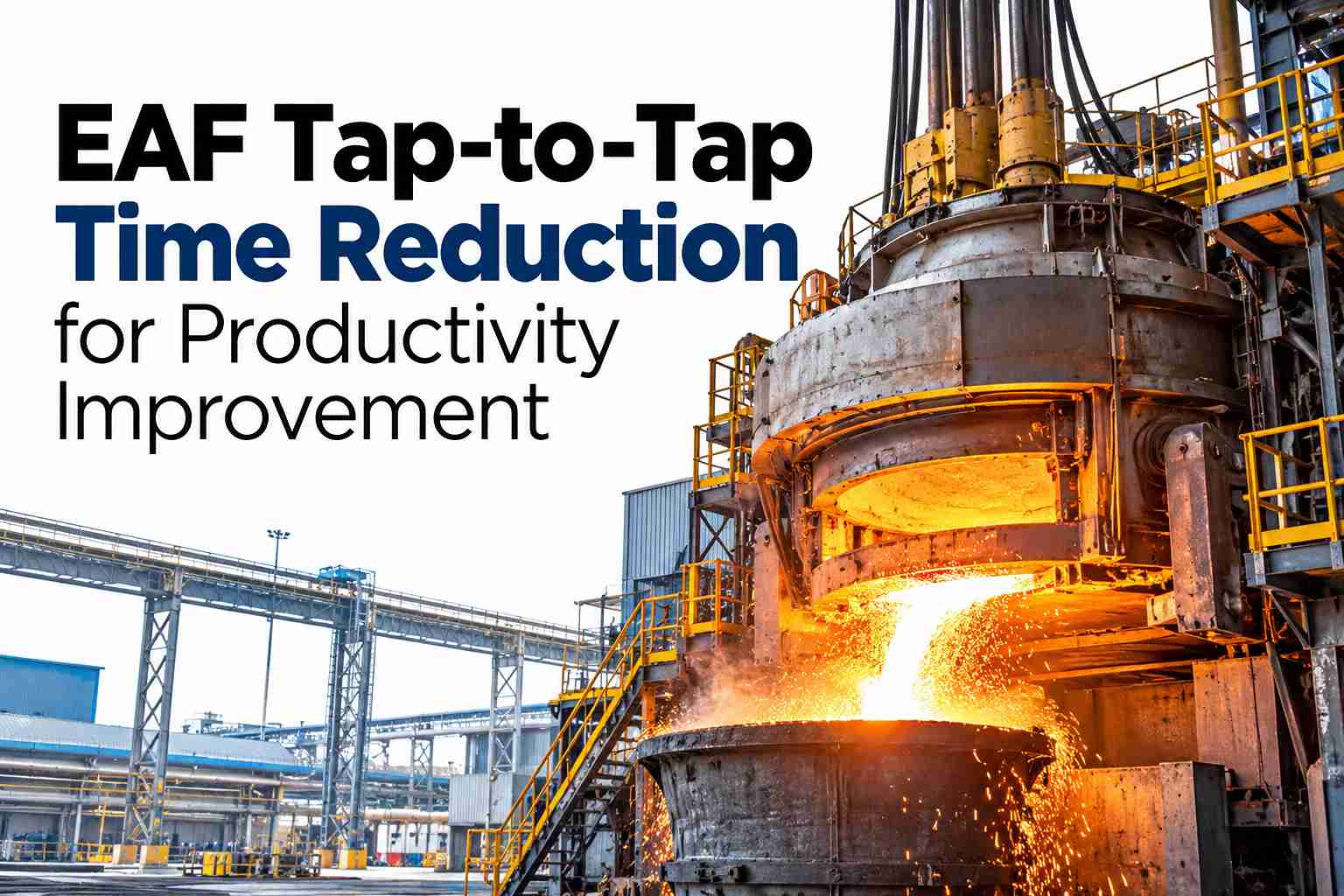
Tap-to-tap time is the single number that determines how many heats an EAF can physically run in a day, and it's made up of several distinct segments, charging, power-on melting, refining, and turnaround, each of which can be optimized somewhat independently but which most operations still treat as one combined cycle time to shave down through general effort rather than targeted attention. A furnace that trims minutes off charging but loses the same minutes to a slow turnaround between heats hasn't actually improved throughput, it's just moved the delay somewhere less visible on the shift report. Real tap-to-tap reduction comes from knowing exactly which segment is actually the constraint on a given furnace and attacking that one specifically, and booking a demo shows how that breakdown gets built against your own cycle data.
EAF ENERGY · TAP-TO-TAP TIME · PRODUCTIVITY
Every Minute Off Tap-to-Tap Is Another Heat You Can Actually Run
iFactory breaks your tap-to-tap cycle into charging, power-on, refining, and turnaround segments, pinpointing the actual constraint driving your cycle time so improvement effort goes where it matters.
THE FOUR SEGMENTS
What Actually Makes Up a Tap-to-Tap Cycle
Tap-to-tap time is rarely dominated by one uniform activity, it's the sum of four distinct phases, and the relative share each one takes varies significantly from furnace to furnace based on charging method, power capacity, and operating practice.
01
Charging
Time to load scrap into the furnace, whether through bucket drops, continuous feeding, or a combination, directly tied to charging method and scrap density.
02
Power-On Melting
Time the arc is actively melting the charge, driven by available power capacity, electrode positioning efficiency, and scrap mix characteristics.
03
Refining
Time spent bringing the bath to target chemistry and temperature through oxygen lancing, alloy additions, and sampling before the heat is tap-ready.
04
Turnaround
Time between tap and the next charge, covering tapping, furnace preparation, and any delay before the next scrap load begins.
FINDING THE CONSTRAINT
Why the Same Improvement Doesn't Work on Every Furnace
A furnace power-constrained by transformer capacity has a different bottleneck than one limited by charging cycle time or refining chemistry adjustments, and applying a generic tap-to-tap reduction program without first identifying which segment is actually binding wastes effort on segments that were never the real limiter.
STEP 1
Break down historical heats by segment to see the actual time distribution
→
STEP 2
Compare segment times against best-heat benchmarks from your own furnace history
→
STEP 3
Identify which segment shows the largest gap between typical and best performance
→
STEP 4
Target improvement effort specifically at that constraint rather than the whole cycle
Find out which segment is actually limiting your tap-to-tap time
iFactory can run a segment breakdown against your recent heat history to show exactly where the constraint sits today.
WHERE THE MINUTES GO
Common Sources of Avoidable Time in Each Segment
Every segment has its own set of typical inefficiencies, and most of them are avoidable once they're actually visible in the data rather than absorbed into a single combined cycle time number.
Charging Delays
Inconsistent scrap bucket preparation timing, crane availability conflicts, and charge sequencing that doesn't match furnace readiness.
Melting Inefficiency
Suboptimal electrode positioning, power curve programs not matched to actual scrap mix, and arc instability from foamy slag practice gaps.
Refining Overrun
Waiting on lab sample results, multiple correction cycles for chemistry misses, and alloy addition timing that isn't synchronized with the bath state.
Turnaround Drag
Slag door and electrode maintenance delays, ladle availability conflicts, and inconsistent tapping practice between operators.
BEFORE AND AFTER
What a Segment-Focused Program Changes
The difference between a generic productivity push and a segment-focused program is that one shows up as a measurable reduction in a specific phase, while the other tends to plateau quickly once easy general improvements run out.
| Approach |
Generic Cycle Focus |
Segment-Focused Program |
| Diagnosis |
Whole cycle treated as one number to reduce |
Each segment measured and benchmarked independently |
| Improvement Target |
General effort applied across the whole process |
Effort concentrated on the actual binding constraint |
| Result Durability |
Early gains often plateau once easy wins are used up |
Sustained gains as each new constraint is identified in turn |
| Heats Per Day Impact |
Inconsistent, depends on which segment happened to improve |
Directly tied to the measured constraint reduction |
TURNKEY DELIVERY
How iFactory Builds Tap-to-Tap Reduction Into Your Operation
iFactory connects to your furnace control and process data systems to break every heat into its four segments automatically, benchmark against your own best-heat history, and surface the specific constraint driving cycle time on an ongoing basis.
What Gets Built
Automated segment breakdown for every heat, charging through turnaround
Best-heat benchmarking specific to your furnace and scrap mix
Constraint identification updated continuously as operating conditions shift
Dashboard tracking heats per day against your productivity targets
Deployment Timeline
Weeks 1-2: Furnace and process data integration
Weeks 3-4: Segment model build and best-heat benchmarking
Weeks 5-6: Dashboard go-live and constraint tracking activation
FREQUENTLY ASKED QUESTIONS
What Operations Teams Ask Before Starting a Tap-to-Tap Program
How much of our current furnace data do you actually need to build the segment breakdown?
The core segment breakdown relies on timestamps already captured by most furnace control systems, charge start and end, power-on and power-off, tap time, and the start of the next charge, so most operations have enough historical data to begin the analysis without new instrumentation. Refining segment detail improves with additional data like sample request and result timestamps, which can be added incrementally where available.
Book a demo to see what your existing data already supports.
What if our biggest constraint turns out to be something outside the furnace itself, like ladle availability?
That's a common finding, turnaround delays are frequently driven by factors outside the furnace's direct control, like ladle scheduling, crane availability, or downstream casting readiness, and the segment analysis is built to surface exactly this kind of cross-department constraint rather than assuming every bottleneck sits within the melting process itself. Identifying that the real constraint is a scheduling coordination issue rather than a furnace performance issue is often the most valuable finding of the whole analysis.
Contact our support team to discuss how cross-department constraints get identified and addressed.
Can this account for the fact that our scrap mix and grade requirements change from heat to heat?
Yes, the benchmarking model is built to compare heats against similar scrap mix and grade requirements rather than treating every heat as directly comparable regardless of what was actually being produced, since a demanding alloy grade naturally requires more refining time than a simple carbon grade. This ensures the constraint identification reflects a genuine inefficiency rather than an expected difference in cycle time driven by the product being made.
Book a demo to see how grade and mix variation is handled in the benchmarking.
How quickly can we expect to see a measurable improvement in heats per day?
Once the constraint is identified, the speed of improvement depends on how straightforward the fix is, a charging sequencing adjustment can show results within days, while a power curve reprogram or a cross-department scheduling change may take several weeks to implement and validate. Most operations see the first measurable segment improvement within the first month after the initial analysis identifies where to focus.
Contact our support team to set realistic improvement timelines for your operation.
Does pushing for faster tap-to-tap time risk compromising steel quality or refractory life?
This is exactly why segment-focused analysis matters, since it targets genuine inefficiency rather than compressing time out of a segment that actually needs it, like adequate refining time to hit chemistry targets or proper tapping practice that protects refractory condition. The goal is removing avoidable delay, not cutting corners on the steps that determine quality or equipment longevity, and any recommended change is evaluated against those constraints before being implemented.
Book a demo to discuss how quality and refractory considerations factor into the improvement recommendations.
FOUR SEGMENTS, ONE REAL CONSTRAINT AT A TIME
Stop Guessing Which Part of the Cycle Is Actually Slowing You Down
iFactory breaks your tap-to-tap cycle into charging, power-on, refining, and turnaround, pinpointing the real constraint so your improvement effort turns directly into more heats per day.