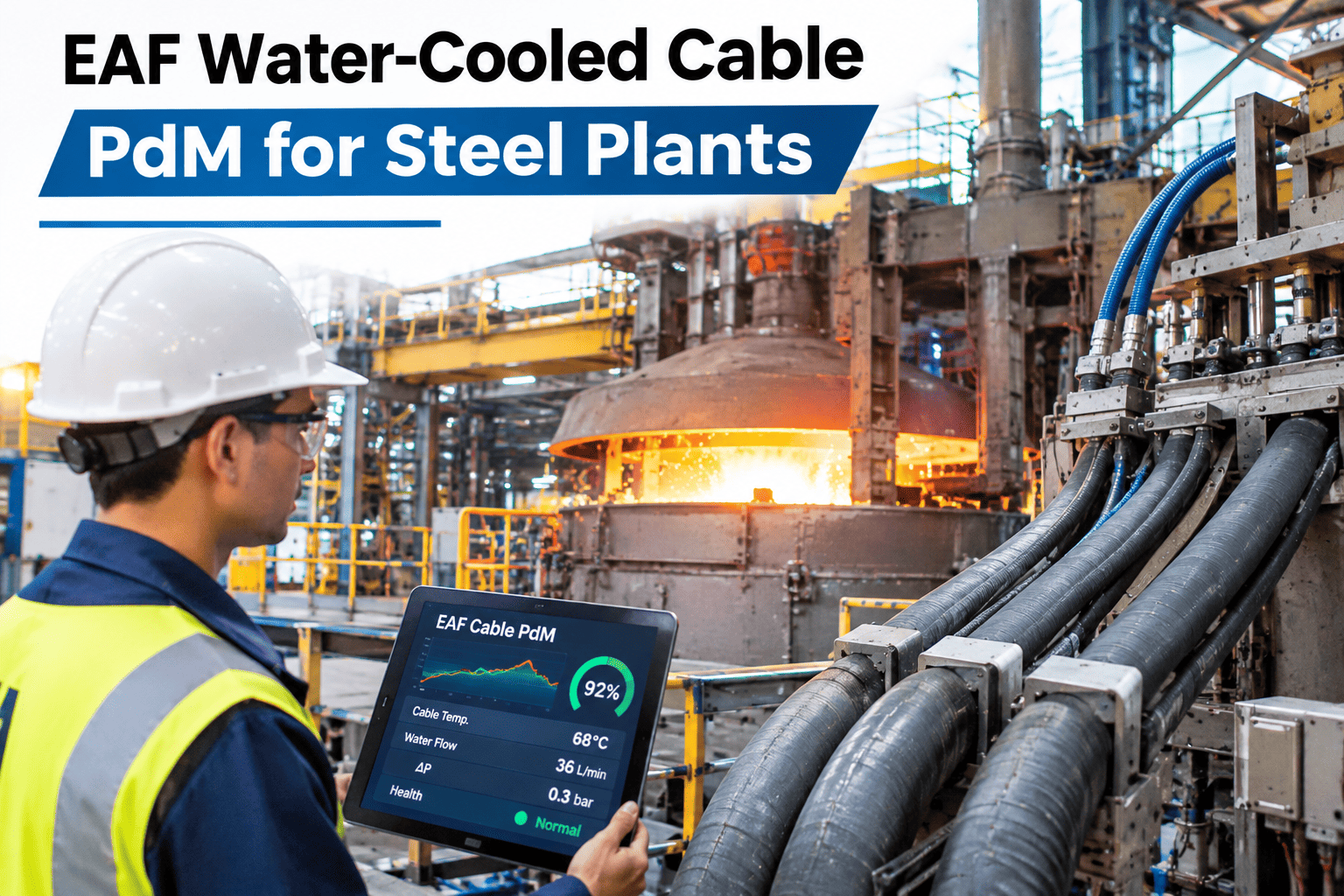
The water-cooled cables carrying current to an EAF's electrodes flex thousands of times a day, carry high current under constant thermal cycling, and depend on an internal water path that is impossible to inspect visually while the furnace is running. When one fails, it rarely gives much warning, and the resulting outage can mean hours of lost melting time plus the cost of emergency replacement. Catching flex fatigue, water leaks and rising electrical resistance before failure is what separates a planned cable change from an unplanned furnace stop, and our team can walk you through how continuous monitoring catches this early.
Electric arc furnace, critical component PdM
Catch Water-Cooled Cable Failure Before It Stops the Furnace
iFactory AI tracks flex fatigue, water leak signals and electrical resistance trends on your EAF cables, turning a critical failure mode into a planned maintenance event.
Why this failure mode is critical
A Cable Failure Rarely Gives Much Warning
Unlike a bearing that develops an audible vibration signature over weeks, a water-cooled cable can carry on normally right up until a flex point fatigues through or a water leak develops into a serious fault, often with very little lead time once the degradation accelerates.
Constant flexing
Thousands of flex cycles daily stress the cable structure
Hidden water path
Internal cooling cannot be inspected visually in operation
Fast failure progression
Degradation often accelerates quickly once it starts
Unplanned furnace stop
A failure means hours of lost melting time
Three signals
What Predictive Monitoring Actually Tracks
Flex fatigue
Cumulative flex cycles and stress patterns tracked against expected cable life.
Water leak detection
Flow and pressure signals flag a developing leak before it becomes critical.
Electrical resistance trending
Rising resistance signals internal degradation before a full failure occurs.
Review Your Current Cable Replacement History
Share your past cable failures and replacement schedule and see what a predictive monitoring baseline would look like.
Signal table
What Each Signal Reveals and How Early
| Signal | What it reveals | Typical warning window |
|---|
| Flex cycle count | Cumulative mechanical fatigue exposure | Weeks to months |
| Water flow and pressure | Developing leak in the cooling path | Days to weeks |
| Electrical resistance trend | Internal conductor degradation | Days to weeks |
| Surface temperature pattern | Localized hot spots from poor cooling | Hours to days |
Monitoring pipeline
Four Steps From Signal to Planned Replacement
1
Track continuously
Flex cycles, flow, pressure and resistance are logged through normal operation.
2
Trend against baseline
Each signal is compared against the cable's own historical pattern.
3
Flag early degradation
A developing trend is surfaced while it is still a maintenance item, not an emergency.
4
Schedule the replacement
The cable is swapped during planned downtime instead of an unplanned stop.
Cost of reactive replacement
Unplanned Failure Costs More Than the Cable Itself
This illustrative scale reflects relative downtime and cost impact, not a measured figure for any specific plant.
Common pitfalls
Three Problems With Fixed-Schedule Cable Replacement
1
Replacing on a calendar, not condition
A fixed schedule either replaces cables too early or misses one failing ahead of schedule.
2
No baseline for normal resistance
Without a known normal range, a rising trend is harder to distinguish from noise.
3
Water leak signals checked only during shutdowns
A leak that develops mid-campaign goes unnoticed until it becomes serious.
Expert review
Water-cooled cables are one of the few EAF components where a sudden failure genuinely surprises operators, precisely because the internal condition is invisible during normal operation. Continuous signal tracking is what makes this failure mode predictable instead of sudden.
Watch for
A cable replacement history dominated by unplanned, reactive swaps rather than scheduled ones.
Do next
Pilot continuous tracking on your highest-use cables before expanding to the full fleet.
— iFactory steel specialists
Frequently asked questions
What Melt Shops Ask About Cable Predictive Maintenance
Can this be added without replacing our current cables?
Yes, monitoring is typically added through sensors and data connections alongside the existing cable installation rather than requiring different cables, so your current fleet can be instrumented directly.
Ask about your current cable setup.
How early can a water leak actually be caught?
Flow and pressure monitoring can often catch a developing leak days to weeks before it would become a critical failure, giving enough lead time to schedule a repair or replacement.
Discuss leak detection timing.
Does flex cycle tracking require counting every single flex?
Cumulative flex exposure can be estimated from furnace operating data and cable movement patterns rather than requiring a dedicated counter on every cable, giving a practical fatigue estimate without added hardware on each unit.
Talk through fatigue tracking.
What resistance change actually signals a problem?
A rising trend relative to that specific cable's own established baseline is the meaningful signal, rather than a single absolute number, since normal resistance varies by cable type and installation.
Ask about resistance baselines.
Can this extend the useful life of our cables?
Catching early-stage degradation sometimes allows for a repair or adjustment rather than full replacement, and even where replacement is still needed, doing it on a planned basis avoids the added stress of running a cable to full failure.
Discuss extending cable life.
From sudden failure to planned replacement
Turn Your Most Unpredictable EAF Failure Mode Into a Planned Event
Book a session with iFactory AI to review your cable history and see how predictive monitoring fits your melt shop.