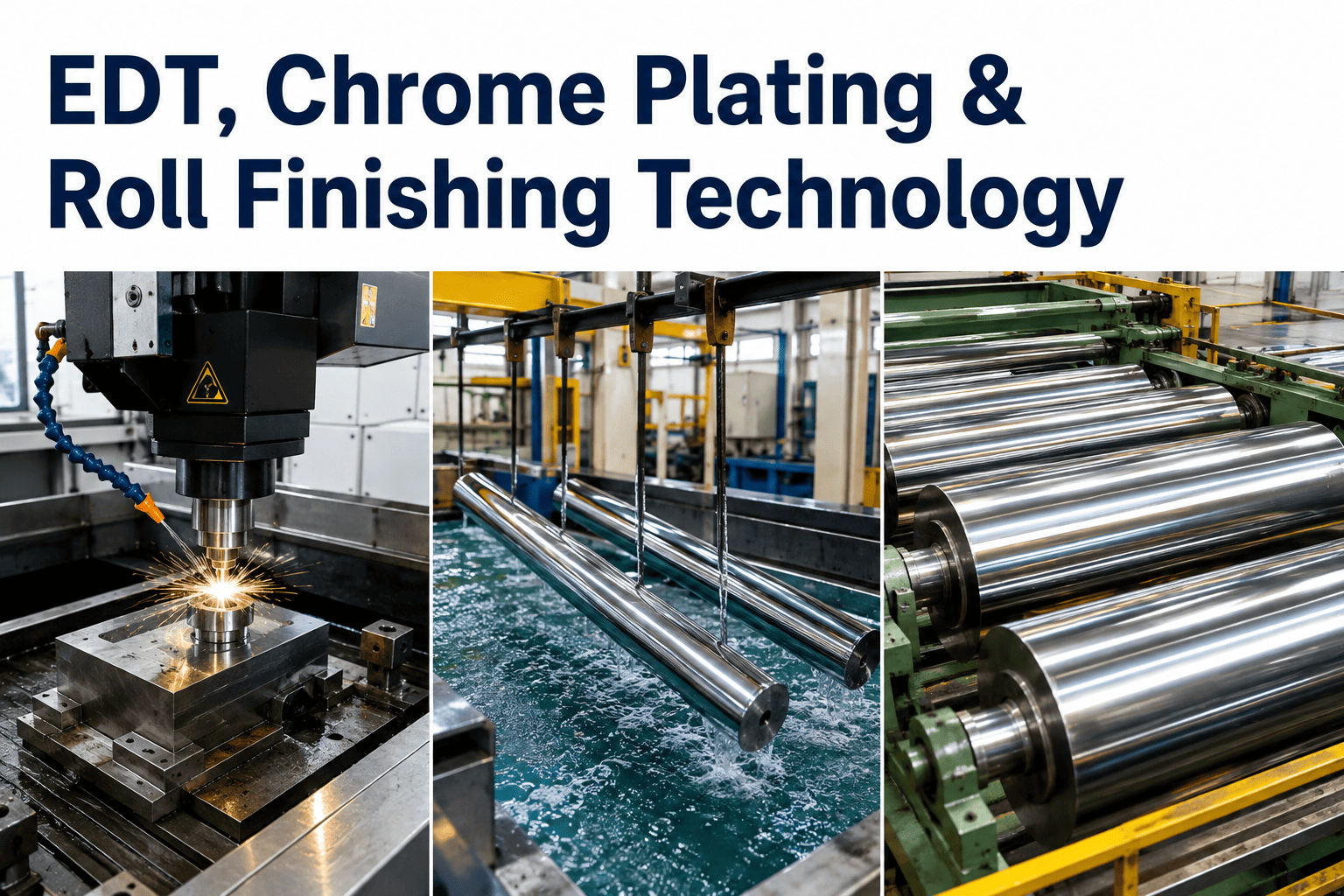
Every work roll surface texture is engineered, not accidental — the microscopic craters, peaks, and valleys transferred from a work roll onto rolled steel or aluminum strip determine paint adhesion, surface reflectivity, and formability in the finished product. Electro-discharge texturing, the dominant method in cold mill and skin-pass applications, creates that texture by discharging controlled sparks through a dielectric fluid, eroding micro-craters whose size and density are tunable through current, voltage, and pulse timing. Chrome plating doesn't create texture on its own — applied over an EDT surface, a 4 to 15 micron hard chrome layer roughly halves wear rate compared to an unplated EDT roll, extending how many coils a single roll grinding cycle can produce before the texture degrades below specification. Choosing the right combination of texturing method and coating is a genuine engineering decision, not a default setting carried over from whatever the mill has always done. See how iFactory tracks roll surface condition and texture degradation against your specific Ra and peak-count targets.
EDT, Chrome Plating & Roll Finishing Technology
Surface engineering for specific strip applications — how EDT texturing, chrome plating, and laser texturing each create or extend the microtopography that transfers from roll to strip, and how to match the right combination to your production requirements.
Controlled Sparks, Not Abrasion
Electrical discharge texturing works by passing electrical pulses between an electrode and the roll surface through a dielectric fluid, with the roll either submerged in the fluid or flooded at the point of contact. Each spark erodes a micro-crater into the roll surface, and the size, depth, and density of those craters are controlled by adjusting peak current, discharge voltage, and pulse on/off timing — the same four parameters that studies confirm most directly determine the resulting surface roughness (Ra) and peak count (Pc) per centimeter. This is fundamentally different from shot blasting, where random steel-shot impact produces a stochastic texture that's harder to reproduce precisely from one texturing cycle to the next.
The process also creates a recast white layer at the surface and a heat-affected zone beneath it, with microcracking that extends through the white layer to a depth directly related to the discharge energy used. This isn't a flaw in the process — it's an expected, characterized metallurgical byproduct that roll shops account for when specifying texturing parameters and planning regrind intervals. Understanding the relationship between discharge energy and HAZ depth is part of what lets a roll shop dial in a specific texture spec with confidence rather than trial and error.
Extending Texture Life, Not Creating It
Hard chromium plating is applied over an existing textured surface — typically EDT, shot blast, or laser beam textured — rather than creating texture on its own. Industrial experience with hard-chrome plated mill rolls, at a typical plating thickness of 4 to 15 microns, consistently shows meaningfully extended roll service life and significantly reduced roll change frequency compared to the same texture left unplated. Hard-chrome plated work rolls have been used in tandem and temper/skin-pass rolling mills for well over two decades, which means the wear-life benefit is backed by extensive industrial history, not a recent or unproven claim.
Topocrom, a related but distinct technology, applies a chromium layer directly to both create and protect surface texture in a single step, rather than texturing first and plating second — this integrated approach is what produces its markedly lower documented wear rate compared to EDT with a separately applied chrome layer.
The dashed box in this cross-section is the detail worth remembering when evaluating a texturing upgrade proposal: the base EDT texture — its crater geometry, its Ra, its peak count — stays fundamentally the same whether or not a chrome layer sits on top of it. Chrome plating is a wear-protection decision layered on top of a texturing decision, not a substitute for one. A roll shop still has to get the EDT parameters right first; the chrome layer only extends how long that correctly specified texture continues performing to spec.
Chrome Doesn't Replace the Texture Underneath — It Protects and Extends It
iFactory tracks texture degradation and wear against your roll's specific base method and any applied coating — so regrind timing reflects actual condition, not a generic interval.
Documented Wear Reduction Across Four Texturing Approaches
Wear rate is the practical, measurable outcome that ultimately determines how many production cycles a texture survives before it needs to be reground and reapplied — the table below lays out the documented pattern across the four methods most commonly used in cold mill and skin-pass applications today.
| Method | Mechanism | Documented Wear Rate |
|---|---|---|
| Shot Blast Texturing (SBD) | Stochastic — steel shot impact creates random surface texture | Up to 38% |
| Electro Discharge Texturing (EDT) | Deterministic — controlled spark erosion creates tunable micro-craters | Up to 32% |
| EDT + Hard Chrome | EDT texture with a 4–15 micron hard chrome layer applied over it | Up to 23% |
| Topocrom | Chromium layer applied directly to create and protect surface texture | Up to 8% |
The clear pattern is that deterministic texturing methods with a protective chrome layer wear substantially slower than stochastic shot-blast texturing — which is precisely why mills producing high-volume, tight-tolerance automotive or appliance-grade strip have largely moved away from shot blasting toward EDT-based and chrome-protected deterministic systems. The wear-rate gap between the fastest-wearing and slowest-wearing methods is large enough that it consistently shows up directly in roll-change frequency and, by extension, in overall line uptime.
Which Technology Fits Which Strip Requirement
No single texturing and coating combination is correct for every application — the right choice depends on strip surface requirements, production volume, and how much roll change downtime the specific line can tolerate before it becomes the binding constraint on throughput.
Confirming the Texture Meets Spec, Not Just Assuming It Does
Ra and peak count are the two standard parameters used to verify a texture meets its specification, and both need to be measured against the actual roll surface after texturing, not inferred from the machine settings used to produce it. Two rolls run through nominally identical EDT parameters can still produce measurably different surface characteristics if dielectric fluid condition, electrode wear, or roll rotation speed varied between the two runs.
Ongoing monitoring matters just as much as the initial verification. A texture that meets spec at the start of a production campaign degrades measurably as coils pass over it, and tracking that degradation against Ra and peak-count targets over time — rather than relying on a fixed regrind calendar interval — is what lets a roll shop time regrind and roll change decisions to actual measured condition instead of a generic assumption.
The question I get most from mills evaluating a texturing upgrade is whether chrome plating is a different texturing method or just an add-on. It's the second one, and getting that distinction right changes the whole conversation. You're not choosing between EDT and chrome — you're choosing your base texture, usually EDT, and then deciding whether the wear-life extension from a chrome layer justifies its added cost for your specific production volume and regrind economics. The mills that get the best return are the ones that actually run the wear-rate math against their own roll-change frequency, not the ones that assume chrome is automatically worth it everywhere. I've seen mills add chrome to a line that regrinds so infrequently the extra cost never pays back, simply because a neighboring line used it successfully.
Frequently Asked Questions
EDT, Chrome Plating, and Laser Texturing — Matched to Your Strip Requirements
iFactory tracks roll surface Ra, peak count, and wear condition against your specific texturing method and coating — so regrind timing and roll change decisions reflect actual measured condition.


-&-finishing-line-analytics.png)
