Plant managers overseeing an electric arc furnace are balancing three high-cost systems at once: graphite electrodes consumed at 1.5 to 2.5 kilograms per tonne of steel, water-cooled shell panels carrying 80 percent of the furnace's thermal load, and a transformer that costs 5 to 15 million dollars to replace with a 12 to 24 month lead time if it fails unexpectedly. Electrode consumption alone represents 8 to 15 percent of total EAF operating cost, and a single breakage event caused by scrap collapse or arc instability halts production immediately for a hot electrode change that eats 20 to 60 minutes every time it happens. AI correlation of electrode performance with furnace practice is now cutting consumption 10 to 15 percent, worth $300,000 to $750,000 annually on a typical furnace, while continuous cooling panel monitoring catches micro-fractures before they become a water leak inside the shell. Plant managers ready to see this modeled against their own furnace availability can book a demo today.
EAF MAINTENANCE · ELECTRODE · SHELL · COOLING · 2026
Protect Your Highest-Cost Furnace Systems
AI monitoring of electrode consumption, shell panel integrity, and water cooling health keeps furnace availability above 90 percent while cutting the largest controllable operating costs.
Where EAF Operating Cost Actually Concentrates
Electrode Consumption — 8-15% of Total Operating Cost
Cooling Panel Thermal Load Handled — 80% by Sidewall Panels
Reline Cost Exposure — $2-4M Per Full Refractory Campaign End
Three Systems, One Unified Monitoring Layer
01
Electrode Consumption
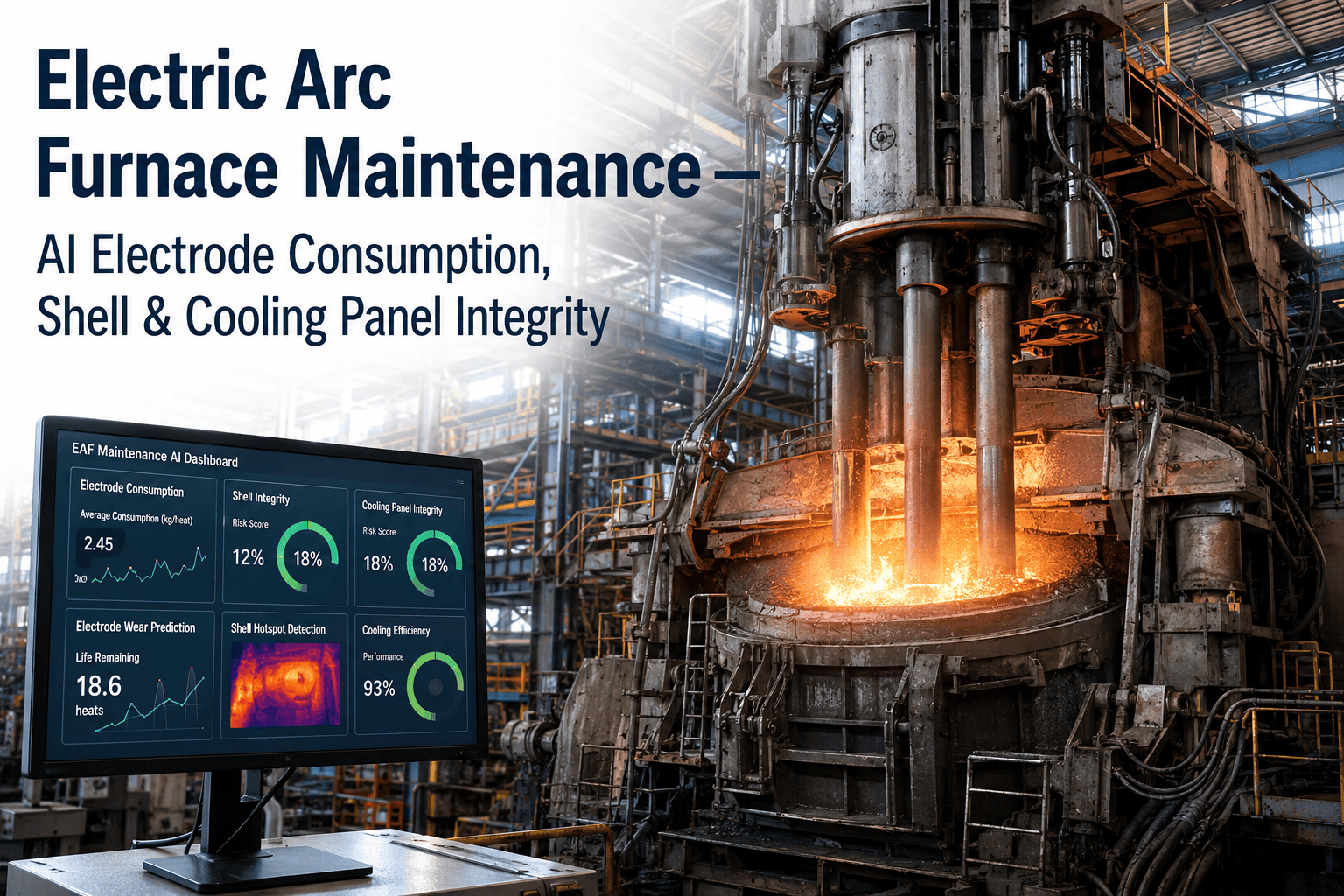
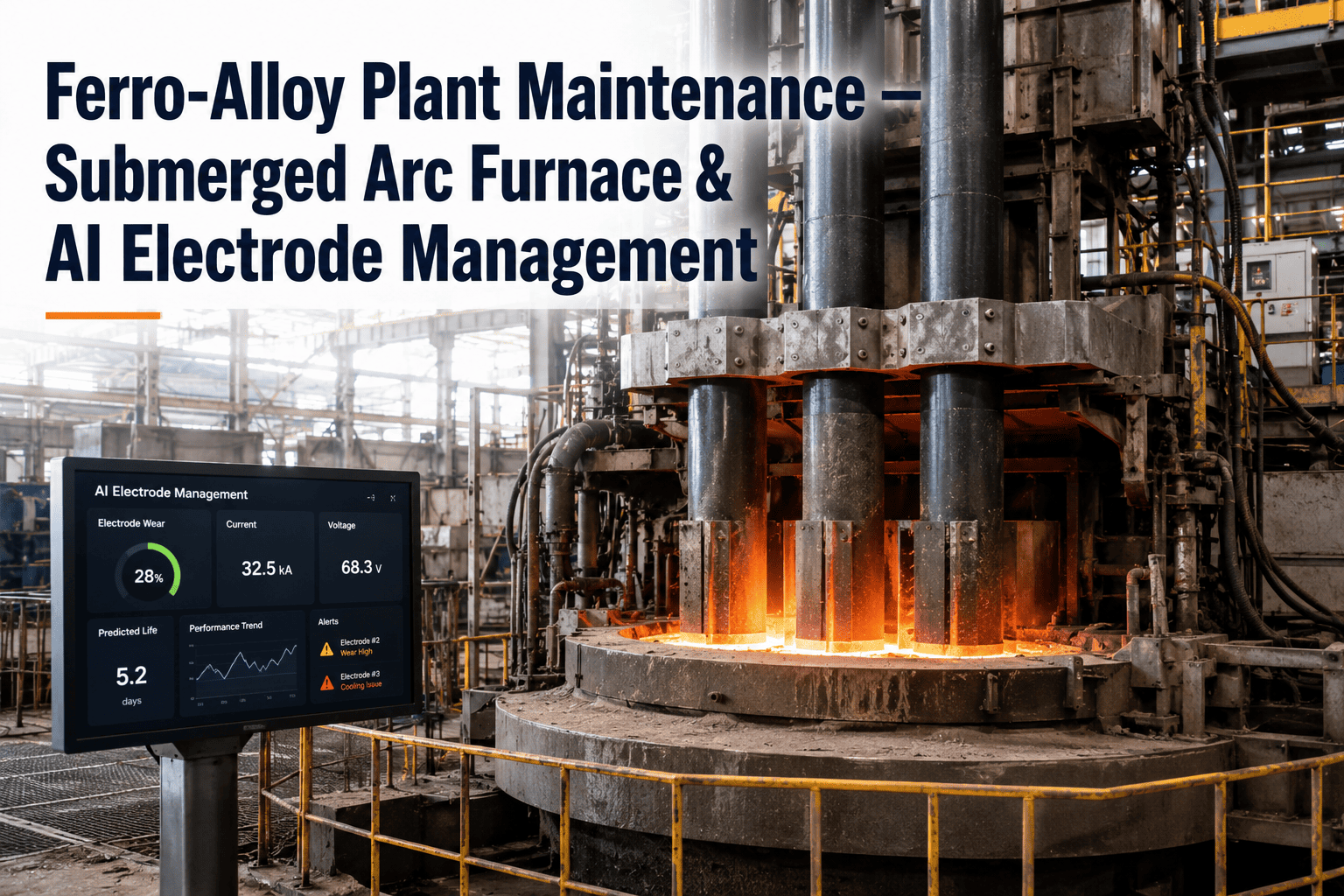
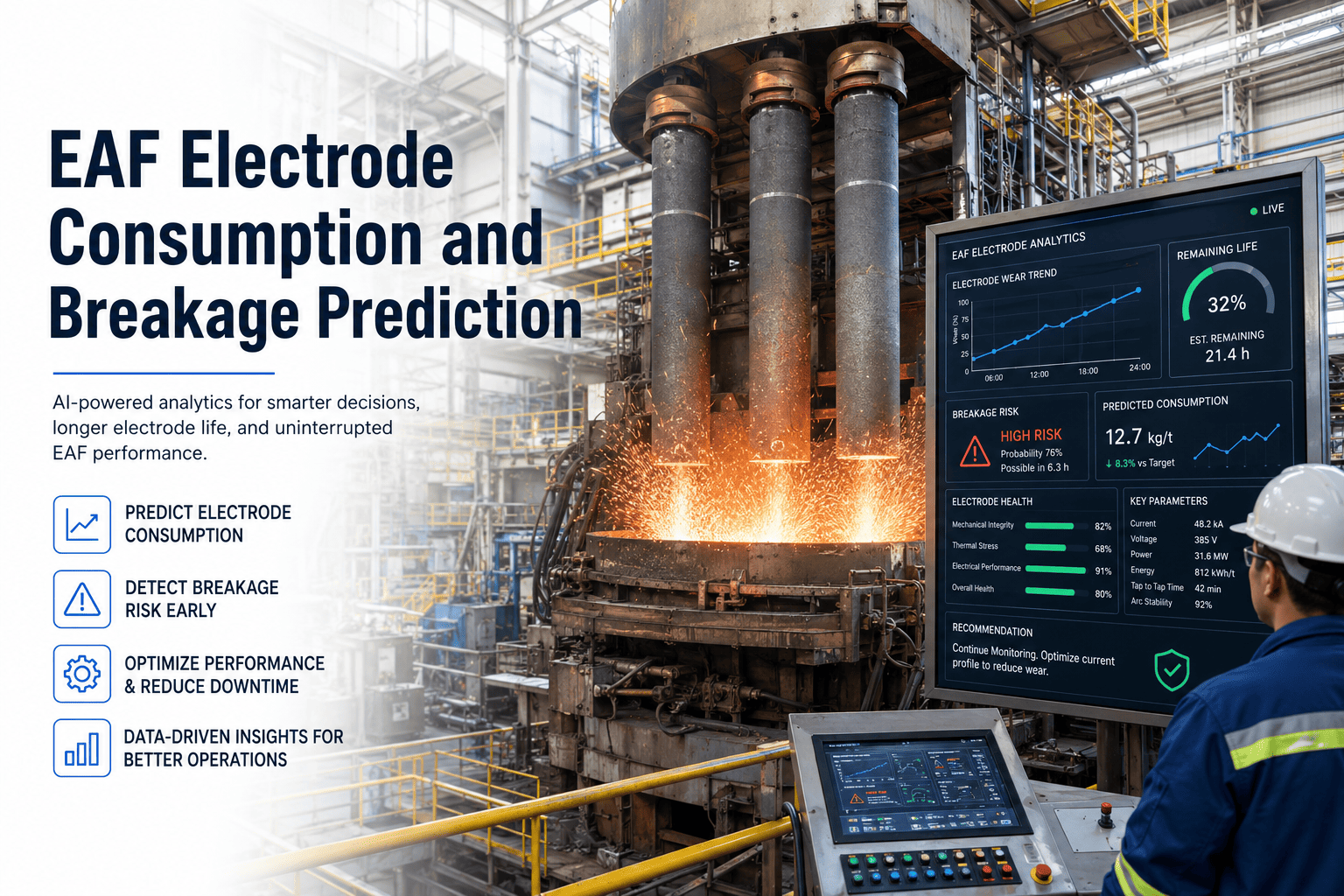
Stub length, consumption per heat, and arc harmonics are tracked to correlate wear against arc regulation and oxygen practice, reducing consumption 10-15% and cutting breakage risk.
02
Shell & Cooling Panels
Delta-T temperature spikes and flow rate differentials across the water-cooling circuit identify micro-fractures before they escalate into a shell water leak and explosion risk.
03
Refractory & Hearth
Thermal profiling maps working lining condition zone by zone, projecting campaign life against the 2,000-5,000 heat range typical for well-managed EAF refractory programs.
PLANT MANAGEMENT · EAF RELIABILITY
See Your Furnace's Cost Recovery Potential
Bring your last quarter's electrode consumption and downtime data to a session and see exactly where AI monitoring changes the numbers.
Reactive vs Predictive EAF Maintenance
Electrode breakage used to cost us an unplanned hot change almost every week. Once we started correlating arc harmonics with regulator mast movement, our breakage rate dropped and we recovered enough in electrode cost alone to justify the whole program within the first two quarters.
Plant Manager, Mini-Mill EAF Operation
Sample Annual Savings Breakdown for a 1M Tonne Furnace
Plant Managers Ask
How much can we realistically save on electrode consumption?
AI correlation of electrode performance with furnace practice reduces consumption by 10 to 15 percent, which translates to $300,000 to $750,000 in annual savings on a typical 1 million tonne furnace at current graphite electrode prices of $3,000 to $8,000 per ton. The optimized power profile also protects refractory panels simultaneously, since the same arc stability improvements that reduce electrode wear also reduce thermal stress on the water-cooled shell.
What actually causes most electrode breakage events?
The most common causes are scrap collapse during charging, arc instability from inconsistent scrap density, and mechanical binding at the joint or clamp that goes undetected until the electrode fails under load. AI monitoring analyzes arc harmonics up to 200 times per second alongside regulator mast movement to detect the mechanical binding and abnormal graphite consumption patterns that precede a breakage event, giving operators time to adjust before it stalls a heat.
How does cooling panel monitoring actually prevent a water leak incident?
Predictive analytics track minute variations in supply-and-return water delta-T and pressure drops across the cooling circuit, identifying micro-fractures in the piping network well before they progress to an active leak. Since any water leak inside the EAF shell introduces explosion risk when it contacts molten steel, catching a micro-fracture during a scheduled inspection window rather than discovering it mid-heat is a meaningful safety improvement, not just a cost one. Teams wanting to understand the sensor requirements can reach out through
support.
Does this integrate with our existing SCADA and furnace control systems?
Yes, the platform ingests data your transformer DGA sensors, hydraulic pressure monitors, electrode regulator logs, and thermal imaging systems already generate rather than requiring a control system replacement. Most mills discover during onboarding that they are already generating far more useful data than their current SCADA displays surface, and the gap is in correlation and prediction rather than data collection. Plant managers can
book a demo to see this run against their own furnace's live data feed.
What is the realistic timeline to see furnace availability improve?
Most furnaces see measurable improvement in unplanned stoppage frequency within the first two to three months, as the model builds a baseline from heat-by-heat data before its breakage and leak predictions reach full accuracy. Documented deployments report over $1.8 million in annual profit recovered from combined electrode savings, reduced unplanned stops, and improved tap-to-tap consistency, with availability climbing toward the 99 percent range that separates top-quartile EAF operations from the rest.
EAF MAINTENANCE · ELECTRODE · SHELL · COOLING
Keep Your Furnace Above 90% Availability
Join plant managers already recovering hundreds of thousands in electrode and downtime cost with AI-driven EAF monitoring.




-analytics-electrode,-shell,-cooling.png)