Heat Number Management: Melt, Cast & Roll Tracking
By James Smith on August 7, 2026
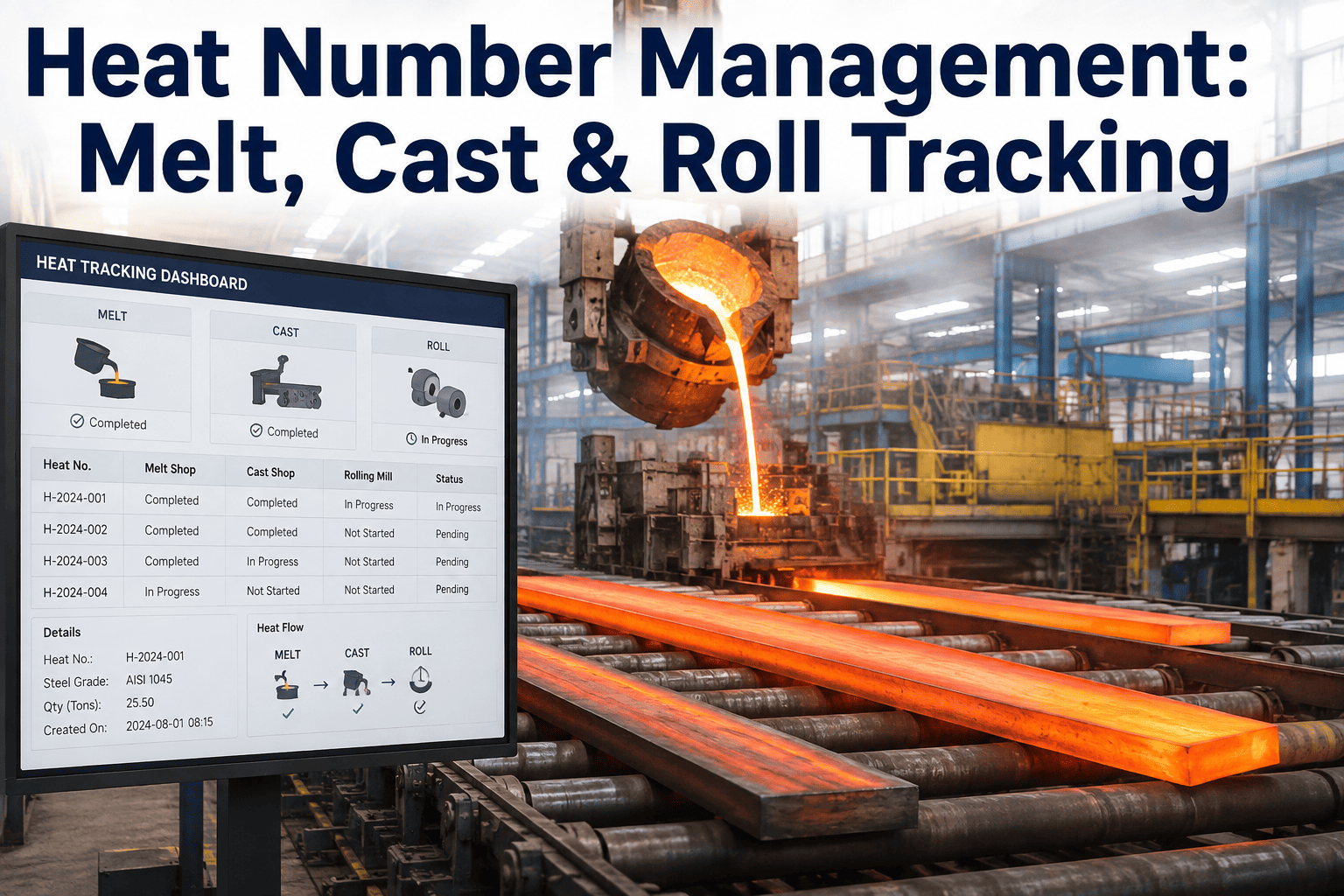
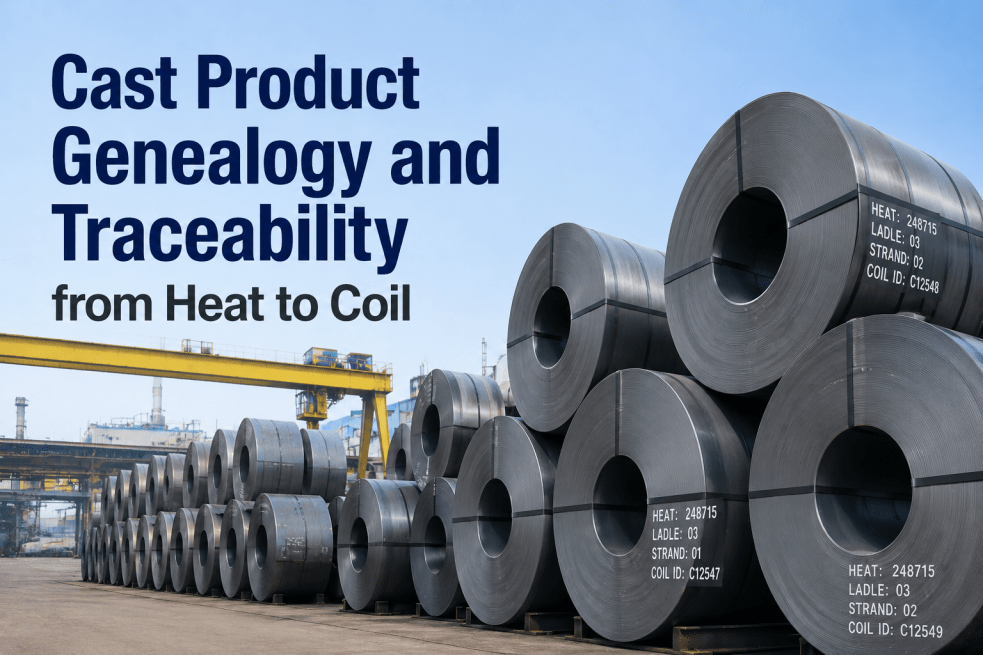
A single heat of steel — perhaps 150 tons produced in one melting cycle — rarely stays a single traceable unit for long. By the time it reaches a customer, that one heat may have split across four continuous casting strands, each strand cut into a dozen slabs, each slab rolled into several coils, and each coil further slit into a dozen finished widths — while simultaneously, the caster may have blended the tail of one heat with the head of the next during a sequence cast, meaning some of those coils actually contain material from two different heats. Heat number management is the discipline of tracking this genealogy accurately through every split and combination event, because when a customer reports a defect and asks which heat it came from, the answer needs to be traceable with certainty, not reconstructed from memory or approximated from production dates. Book a session with the iFactory traceability systems team to see how heat genealogy tracking works from melt through final product.
Traceability · Heat Number Management
Heat Number Management: Tracking Genealogy from Melt Through Cast to Roll
Managing heat identity through splitting, combination, and every downstream production stage — so that when a customer asks which heat a defective coil came from, the answer is certain, not reconstructed.
What a Heat Number Actually Represents — and Why It Matters
A heat number identifies a single melting cycle in a steelmaking furnace — the specific batch of molten steel produced together, sharing the same chemistry, deoxidation practice, and melting conditions. This shared origin is what makes heat number traceability valuable: any quality characteristic traced to a specific heat number tells you something meaningful about chemistry and melting practice, information that would be lost if products were tracked only by production date or general product specification.
Chemistry Identity
Every heat has a certified chemical analysis specific to that melt — the foundation that makes heat-level traceability meaningful for any chemistry-related quality investigation, customer certification requirement, or metallurgical failure analysis.
Process History Identity
Melting time, tap temperature, deoxidation practice, and any process deviations during the melt are recorded against the heat number — process history that is essential context when investigating any quality issue that could originate from melting practice rather than downstream processing.
Regulatory and Contractual Identity
Many customer specifications and regulatory standards (particularly in pressure vessel, aerospace, and pipeline applications) require heat-traceable certification — meaning the ability to prove which specific heat a delivered product originated from is not optional but a contractual and sometimes legal requirement.
The Splitting Problem
When One Heat Becomes Many Products — Maintaining Genealogy Through Divergence
A single heat routinely diverges into multiple casting strands, each strand into multiple slabs or blooms, each of those into multiple coils or bars, and each of those potentially into multiple slit or cut finished pieces. Every split event is a point where the genealogy tracking system must correctly propagate the parent heat identity to every child product, and a system that loses this linkage at any single split stage breaks traceability for everything downstream of that point.
Split Event
Typical Divergence Factor
Critical Tracking Requirement
Common Failure Point
Heat → Casting strands
2–8× (multi-strand casters)
Strand assignment logged per heat at cast start
Strand reassignment mid-cast not captured
Strand → Slabs/blooms
5–20× per strand
Sequential slab numbering linked to strand and position
Slab identification mark lost or misread downstream
Slab → Coils
1–3× depending on gauge/width
Rolling mill genealogy log linking coil ID to source slab
Coil ID assignment delay creates a tracking gap
Coil → Slit widths
2–15× depending on order mix
Slitting record linking each output coil to parent coil
Slit coil identification relies on manual tagging
The Combination Problem
When Multiple Heats Blend Into One Product — The Sequence Cast Challenge
Continuous casting frequently runs sequence casts, where multiple heats are cast back-to-back without stopping the caster between them — meaning the tail portion of one heat and the head portion of the next heat physically mix in the tundish during the transition, producing a defined transition zone of material that is genuinely a blend of two heat chemistries rather than cleanly attributable to either one alone.
Transition Zone Identification
Accurately marking the physical location in the cast strand where the transition zone begins and ends — typically based on tundish weight change timing and known mixing characteristics for the specific caster geometry — so that slabs cut from the transition zone are correctly flagged as dual-heat material rather than incorrectly attributed to a single heat.
Dual-Heat Product Disposition
Establishing a clear policy for how transition zone material is handled — whether it is downgraded to a lower specification, segregated for less chemistry-sensitive applications, or certified against the more conservative of the two heat chemistries — and ensuring the genealogy record reflects this disposition decision clearly for any future traceback.
See Your Genealogy Gaps Before a Customer Finds Them
iFactory Maps Heat Genealogy Through Every Split and Combination Event in Your Process
Most mills have genealogy tracking that works well for the simple, single-heat-to-single-product case but breaks down at sequence cast transitions and multi-way splits. iFactory's traceability assessment identifies exactly where your genealogy chain has gaps, before a customer traceback request finds them for you.
Structuring the Database to Represent Splits and Combinations Correctly
A genealogy data model that only supports simple one-parent-to-one-child relationships cannot correctly represent either splitting (one parent, many children) or combination (many parents, one child) events — both must be modeled as first-class relationship types in the underlying data structure, not handled as exceptions or workarounds.
01
Many-to-Many Relationship Structure
The core data model represents genealogy as a many-to-many relationship table (each product can have multiple parent heats, each heat can have multiple child products) rather than a simple parent-ID field on each product record, which can only represent a single parent and therefore cannot model combination events.
02
Contribution Percentage Tracking
For combination events, the genealogy record captures not just which heats contributed to a product but the estimated proportion each contributed — essential for any downstream chemistry-sensitive investigation where the degree of blending matters, not just the fact that blending occurred.
03
Stage-Specific Identifier Continuity
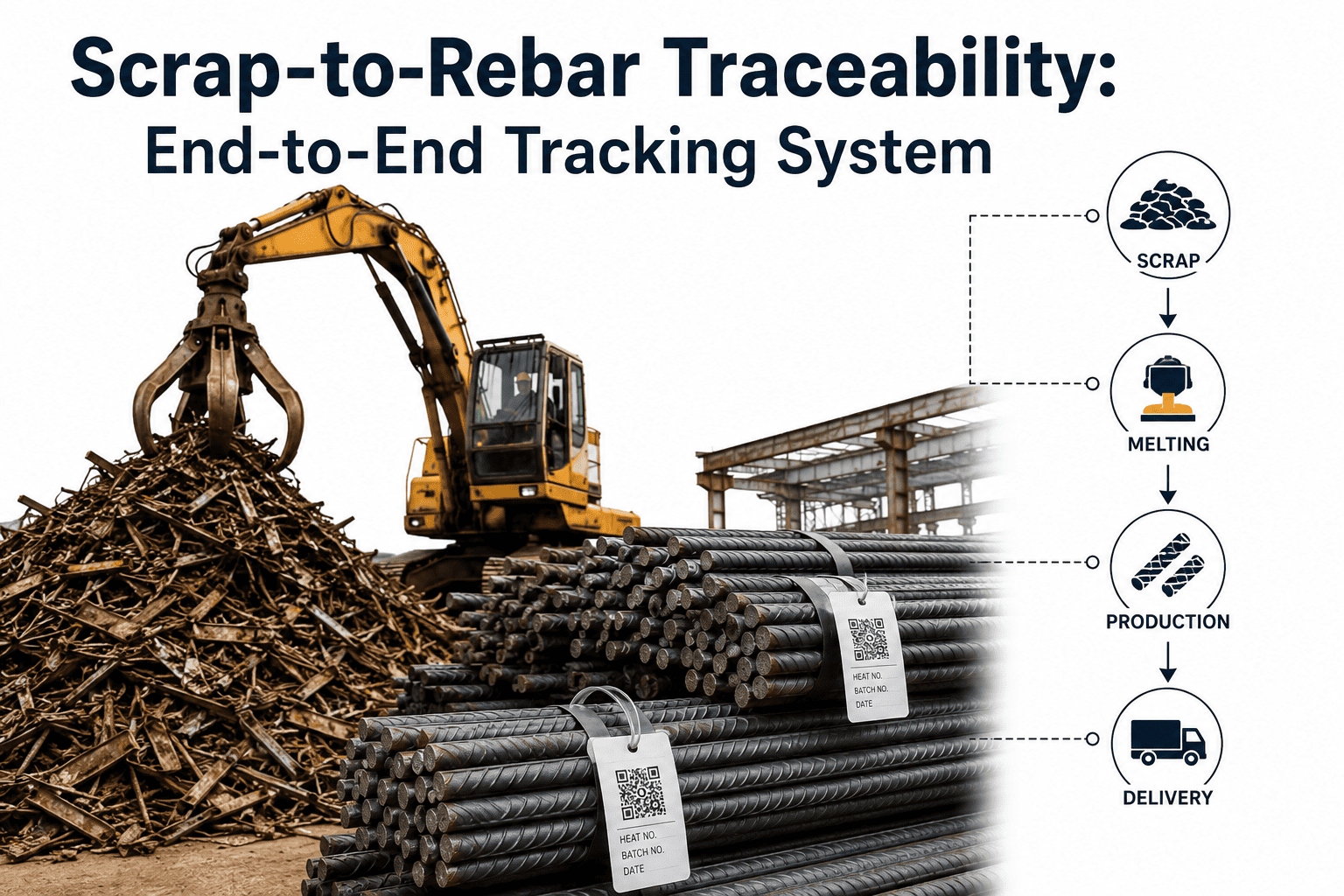
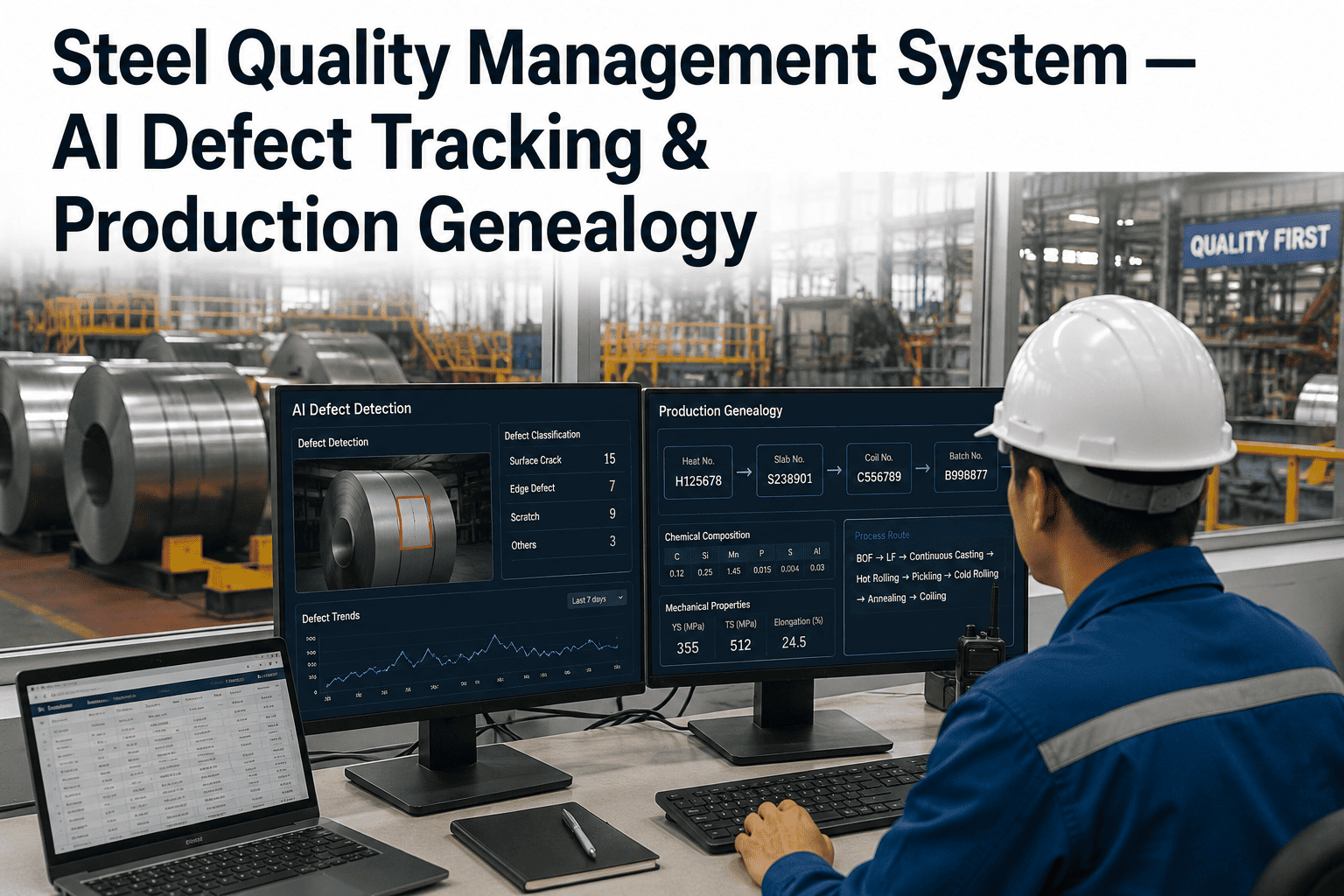
Each production stage generates its own identifier (slab number, coil number, slit piece number) while maintaining an explicit link back to the identifier from the previous stage — creating an unbroken chain that can be walked in either direction, from finished product back to originating heat, or from a heat forward to every product it touched.
Query & Traceback
Answering the Two Directions of Traceability — Forward and Backward
A genealogy system must support two distinct query directions with equal reliability, since different investigation scenarios require different traversal directions through the same underlying data.
Backward Traceback — Product to Heat
Given a specific finished product (a customer complaint about a specific coil, for example), trace back through every split stage to identify the originating heat or heats — the most common query direction, driven by customer-facing quality investigations.
Forward Traceback — Heat to All Products
Given a specific heat identified as having a chemistry issue or process deviation, identify every downstream product that heat contributed to — critical for scope-of-impact assessment when a melt shop issue is discovered after production has already continued through casting and rolling.
Traceability KPIs
Six Metrics That Define Heat Genealogy System Reliability
Genealogy Chain Completeness
Target: 100%
Percentage of finished products with an unbroken genealogy chain back to originating heat — any gap represents a traceability failure that would surface at the worst possible moment, during a customer investigation.
Traceback Query Time
Target: <5 minutes
Time required to answer a complete backward or forward traceback query — should be near-instant with a well-structured digital system, versus hours or days with manual paper-record reconstruction.
Sequence Cast Transition Accuracy
Target: within ±1 slab position
Accuracy of transition zone boundary identification during sequence casting — directly determines whether dual-heat material is correctly flagged rather than misattributed to a single heat.
Identifier Continuity Rate
Target: 100% at each stage transition
Percentage of products successfully carrying forward their genealogy link at each production stage transition — measured separately per transition point to identify which specific stage is the weakest link.
Scope-of-Impact Query Accuracy
Target: 100% recall
Whether a forward traceback from a flagged heat correctly identifies every affected downstream product with no omissions — a missed product in a scope-of-impact assessment can mean defective material ships undetected.
Manual Record Dependency
Target: 0%
Percentage of the genealogy chain still dependent on paper records or manual data entry rather than automated system capture — manual dependency is the most common source of genealogy chain breaks.
From the Traceability Floor
“
The genealogy failures I see most often are not dramatic system crashes — they are quiet gaps that nobody notices until someone actually needs to walk the chain during a real investigation. A slab identification mark that gets partially obscured during hot rolling, a coil that gets manually re-tagged after an ID reader failure without the re-tag being properly logged against the original genealogy record, a sequence cast transition zone that was never precisely mapped because nobody thought it would matter until the day it did. Every one of these gaps is invisible during normal operation because nobody is trying to trace anything. The gap only becomes visible the day a customer calls about a defect and someone tries to walk the chain backward and hits a dead end. Building genealogy tracking that actually holds up under real investigation pressure means treating every single split and combination event as a moment where the chain could break, and instrumenting each one deliberately rather than assuming the system will somehow handle it. The mills that get this right are the ones that stopped treating traceability as a compliance checkbox and started treating it as a genuine engineering discipline with its own failure modes to design against.
Aurelio Kowalczyk-Mbeki
Steel Production Traceability Systems Engineer · 19 years designing heat genealogy and quality traceability systems for integrated steel producers · Former Manager of Quality Systems, multi-mill steel group · Specialist in continuous cast sequence tracking and multi-stage genealogy data architecture
Traceability Team Questions
Heat Number Management — Frequently Asked
How do we handle transition zone material from a sequence cast that we can no longer precisely identify retroactively?
When precise identification is not available, the conservative approach flags the entire uncertain range as dual-heat material rather than guessing which single heat it belongs to. Book a demo to discuss transition zone identification methods for your specific caster.
Can our existing MES be extended to support proper genealogy tracking, or do we need a dedicated system?
Many MES platforms can support genealogy tracking with the right data model extensions — a full replacement is not always necessary. Book a demo to review your current MES capability against genealogy tracking requirements.
How far back in our historical production data can genealogy tracking realistically be reconstructed?
This depends heavily on what identification records already exist — paper heat certificates and slab marking records can often support reconstruction, though completeness typically declines the further back you go. Book a demo to assess your historical data reconstruction potential.
What happens to genealogy tracking when a coil is slit into many narrow widths for different customers?
Each slit width should receive a new identifier while maintaining an explicit link back to the parent coil, preserving the full chain back through rolling to the originating heat. Book a demo to see how slitting genealogy is structured in practice.
How quickly can we identify every product affected if a quality issue is discovered in a specific heat after production has continued?
With a properly structured genealogy system, a forward traceback query should return the complete list of affected products in minutes rather than the days a manual investigation typically requires. Book a demo to see a forward traceback query in action.
Every Split and Every Blend Is a Point Where Genealogy Can Break
Build Heat Traceability That Holds Up Under Real Investigation Pressure
iFactory helps steel producers design and deploy genealogy tracking systems that correctly model splitting and combination events from melt through final product — with a data structure built for many-to-many relationships, sequence cast transition zone tracking, and traceback queries that return complete, accurate results in minutes.