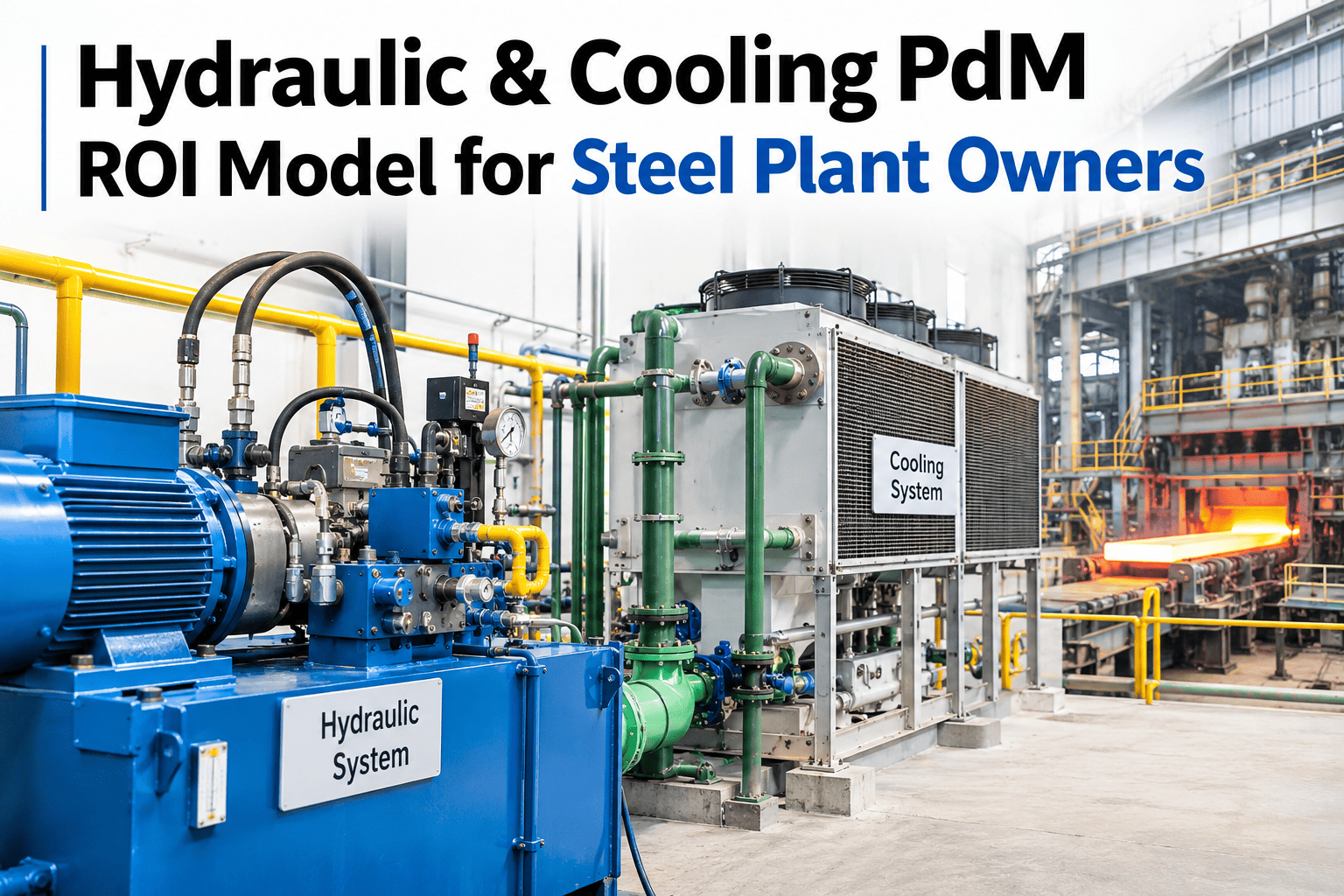
A predictive maintenance program for hydraulic and cooling water systems generates value in several different ways at once, avoided quality-loss events when a hydraulic fault would have affected product, oil-loss savings from catching leaks early, and downtime avoidance from planned rather than emergency repairs. Presenting these as one vague benefit rarely survives a budget conversation, but stacking them into a defensible, itemized model that a plant owner or CFO can actually verify against their own numbers is what gets the program funded. Building that case means treating each value source with its own measurement, then combining them into one total, and our team can help you build this ROI model from your own plant's numbers.
Steel plant hydraulic and cooling PdM, business case
Stack Avoided Quality Loss, Oil Savings and Downtime Avoidance Into One Defensible Case
iFactory AI helps steel plant owners build a hydraulic and cooling PdM ROI model grounded in avoided quality-loss events, oil-loss savings and downtime avoidance.
Why vague benefits stall
"Fewer Failures" Is Not a Number a CFO Can Evaluate
A PdM program pitched as generally reducing failures or improving reliability gives finance nothing concrete to weigh against the cost of the program, while a model broken into specific, measurable value sources gives them exactly the kind of figure they can actually assess.
Vague benefit claim
"This will reduce failures and improve reliability"
No specific number attached
Finance has nothing concrete to evaluate
Competes poorly for budget
Other requests with real numbers win the conversation
Program stays unfunded
The case waits another budget cycle
Three value sources
What Actually Makes Up the ROI Case
Avoided quality-loss events
Scrap and rework cost avoided when a hydraulic fault would have affected product.
Oil-loss savings
Cost of leaked oil and compensating pump work avoided by catching leaks early.
Downtime avoidance
Planned repair cost instead of the far higher cost of an unplanned stop.
Build Your Own ROI Model
Share your recent hydraulic or cooling-related incidents and see how each value source would be calculated for your plant.
Value source table
How Each Value Source Is Measured
| Value source | What to measure | Typical data source |
|---|
| Avoided quality loss | Scrap and rework cost per past hydraulic-related defect event | Quality records linked to hydraulic incidents |
| Oil-loss savings | Cost of oil and associated energy loss per leak caught | Oil top-up and leak detection records |
| Downtime avoidance | Cost difference between planned and unplanned repair | Maintenance and production downtime logs |
Building the case
Four Steps From Value Sources to a Funded Program
1
Baseline each value source
Measure current quality, oil-loss and downtime costs from historical records.
2
Estimate the avoided cost
Project how much of each cost a PdM program would realistically prevent.
3
Stack the total ROI
Combine all three value sources into one total projected benefit.
4
Compare against program cost
Set the total benefit against the cost and timeline of the PdM program.
Common pitfalls
Three Mistakes That Weaken This ROI Case
1
Skipping oil-loss savings as too small to matter
Oil loss accumulates continuously and often adds up to a meaningful figure over a year.
2
Using industry averages instead of your own incident history
Generic figures are less defensible than numbers pulled from your own records.
3
Bundling all three sources into one unexplained total
A single combined number is harder for finance to verify than three separately justified ones.
Expert review
The strongest ROI cases are built from a plant's own incident history, not industry benchmarks. A finance team can check your own quality records and downtime logs, which makes a self-derived number far more credible than a generic industry figure.
Watch for
An ROI estimate built entirely from industry benchmarks rather than your own historical records.
Do next
Pull your last year of hydraulic and cooling-related incidents before estimating any of the three value sources.
— iFactory steel specialists
Frequently asked questions
What Plant Owners Ask About This ROI Model
How do we find hydraulic-related quality defects in our past records?
Cross-referencing quality defect records against maintenance logs for hydraulic-related incidents during the same timeframe can reveal connections that were not obvious when each was reviewed separately.
Discuss your quality record data.
What if we have not been tracking oil-loss data?
Oil purchase and top-up records, even if not previously analyzed for this purpose, can often be reconstructed into an estimate of historical oil loss, giving a starting baseline even without dedicated leak detection data.
Ask about estimating oil-loss history.
How is the cost difference between planned and unplanned repair calculated?
Comparing the production downtime, labor and often expedited parts cost of a past unplanned failure against what a similar planned repair would typically cost gives a concrete per-event figure to build the downtime avoidance estimate from.
Talk through your downtime cost comparison.
Should we present all three value sources together or separately to finance?
Presenting each value source with its own calculation, then summing them into a total, is generally more persuasive than a single bundled number, since it lets finance verify each piece independently.
Ask about presenting your case.
How conservative should our estimates be?
Using a conservative estimate of what percentage of past incidents a PdM program would realistically have prevented, rather than assuming all of them, builds a more credible and defensible case than an overly optimistic projection.
Discuss setting realistic estimates.
From a vague benefit to a verifiable number
Build a Hydraulic and Cooling PdM Case Finance Can Actually Approve
Book a session with iFactory AI to review your incident history and build a stacked ROI model for your hydraulic and cooling PdM program.