Induced draft fans, cooling tower fans, and process blowers rarely get the maintenance attention that mill stands and cranes receive, yet a single failed fan can force a full furnace shutdown just as fast as a major mechanical failure elsewhere in the plant. Imbalance, bearing wear, and airborne contamination build up gradually, and most fan and blower monitoring still relies on a technician walking the plant with a handheld vibration meter every few weeks. By the time a fault shows up on that schedule, the failure is often already close. Fan and blower leads looking for continuous coverage can book a demo to see how AI-driven monitoring closes that gap.
Catch Fan and Blower Failures Before They Take Down a Process Line
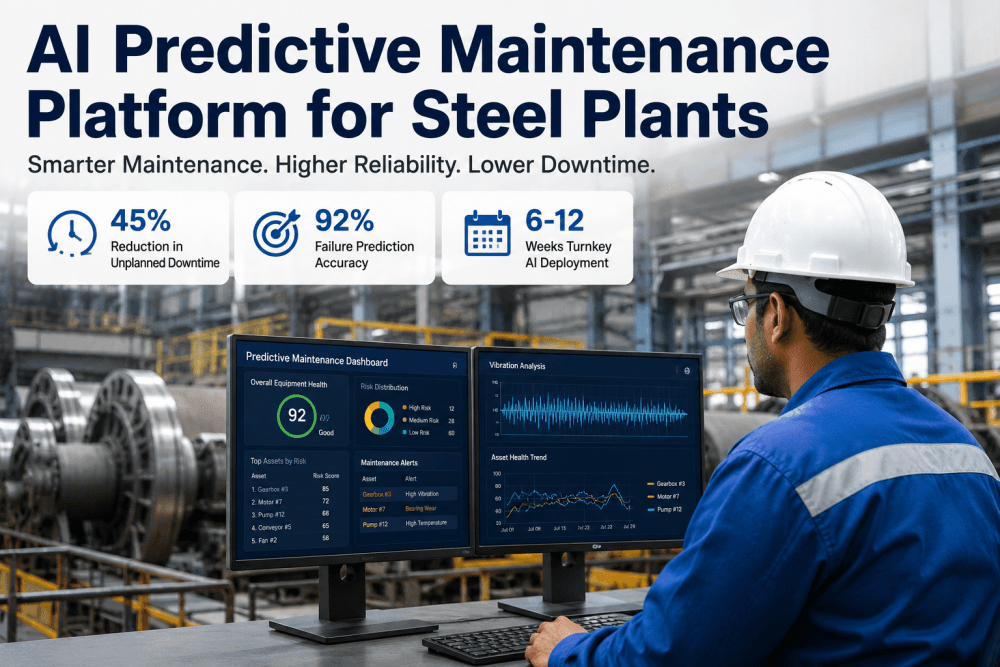
AI vibration spectral analysis reads imbalance, bearing wear, and contamination signatures on plant fans and blowers continuously, replacing a periodic handheld check with round-the-clock coverage.
Three Failure Modes That Dominate Fan Fleets
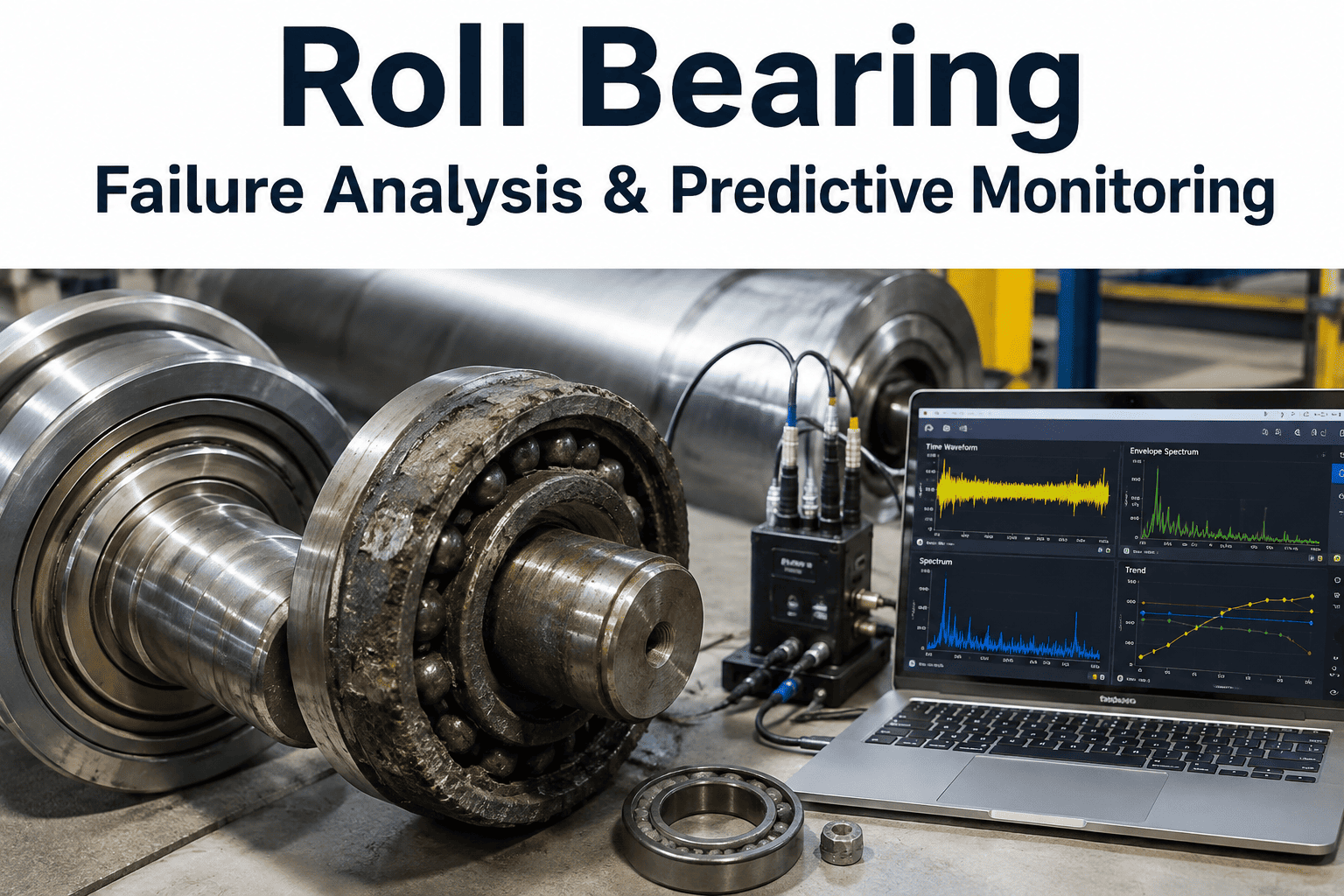
Across most plants, the majority of fan and blower failures trace back to just three root causes. Each has a distinct vibration signature, which is exactly what makes them well suited to continuous AI monitoring rather than infrequent manual spot checks.
| Failure Mode | Typical Cause | Vibration Signature | Manual Detection Lag |
|---|---|---|---|
| Rotor Imbalance | Scale buildup, blade wear, erosion | 1x running speed amplitude rise | 2–6 weeks |
| Bearing Wear | Lubrication failure, contamination | High-frequency envelope spikes | 3–8 weeks |
| Misalignment | Coupling wear, foundation shift | 2x running speed, axial vibration | 2–5 weeks |
Why Handheld Checks Miss So Much
A quarterly or monthly vibration route is a snapshot, not a trend. Fan failures do not wait politely for the next scheduled visit, and the conditions that drive fan degradation in a steel plant make the gap between visits especially costly.
What Continuous Monitoring Actually Changes
The shift from periodic to continuous monitoring is not just about frequency — it changes what maintenance teams can act on and when they can act on it.
Find Out Which Fans in Your Plant Are Already at Risk
Share your fan and blower asset list along with any recent vibration readings you already have. iFactory engineers will flag which units show early warning signs worth investigating first.
Sizing the Downside of a Fan Failure
Not every fan carries the same consequence when it fails. Ranking fans by criticality — not just by size — is the first step most plants skip before deploying any monitoring programme.
Planning a Fleet-Wide Rollout Without Disrupting Operations
Plants running dozens of fans and blowers rarely have the appetite to instrument every unit at once, and they don't need to. The most successful rollouts treat fan monitoring as a phased programme rather than a single project, starting with the units where a failure would actually stop a process line and expanding outward from there as the programme proves itself.
The first step is a criticality pass across the full fan and blower list, not a technical audit but a simple business exercise: for each unit, what actually happens if it fails without warning? Some fans have redundant backups that absorb a failure with no real production impact. Others sit directly in a process path with no alternative, and a failure there means an immediate stoppage. Sorting the fleet this way, before any sensor is ordered, means the monitoring budget goes to the units where it actually changes the outcome of a failure.
Installation planning matters more for fans than for most rotating equipment, because many units sit in locations that are difficult or hazardous to access during operation. Coordinating sensor installation with an existing planned maintenance window, rather than scheduling a separate shutdown, keeps the rollout from adding its own disruption to the production schedule. Wireless sensors with multi-year battery life are typically chosen specifically because they avoid the need for a wired power run to fan locations that were never designed with instrumentation in mind.
Model tuning takes longer for fans with highly variable duty cycles than for equipment that runs at a constant load. A fan tied to a process that ramps up and down throughout the day needs enough operating history across that full range before the model can reliably separate a normal load-driven vibration change from an actual developing fault. Plants that see the fastest results are the ones that resist the temptation to act on early alerts before the model has had time to learn each fan's full operating envelope.
As coverage expands past the initial pilot fans, the biggest practical challenge shifts from installation to alert management. A maintenance team that suddenly has continuous visibility into thirty or forty fans needs a clear process for triaging alerts by severity, or the volume of notifications can start to feel like noise rather than signal. Building that triage workflow alongside the technical rollout, not as an afterthought once the sensors are already live, is what separates programmes that scale smoothly from ones that stall out after the first few units.
Interpreting Vibration Alerts as a Non-Specialist
One of the biggest practical barriers to continuous fan monitoring has historically been that vibration analysis is a specialist skill, and most maintenance teams don't have a dedicated vibration analyst on staff to interpret every alert. A monitoring system that simply hands a maintenance planner a raw spectral plot and expects them to diagnose the fault is not actually solving the coverage problem — it is just moving the bottleneck from data collection to interpretation.
The alerts that actually get acted on are the ones that translate a vibration signature into a plain description of the likely fault and its urgency, without requiring the recipient to have spent years learning to read frequency spectra. An alert that says imbalance is developing on a specific fan, with an estimated severity and a suggested inspection window, is something any maintenance planner can act on immediately, even without specialist vibration training.
That said, having some in-house familiarity with the basics of what different fault types look like helps a team get more value from the system over time. Bearing wear tends to show up as high-frequency signature growth long before any change in overall vibration amplitude, while imbalance typically drives amplitude at the fan's running speed. Teams that build even a basic working understanding of these patterns become better at prioritising which alerts warrant an immediate inspection versus which can be scheduled into the next routine maintenance window.
For plants without in-house vibration expertise at all, many monitoring programmes include access to a specialist review for alerts flagged at high severity, giving the maintenance team a second opinion before committing resources to an unplanned inspection. This hybrid approach — automated screening for the full fleet, specialist review only for the alerts that matter most — tends to deliver the coverage benefits of continuous monitoring without requiring every plant to build a dedicated vibration analysis function from scratch.
Frequently Asked Questions
The questions fan and blower leads most often raise before expanding vibration coverage across a full fleet.
Get a Fleet Criticality Review
Send your fan and blower asset list. iFactory engineers will rank units by failure consequence and show you exactly where continuous monitoring would pay off first.