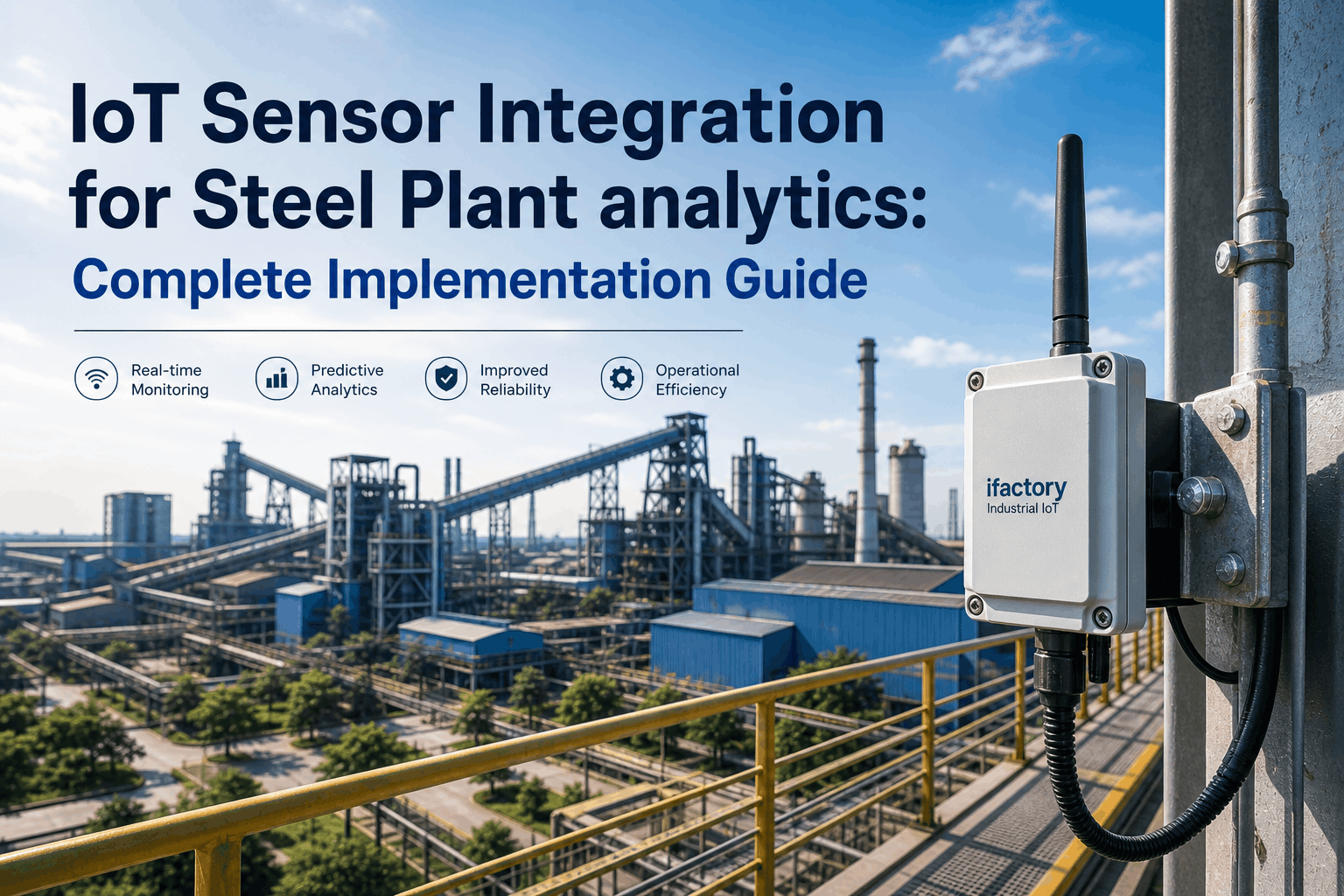
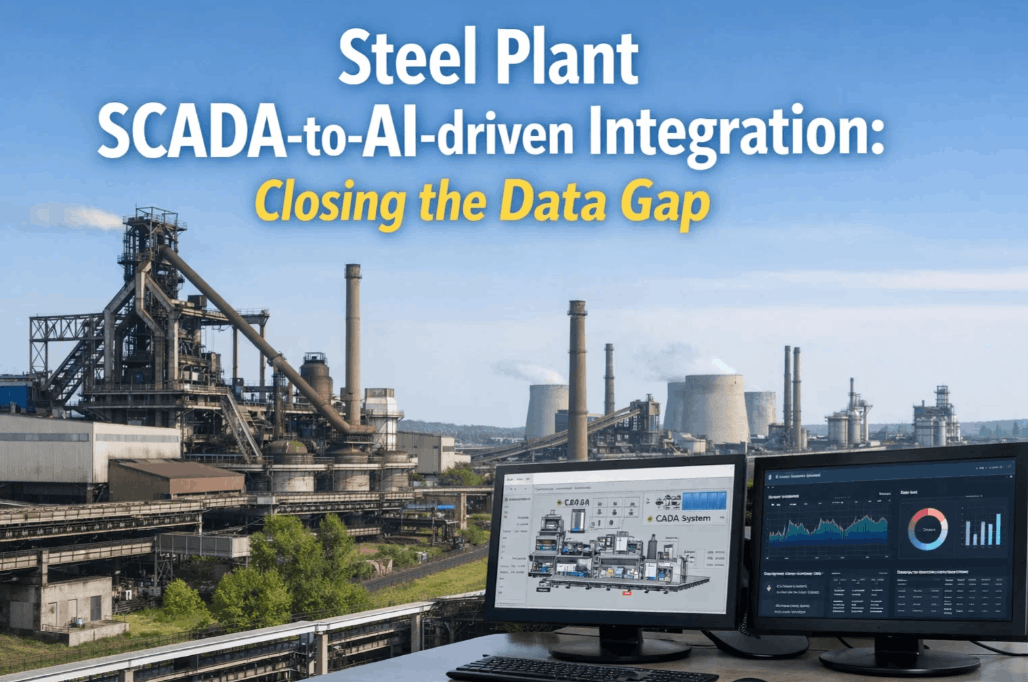
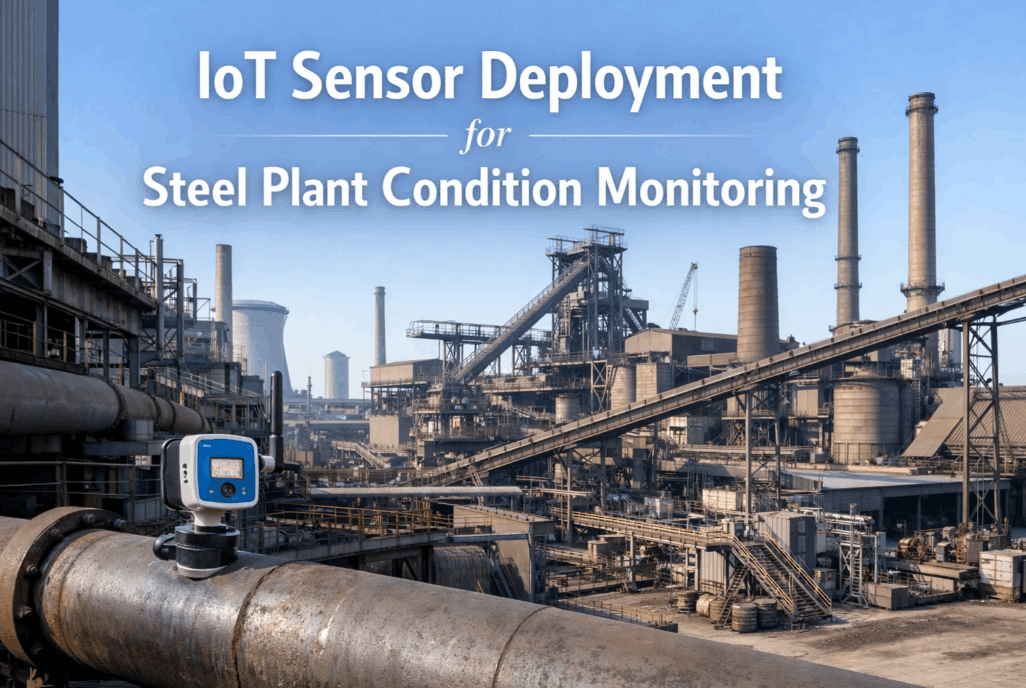
Steel plants already have more sensor data than they know what to do with — and that is precisely the problem. The integrated mill that installed a vibration network on critical rotating equipment three years ago is generating 2.4 million data points per day from those sensors. The melt shop that runs Siemens SIMATIC PLCs on every major drive system is producing motor current, temperature, and torque telemetry continuously through the SCADA layer. The cooling water plant has thermocouples on every loop. The hot strip mill has pressure transducers, load cells, and flow meters on every stand. The data exists. The signal is there. What is missing is the integration layer that converts that ocean of sensor data into the specific condition alert, work order, or maintenance action it should be generating. In most U.S. steel facilities, the gap between sensor and work order is measured in hours or days — a PLC fault code appears on a SCADA screen, gets acknowledged by an operator, and disappears, leaving no work order trail. A vibration reading crosses the alarm threshold but goes unreviewed because the data historian and the CMMS do not talk to each other. An oil sample arrives at the lab, returns a result five days later, and reaches the maintenance scheduler two days after that. The economic cost of this gap compounds: bearings that fail because the early signal was buried in data nobody connected, cooling pumps that cavitate progressively because the temperature trend was visible but not actioned, gear sets that wear out because the oil particle count trend was being measured but not routed to a work order trigger. iFactory's IoT sensor integration platform closes the gap by ingesting data from every protocol your steel plant already runs — OPC-UA, Modbus, PROFINET, WirelessHART, ISA100, LoRaWAN, MQTT, and direct PLC connections — through edge gateways with local inference, then routing structured condition events directly into CMMS work order generation in under 60 seconds from sensor reading to actionable work order. Facilities deploying iFactory's IoT integration platform report a 94% reduction in sensor-to-work-order time, 58% improvement in condition signal capture rate, and an average $1.9 million annual cost reduction per facility from acting on signals that were previously being collected but not converted into maintenance action.
Why Sensor Data Without Integration Generates No Operational Value
The most common mistake in steel plant IIoT programs is treating sensor deployment as the deliverable rather than sensor integration. A facility can install 800 vibration sensors and still see no measurable improvement in unplanned downtime if those sensors stream into a data historian that nobody actively monitors and a SCADA system that does not route alerts to the CMMS. The sensors are working. The data is being collected. The condition signals are present in the data — bearing defect frequencies appearing 28 days before failure, temperature drift patterns developing across cooling circuits, oil particle counts trending upward — but none of those signals are reaching the maintenance team in time to act on them, because the integration layer that converts a sensor reading into a structured condition event and then into a work order does not exist between the data historian and the CMMS.
iFactory's IoT integration platform was built around this gap. The platform's value is not the sensors — those are deployed regardless. The value is the connection layer that ingests sensor data through every major industrial protocol, normalizes it into a unified asset-aware condition model, applies edge inference for latency-critical detections, and routes structured condition events directly into CMMS work order generation. Book a Demo to see this integration applied to your specific sensor and historian landscape.
- Sensor data accumulates in historians with no automated condition logic running against it
- PLC fault codes appear on SCADA screens, get acknowledged, and disappear with no WO trail
- Vibration trends are visible in spectrum software but never reach maintenance schedulers
- Oil sample lab results arrive 5–7 days late and rarely trigger immediate action
- Wireless and wired sensors run on incompatible protocols with no unified data view
- Sensor-to-work-order time measured in hours or days — when it happens at all
- Every sensor data stream flows into asset-aware condition models with continuous inference
- PLC and SCADA fault codes route automatically into CMMS work order generation
- Vibration spectra analyzed continuously — defect frequencies trigger work orders without manual review
- Oil condition data ingested in real time from in-line sensors or lab result feeds
- Mixed protocol ecosystem unified through edge gateways — OPC-UA, Modbus, WirelessHART, MQTT
- Sensor-to-work-order time under 60 seconds — 94% reduction from disconnected baseline
The Five-Layer IoT Integration Architecture: How iFactory Connects Sensors to Action
iFactory's IoT integration platform is organized as five connected layers, each addressing a specific technical challenge in moving sensor data from the field to actionable maintenance output. The architecture is designed for the reality of U.S. steel plant infrastructure: mixed-vintage equipment, legacy SCADA and PLC environments that cannot be replaced, and intermittent network connectivity in remote areas of the facility. Each layer below is what makes the connection layer actually work in production.
Steel Plant Sensor Coverage Map: iFactory Integration by Asset and Measurement Type
The value of an IoT integration platform is determined by how completely it covers the sensor and asset landscape that actually exists in a steel plant. The matrix below maps each major sensor and measurement type to its primary protocol, the asset class it monitors, the failure mode it detects, and the recommended sensor specification for steel plant environments. iFactory integrates with every entry in this matrix without requiring sensor replacement. Book a Demo to see this coverage map applied to your facility's current sensor inventory.
| Sensor Type | Asset Class | Protocol | Failure Mode Detected | Spec for Steel Plant | Detection Lead Time |
|---|---|---|---|---|---|
| Piezoelectric Vibration | Motors, pumps, fans, gearboxes | 4-20 mA, Modbus, WirelessHART | Bearing fatigue, imbalance, misalignment | IP67+ stainless housing, 150°C rated | 14–45 days |
| Type K Thermocouples | BF shell, motor windings, bearings | Modbus, OPC-UA via PLC | Refractory wear, overheating, lube failure | −200°C to 1,260°C range | Real-time + trend hours-ahead |
| Type S/R Thermocouples | Reheat furnaces, tundish, ladle | OPC-UA via DCS bridge | Thermal profile deviation | Up to 1,700°C rated | Real-time process |
| Pressure Transducers | Hydraulics, cooling water, gas systems | 4-20 mA, HART, PROFINET | Leak, blockage, pump degradation | Hastelloy/ceramic for corrosive media | Hours to days ahead |
| In-Line Oil Quality | Gearboxes, hydraulic systems | Modbus RTU, MQTT | Particle count, water, viscosity drift | Inline industrial sensor module | 14–60 days before damage |
| Motor Current (MCSA) | AC drive motors, submerged pumps | EtherNet/IP from MCC, Modbus | Rotor bar crack, load variation | From MCC current transducer | 30–90 days |
| Wireless Accelerometer | Inaccessible / high-risk locations | WirelessHART, ISA100, LoRaWAN | Vibration on remote assets | IP68, 5-year battery, hazardous-rated | 14–45 days |
| Thermal Cameras (FLIR-class) | BF tuyeres, electrical, conveyors | GigE Vision, RTSP, REST API | Hot spots, electrical degradation | Industrial-grade enclosure | Days to weeks ahead |
Edge Computing: Why Local Inference Matters for Steel Plant IoT
The cloud-only IIoT architecture that dominates marketing presentations fails in actual steel plant production environments. The round-trip latency from a sensor to a cloud platform to a CMMS and back is 200 to 1,200 milliseconds in optimal network conditions, and several seconds when the plant network is congested — both unacceptable for latency-critical detections like motor protection or rapid temperature excursions. Network outages in remote facility areas mean cloud-dependent sensors stop working when the plant needs them most. Cloud-only architecture also creates security exposure that steel facility OT teams legitimately resist. The answer is edge computing: industrial edge gateways installed at the asset or process area level, performing local protocol translation, data buffering, and inference, then syncing structured events to the cloud platform when relevant.
Expert Perspective: What Steel Plant Operations and IT Leaders Learn From Real IoT Integration Deployments
I have led IIoT and condition monitoring integration programs at three U.S. steel facilities over the past 14 years — two integrated mills and one mini mill — and the lesson that every operations leader learns the hard way is that sensor deployment is the easy part. Hardware is mature, vendor selection is well understood, installation is routine. What kills IIoT programs is the integration gap. We had a facility where we had spent $4.2 million over three years installing vibration sensors on critical rotating equipment, and our unplanned downtime rate had not moved. The board was asking pointed questions about ROI. When we audited the program, the answer was uncomfortable but simple: every sensor was working, every data point was being collected, and almost none of it was reaching the maintenance team in a form they could act on. The data sat in a historian. Alerts went to email distribution lists that maintenance schedulers had filtered out three months in. Work orders were not being generated from sensor events because nobody had built the integration between the historian and the CMMS. That experience taught me that the value of IIoT is not in the sensors. It is in the integration layer that converts sensor data into the work order, the parts requisition, the condition score on the asset register. When we deployed iFactory's IoT integration platform at our second facility, we did not install a single new sensor for the first six months. We connected the platform to the historian data that was already being collected, and we generated more actionable maintenance signals in the first 90 days than the previous three years of sensor deployment had produced. The integration layer was the unlock. Everything else was already there."
Conclusion
IoT sensor integration in steel manufacturing is not about installing more sensors — it is about converting the sensor data already being collected into the work orders, condition alerts, and maintenance actions that justify the sensor investment in the first place. The gap between sensor and work order is where most steel plant IIoT programs lose their value, and closing that gap requires more than dashboards and historian connections. It requires a connection layer that ingests every major industrial protocol, applies asset-aware condition modeling at the edge, runs adaptive analytics that catch developing conditions weeks before threshold alarms would fire, and routes structured events directly into CMMS work order generation in under 60 seconds.
iFactory's IoT integration platform delivers that connection layer natively for U.S. steel operations — through OPC-UA, Modbus, PROFINET, WirelessHART, ISA100, LoRaWAN, and MQTT, on industrial edge gateways that work through network outages, with the OT/IT segmentation that steel plant security teams require. The 94% reduction in sensor-to-work-order time, 58% improvement in condition signal capture, and $1.9 million average annual cost reduction per facility are the documented outcomes of finally connecting what was always there. Book a Demo to see how iFactory's IoT integration platform would perform on your specific sensor and historian landscape.
Frequently Asked Questions
No. iFactory connects to your existing SCADA historians, DCS systems, and PLCs through OPC-UA, Modbus RTU/TCP, PROFINET, EtherNet/IP, and direct API connections. The platform is built around legacy integration — you keep your Siemens, ABB, Rockwell, and Honeywell investments intact.
Yes, with industrial wireless sensors rated IP67/IP68 operating on WirelessHART, ISA100, or LoRaWAN protocols. These are designed for the electromagnetic interference, heat, vibration, and dust common in steel plants — proven reliable in blast furnace, melt shop, and hot mill deployments.
Edge gateways buffer all incoming sensor data locally for up to 30 days during connectivity loss. When network restores, queued data syncs automatically with timestamps and ordering preserved. No data loss occurs and no gaps appear in the trend record used for condition analytics.
The edge gateway architecture provides natural OT/IT network segmentation aligned with IEC 62443 and NIST SP 800-82. Outbound-only connectivity, encrypted data transmission, role-based access controls, and on-premise/private cloud deployment options meet steel plant cybersecurity requirements.
Initial integration and platform deployment runs 6 to 10 weeks at $85,000 to $185,000 covering edge gateways, protocol connectivity, asset register build, and CMMS integration. Supplemental sensor hardware where coverage gaps exist adds $40,000 to $180,000. Payback typically occurs in 4 to 7 months.