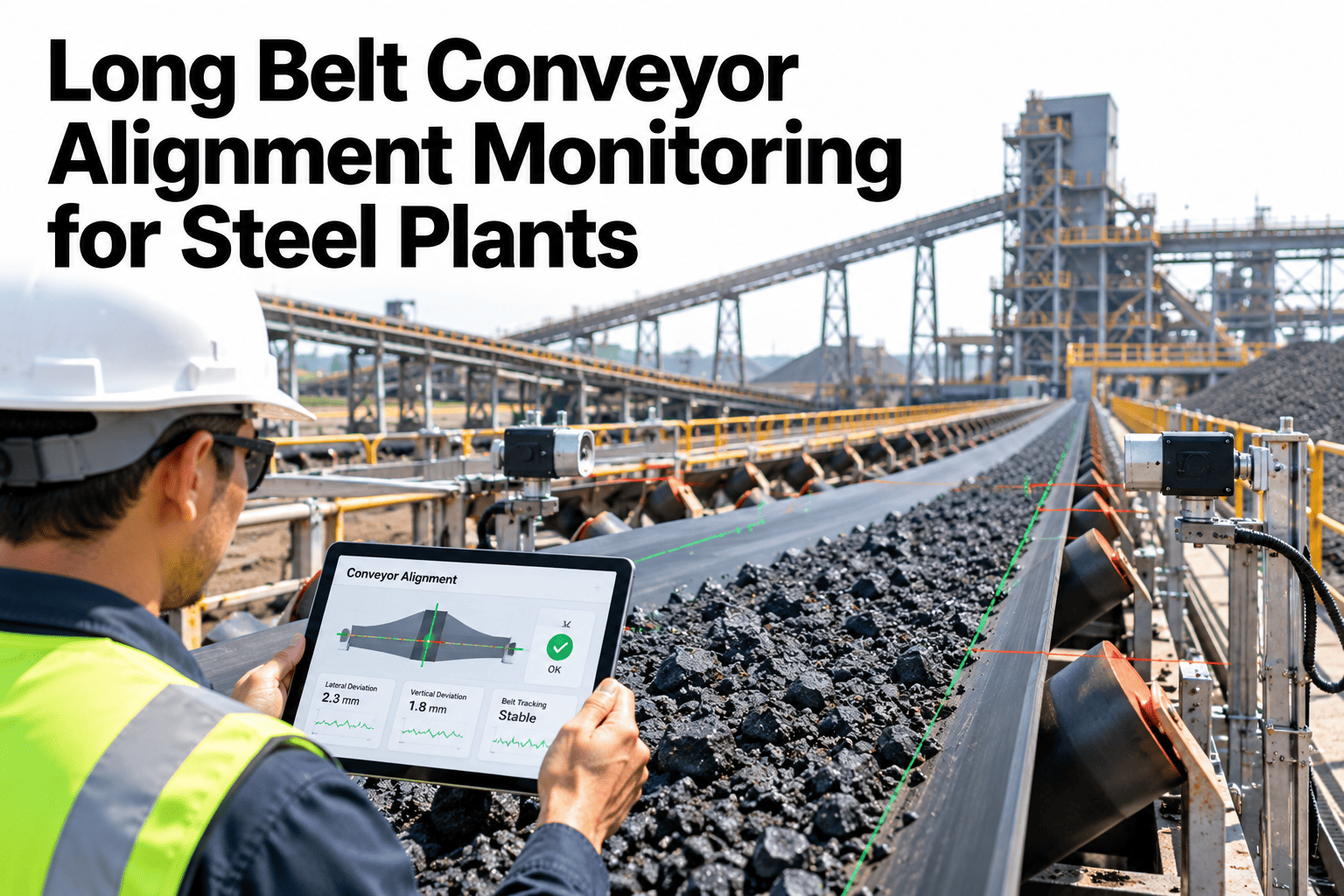
A belt drifting just a few millimeters off center on a short conveyor is a minor nuisance; the same drift on a long conveyor running hundreds of meters compounds over distance until the belt edge is grinding against the structure, spilling material, and wearing unevenly in a way that shortens its service life considerably. Camber, tracking, and drift all describe slightly different versions of the same underlying problem, and on a long run the difference between catching it early and catching it after the belt edge is already damaged is often a matter of days, not weeks. See alignment monitoring running on your own long conveyor.
Catch the Drift Before the Edge Damage
iFactory AI monitors camber, tracking, and drift continuously across long belt conveyors, with automatic correction alerts before spillage or belt-edge damage occurs.
Why Drift Compounds Over Distance
A short conveyor can tolerate a small amount of belt misalignment without much consequence, but stretch that same small drift across a conveyor running several hundred meters and the cumulative effect grows until the belt edge is contacting the structure, material is spilling off the side, and the belt itself is wearing asymmetrically in a way a standard tracking adjustment can no longer fully correct.
Camber
A belt's natural curvature tendency, which left unmonitored drives persistent drift.
Tracking
How centered the belt runs on its idlers and pulleys across the conveyor's length.
Drift
The cumulative lateral movement that builds when camber and tracking go unchecked.
Monitor Alignment on Your Own Conveyor
Book a 30-minute session and see camber, tracking, and drift monitoring running on your own long belt conveyor.
What Misalignment Actually Costs
Left unaddressed, drift does not stay a cosmetic issue for long; it progresses through a fairly predictable sequence of consequences.
| Stage | Visible Effect | Cost if Unaddressed |
|---|---|---|
| Early drift | Belt running slightly off-center, barely visible | Minimal, easily corrected with a tracking adjustment |
| Progressive drift | Belt edge nearing the structure at points along the run | Increased wear, spillage beginning at drift points |
| Edge contact | Belt edge grinding against structure or skirting | Accelerated belt damage, material loss, safety risk |
| Structural damage | Belt edge torn or structure damaged from sustained contact | Emergency repair, extended conveyor downtime |
From Drift Reading to Correction Alert
Monitoring runs continuously along the conveyor's length, catching drift at the earliest stage rather than waiting for it to become visible.
Rolling Out Across Long Conveyors
iFactory AI installs tracking sensors along the conveyor's length, calibrated to that specific belt's normal alignment behavior.
Expert Review
Belt alignment issues are almost always diagnosed too late on a long conveyor because the drift that finally becomes visible to a walking inspector has usually been building for weeks, which is exactly the window continuous sensor coverage is positioned to close.
Frequently Asked Questions
How many sensors does a long conveyor need for full coverage?
Sensor spacing is calculated based on the conveyor's length and known trouble points, so coverage is positioned to catch drift developing anywhere along the run. Support can scope sensor placement for your conveyor.
Does this trigger an automatic mechanical correction?
The system generates a correction alert for the maintenance team to act on; whether the correction itself is automated depends on what tracking hardware your conveyor already has installed.
Can this distinguish camber from a tracking adjustment issue?
Yes, the pattern of drift over time helps distinguish a camber-driven tendency from a one-time tracking misalignment, pointing toward the right corrective action. See how the two are distinguished on a call.
Does this work on conveyors with curves or inclines?
Yes, baselines account for the conveyor's own geometry, including curves and inclines, so normal alignment behavior reflects the actual layout rather than a flat-run assumption.
How quickly after installation does monitoring go live?
An initial baseline period is needed to learn the belt's normal alignment pattern before alerting begins, after which monitoring runs continuously. Ask support about the baseline timeline.
Stop Drift Before It Reaches the Edge
iFactory AI monitors camber, tracking, and drift continuously, with correction alerts before belt-edge damage occurs. Book a demo on your own conveyor.